
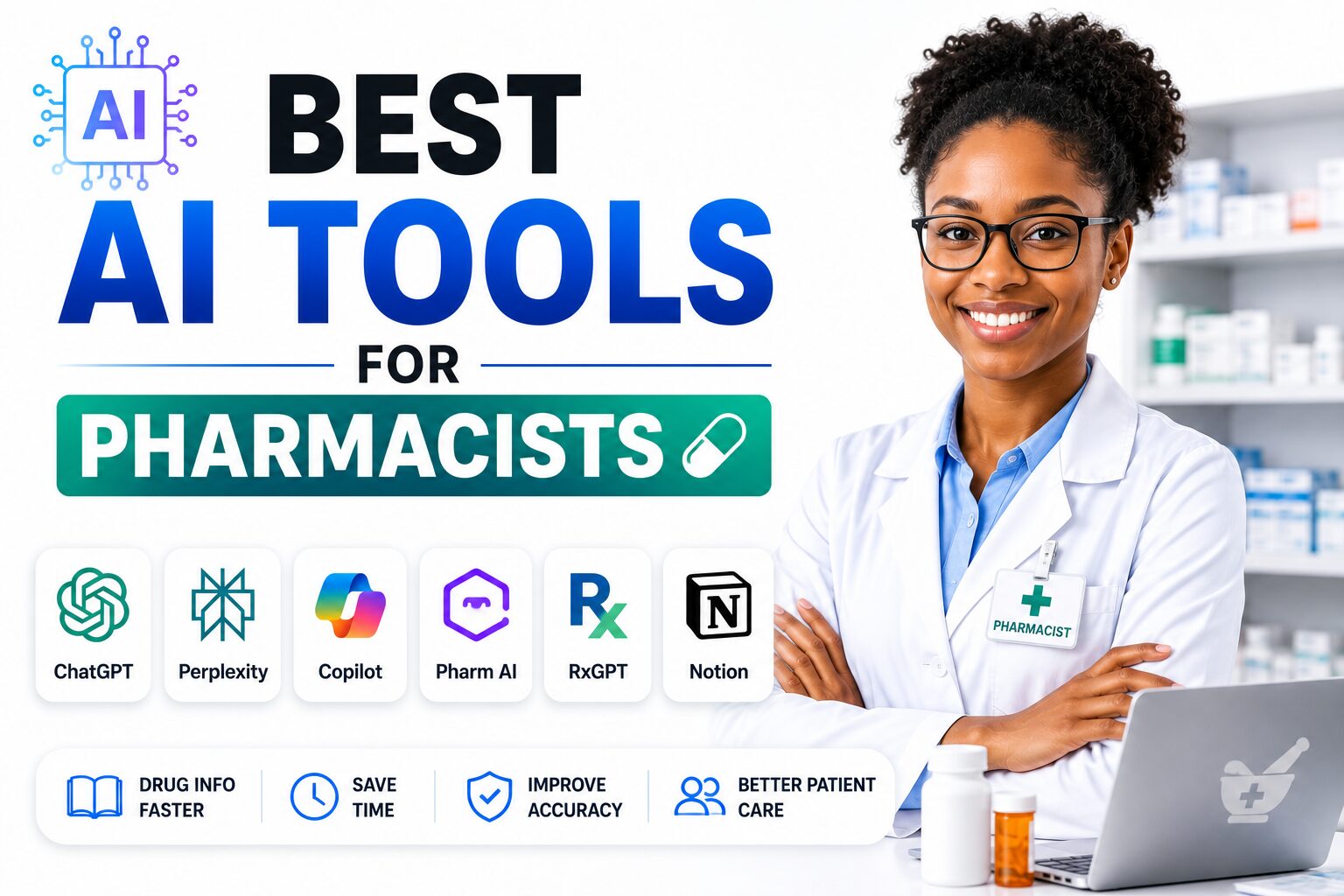
Best AI Tools for Pharmacists in 2026: Practical AI Every Pharmacist Should Be Using
By Dr Festus Kaasung Kunde, MD
Medical Doctor | AI in Healthcare Advocate | Founder, AI Doctor Africa & Ghana Vitals
Artificial intelligence is transforming pharmacy practice. Whether you work in a community pharmacy, hospital, industry, academia, or research, AI can help you answer drug information questions faster, improve patient counselling, stay up to date with new medicines, and reduce the time spent on routine administrative tasks.
However, AI should never replace professional judgement. Every recommendation must still be verified using approved drug references, national formularies, and local clinical guidelines.
Here are the best AI tools pharmacists can start using today—and exactly how to use them.
1. ChatGPT – Your Everyday Pharmacy Assistant
ChatGPT is one of the most versatile AI tools for pharmacists.
Practical Uses
Imagine a patient asks:
“Can I take metformin with omeprazole?”
Instead of spending several minutes searching multiple resources, you can ask:
“Explain whether metformin and omeprazole have clinically significant interactions. Include the mechanism, level of evidence, monitoring advice, and patient counselling points.”
You can also use ChatGPT to:
- Explain drug mechanisms.
- Compare medications within the same class.
- Generate patient-friendly counselling scripts.
- Create medicine information leaflets.
- Prepare CPD presentations.
- Draft medication review reports.
- Summarise treatment guidelines.
Best For
- Drug explanations
- Patient counselling
- Professional writing
- Continuing education
2. Perplexity AI – Finding the Latest Drug Information
Unlike many AI chatbots, Perplexity searches the web in real time and provides citations.
Practical Uses
A new antihypertensive drug is approved.
Instead of manually searching multiple websites, ask:
“What are the latest NICE, WHO and FDA recommendations for this medicine?”
Perplexity provides current sources that you can verify.
It is excellent for:
- New drug approvals.
- Updated treatment guidelines.
- Safety alerts.
- Drug recalls.
- Emerging evidence.
Best For
- Evidence-based pharmacy.
- Current guidelines.
- Recent publications.
3. Claude – Reading Long Drug Guidelines
Pharmacists regularly encounter lengthy documents.
Examples include:
- National treatment guidelines.
- Hospital formularies.
- WHO Essential Medicines List.
- Clinical protocols.
- Drug monographs.
Instead of reading hundreds of pages, upload the document to Claude and ask:
“Summarise all antibiotic dosing recommendations.”
or
“Create a table comparing anticoagulants.”
Claude excels at handling large documents.
Best For
- Clinical guidelines.
- Hospital protocols.
- Research papers.
- Formularies.
4. Google Gemini – The Productivity Tool
Gemini integrates seamlessly with Google Workspace.
Suppose you’re preparing a presentation on antimicrobial stewardship.
Gemini can:
- Draft slides.
- Summarise research papers.
- Organise references.
- Write emails.
- Analyse spreadsheets.
- Create educational materials.
If your pharmacy team uses Google Docs and Drive, Gemini can significantly streamline collaboration.
Best For
- Productivity.
- Collaboration.
- Presentations.
5. NotebookLM – Your Personal Drug Information Library
NotebookLM allows you to upload your own trusted references.
For example:
- British National Formulary (where licensing permits).
- Hospital antimicrobial guidelines.
- Local treatment protocols.
- Standard operating procedures.
- Pharmacy lecture notes.
- Personal CPD materials.
Then ask:
“What does our hospital guideline recommend for severe community-acquired pneumonia?”
NotebookLM answers using only the uploaded sources, making it ideal for internal reference and study.
Best For
- Hospital protocols.
- Pharmacy education.
- CPD.
- Local guidelines.
6. Consensus – Fast Evidence Searches
Suppose someone asks:
“Does zinc reduce the duration of the common cold?”
Instead of searching PubMed manually, Consensus summarises findings from peer-reviewed literature.
It helps pharmacists quickly understand what the evidence says before reading the original studies.
Best For
- Evidence-based pharmacy.
- Literature searches.
- Clinical questions.
7. Elicit – Research Made Easier
Pharmacists involved in research will appreciate Elicit.
It can:
- Search scientific papers.
- Extract study data.
- Compare clinical trials.
- Summarise research findings.
- Support systematic reviews.
Best For
- Pharmacy research.
- Literature reviews.
- Meta-analysis.
8. Grammarly – Professional Writing
Pharmacists write:
- Drug information responses.
- Research papers.
- Emails.
- Reports.
- SOPs.
- Patient education materials.
Grammarly improves clarity, grammar, and readability.
Best For
Professional communication.
9. Canva Magic Studio – Patient Education
Many patients understand visuals better than text.
Canva helps pharmacists create:
- Medicine posters.
- Diabetes education leaflets.
- Hypertension infographics.
- Social media campaigns.
- Community pharmacy promotions.
Best For
Health education and patient engagement.
10. Microsoft Copilot – Office Productivity
If your workplace relies on Microsoft Office, Copilot can help:
- Analyse Excel inventory data.
- Draft reports.
- Summarise meetings.
- Create PowerPoint presentations.
- Manage emails in Outlook.
This is particularly useful for pharmacy managers and administrators.
Best For
Administrative and operational tasks.
A Practical Workflow for Pharmacists
Here’s how a pharmacist might combine AI tools during a typical day:
| Task | Recommended AI Tool |
|---|---|
| Explain a drug mechanism | ChatGPT |
| Check recent guideline updates | Perplexity |
| Summarise a 200-page treatment guideline | Claude |
| Review hospital protocols | NotebookLM |
| Search scientific evidence | Consensus |
| Conduct a literature review | Elicit |
| Create patient education leaflets | Canva |
| Draft reports and presentations | Gemini or Microsoft Copilot |
| Proofread professional documents | Grammarly |
What AI Should NOT Be Used For
AI is a support tool—not a substitute for professional pharmacy practice.
Do not rely on AI alone to:
- Verify medication doses.
- Confirm drug interactions.
- Make compounding decisions.
- Dispense medications.
- Calculate chemotherapy doses.
- Recommend treatment without consulting approved references.
- Replace professional clinical judgement.
Always verify critical information using trusted resources such as your national formulary, hospital protocols, and recognised drug information databases.
Related Articles
- Best AI Tools for Nurses
- Best AI Tools for Dentists
- Best AI Tools for Radiologists
- Best AI Tools for Surgeons
- Best AI Tools for Medical Educators
- Best AI Tools for Medical Writers
About the Author
Dr Festus Kaasung Kunde is a Medical Doctor, AI in Healthcare Advocate, and Founder of AI Doctor Africa and Ghana Vitals. He holds an MD from Stavropol State Medical University, Russia (2025), and completed an internship at Korle-Bu Teaching Hospital in Accra. His mission is to help African healthcare professionals adopt AI responsibly to improve learning, research, and patient outcomes.
AI Doctor Africa | aidoctorafrica.com
Medical Disclaimer: For educational purposes only. AI tools do not replace clinical supervision, verified study resources, or your medical school’s academic guidance. Always verify clinical facts against authoritative primary sources.