Best AI Tools for Dentists in 2026: Practical AI Every Dentist Should Be Using
By Dr Festus Kaasung Kunde, MD
Medical Doctor | AI in Healthcare Advocate | Founder, AI Doctor Africa & Ghana Vitals
Artificial intelligence is rapidly changing dentistry. From interpreting dental radiographs and educating patients to writing clinical notes and staying current with new research, AI is helping dentists work more efficiently while improving patient communication and clinical workflows.
That said, AI is not a replacement for clinical expertise. A diagnosis should always be based on a comprehensive history, clinical examination, appropriate investigations, and professional judgement.
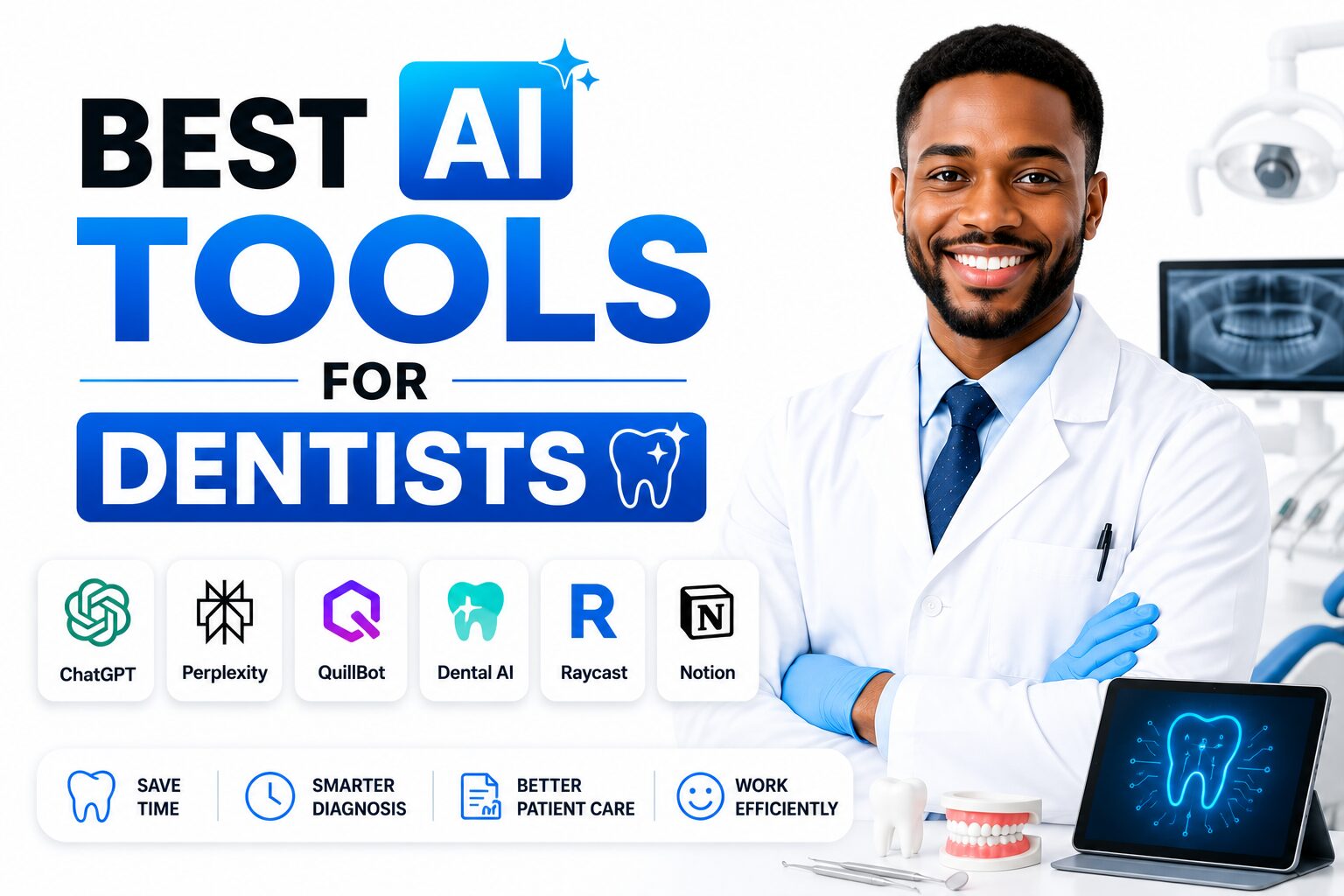
Here are the best AI tools dentists can use in 2026—and how to use them in real-world practice.
1. ChatGPT – The Everyday Dental Assistant
ChatGPT is one of the most useful AI tools for general dentists and dental specialists.
Practical Uses
Imagine a patient asks:
“Why do I need a root canal instead of just having the tooth filled?”
Instead of explaining from scratch every time, you can ask ChatGPT:
“Explain the difference between a dental filling and root canal treatment in simple language suitable for a patient.”
Within seconds, you have a clear explanation that can be adapted during your consultation.
Dentists can also use ChatGPT to:
- Explain dental diseases.
- Create patient education handouts.
- Draft post-operative instructions.
- Prepare informed consent documents.
- Generate social media content.
- Create continuing education summaries.
- Draft referral letters.
- Develop treatment plan explanations.
Best For
- Patient communication
- Clinical education
- Professional writing
- Practice marketing
2. Perplexity AI – Staying Current with Dental Evidence
Dentistry evolves rapidly with new restorative materials, implant techniques, orthodontic methods, and clinical guidelines.
Perplexity searches current sources and provides citations.
Practical Uses
A patient asks about:
“Are clear aligners better than braces?”
Rather than relying solely on memory, search:
“Compare the latest evidence on clear aligners versus fixed orthodontic appliances.”
Perplexity returns recent evidence with links to the original sources.
It is excellent for:
- Clinical guidelines.
- New restorative materials.
- Implant research.
- Infection prevention updates.
- Dental public health recommendations.
Best For
- Evidence-based dentistry
- Clinical updates
- Literature searches
3. Claude – Analysing Long Clinical Documents
Dentists regularly work with lengthy documents, including:
- Clinical guidelines.
- Implant protocols.
- Infection control manuals.
- Dental research papers.
- Continuing education resources.
Claude can summarise these documents in minutes.
Practical Uses
Upload a 150-page implant guideline and ask:
“Summarise indications, contraindications, complications, and follow-up recommendations.”
Instead of reading every page, Claude provides a structured overview that you can verify against the original document.
Best For
- Clinical guidelines
- Research papers
- Continuing education
- Policy documents
4. Google Gemini – Productivity for Dental Practices
Gemini integrates with Google Workspace, making it useful for dentists managing a busy practice.
It can help you:
- Draft emails.
- Create presentations.
- Organise treatment protocols.
- Analyse spreadsheets.
- Prepare staff training materials.
- Summarise meeting notes.
If your clinic already uses Google Drive and Google Docs, Gemini fits naturally into your workflow.
Best For
- Practice management
- Team collaboration
- Administrative tasks
5. NotebookLM – Your Digital Dental Library
NotebookLM lets you upload trusted documents and ask questions based only on those files.
For example, you can upload:
- National dental guidelines.
- Practice protocols.
- Implant manuals.
- Orthodontic references.
- Endodontic textbooks.
- Continuing education notes.
Then ask:
“What does our infection control policy recommend after treating a patient with suspected tuberculosis?”
The answers are generated from your own uploaded documents rather than the open web.
Best For
- Practice protocols
- Dental education
- Internal knowledge management
6. Canva Magic Studio – Patient Education Made Easy
Visual education is particularly important in dentistry.
Patients often understand treatment plans better when they see diagrams or illustrations.
Canva allows dentists to create:
- Oral hygiene posters.
- Before-and-after treatment explanations.
- Children’s dental education materials.
- Social media posts.
- Community oral health campaigns.
- Practice brochures.
Best For
- Patient education
- Practice branding
- Community outreach
7. Consensus – Evidence-Based Dentistry
Consensus searches peer-reviewed scientific literature and summarises research findings.
Practical Uses
Suppose you’re considering a new whitening technique.
Ask:
“What does current evidence say about the effectiveness and safety of in-office versus home bleaching?”
Consensus provides summaries linked to published studies.
Best For
- Evidence-based clinical decisions
- Research updates
- Journal club discussions
8. Elicit – For Dental Researchers
Dentists involved in academia or postgraduate training can use Elicit to:
- Search scientific literature.
- Compare studies.
- Extract research data.
- Conduct systematic reviews.
- Summarise evidence.
Best For
- Academic dentistry
- Dental research
- Literature reviews
9. Grammarly – Better Professional Communication
Dentists write:
- Referral letters.
- Clinical reports.
- Research papers.
- Patient information leaflets.
- Practice emails.
Grammarly improves grammar, tone, and readability, making communication clearer and more professional.
Best For
- Clinical documentation
- Academic writing
- Patient communication
10. Microsoft Copilot – Managing the Business Side of Dentistry
Practice owners spend significant time on administrative work.
Microsoft Copilot can help:
- Analyse financial spreadsheets.
- Draft reports.
- Summarise meetings.
- Prepare PowerPoint presentations.
- Manage Outlook emails.
Best For
- Practice management
- Administration
- Business operations
A Practical AI Workflow for Dentists
Here’s how AI can support a typical day in a dental practice:
| Task | Recommended AI Tool |
|---|---|
| Explain treatment options to patients | ChatGPT |
| Search the latest clinical evidence | Perplexity |
| Summarise clinical guidelines | Claude |
| Review practice protocols | NotebookLM |
| Research scientific literature | Consensus |
| Conduct literature reviews | Elicit |
| Create oral health education materials | Canva |
| Draft presentations and reports | Gemini or Microsoft Copilot |
| Proofread professional documents | Grammarly |
What AI Should NOT Be Used For
AI should never replace comprehensive dental assessment or professional judgement.
Do not rely solely on AI to:
- Diagnose dental diseases.
- Interpret radiographs without appropriate training and verification.
- Decide treatment plans independently.
- Prescribe medications without reviewing the patient’s medical history.
- Perform orthodontic planning without clinical examination.
- Replace informed consent discussions.
- Ignore local regulations and professional guidelines.
AI should support clinical decision-making—not make decisions on behalf of the dentist.
Related Articles
- Best Free AI Tools for Healthcare Professionals
- Best AI Tools for Nurses
- Best AI Tools for Pharmacists
- Best AI Tools for Radiologists
- Best AI Tools for Surgeons
About the Author
Dr Festus Kaasung Kunde is a Medical Doctor, AI in Healthcare Advocate, and Founder of AI Doctor Africa and Ghana Vitals. He holds an MD from Stavropol State Medical University, Russia (2025), and completed an internship at Korle-Bu Teaching Hospital in Accra. His mission is to help African healthcare professionals adopt AI responsibly to improve learning, research, and patient outcomes.
AI Doctor Africa | aidoctorafrica.com
Medical Disclaimer: For educational purposes only. AI tools do not replace clinical supervision, verified study resources, or your medical school’s academic guidance. Always verify clinical facts against authoritative primary sources.