
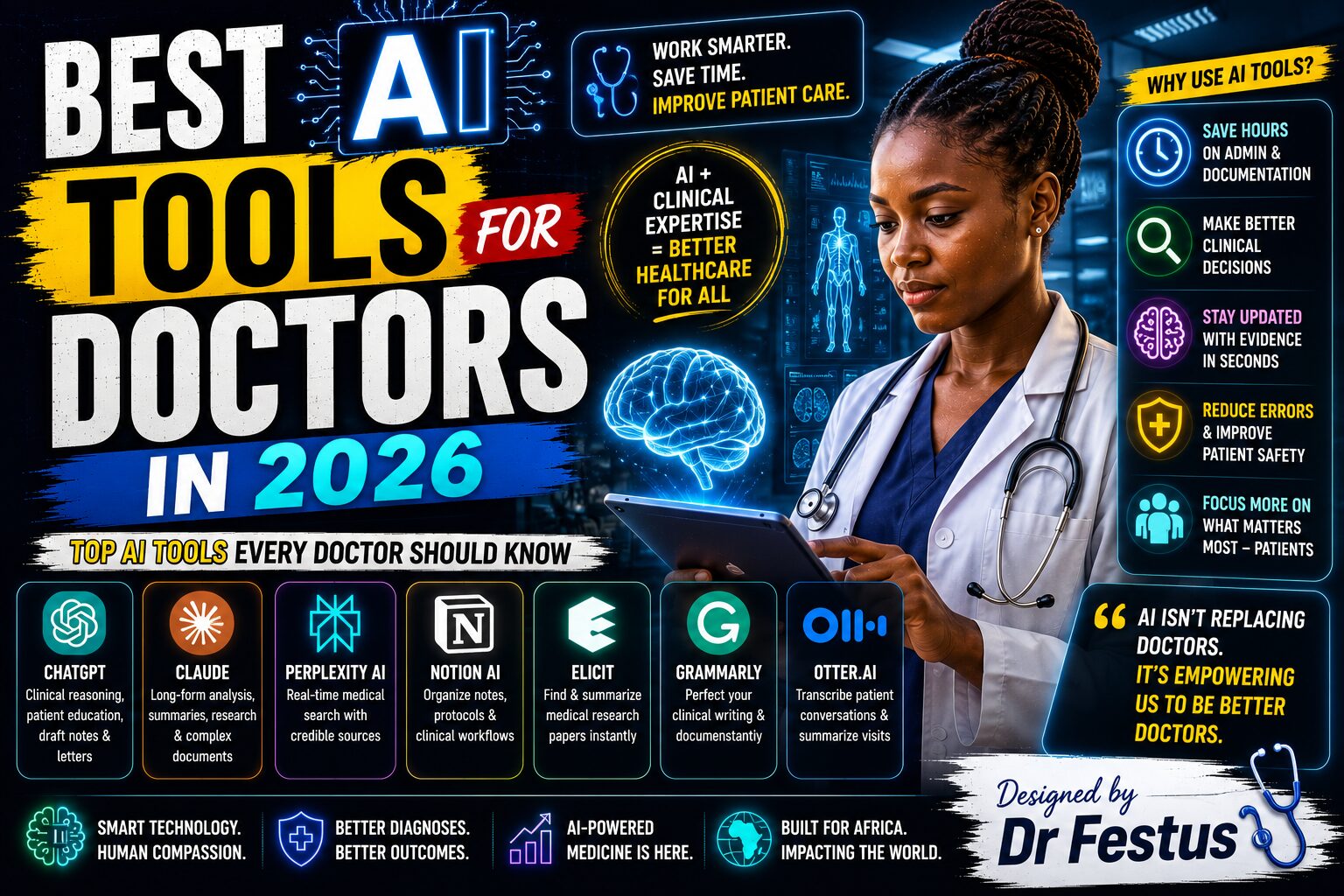
Best AI Tools for Doctors in 2026
By Dr Festus Kaasung Kunde, MD
Medical Doctor | AI in Healthcare Advocate | Founder, AI Doctor Africa & Ghana Vitals
AI has become an essential part of modern medical practice. From drafting clinic notes and summarising research to interpreting medical images and supporting clinical decision-making, AI tools are helping doctors save time while improving efficiency.
However, not every AI tool is designed for healthcare. The best platforms combine accuracy, strong reasoning, security, and practical workflows that fit into a doctor’s daily routine.
Here are the AI tools every doctor should know in 2026.
1. ChatGPT (OpenAI)
ChatGPT remains one of the most versatile AI assistants for healthcare professionals. Doctors use it to explain complex diseases, summarise medical literature, generate patient education materials, draft referral letters, prepare presentations, and organise clinical notes.
The newer reasoning models have significantly improved diagnostic discussions and clinical problem-solving, although all outputs should be verified against current clinical guidelines.
Best for: Clinical learning, documentation, patient education, research, and medical writing.
2. Claude AI (Anthropic)
Claude has become a favourite among doctors because of its ability to analyse lengthy medical documents while maintaining strong reasoning and clear writing.
It excels at reviewing clinical guidelines, analysing research papers, creating educational content, and summarising large PDFs without losing context.
For physicians involved in research or academic medicine, Claude is one of the strongest writing assistants currently available.
Best for: Literature reviews, guideline analysis, research writing, and long-form medical content.
3. Google Gemini
Gemini integrates naturally with Google’s ecosystem, making it useful for clinicians who already rely on Gmail, Google Docs, Google Drive, and Google Workspace.
Doctors can quickly organise clinical information, prepare presentations, summarise documents, and collaborate with colleagues across multiple platforms.
Its multimodal capabilities also make it useful for analysing images, charts, and medical documents.
Best for: Productivity, collaboration, and Google Workspace users.
4. Microsoft Copilot
Hospitals and healthcare organisations using Microsoft 365 increasingly rely on Copilot to improve administrative efficiency.
It can summarise meetings, organise emails, generate reports, draft documents, and automate repetitive office tasks.
For clinicians working within enterprise healthcare systems, Copilot fits naturally into existing workflows.
Best for: Hospital administration, documentation, and Microsoft 365 users.
5. Perplexity AI
Doctors often need quick access to reliable medical information rather than lengthy AI-generated responses.
Perplexity combines conversational AI with real-time web search and provides citations for its answers, making it useful for checking recent evidence, treatment recommendations, and clinical updates.
It should complement—not replace—traditional evidence-based resources.
Best for: Rapid evidence searches and staying current with medical literature.
6. NotebookLM (Google)
NotebookLM is particularly valuable for doctors who regularly work with large collections of medical documents.
Users can upload clinical guidelines, journal articles, textbooks, protocols, and lecture notes, then ask questions based only on those sources.
This reduces the risk of mixing trusted references with unrelated internet content.
Best for: Guideline review, exam preparation, protocol development, and continuing medical education.
7. OpenEvidence
Designed specifically for physicians, OpenEvidence provides evidence-based clinical answers supported by current medical literature.
Rather than functioning as a general-purpose chatbot, it focuses on helping clinicians answer practical bedside questions using published research.
Its healthcare-specific design makes it increasingly valuable in everyday clinical practice.
Best for: Evidence-based medicine and point-of-care clinical questions.
8. Doximity GPT
Built for healthcare professionals, Doximity GPT assists with clinical documentation, patient communication, referral letters, and administrative workflows.
It aims to reduce time spent on paperwork while maintaining clinician oversight of all generated content.
Best for: Clinical documentation and physician workflow.
9. Freed AI
Freed AI functions as an AI medical scribe, automatically generating consultation notes during patient encounters.
By reducing documentation time, clinicians can spend more attention interacting directly with patients rather than typing into electronic health records.
Best for: Clinic documentation and reducing administrative burden.
10. Nabla
Nabla is another leading AI medical assistant focused on ambient clinical documentation.
It listens during consultations and generates structured clinical notes that physicians can review and edit before saving.
Its goal is simple: allow doctors to focus on patients instead of paperwork.
Best for: AI-assisted clinical note generation.
Choosing the Right AI Tool
No single AI platform is perfect for every doctor.
A practical combination might look like this:
- ChatGPT: Daily clinical support and patient education.
- Claude: Research, guidelines, and long-document analysis.
- Perplexity: Current evidence and literature searches.
- NotebookLM: Personal medical knowledge base.
- Freed AI or Nabla: Clinical documentation.
- OpenEvidence: Evidence-based clinical decision support.
Related Articles
- Best AI Tools for Researchers in 2026
- Claude vs Gemini for Healthcare Professionals
- ChatGPT vs Perplexity for Medical Research
- Best Free AI Tools for Healthcare Professionals
About the Author
Dr Festus Kaasung Kunde is a Medical Doctor, AI in Healthcare Advocate, and Founder of AI Doctor Africa and Ghana Vitals. He holds an MD from Stavropol State Medical University, Russia (2025), and completed an internship at Korle-Bu Teaching Hospital in Accra. His mission is to help African healthcare professionals adopt AI responsibly to improve learning, research, and patient outcomes.
AI Doctor Africa | aidoctorafrica.com
Medical Disclaimer: For educational purposes only. AI tools do not replace clinical supervision, verified study resources, or your medical school’s academic guidance. Always verify clinical facts against authoritative primary sources.