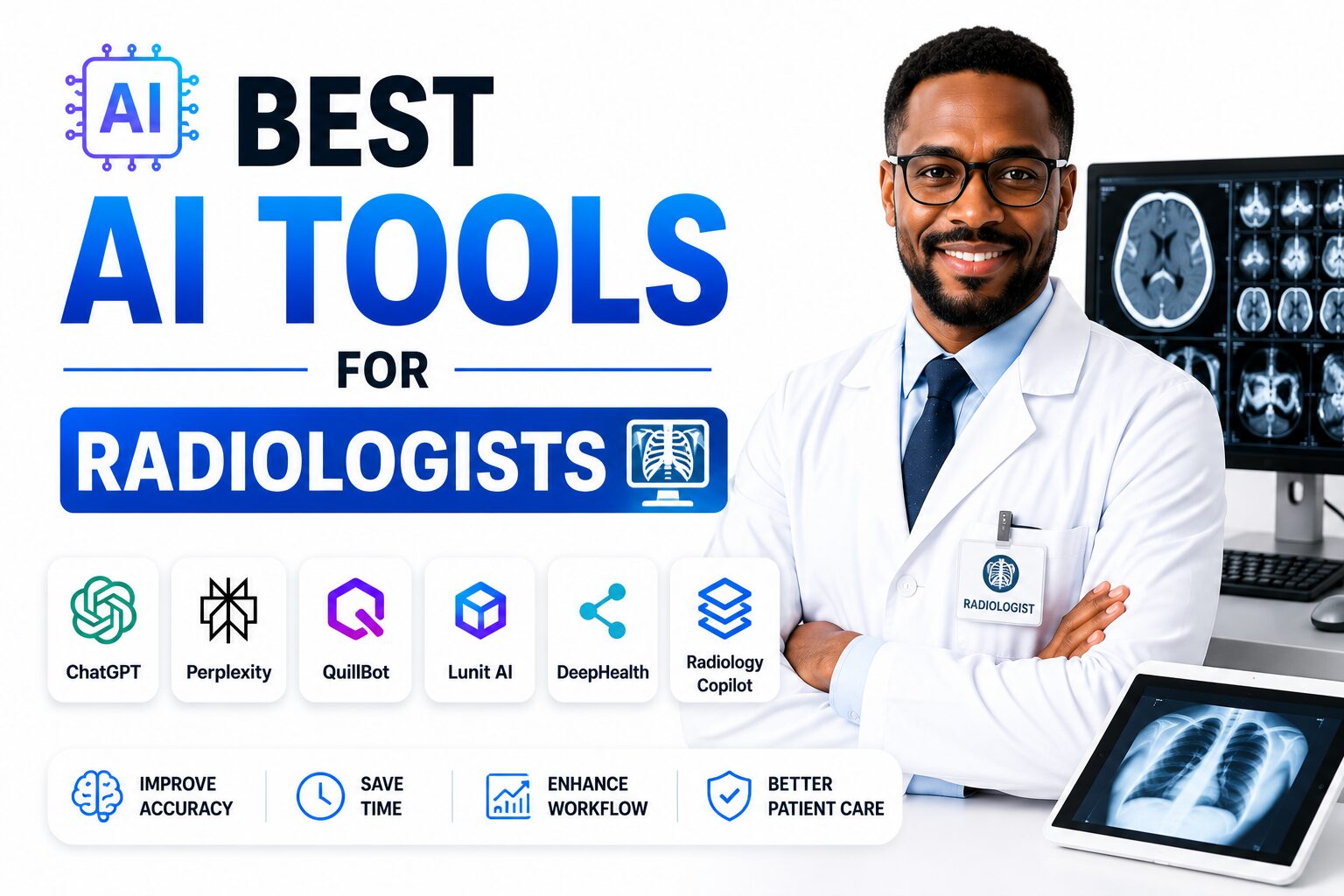
Best AI Tools for Radiologists in 2026: Practical AI Every Radiologist Should Be Using
By Dr Festus Kaasung Kunde, MD
Medical Doctor | AI in Healthcare Advocate | Founder, AI Doctor Africa & Ghana Vitals
Artificial intelligence has become one of the biggest technological advances in radiology. AI can now assist with image analysis, workflow prioritisation, report generation, quality assurance, research, and education. Rather than replacing radiologists, AI is helping them manage increasing imaging volumes while improving efficiency and consistency.
The keyword, however, is assist. AI should support—not replace—the expertise of a trained radiologist. Every AI-generated suggestion must be interpreted within the context of the patient’s history, clinical findings, and the imaging study itself.
Here are the best AI tools radiologists should consider using in 2026.
1. ChatGPT – The Everyday Radiology Assistant
ChatGPT is not designed to interpret medical images, but it is an excellent productivity tool for radiologists.
Practical Uses
Suppose you’ve diagnosed a pulmonary embolism on a CT pulmonary angiogram and want to explain the findings to a referring clinician or a patient.
You could ask:
“Explain acute pulmonary embolism in language suitable for a patient.”
Or:
“Create a concise teaching summary comparing pulmonary embolism, pulmonary infarction, and chronic thromboembolic disease.”
Radiologists can also use ChatGPT to:
- Draft educational reports.
- Explain imaging findings.
- Create teaching presentations.
- Summarise radiology guidelines.
- Develop resident teaching materials.
- Generate multiple-choice questions.
- Draft research manuscripts.
Best For
- Medical writing
- Teaching
- Reporting support
- Education
2. Perplexity AI – Keeping Up with Radiology Research
Radiology evolves rapidly with advances in imaging techniques, AI algorithms, and reporting standards.
Perplexity searches current sources and provides citations.
Practical Uses
Suppose you want to know:
“What are the latest recommendations for incidental pulmonary nodules?”
or
“What’s new in PI-RADS version updates?”
Perplexity retrieves recent literature and guideline documents with links to the original sources.
Best For
- Current radiology guidelines
- Recent publications
- Evidence-based imaging
3. Claude – Analysing Long Guidelines
Radiologists regularly review:
- ACR Appropriateness Criteria.
- Society guidelines.
- Hospital imaging protocols.
- AI validation studies.
- Research papers.
Claude excels at analysing lengthy documents.
Practical Uses
Upload an ACR guideline and ask:
“Summarise imaging recommendations for suspected pulmonary embolism.”
or
“Compare MRI and CT indications for acute stroke.”
Instead of reading hundreds of pages, Claude provides an organised summary that can be checked against the original document.
Best For
- Guideline summaries
- Research papers
- Policy documents
- Continuing education
4. Google Gemini – Productivity for Radiology Departments
Gemini integrates with Google Workspace.
Radiologists can use it to:
- Prepare departmental presentations.
- Draft emails.
- Analyse audit spreadsheets.
- Create educational documents.
- Summarise meeting notes.
- Organise multidisciplinary meeting materials.
Best For
- Administrative work
- Department collaboration
- Productivity
5. NotebookLM – Your Personal Radiology Knowledge Base
NotebookLM allows radiologists to upload trusted references and interact with them using AI.
Upload:
- Hospital imaging protocols.
- ACR guidelines.
- RSNA educational material.
- Teaching files.
- Fellowship notes.
- Research articles.
Then ask:
“What does our protocol recommend for incidental adrenal lesions?”
NotebookLM answers using only your uploaded documents.
Best For
- Local imaging protocols
- Resident education
- Fellowship revision
- Departmental knowledge management
6. AI Image Analysis Platforms
Unlike general AI chatbots, dedicated radiology AI platforms are specifically designed to analyse medical images.
Examples include:
- Aidoc
- Viz.ai
- Annalise.ai
- Qure.ai
- Gleamer
- Lunit
- Subtle Medical
These platforms can assist with:
- Intracranial haemorrhage detection.
- Large vessel occlusion identification.
- Pulmonary embolism detection.
- Pneumothorax detection.
- Lung nodule identification.
- Fracture detection.
- Chest X-ray analysis.
- Breast imaging support.
- Stroke workflow prioritisation.
Many are integrated directly into PACS or radiology workflows and highlight potentially urgent studies for faster review.
Best For
- Clinical image analysis
- Workflow prioritisation
- Emergency radiology
- Quality assurance
7. Consensus – Evidence-Based Radiology
Consensus searches peer-reviewed scientific literature.
Suppose you’re evaluating a new MRI protocol.
Ask:
“Does abbreviated breast MRI improve cancer detection compared with standard protocols?”
Consensus summarises the evidence from published studies.
Best For
- Journal clubs
- Evidence-based imaging
- Clinical questions
8. Elicit – Radiology Research
Radiologists involved in academic work can use Elicit to:
- Search for research papers.
- Compare imaging studies.
- Extract data.
- Conduct systematic reviews.
- Support meta-analyses.
Best For
- Academic radiology
- Literature reviews
- Research
9. Grammarly – Professional Reporting
Radiologists produce thousands of reports each year.
Grammarly helps improve:
- Research manuscripts.
- Educational materials.
- Emails.
- Conference abstracts.
- Administrative reports.
Although it is not intended to edit formal radiology reports within reporting systems, it is useful for other professional writing.
Best For
Professional communication.
10. Microsoft Copilot – Department Management
Radiology department leaders often spend significant time on administration.
Copilot can assist with:
- Audit reports.
- Workforce planning.
- Equipment utilisation analysis.
- Meeting summaries.
- Excel dashboards.
- PowerPoint presentations.
Best For
Leadership and departmental management.
A Practical AI Workflow for Radiologists
Here’s how AI can fit into a typical radiology workflow:
| Task | Recommended AI Tool |
|---|---|
| Explain imaging findings or create teaching material | ChatGPT |
| Search the latest imaging evidence | Perplexity |
| Summarise lengthy radiology guidelines | Claude |
| Review local imaging protocols | NotebookLM |
| AI-assisted image detection and triage | Dedicated radiology AI platforms (e.g., Aidoc, Viz.ai, Qure.ai) |
| Search peer-reviewed evidence | Consensus |
| Conduct literature reviews | Elicit |
| Draft presentations and departmental documents | Gemini or Microsoft Copilot |
| Proofread manuscripts and reports | Grammarly |
What AI Should NOT Be Used For
Radiologists should never rely solely on AI to:
- Make a final diagnosis.
- Sign off reports without independent review.
- Ignore clinical history or prior imaging.
- Override concerning findings because AI reports a normal study.
- Replace multidisciplinary discussion or specialist consultation.
- Interpret images beyond the validated scope of the AI system being used.
Even dedicated imaging AI can miss subtle abnormalities or generate false positives. Every result must be interpreted in the full clinical context.
Related Articles
- Best Free AI Tools for Healthcare Professionals
- Best AI Tools for Nurses
- Best AI Tools for Pharmacists
- Best AI Tools for Dentists
- Best AI Tools for Surgeons
About the Author
Dr Festus Kaasung Kunde is a Medical Doctor, AI in Healthcare Advocate, and Founder of AI Doctor Africa and Ghana Vitals. He holds an MD from Stavropol State Medical University, Russia (2025), and completed an internship at Korle-Bu Teaching Hospital in Accra. His mission is to help African healthcare professionals adopt AI responsibly to improve learning, research, and patient outcomes.
AI Doctor Africa | aidoctorafrica.com
Medical Disclaimer: For educational purposes only. AI tools do not replace clinical supervision, verified study resources, or your medical school’s academic guidance. Always verify clinical facts against authoritative primary sources.