
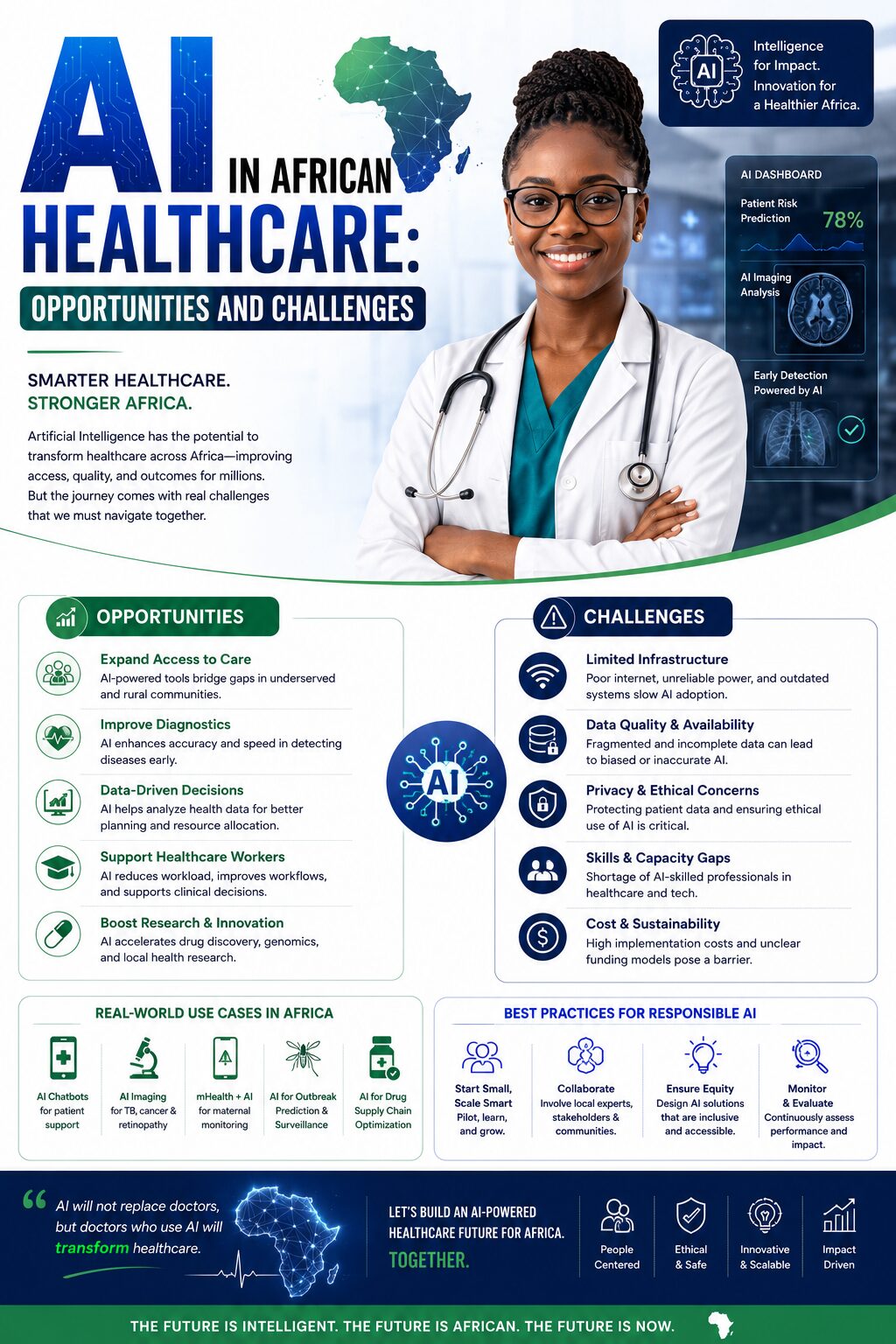
AI in African Healthcare: Opportunities and Challenges
By Dr Stephanie Owusu Ankomah
Medical Doctor | Medical Writer, AI Doctor Africa
During my clinical rotation at KNUST Hospital in Ghana, I watched a line of patients stretch from the OPD doors to the car park. Some had been waiting since 6 am. By noon, nurses were still calling names from a paper register. In 2024, in one of West Africa’s top teaching hospitals, this was still healthcare delivery. AI in African Healthcare: Opportunities and Challenges.
This is exactly where AI in African healthcare can change the game.
Artificial Intelligence is no longer
That day made one thing clear: Africa does not just have a disease burden problem. We have an access, efficiency, and systems problem.
Let’s start with a question you’ve probably asked yourself, maybe without realising it: why does it sometimes take a full day of travel to see a doctor, when your phone can diagnose your car engine faster than that?
This is exactly where AI in African healthcare can change the game.
Artificial Intelligence is no longer science fiction. From reading chest X-rays in Lagos to predicting malaria outbreaks in Accra, AI is already being tested across the continent. For a region with 1.4 billion people and only 3 doctors per 10,000 people, AI is not a luxury. It’s a necessity.
But let’s not get ahead of ourselves. For every success story, there’s a clinic somewhere without reliable electricity to even charge the device the AI runs on.
In this article, we’ll break down some of the biggest opportunities for AI in African healthcare, the major challenges holding us back in Ghana, Nigeria, and across Africa, and some practical solutions to move from pilot projects to real impact.
What is AI in Healthcare and Why Africa Needs It Now
AI in healthcare refers to the use of computer systems to perform tasks that typically require human intelligence: pattern recognition, decision-making, prediction, and automation.
Think of it as a digital assistant that never sleeps. It can read 1000 X-rays in an hour, predict which patients are likely to be readmitted, or send an SMS reminder to a diabetic patient to take insulin.
Why Africa?
According to WHO, Africa carries 25% of the global disease burden but has only 3% of the world’s health workers. In Ghana, the doctor-to-patient ratio is 1:8,000. In Nigeria, it’s 1:5,000. The WHO recommendation is 1:600.
The result: long wait times, missed diagnoses, drug stockouts, and burnout.
AI cannot replace doctors. But it can extend them. It can help one clinician do the work of three, reach patients in rural villages, and make fewer mistakes under pressure. For countries like Ghana and Nigeria with young, mobile-first populations, the timing is perfect.
Why This Conversation Matters Right Now
Here’s something that puts things in perspective: in Rwanda, there is roughly one healthcare worker for every 1,000 people. The World Health Organisation recommends four. At the rate things are going, closing that gap the traditional way, training more doctors and nurses, would take well over a century. And Rwanda is far from the worst-off country on the continent.
If you’ve ever waited hours in an overcrowded clinic or watched a family member travel half a day for a test result, you already understand the problem AI is being asked to help solve. It’s not that Africa lacks smart, capable health workers, but rather it’s just that there simply aren’t enough of them to go around, especially outside major cities.
The Gates Foundation and OpenAI
At the same time, something else is happening: more people than ever are carrying a smartphone. That combination, a real staffing crisis and a rapidly digitising population, is exactly why global players are paying attention. In 2026, the Gates Foundation and OpenAI jointly committed $50 million to a project called Horizon 1000, aiming to bring AI tools into 1,000 African clinics by 2028, starting in Rwanda. The point isn’t to replace doctors and nurses. It’s to take some of the paperwork and guesswork off their plates so they can spend more time actually treating people.
Money is following that logic too. Analysts tracking digital health across the continent expect the broader market, apps, records systems, diagnostics, and AI tools combined to grow into the tens of billions of dollars by the end of the decade. That kind of investment doesn’t guarantee good outcomes on its own, but it does mean AI in African healthcare is no longer a niche experiment. It’s becoming an infrastructure.
The Opportunities: What AI Is Already Doing Well
Faster and More Accurate Diagnostics
Radiology and pathology have a massive bottleneck. Imagine a nurse in a small clinic, hours from the nearest specialist, staring at a chest X-ray she’s not fully trained to interpret. In Rwanda, AI tools are now helping with exactly these tasks, like screening for tuberculosis in facilities with no radiologist on-site, catching cases that might otherwise sit undiagnosed for weeks.
AI tools can also now read CT scans for stroke and retinal images for diabetic retinopathy in under 60 seconds. Companies like DeepTek are already piloting in South Africa and Kenya.
In Ghana, AI-powered ultrasound can help midwives detect high-risk pregnancies without a specialist present. This is critical for reducing maternal mortality.
In Nigeria, a startup called Ubenwa took an even more surprising approach: teaching a machine-learning model to listen to a newborn’s cry and flag early signs of birth asphyxia, a condition where minutes genuinely matter. Nobody’s suggesting these tools replace a doctor’s judgment. Think of them more like a second set of trained ears and eyes, available in places where the first set simply isn’t.
Predictive Analytics for Disease Outbreaks
One of AI’s quieter strengths is pattern recognition at scale that turns out to be incredibly useful for public health. Pilots in Nigeria have combined phone location data, weather patterns, and historical case records to anticipate cholera outbreaks before they spread, giving health authorities a head start most outbreak responses never get.
In Uganda, researchers at Makerere University built an AI-powered air quality monitoring system, now used in multiple African cities, tackling air pollution — a health risk that rarely gets the attention it deserves.
AI can analyse weather data, social media, and clinic reports to predict outbreaks 2-4 weeks early. During COVID-19, models from the Africa CDC used AI to forecast hotspots and guide vaccine distribution.
In Ghana, the Ghana Health Service is testing AI to predict malaria spikes based on rainfall and temperature data. Early warning equals early prevention.
Reducing Wait Times and Administrative Burden
If you have ever sat in an OPD in Ghana or Nigeria, you know the real bottleneck isn’t always the doctor. It’s the system around the doctor.
During my clinical rotation at KNUST Hospital, I saw it firsthand. Patients arrived at 5 am to queue. By 9 am, the waiting area was full. But the delay wasn’t because clinicians were slow; the systems around it were impossible to bypass or go by.
3 places where time was lost:
1. Registration & Triage: Paper registers, manual ID checks, and nurses asking the same 10 questions to 60 patients.
2. Folder Retrieval: Health records were stored in huge paper files. Nurses spent 15-20 minutes searching for one folder. Sometimes folders were missing entirely, and care had to start from scratch.
3. Billing, Pharmacy, Discharge: Multiple desks, multiple stamps, multiple queues. A patient could see the doctor in 10 minutes but spend 2 hours leaving the hospital.
This is not unique to KNUST. A 2023 WHO report on health systems in Sub-Saharan Africa found that up to 40% of a patient’s total hospital time is spent on non-clinical administration.
How AI is solving this in Africa right now
1. AI-Powered Patient Check-in and Triage:
Instead of paper, patients check in via USSD, WhatsApp chatbot, or a kiosk. An AI asks symptom questions in Twi, Hausa, Yoruba, or English and assigns a triage score.
– Impact: Urgent cases are seen first. Routine cases are routed to nurses or telemedicine. This cuts OPD congestion by 25-35% in pilot hospitals in Kenya and South Africa.
2. Electronic Health Records + AI Search:
AI can digitise handwritten notes using OCR and NLP. More importantly, it can search. A doctor types “diabetic + last HbA1c” and gets the result in 2 seconds, not 20 minutes.
– Impact: No lost folders. Better continuity of care. In Nigeria, Helium Health’s EHR with AI search reduced record retrieval time by 70% in partner clinics.
3. Automated Scheduling and No-Show Reduction
AI analyses past appointment data and predicts which patients are likely to miss appointments. It then sends SMS/WhatsApp reminders 24 hours and 2 hours before.
– Impact: Some private hospitals in Lagos reported a 30% drop in no-shows. That means more patients seen per day without hiring more staff.
4. AI for Billing, Coding, and Documentation
Doctors spend hours typing notes. Artificial Intelligence´s voice scribes can listen during consultation and auto-generate a SOAP note. It can also auto-code diagnoses for NHIS claims in Ghana, reducing rejections.
– Impact: Clinicians get 1-2 hours back per day. Less burnout. Faster claims = better hospital cash flow.
Why this matters for Africa
We don’t need AI to replace nurses or clerks. We need AI to remove the repetitive tasks so they can focus on patients.
For a country like Ghana with 1 doctor to 8,000 people, “time saved” equals “lives saved”. If AI can cut wait times by even 40%, that’s thousands more patients seen per year in one teaching hospital alone.
The KNUST queue I saw at 6 am could look very different by 2027: check in on your phone, get a triage number, walk straight to the right department, and leave with digital prescriptions. That’s the promise.
Smarter Drug Supply And Inventory Management
“Sorry, we’re out of stock.”
For many patients in Ghana and Nigeria, this is the sentence that ends treatment. Drug stockouts are not just an inconvenience. They lead to treatment failure, drug resistance, and deaths.
During my time at KNUST Hospital, the pharmacy would run out of basic antibiotics, insulin, and antihypertensives mid-month. Clinicians would then have to prescribe alternatives that patients couldn’t afford outside or delay care entirely.
The root cause is rarely “no drugs in the country.” It’s poor forecasting, manual inventory, theft, and expiry. Most hospital pharmacies still use paper stock cards. A nurse counts tablets once a month. By the time someone notices a shortage, it’s already a crisis. AI in African Healthcare: Opportunities and Challenges. AI in African Healthcare: Opportunities and Challenges.
This is where AI in African healthcare can plug one of the biggest leaks in the system.
How AI is transforming drug supply across Africa
1. AI-Powered Demand Forecasting
AI systems analyse 3 things at once:
1. Past consumption data from the hospital pharmacy
2. Seasonal disease trends – e.g. malaria drugs spike in the rainy season
3. Epidemiological alerts from Ghana Health Service / NCDC Nigeria
Instead of guessing, the AI predicts: “Based on current admissions and rainfall data, you will run out of ACTs in 18 days. Reorder 400 packs now.”
-Impact: Kenya’s KEMSA and Rwanda’s medical stores have piloted AI forecasting and cut stockouts of essential medicines by 30-45%. For NHIS facilities in Ghana, this means fewer emergency procurements and less waste.
2. Real-Time Inventory Tracking + Expiry Alerts
AI + barcode/RFID scanning lets every vial and tablet be tracked from the central medical store to the patient’s bedside.
The system sends 3 alerts automatically:
1. Low stock alert – Reorder threshold reached
2. Expiry alert – “200 units of amoxicillin expire in 60 days. Use first or transfer.”
3. Theft/diversion alert – Unusual dispensing patterns flagged
– Impact: In Nigeria, some tertiary hospitals using AI inventory reduced drug wastage from expiry by 25%. That’s millions of cedis/naira saved yearly.
3. AI-Optimized Logistics and Last-Mile Delivery
This is where Africa is already leading the world.
Zipline in Ghana and Rwanda uses AI to route drones for blood, vaccines, and essential medicines. The AI considers weather, battery life, and urgency to decide delivery priority. Average delivery time: 30 minutes to remote clinics.
In urban areas, AI is being used by startups to optimise delivery truck routes for medical distributors. Less fuel, faster delivery, fewer cold-chain breaks.
4. Preventing Antimicrobial Resistance Through Smarter Dispensing
AI can flag when a clinic is over-prescribing antibiotics compared to national guidelines. It can also track resistance patterns by region and suggest alternative first-line drugs.
For Ghana and Nigeria battling AMR, this data is critical for NAFDAC and FDA policy.
The challenges we still face
1. Fragmented data: Most pharmacies are not digitised yet. AI needs clean data to work.
2. Cost: Enterprise inventory software can cost $10,000-$50,000/year. Public hospitals need donor or government subsidies.
3. Trust: Pharmacists worry AI will replace them. The reality: AI handles counting and forecasting. Pharmacists handle counselling and clinical decisions.
Why this matters
A hospital with reliable drugs is a hospital patients trust.
AI won’t manufacture more drugs. But it will make sure the right drug is in the right place, at the right time, and not expired on a shelf.
For healthcare managers, this is low-hanging fruit. ROI is clear: less waste plus fewer stockouts plus better patient outcomes. For a country like Ghana pushing “Agenda 111” hospitals, building an AI inventory from day 1 is cheaper than retrofitting later.
From KNUST to a CHPS compound in the Northern Region, the goal is the same: no patient should be told “we’re out” for a life-saving medicine.
The Challenges: What Could Get in the Way
The potential is huge. But if we ignore the barriers, AI in Africa will stay stuck in pilot projects and press releases.
Across Ghana, Nigeria, and the rest of the continent, 6 core challenges keep coming up.
1. Data Gaps and Poor Data Quality:
AI is only as good as the data it’s trained on. And right now, African health data is fragmented.
The problems:
1. Paper records: 60-70% of public hospitals in Ghana and Nigeria still use paper folders. Data gets lost, damaged, or never digitised.
2. Siloed systems: The lab uses one software, the pharmacy another, and OPD uses paper. Nothing talks to each other.
3. Western bias: Most AI models are trained on European and US patient data. A chest X-ray AI trained in the US will underperform on TB- and HIV-related lung patterns common in Africa.
What this means:
You can’t build an AI for sickle cell, Lassa fever, or maternal mortality if you don’t have African datasets. “African data for African patients” isn’t a slogan. It’s a requirement.
What’s being done:
KNUST, University of Lagos, and Africa CDC are starting data consortia. Ghana’s National Health Insurance Scheme has 30M+ patient records that could be anonymised for AI training if governance is right. AI in African Healthcare: Opportunities and Challenges.
2. Infrastructure: Power, Internet, and Devices
AI needs 3 things to run: electricity, internet, and devices.
The reality in 2026:
1. Power: Dumsor/load shedding in Ghana and Nigeria means rural clinics can go 8-12 hours without power.
2. Internet: Only 36% of people in Sub-Saharan Africa have reliable internet. Cloud-based AI won’t work in a CHPS compound with no 4G.
3. Devices: Most district hospitals don’t have enough computers, let alone GPUs.
The solution: “Frugal AI”
Engineers are now building AI that runs offline on a $200 Android phone. Example: AI ultrasound that works without internet and syncs when back in town. But this needs upfront investment and local R&D, not just importing tools from Silicon Valley.
3. Cost and Funding Barriers
AI is expensive. And healthcare budgets are already stretched.
The numbers:
1. Enterprise licenses: A single AI radiology tool can cost $15,000 – $50,000 per year.
2. Implementation: Digitising records, training staff, and cybersecurity can cost 3x the software license.
3. Pilot trap: 80% of donor-funded AI pilots in Africa die after 12 months because there’s no budget to scale.
Why it matters for Ghana/Nigeria:
With NHIS deficits and out-of-pocket payments still high, hospitals can’t justify AI unless it shows clear ROI: fewer stockouts, more patients seen, less waste.
The way forward: Tiered pricing, government subsidies, and PPPs. Let startups prove ROI in 2-3 hospitals, then the government scales it.
4. Regulation, Ethics, and Algorithmic Bias
If an AI misses a cancer, who is liable? The doctor? The hospital? The software company?
Key gaps today:
1.No AI-specific laws: Ghana’s Data Protection Act 2012 and Nigeria’s NDPR cover data, but not AI decision-making.
2. Patient consent: Most patients don’t know their data is being used to train AI.
3. Bias: If training data is only from urban, male patients, the AI will fail women and rural patients.
What we need:
1.AI Sandboxes: Ghana FDA and NAFDAC should create fast-track approval for low-risk AI tools.
2. Auditing: Every health AI deployed in Africa should be tested on local populations before rollout.
3. Transparency: Patients have a right to know if AI was involved in their diagnosis.
5. Workforce Training and Trust Deficit
The biggest resistance to AI isn’t tech. It’s people.
From clinicians:
“I didn’t go to med school to be replaced by a robot.”
Reality: AI won’t replace doctors. But doctors who use AI will replace doctors who don’t. We need to add “AI for Health” to medical, nursing, and pharmacy school curricula in KNUST, UniLag, etc.
From patients:
“Is this app going to leak my HIV status?”
We need community education in Twi, Hausa, Yoruba, and Igbo explaining what AI does and doesn’t do.
From policymakers:
Many still see AI as a “nice to have, not a “must have” for UHC. That has to change.
6. The Innovation vs Implementation Gap: Ghana & Nigeria Case Studies
Ghana – The Policy Leader, Slow on Rollout
Wins: Zipline drone delivery, National Digital Health Strategy, strong research at KNUST.
Gaps: Most public hospitals are still paper-based. AI tools are in 2-3 private hospitals in Accra, not in Tamale or Sunyani. Bureaucracy slows procurement.
Nigeria – The Innovation Hub, Uneven Coverage
Wins: Lagos has 54gene, Helium Health, and Reliance Health using AI for diagnostics and insurance. Huge VC funding
Gaps: 70% of Nigerians live outside Lagos. Infrastructure and regulation haven’t caught up. Data protection enforcement is weak.
The common thread: Innovation is happening in capitals. The patient in rural Borno or the Northern Region is still waiting. Closing that gap is the real challenge.
What Getting This Right Actually Looks Like
None of these challenges is a reason to hit pause. They’re more like a to-do list for doing this properly:
1. Train models on African data, not repackaged versions of tools built for someone else’s patients.
2. Back African ownership of the infrastructure, the way Medic Afya and Data Science Africa are already doing.
3. Write the rules before scaling up, not after something goes wrong.
4. Build for the internet and power that actually exists, not the ideal version that doesn’t.
5. Keep a human at the centre of every decision — every credible success story so far, from TB screening to infant cry analysis, supports a health worker rather than replacing one.
Lessons from KNUST Hospital – What One Teaching Hospital Taught Me About AI
During my clinical rotation at KNUST Hospital and Komfo Anokye Teaching Hospital in Kumasi, I didn’t just learn medicine. I learned how systems fail patients.
KNUST Hospital is one of Ghana’s 2 major teaching hospitals. It serves over 2 million people across the Ashanti Region and beyond. The clinicians are brilliant. The intent is good. But the flow is broken.
3 Core Problems I Observed
1. The Queue Problem: Access Delayed is Care Denied
Patients were arriving as early as 5:00 AM to join a queue for a 9:00 AM OPD. By 11:00 AM, the waiting benches were full, children were crying, and elderly patients were sitting on the floor.
Why? One doctor was seeing 50-60 patients per day. Triage was manual. No system prioritised urgent cases.
Lesson: In low-resource settings, time is a clinical resource. If we can’t manage patient flow, we can’t manage disease.
2. The Paper Problem: Lost Folders = Lost Information
Every patient had a manila folder. Nurses spent 15-20 minutes searching racks for records. Sometimes folders were misfiled. Sometimes they were missing.
When that happened, we had to restart history-taking from zero. For chronic patients with hypertension or diabetes, that meant lost lab results, lost drug history, lost progress.
Lesson: Paper doesn’t scale. Without digitised, searchable records, continuity of care is impossible.
3. The Burnout Problem: Clinicians Doing Admin Work
Doctors were writing notes by hand, nurses were doing billing runs, and pharmacists were counting stock manually. Decision fatigue was real by 2 pm.
Lesson: When clinicians spend 40% of their time on admin, patients get less attention and more errors.
How AI Could Transform KNUST Hospital Tomorrow
If we applied AI with a healthcare management lens, here’s what could change in 12-18 months:
1. AI Triage + Virtual Check-in Kiosk
Patients scan a QR code or use USSD on arrival. An AI chatbot in Twi/English asks: “What is your main problem today?”
The AI assigns a priority score and sends them to the right clinic. Red flags like chest pain or severe bleeding get flagged for immediate attention.
Projected Impact: Cut waiting time by 30-40%. Reduce OPD congestion.
2. AI-Powered Electronic Health Records with Smart Search
No more folders. Every patient gets a digital ID. Doctors type “last BP” or “metformin” and get results in 2 seconds.
NLP can also transcribe doctor-patient conversations and auto-generate notes, so clinicians can look at the patient, not the paper.
Projected Impact: Save 1-2 hours per doctor per day. Eliminate lost records.
3. Predictive Staffing and Bed Management
AI can analyse past OPD data + seasonal trends to forecast busy days. “Tuesdays in rainy season = 40% more malaria cases. Schedule 2 extra nurses.”
It can also predict which admitted patients are at risk of deterioration and alert the ward team early.
Projected Impact: Better staff allocation, fewer bottlenecks, improved patient safety.
4. AI for Pharmacy and Lab Turnaround
Link the lab and pharmacy to the EHR. AI flags: “Patient has been waiting 45min for lab results” or “This drug will stock out in 5 days.”
Projected Impact: Faster discharge, fewer drug stockouts.
What I learned at KNUST is that patients don’t die only from disease. They die from delay, from lost information, from inefficiency.
AI is not a magic wand. But if deployed right with local data, local languages, and clinician buy-in, it can turn a 6-hour hospital visit into a 90-minute one. That’s thousands of extra patients seen per year, with the same staff.
From KNUST to every district hospital in Ghana and Nigeria, the lesson is the same: Fix the flow, and you fix a lot of healthcare.
Where This Leaves Us
AI in African healthcare isn’t a future promise anymore — it’s already screening for tuberculosis in Rwandan clinics, flying blood over Ghanaian forests, and helping Kenyan community health workers manage more patients than they ever could alone. That’s genuinely worth celebrating.
But technology on its own doesn’t fix a broken system. Without reliable power, data that actually reflects African patients, clear rules, and African leadership over how these tools get built, AI risks becoming just another well-funded pilot that never quite scales — one more idea that looked great in a conference slide and quietly faded. The next few years will decide which story we end up telling: one where AI widens the gap, or one where it finally helps African healthcare leapfrog decades of underinvestment.
Related Articles
- How African Doctors Can Use AI in Daily Practice
- The Future of AI in Ghanaian Healthcare
- AI for Rural Healthcare in Africa
- Can AI Solve Africa’s Healthcare Workforce Shortage?
- AI for Community Health Workers in Africa
About the Author
Dr Stephanie Owusu Ankomah is a Medical Doctor, Medical Writer at aidoctorafrica, and a Healthcare Management MSc Student. She holds an MD from Stavropol State Medical University, Russia (2024), and is currently pursuing an MSc in International Healthcare Management in Germany, with hands-on experience supporting hospital operations, patient care coordination, clinical documentation, and multidisciplinary healthcare teams across outpatient clinics, wards, emergency care, surgery, and paediatrics.
AI Doctor Africa | aidoctorafrica.com
Medical Disclaimer: For educational purposes only. AI tools do not replace clinical supervision, verified study resources, or your medical school’s academic guidance. Always verify clinical facts against authoritative primary sources.
Stephanie Owusu Ankomah
Medical doctor and founder of AI Doctor Africa.
View author profile →