
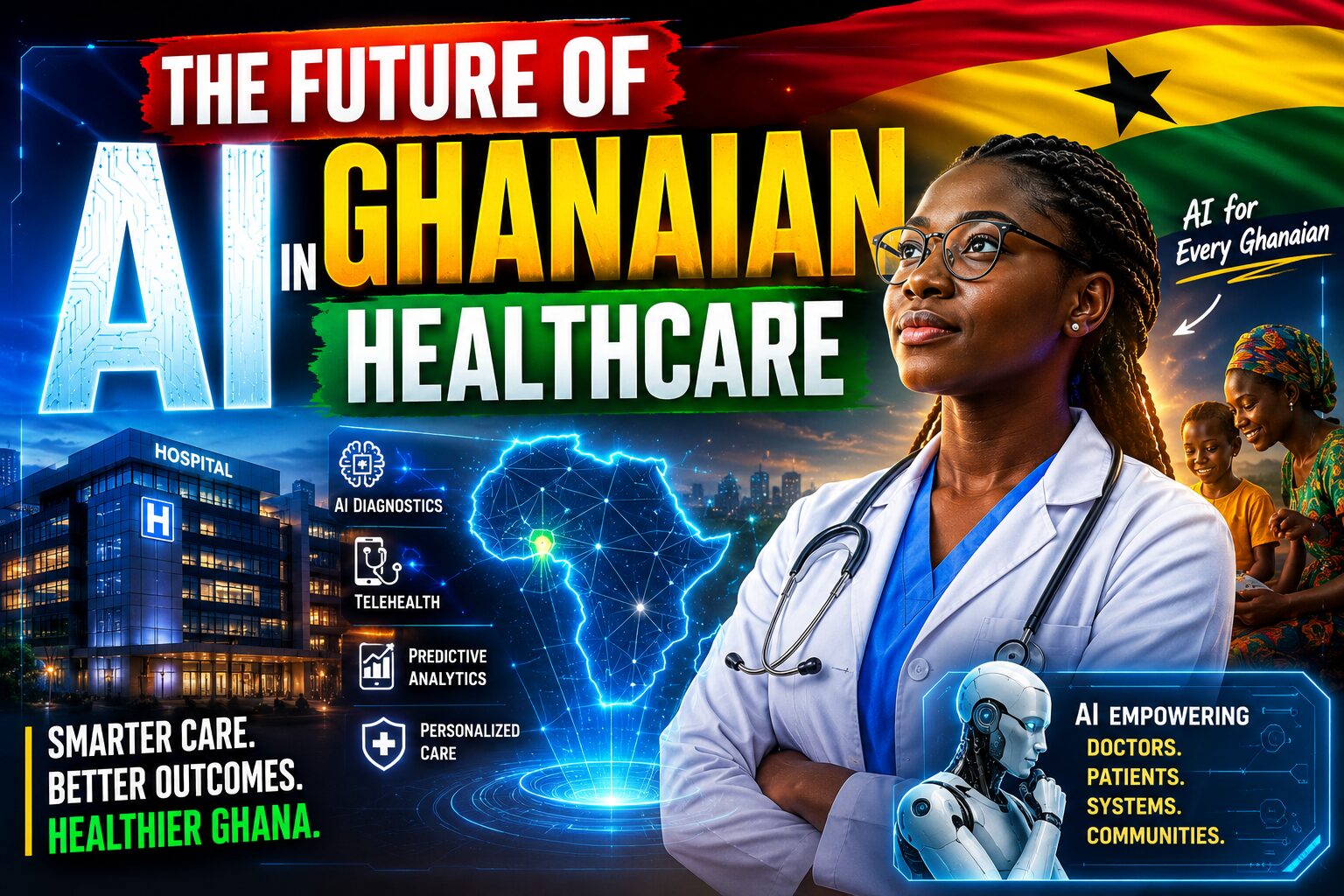
The Future of AI in Ghanaian Healthcare
By Dr Stephanie Owusu Ankomah
Medical Doctor | Medical Writer, AI Doctor Africa
Artificial intelligence is no longer a distant idea reserved for technology companies in Europe, Asia, or the United States. It is already influencing how doctors learn, how researchers analyse information, how hospitals manage data, and how patients access healthcare.
The real question for Ghana is no longer whether AI will enter our healthcare system.It is whether we will shape that future deliberately or simply become consumers of technologies designed for other populations.
As a medical doctor and a Medical Writer, I see AI as one of the most important opportunities Ghana has to strengthen healthcare delivery. However, I do not believe AI will solve our problems automatically. Technology must be built around the realities of our hospitals, communities, health workers, patients, infrastructure, and data systems.
The future of AI in Ghanaian healthcare will depend on how well we combine innovation with local knowledge.
AI Will Support Doctors, Not Replace Them
There is understandable concern that AI may eventually replace doctors, nurses, pharmacists, laboratory professionals, and other healthcare workers.
In Ghana, that is unlikely to be the most immediate effect.
Our health system needs more healthcare professionals, not fewer. Many facilities are already operating with limited staff, high patient numbers, and demanding workloads. In such an environment, AI is more useful as an assistant than as a replacement.
A doctor may use AI to organise a patient’s history, generate possible differential diagnoses, review treatment guidelines, prepare discharge instructions, or identify important information that may have been overlooked.
However, AI does not examine the patient, understand the full social context, take responsibility for treatment, or replace professional judgment.
The future is therefore not AI versus doctors.
It is doctors who understand how to use AI responsibly, working more efficiently than those who do not.
Earlier Detection of Disease
One of Ghana’s biggest healthcare challenges is late diagnosis.
Many people live with hypertension, diabetes, kidney disease, cardiovascular risk, or other chronic conditions without knowing it. They often present only after complications have developed.
This is one of the reasons Dr Festus started Ghana Vitals.
Preventive healthcare should not begin only when someone becomes seriously ill. Community screening, regular monitoring, follow-up, and health education can identify risks much earlier.
AI could strengthen this process by analysing patterns across blood pressure, blood glucose, body mass index, age, family history, symptoms, medication use, and lifestyle factors.
Instead of simply telling someone that their blood pressure is elevated, an AI-supported system could help identify who is at the highest risk, who needs urgent referral, and who requires closer follow-up.
The value will not come from screening alone.
It will come from connecting screening data to action.
Better Clinical Decision Support
Ghanaian doctors often work in environments where access to specialists, advanced investigations, and continuous medical information may be limited.
AI-powered clinical decision-support systems could help healthcare workers consider important diagnoses, recognise warning signs, and follow evidence-based treatment pathways.
For example, a clinician in a district hospital may use a locally adapted system to review possible causes of a patient’s symptoms while considering Ghanaian disease patterns, available investigations, medicine availability, and national treatment guidelines.
This local adaptation is essential.
An AI system trained mainly on foreign data may recommend investigations or treatments that are unavailable, unaffordable, or inappropriate for the Ghanaian setting.
Our tools must understand malaria, tuberculosis, sickle cell disease, maternal health, hypertension, diabetes, infectious diseases, and the practical realities of healthcare delivery in Ghana.
AI in Medical Education
AI will also transform how Ghanaian medical students, nurses, doctors, and other health professionals learn.
Students can already use AI to explain difficult concepts, generate practice questions, simulate clinical cases, and prepare for examinations. Doctors can use it for continuous medical education, guideline summaries, clinical revision, research, and presentation preparation.
The danger is that students may use AI to avoid thinking. A tool that provides fast answers can create false confidence when the learner has not developed proper clinical reasoning.
Medical schools and professional bodies should therefore teach responsible AI use rather than simply banning it. Healthcare professionals need to understand prompting, verification, data privacy, hallucinations, bias, and ethical limitations.
AI literacy will soon become part of clinical competence.
Improving Public Health Surveillance
Ghana generates large amounts of health information through hospitals, laboratories, community programmes, pharmacies, insurance claims, and public health reporting systems.
Much of this information remains fragmented or underused.
AI could help identify disease outbreaks, monitor treatment patterns, forecast medicine demand, detect unusual increases in symptoms, and support public health planning.
For example, changes in clinic attendance, laboratory results, medicine purchases, or community reports may provide early warning of an outbreak.
AI could help health authorities detect these patterns faster.
However, the quality of the output will depend on the quality of the data.
Incomplete, inconsistent, or inaccurate data will produce unreliable predictions. Ghana must therefore invest not only in AI but also in strong health-information systems, standardised data collection, secure storage, and trained personnel.
Reducing Administrative Burden
Many healthcare professionals spend valuable time on documentation, reports, appointment scheduling, stock records, referrals, and routine communication. AI could automate parts of these administrative tasks. This would allow clinicians to spend more time with patients and less time completing repetitive paperwork.
Hospitals could use AI to predict patient flow, identify medicine shortages, optimise staff allocation, and manage appointments more efficiently. These may not sound as exciting as an AI diagnosing a rare disease, but they could have a major effect on daily healthcare delivery. Sometimes the most valuable innovation is the one that removes frustration from the system.
Expanding Access Through Telemedicine
AI and telemedicine could help reduce the gap between urban and rural healthcare.
Patients in underserved communities may be able to access preliminary health information, follow-up support, medication reminders, and remote consultations through mobile devices.
Community health workers could use AI-supported tools to recognise danger signs, organise referrals, and provide standardised health education.
Language will be important.
Many Ghanaians are more comfortable discussing health issues in Twi, Ga, Ewe, Dagbani, Hausa, Fante, or other local languages. Future AI systems should be able to communicate accurately in these languages without losing important clinical meaning.
Healthcare becomes more accessible when patients can understand it.
The Risks Ghana Must Take Seriously
The future of AI in healthcare is promising, but it is not without danger.
Patient information may be exposed if health data are uploaded to insecure platforms. Algorithms may discriminate against Ghanaian patients if local populations are poorly represented in the training data. Healthcare workers may trust incorrect recommendations because the system sounds confident.
AI may also widen inequality.
Private hospitals and wealthy patients may gain access to advanced tools while rural and public facilities are left behind.
Ghana needs clear standards for:
- Patient privacy.
- Data ownership.
- Clinical accountability.
- AI validation.
- Cybersecurity.
- Informed consent.
- Bias monitoring.
- Use of patient information.
No AI system should be introduced into clinical care simply because it is impressive.
It must be safe, useful, tested, and appropriate for the setting.
Ghana Must Build, Not Only Import
Ghana cannot rely entirely on foreign companies to define the future of its healthcare. We need collaboration between doctors, nurses, researchers, engineers, universities, technology companies, regulators, hospitals, and patients.
Local innovators should be supported to build systems using Ghanaian data and designed around Ghanaian problems. The country must also invest in research that evaluates whether these tools actually improve outcomes. An AI application may look impressive during a presentation but fail in a busy clinic with poor internet, limited devices, and overstretched staff. Innovation must survive reality.
Related Articles
- How African Doctors Can Use AI in Daily Practice
- AI in African Healthcare: Opportunities and Challenges
- AI for Rural Healthcare in Africa
- Can AI Solve Africa’s Healthcare Workforce Shortage?
- AI for Community Health Workers in Africa
About the Author
Dr Stephanie Owusu Ankomah is a Medical Doctor, Medical Writer at aidoctorafrica, and a Healthcare Management MSc Student. She holds an MD from Stavropol State Medical University, Russia (2024), and is currently pursuing an MSc in International Healthcare Management in Germany, with hands-on experience supporting hospital operations, patient care coordination, clinical documentation, and multidisciplinary healthcare teams across outpatient clinics, wards, emergency care, surgery, and paediatrics.
AI Doctor Africa | aidoctorafrica.com
Medical Disclaimer: For educational purposes only. AI tools do not replace clinical supervision, verified study resources, or your medical school’s academic guidance. Always verify clinical facts against authoritative primary sources.