
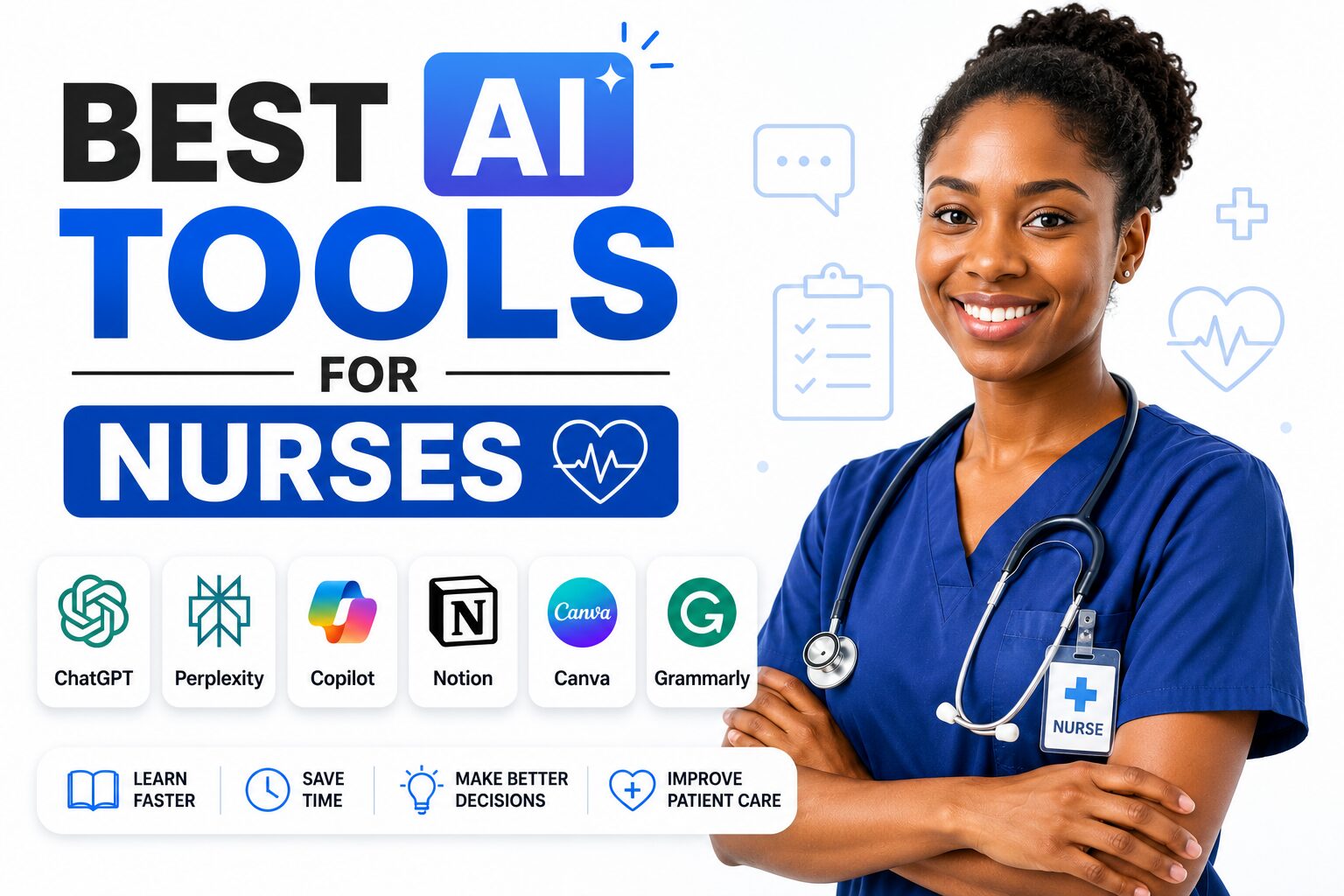
Best AI Tools for Nurses in 2026
By Dr Festus Kaasung Kunde, MD
Medical Doctor | AI in Healthcare Advocate | Founder, AI Doctor Africa & Ghana Vitals
Artificial intelligence is rapidly becoming an essential part of modern nursing. From documenting patient encounters and finding evidence-based answers to creating patient education materials and supporting continuing education, AI can help nurses work more efficiently while allowing more time for what matters most—patient care.
Importantly, AI is not replacing nurses. Instead, it is helping reduce administrative workload, improve access to information, and support better clinical decision-making.
Here are the best AI tools every nurse should know in 2026.
1. ChatGPT
ChatGPT is one of the most versatile AI assistants available to nurses.
It can help with:
- Explaining disease processes.
- Summarising nursing guidelines.
- Creating patient education materials.
- Drafting discharge instructions.
- Preparing nursing presentations.
- Generating nursing care plans for learning purposes.
- Creating NCLEX-style practice questions.
- Supporting continuing professional development.
It is particularly valuable for nursing students and practising nurses who need quick explanations of unfamiliar conditions or treatments.
Best for: Clinical learning, patient education, nursing documentation, and professional development.
2. Claude
Claude excels at analysing lengthy nursing documents and producing clear, structured summaries.
Nurses can use Claude to:
- Review hospital protocols.
- Summarise clinical guidelines.
- Compare treatment recommendations.
- Draft educational content.
- Analyse research papers.
- Improve reports and presentations.
Its natural writing style makes it especially useful for nurses involved in leadership, education, or research.
Best for: Long-document analysis, nursing education, and academic writing.
3. Google Gemini
Gemini integrates well with Google Workspace, making it ideal for nurses who frequently use Gmail, Google Docs, Google Drive, and Google Sheets.
It can assist with:
- Writing emails.
- Preparing presentations.
- Analysing spreadsheets.
- Summarising meeting notes.
- Organising educational materials.
- Brainstorming quality-improvement projects.
Best for: Productivity and collaboration.
4. Perplexity AI
Perplexity combines conversational AI with real-time web search.
Nurses can quickly find:
- Evidence-based guidelines.
- Clinical recommendations.
- Drug information.
- Infection prevention updates.
- Nursing best practices.
Every answer includes source links, making it easier to verify information.
Best for: Evidence-based nursing practice.
5. NotebookLM
NotebookLM allows nurses to upload their own documents and interact with them using AI.
You can upload:
- Hospital policies.
- Nursing procedures.
- Clinical guidelines.
- Lecture notes.
- Continuing education materials.
NotebookLM answers questions using only the uploaded sources, making it particularly useful for revision and workplace learning.
Best for: Personal learning and policy review.
6. Canva Magic Studio
Nurses frequently educate patients, families, students, and communities.
Canva’s AI tools help create:
- Patient information leaflets.
- Health promotion posters.
- Community education materials.
- Social media graphics.
- Nursing presentations.
Visual communication can significantly improve patient understanding.
Best for: Patient education and health promotion.
7. Grammarly
Whether writing reports, emails, research papers, or educational materials, Grammarly improves grammar, clarity, and professionalism.
It is particularly useful for:
- Research writing.
- Professional correspondence.
- Patient education documents.
- Conference abstracts.
Best for: Professional writing.
8. Microsoft Copilot
Microsoft Copilot integrates with Word, Excel, Outlook, and other Microsoft applications.
Nurses can use it to:
- Draft documents.
- Summarise reports.
- Analyse spreadsheets.
- Organise meeting notes.
- Improve administrative productivity.
Best for: Nurses working in Microsoft environments.
9. Consensus
Consensus searches peer-reviewed scientific literature and summarises research findings.
Nurse educators, advanced practice nurses, and researchers can quickly identify the current evidence on clinical questions.
Best for: Evidence-based nursing and research.
10. Elicit
Elicit is designed specifically for researchers.
It helps users:
- Search scientific papers.
- Screen research studies.
- Extract study data.
- Summarise findings.
- Support literature reviews.
It is particularly valuable for nurses undertaking postgraduate studies or evidence-based practice projects.
Best for: Nursing research and systematic reviews.
How Nurses Can Use AI Every Day
A typical AI-assisted nursing workflow might include:
- ChatGPT to explain unfamiliar diseases or prepare patient education.
- Perplexity to find the latest clinical guidelines.
- NotebookLM to review hospital protocols.
- Claude to summarise lengthy documents or research papers.
- Canva to create health promotion materials.
- Grammarly to polish reports and educational content.
Used together, these tools can save several hours each week while improving the quality of documentation, education, and professional development.
Important Limitations
AI should never replace professional nursing judgement.
Nurses should always:
- Verify AI-generated information using trusted clinical guidelines.
- Follow institutional protocols and national standards.
- Protect patient confidentiality by avoiding identifiable patient information in consumer AI platforms.
- Consult senior colleagues or appropriate specialists when managing complex clinical situations.
- Remember that AI supports—not replaces—critical thinking and compassionate patient care.
Related Articles
- Best Free AI Tools for Healthcare Professionals
- Best Free AI Tools for Healthcare Professionals
- Best AI Tools for Pharmacists
- Best AI Tools for Dentists
- Best AI Tools for Radiologists
About the Author
Dr Festus Kaasung Kunde is a Medical Doctor, AI in Healthcare Advocate, and Founder of AI Doctor Africa and Ghana Vitals. He holds an MD from Stavropol State Medical University, Russia (2025), and completed an internship at Korle-Bu Teaching Hospital in Accra. His mission is to help African healthcare professionals adopt AI responsibly to improve learning, research, and patient outcomes.
AI Doctor Africa | aidoctorafrica.com
Medical Disclaimer: For educational purposes only. AI tools do not replace clinical supervision, verified study resources, or your medical school’s academic guidance. Always verify clinical facts against authoritative primary sources.