
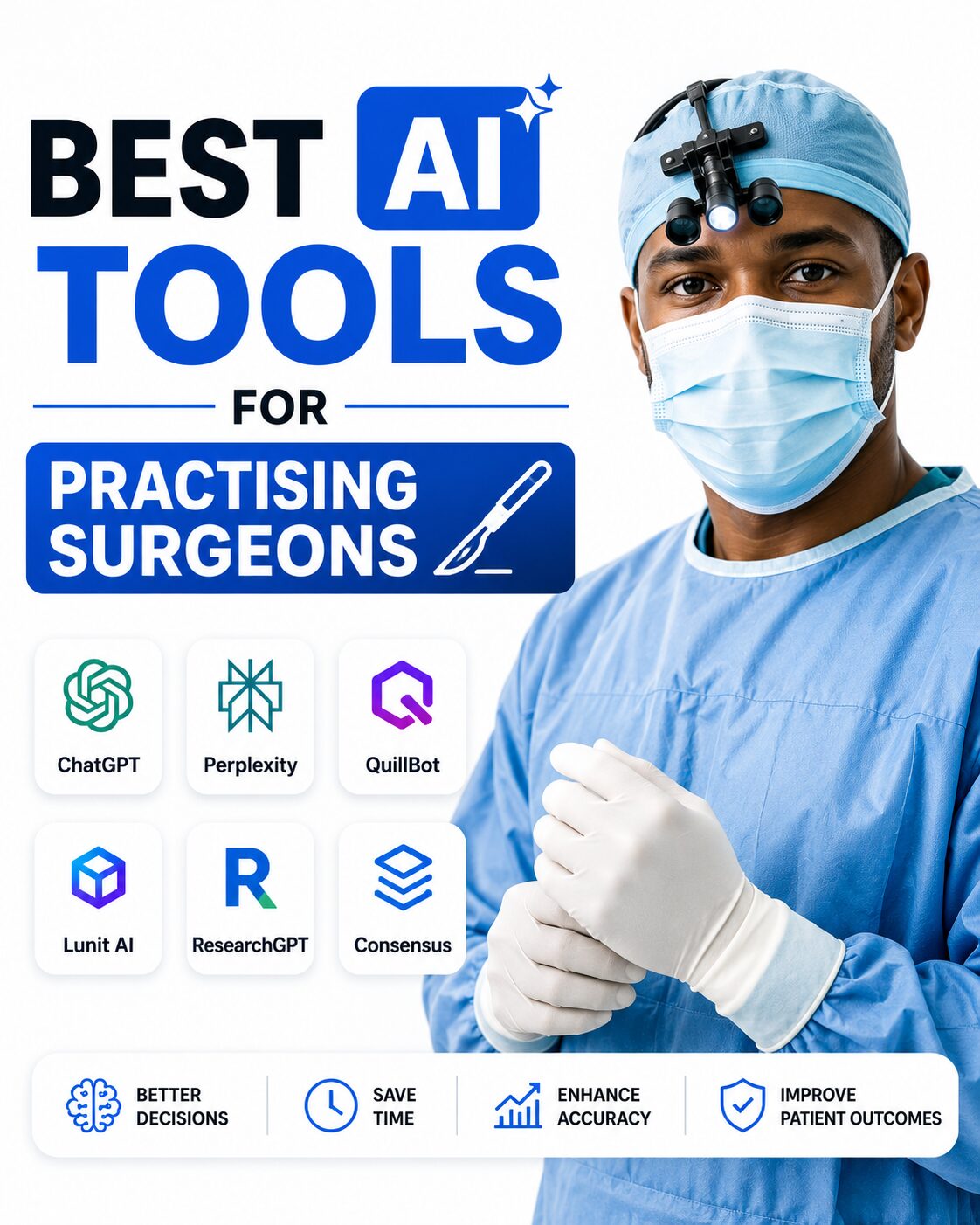
Best AI Tools for Practising Surgeons in 2026: Practical AI Every Surgeon Should Be Using
By Dr Festus Kaasung Kunde, MD
Medical Doctor | AI in Healthcare Advocate | Founder, AI Doctor Africa & Ghana Vitals
Artificial intelligence is becoming an important tool in modern surgery. While AI cannot replace a surgeon’s clinical judgement, technical skill, or intraoperative decision-making, it can streamline many of the tasks surrounding patient care—from reviewing imaging and summarising guidelines to writing operative notes and staying current with surgical research.
The best surgeons in 2026 won’t necessarily be those who use AI the most, but those who use it wisely to improve efficiency, learning, and patient outcomes.
Here are the best AI tools every practising surgeon should know.
1. ChatGPT – Your Everyday Surgical Assistant
ChatGPT is one of the most useful AI tools for surgeons because it supports both clinical learning and administrative work.
Practical Uses
Imagine you’re seeing a patient scheduled for a laparoscopic cholecystectomy.
You can ask:
“Explain laparoscopic cholecystectomy, including risks, benefits, possible complications, and recovery in language suitable for a patient.”
Within seconds, you have a clear explanation that can help during informed consent discussions.
ChatGPT can also help you:
- Explain diseases and surgical procedures.
- Draft discharge summaries.
- Prepare patient education materials.
- Generate operative note templates.
- Write referral and consultation letters.
- Create teaching slides for residents.
- Prepare morbidity and mortality (M&M) presentations.
- Summarise surgical guidelines.
Best For
- Patient education
- Clinical documentation
- Surgical teaching
- Medical writing
2. Perplexity AI – Staying Up to Date with Surgical Evidence
Surgical guidelines evolve rapidly as new trials and techniques emerge.
Perplexity searches current literature and provides references.
Practical Uses
Suppose you’re reviewing evidence before adopting a new hernia repair technique.
Ask:
“What is the latest evidence comparing laparoscopic versus open inguinal hernia repair?”
Or:
“Latest WSES guidelines for acute appendicitis.”
Perplexity returns recent publications and guideline sources for verification.
Best For
- Clinical guidelines
- Surgical updates
- Evidence-based practice
3. Claude – Summarising Long Surgical Guidelines
Surgeons often need to review lengthy documents such as:
- WHO Surgical Safety recommendations.
- Enhanced Recovery After Surgery (ERAS) guidelines.
- Surgical society recommendations.
- Trauma protocols.
- Oncology guidelines.
Claude can summarise these documents into practical, organised notes.
Practical Uses
Upload an ERAS guideline and ask:
“Summarise the key preoperative, intraoperative, and postoperative recommendations for colorectal surgery.”
Claude produces structured summaries that are easier to review while still allowing you to verify important details in the original document.
Best For
- Clinical guidelines
- Surgical protocols
- Research papers
- Continuing education
4. Google Gemini – Productivity for Busy Surgeons
Surgeons spend a significant amount of time outside the operating theatre.
Gemini helps with:
- Writing emails.
- Preparing lectures.
- Organising multidisciplinary meeting notes.
- Creating PowerPoint presentations.
- Analysing spreadsheets.
- Planning departmental audits.
If your team already uses Google Workspace, Gemini integrates seamlessly into your workflow.
Best For
- Productivity
- Departmental collaboration
- Administrative work
5. NotebookLM – Your Personal Surgical Library
NotebookLM allows you to upload trusted surgical resources and ask questions based only on those documents.
Upload:
- Hospital protocols.
- ERAS pathways.
- ATLS notes.
- Surgical textbooks.
- Local antibiotic guidelines.
- Department SOPs.
- Fellowship notes.
Then ask:
“What does our protocol recommend for prophylactic antibiotics before colorectal surgery?”
Because NotebookLM only references your uploaded materials, it is particularly useful for reviewing local policies and preparing for theatre or teaching sessions.
Best For
- Surgical protocols
- Resident education
- Department knowledge management
6. AI-Powered Surgical Planning and Imaging Platforms
Beyond general AI assistants, there are specialised platforms that support surgical planning and image analysis.
Examples include:
- Proximie (remote surgical collaboration and education)
- Visible Patient (3D surgical planning)
- Brainlab (image-guided surgery and navigation)
- Touch Surgery™ Enterprise (AI-assisted surgical video analysis and performance insights)
Depending on the specialty, these platforms can help with:
- Preoperative planning.
- Three-dimensional anatomical visualisation.
- Surgical simulation.
- Intraoperative navigation.
- Performance review and education.
- Remote collaboration.
Best For
- Surgical planning
- Simulation
- Education
- Image-guided procedures
7. Consensus – Evidence-Based Surgery
Consensus searches peer-reviewed scientific literature and summarises research findings.
Practical Uses
Suppose you want to know:
“Does routine abdominal drainage reduce postoperative complications after colorectal surgery?”
Consensus provides summaries of published evidence, helping you identify the current state of the literature before reviewing the original studies.
Best For
- Clinical decision support
- Journal clubs
- Evidence-based surgery
8. Elicit – Surgical Research
Academic surgeons and surgical trainees can use Elicit to:
- Search scientific literature.
- Compare clinical trials.
- Extract study data.
- Conduct literature reviews.
- Support systematic reviews and meta-analyses.
Best For
- Surgical research
- Academic writing
- Literature reviews
9. Grammarly – Professional Communication
Surgeons regularly write:
- Operative reports.
- Research manuscripts.
- Grant applications.
- Referral letters.
- Conference abstracts.
- Teaching materials.
Grammarly improves clarity, grammar, and readability, particularly for academic and administrative writing.
Best For
Professional writing.
10. Microsoft Copilot – Managing the Surgical Department
For consultants and department heads, Microsoft Copilot can help with:
- Theatre utilisation reports.
- Audit data.
- Waiting list analysis.
- Staff scheduling summaries.
- Budget spreadsheets.
- Presentation preparation.
- Meeting summaries.
Best For
Leadership and departmental management.
A Practical AI Workflow for Surgeons
| Task | Recommended AI Tool |
|---|---|
| Explain surgical procedures to patients | ChatGPT |
| Search the latest surgical evidence | Perplexity |
| Summarise ERAS or specialty guidelines | Claude |
| Review hospital surgical protocols | NotebookLM |
| Surgical planning and simulation | Proximie, Brainlab, Visible Patient, Touch Surgery™ Enterprise |
| Search peer-reviewed evidence | Consensus |
| Conduct literature reviews | Elicit |
| Prepare presentations and audits | Gemini or Microsoft Copilot |
| Proofread research papers | Grammarly |
What AI Should NOT Be Used For
AI should never replace surgical judgement or responsibility.
Do not rely solely on AI to:
- Decide whether a patient requires surgery.
- Obtain informed consent without direct discussion.
- Interpret imaging without reviewing the images yourself or consulting a radiologist.
- Choose operative techniques without considering patient-specific factors.
- Calculate medication or anaesthetic doses without verification.
- Make intraoperative decisions independently.
- Replace multidisciplinary discussions with complex cases.
AI should support surgical practice—not perform surgery or make clinical decisions on your behalf.
Related Articles
- Best Free AI Tools for Healthcare Professionals
- Best AI Tools for Nurses
- Best AI Tools for Pharmacists
- Best AI Tools for Dentists
- Best AI Tools for Radiologists
About the Author
Dr Festus Kaasung Kunde is a Medical Doctor, AI in Healthcare Advocate, and Founder of AI Doctor Africa and Ghana Vitals. He holds an MD from Stavropol State Medical University, Russia (2025), and completed an internship at Korle-Bu Teaching Hospital in Accra. His mission is to help African healthcare professionals adopt AI responsibly to improve learning, research, and patient outcomes.
AI Doctor Africa | aidoctorafrica.com
Medical Disclaimer: For educational purposes only. AI tools do not replace clinical supervision, verified study resources, or your medical school’s academic guidance. Always verify clinical facts against authoritative primary sources.