Can AI Solve Africa’s Healthcare Workforce Shortage?
By Dr Stephanie Owusu Ankomah
Medical Doctor | Medical Writer, AI Doctor Africa
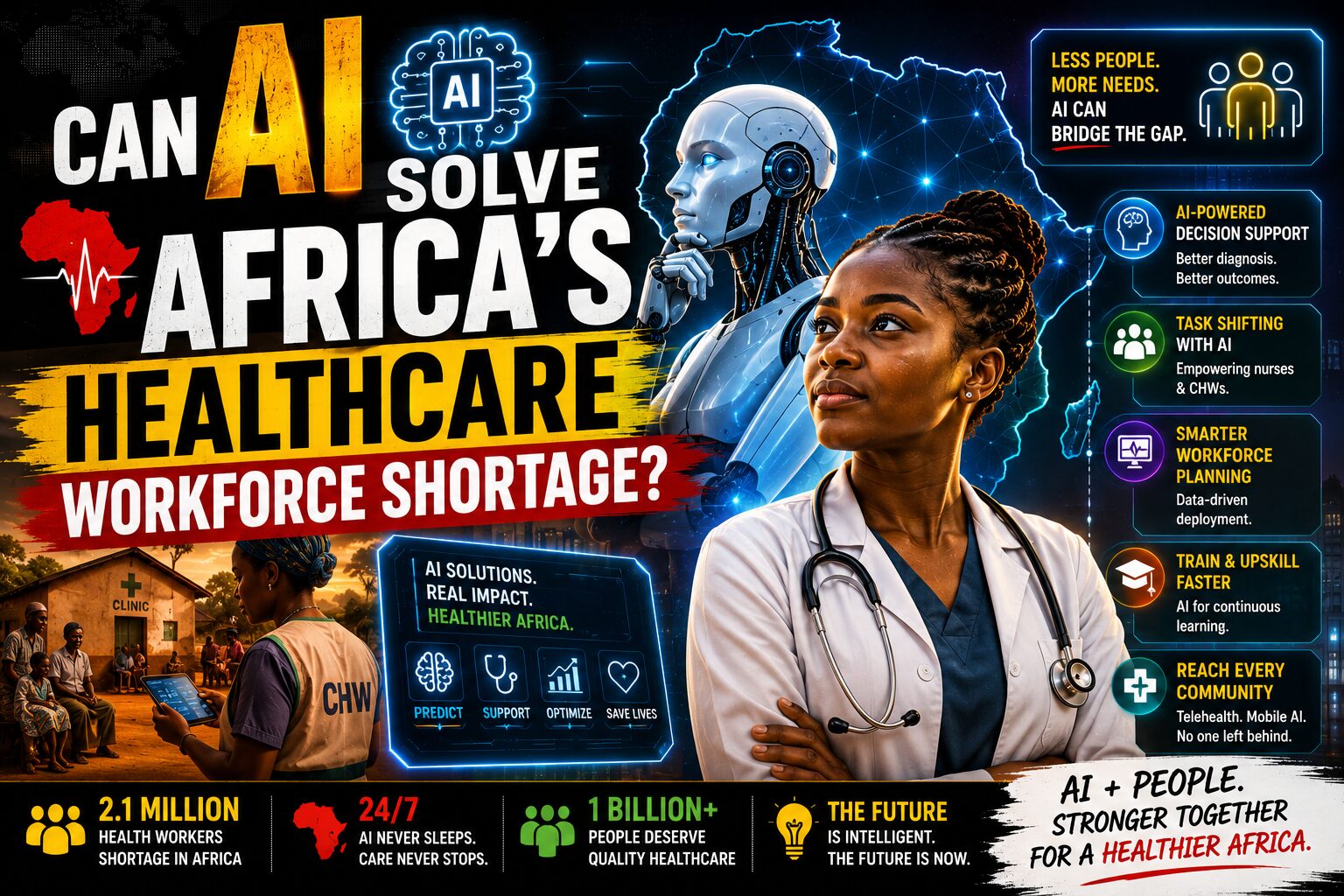
Africa faces a serious healthcare workforce shortage. Many communities have too few doctors, nurses, midwives, pharmacists, laboratory professionals, and specialists to meet the needs of their populations. Can AI Solve Africa’s Healthcare Workforce Shortage?
The problem is most visible in rural and underserved areas, where one healthcare worker may serve thousands of people. Patients often travel long distances for care, wait several hours at health facilities, or receive treatment in settings with limited equipment and specialist support.
Artificial intelligence is increasingly presented as a possible solution. AI can support diagnosis, automate documentation, assist health workers, expand telemedicine, and improve how hospitals use limited resources.
But can AI truly solve Africa’s healthcare workforce shortage?
The honest answer is no—not by itself.
AI cannot replace the healthcare professionals Africa urgently needs. However, it can help existing workers become more efficient, extend specialist knowledge to underserved areas, and reduce the pressure created by limited staffing.
Why Africa Has a Healthcare Workforce Shortage
The shortage is not caused by one problem.
Many African countries train fewer healthcare professionals than their populations require. Those who are trained may migrate to countries offering better pay, working conditions, specialist opportunities, and career development.
Within individual countries, healthcare workers are often concentrated in major cities. Rural facilities may struggle to attract and retain staff because of poor accommodation, limited equipment, heavy workloads, weak transport systems, and fewer professional opportunities.
The shortage also extends beyond doctors.
A functioning health system needs:
- Nurses and midwives.
- Pharmacists.
- Laboratory scientists.
- Radiographers.
- Physiotherapists.
- Public health professionals.
- Community health workers.
- Health-information specialists.
- Hospital administrators.
AI cannot repair all the financial, political, educational, and infrastructural causes of these shortages. It can only support the workforce available.
Helping Health Workers Manage Larger Workloads
Healthcare professionals spend significant time on activities that are necessary but repetitive.
These include:
- Writing clinical notes.
- Preparing discharge summaries.
- Completing referral letters.
- Reviewing routine laboratory results.
- Scheduling appointments.
- Producing administrative reports.
- Responding to common patient questions.
AI tools could assist with some of these tasks.
For example, an AI-supported documentation system could convert structured clinical notes into a draft discharge summary. A doctor would still review and approve the document, but less time would be spent typing.
This may allow healthcare workers to spend more time examining patients, explaining treatment, and making clinical decisions.
AI does not create more doctors. It can help available doctors use their time more effectively.
Extending Specialist Support
Many district and rural hospitals have limited access to specialists.
A general practitioner or physician assistant may need to manage patients with complicated medical, surgical, paediatric, or obstetric conditions before referral.
AI-powered clinical decision-support systems could help health workers:
- Recognise danger signs.
- Develop appropriate differential diagnoses.
- Review clinical guidelines.
- Select initial investigations.
- Identify patients who require urgent referral.
Telemedicine can further connect local healthcare workers with specialists in larger hospitals. AI may help organise the patient’s history, vital signs, test results, and referral question before the specialist consultation.
This could make specialist support available to more patients without requiring every specialist to be physically present in every facility.
However, these tools must be adapted to local guidelines, available medicines, disease patterns, and referral systems.
Strengthening Community Health Workers
Community health workers are essential to healthcare delivery in many African countries.
They support immunisation, maternal health, disease screening, health education, follow-up, and referral services. In communities with few doctors, they may be the most accessible connection to the formal health system.
AI-supported mobile applications could help community health workers:
- Ask structured screening questions.
- Identify warning signs.
- Track pregnant women and children.
- Send medication reminders.
- Follow up with patients with hypertension or diabetes.
- Provide health information in local languages.
- Prioritise patients for referral.
AI could therefore expand the range of tasks community health workers can perform safely, provided they receive proper training and supervision.
The aim should not be to turn community workers into replacements for doctors. It should be to help them recognise risk earlier and connect patients to appropriate care.
Supporting Training and Continuous Education
Africa must train and retain more healthcare professionals. AI can support this process.
Medical students and health workers can use AI to:
- Review clinical cases.
- Practise examination questions.
- Explain difficult concepts.
- Simulate patient interviews.
- Prepare for clinical assessments.
- Summarise treatment guidelines.
- Maintain professional knowledge.
A nurse in a rural facility, for example, may use an approved educational tool to revise the recognition and initial management of obstetric emergencies.
This does not replace formal education or supervision. It makes learning more accessible, especially where specialist educators are limited.
Healthcare institutions should teach professionals how to use AI responsibly, verify its outputs, and recognise its limitations.
Improving Workforce Planning
AI could also help governments and health institutions understand where workers are most needed.
By analysing information such as patient attendance, disease burden, referral patterns, staff numbers, and facility workload, AI may help predict:
- Which facilities are understaffed?
- Where patient demand is increasing.
- Which specialist services are most needed?
- When staffing shortages are likely to become critical.
- How shifts can be allocated more efficiently.
This could support better workforce distribution.
However, AI recommendations will only be reliable if the underlying data are accurate and complete.
Poor data will produce poor decisions.
The Risk of Treating AI as a Cheap Replacement
The greatest danger is that governments or institutions may use AI as an excuse not to employ more healthcare professionals.
A chatbot cannot examine a patient’s abdomen, perform emergency surgery, deliver a baby, administer medication, comfort a grieving family, or take responsibility for a clinical decision.
African patients deserve care from trained professionals, not technology introduced mainly to reduce labour costs.
AI should not be used to justify unsafe staffing levels.
It should reduce unnecessary workload while governments continue investing in:
- Healthcare education.
- Fair salaries.
- Safe working environments.
- Rural incentives.
- Specialist training.
- Modern facilities.
- Professional development.
- Retention programmes.
Challenges That Must Be Addressed
AI in healthcare also introduces risks.
Systems may give incorrect advice, misunderstand local disease patterns, expose confidential patient information, or perform poorly in African populations.
Many facilities also face unreliable electricity, weak internet access, limited devices, and poor digital infrastructure.
Before AI is widely adopted, countries must address:
- Patient privacy.
- Data protection.
- Clinical accountability.
- Algorithmic bias.
- Cybersecurity.
- Local validation.
- Staff training.
- Cost and sustainability.
An impressive demonstration does not guarantee that a tool will work safely in a busy rural clinic.
Related Articles
- How African Doctors Can Use AI in Daily Practice
- AI in African Healthcare: Opportunities and Challenges
- The Future of AI in Ghanaian Healthcare
- Top African HealthTech Startups Using AI
- AI for Community Health Workers in Africa
- AI for Rural Healthcare in Africa
About the Author
Dr Stephanie Owusu Ankomah is a Medical Doctor, Medical Writer at aidoctorafrica, and a Healthcare Management MSc Student. She holds an MD from Stavropol State Medical University, Russia (2024), and is currently pursuing an MSc in International Healthcare Management in Germany, with hands-on experience supporting hospital operations, patient care coordination, clinical documentation, and multidisciplinary healthcare teams across outpatient clinics, wards, emergency care, surgery, and paediatrics.
AI Doctor Africa | aidoctorafrica.com
Medical Disclaimer: For educational purposes only. AI tools do not replace clinical supervision, verified study resources, or your medical school’s academic guidance. Always verify clinical facts against authoritative primary sources.