
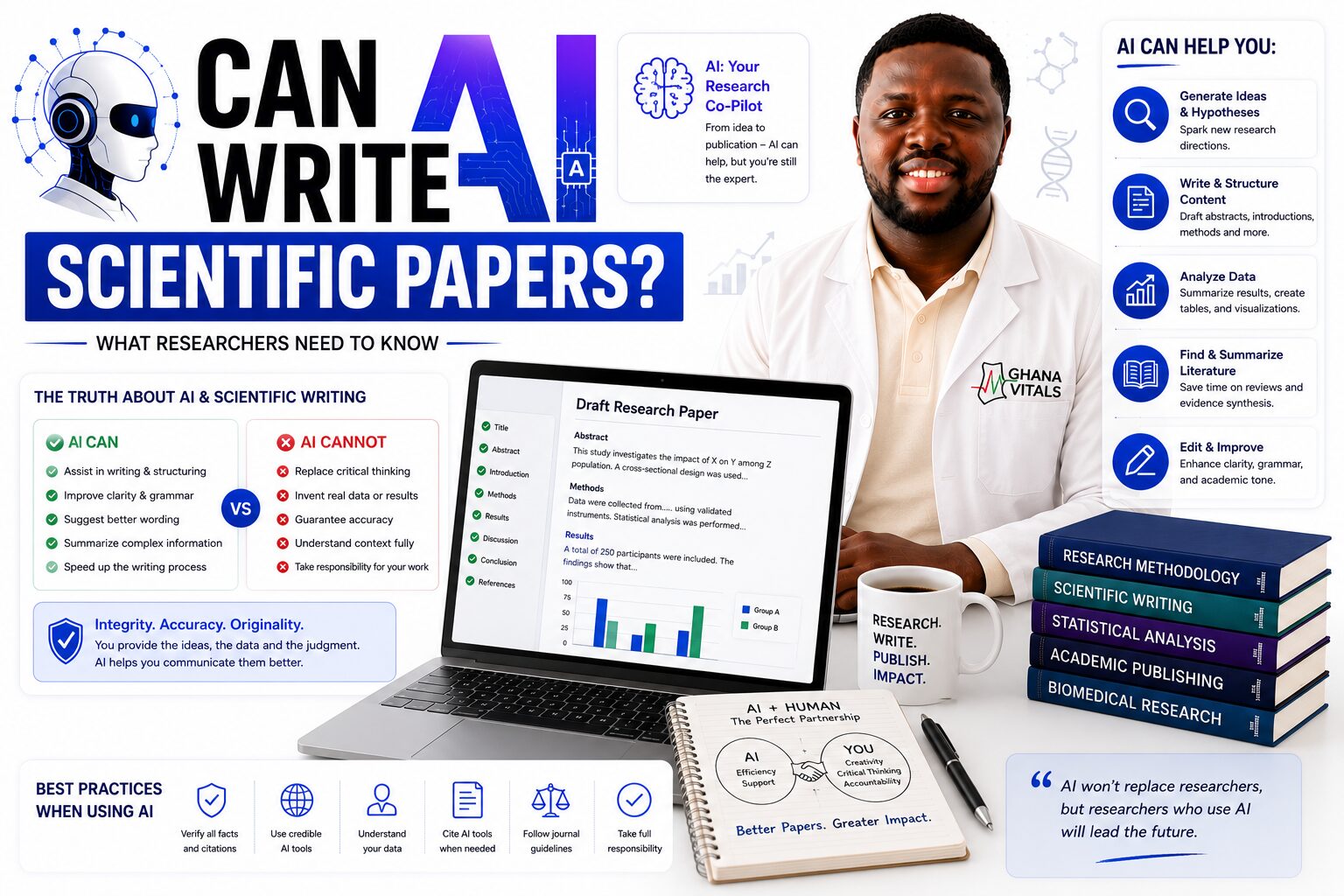
Can AI Write Scientific Papers? What Researchers Need to Know in 2026
By Dr Festus Kaasung Kunde, MD
Medical Doctor | AI in Healthcare Advocate | Founder, AI Doctor Africa & Ghana Vitals
Category: AI for Research
Can ChatGPT, Claude, Gemini, and Other AI Tools Help Researchers Write Publishable Scientific Papers?
The Question Every Researcher Is Asking
Only a few years ago, the idea of asking a computer to help write a scientific paper sounded unrealistic.
Today, it has become one of the most debated topics in academia.
Researchers across the world are asking questions such as:
- Can ChatGPT write my paper?
- Is Claude better for scientific writing?
- Will journals reject AI-assisted manuscripts?
- Is using AI considered plagiarism?
- Can AI perform literature reviews?
- Can AI write discussion sections?
These questions are no longer hypothetical. Artificial intelligence has rapidly become part of the modern research workflow. Medical students use it to summarise papers. Clinicians use it to organise literature.
Researchers use it to brainstorm ideas, improve writing, and edit manuscripts. But somewhere along the way, a dangerous misconception has developed. Some people now believe AI can replace researchers. It cannot. As someone interested in healthcare innovation and currently developing projects such as Ghana Vitals, I have found AI incredibly useful for organising ideas, improving clarity, and exploring different research approaches.
However, every important scientific decision still depends on human expertise.
- AI is an assistant.
- Not an author.
- Not a scientist.
- Not a replacement for critical thinking.
This article explains exactly what AI can—and cannot—do when writing scientific papers.
The Short Answer
Can AI write a scientific paper?
Yes.
Can AI write a publishable, trustworthy, ethical scientific paper without human oversight?
No.
That distinction is extremely important.
Artificial intelligence is capable of generating:
- Introductions
- Literature summaries
- Methodology drafts
- Discussion ideas
- Tables
- Academic language
- Grammar corrections
However, AI cannot independently guarantee:
- Scientific accuracy
- Originality
- Ethical compliance
- Valid references
- Appropriate interpretation
- Research integrity
Those responsibilities remain with the researcher.
Why Researchers Are Turning to AI
Research has always been demanding.
Writing a scientific paper often involves:
- Reading hundreds of articles
- Organizing references
- Summarizing evidence
- Writing multiple drafts
- Revising language
- Responding to reviewers
This process can take months.
Artificial intelligence helps reduce some of the administrative burden.
Instead of spending three hours rewriting a paragraph, researchers can spend that time thinking about the science.
That is where AI provides the greatest value.
What AI Can Do Well
AI excels at tasks involving language, organisation, and communication.
Examples include:
Brainstorming Research Ideas
Prompt:
Suggest five research questions on hypertension screening in rural Ghana.
The AI can generate multiple possibilities within seconds.
Improving Academic Writing
Researchers often know exactly what they want to say but struggle to express it clearly.
Prompt:
Rewrite this paragraph in clear academic English while preserving its scientific meaning.
This is particularly helpful for researchers writing in English as a second language.
Summarizing Articles
Instead of repeatedly reading a 30-page paper, AI can help summarise key sections.
Researchers should always compare summaries against the original article.
Creating Tables
Prompt:
Convert these findings into a comparison table.
Structured information is easier to interpret.
Explaining Statistics
Many early-career researchers struggle with statistical terminology.
Prompt:
Explain logistic regression using simple language suitable for a medical researcher.
Educational explanations are one of AI’s strongest applications.
What AI Cannot Do Reliably
Although impressive, AI still has important limitations.
Understanding these limitations protects researchers from making serious mistakes.
AI Can Invent References
One of the most dangerous problems is fabricated citations.
AI sometimes produces references that look genuine but do not actually exist.
For example, it may generate:
- Real author names
- Real journal names
- Real publication years
But combine them into entirely fictional articles.
Researchers must verify every citation.
AI Can Misinterpret Research
Scientific papers often contain nuance.
Results may depend on:
- Population
- Sample size
- Study design
- Confounding variables
AI may oversimplify these findings.
That is why researchers must always interpret evidence themselves.
AI Does Not Understand Context
AI predicts language.
It does not conduct scientific reasoning in the way experienced researchers do.
AI cannot determine whether your hypothesis is biologically plausible.
It cannot judge whether a methodology is practical within your local setting.
Those decisions require human expertise.
AI Across Different Sections of a Scientific Paper
Not every section benefits equally from AI.
Title
AI is excellent at generating multiple title options.
Prompt:
Generate ten journal-style titles for this manuscript.
Abstract
AI can draft concise summaries.
Researchers should verify every statement.
Introduction
One of AI’s strongest applications.
It can help organise:
- Background
- Knowledge gap
- Study rationale
However, citations must always be verified.
Literature Review
AI can summarise themes.
It cannot replace a systematic literature search.
Methodology
AI can explain study designs.
It should not invent methods that were never used.
Results
AI should never generate or manipulate results.
Results must reflect actual data.
Discussion
AI can help organise interpretation.
Conclusions belong to the researcher.
My Experience Using AI for Research
When I began developing the Ghana Vitals concept, I wasn’t looking for AI to think for me.
I was looking for AI to challenge me.
Often, I would explain an idea and ask:
“What important questions have I not considered?”
The responses frequently highlighted issues such as:
- Scalability
- Data governance
- Sustainability
- Stakeholder engagement
- Potential limitations
These weren’t final answers.
They were starting points for deeper thinking.
That, in my opinion, is one of AI’s greatest strengths in research.
It encourages better questions.
And better questions often lead to better research.
ChatGPT vs Claude for Scientific Writing
Researchers frequently ask which platform is better.
The answer depends on the task.
ChatGPT
Excellent for:
- Brainstorming
- Editing
- Outlining
- Tables
- Quick summaries
Claude
Excellent for:
- Long-form writing
- Complex explanations
- Reviewing complete manuscripts
- Logical flow
- Academic tone
My Recommendation
Use Claude to strengthen the manuscript.
Use ChatGPT to test and refine ideas.
Neither should replace your own scientific judgment.
Can ChatGPT or Claude Be Listed as an Author?
One of the biggest debates in scientific publishing today is whether artificial intelligence deserves authorship.
The answer from most major publishers—including leading journals and editorial organisations—is clear.
No.
Artificial intelligence cannot be listed as an author because it cannot:
- Accept responsibility for the paper.
- Verify the accuracy of the findings.
- Declare conflicts of interest.
- Respond to reviewers.
- Take legal or ethical accountability.
Authorship requires responsibility.
AI has none.
If you use AI to improve writing or organise ideas, you remain fully responsible for every sentence submitted.
Think of AI as an advanced writing assistant rather than a co-author.
What Do Scientific Journals Say About AI?
Academic publishing is changing rapidly.
Many journals now recognise that researchers are using AI.
However, they expect transparency.
Although policies vary between publishers, several common principles have emerged.
Researchers are generally expected to:
- Verify all AI-generated content.
- Ensure references are accurate.
- Take full responsibility for the manuscript.
- Follow the journal’s disclosure requirements if AI-assisted writing was used.
Always check the submission guidelines of your target journal before using AI extensively.
Is Using AI Considered Plagiarism?
This is one of the most misunderstood questions.
Using AI itself is not automatically plagiarism.
Plagiarism occurs when someone presents another person’s work or ideas as their own without proper acknowledgement.
However, AI creates other risks.
For example:
- Copying AI-generated text without reviewing it.
- Allowing AI to fabricate citations.
- Using copyrighted material improperly.
- Submitting AI-generated work that violates university or journal policies.
The safest approach is simple:
Use AI to improve your writing—not to replace your own thinking.
The Biggest Danger: AI Hallucinations
Artificial intelligence can occasionally produce information that sounds convincing but is completely wrong.
Researchers call these errors hallucinations.
Examples include:
- Fake references
- Incorrect statistics
- Misquoted findings
- Invented clinical trials
- Incorrect journal names
This is why every researcher should adopt one simple rule:
Never cite a paper you have not personally verified.
If AI suggests a reference:
- Locate the original paper.
- Read the abstract.
- Confirm the authors.
- Confirm the journal.
- Confirm the publication year.
- Confirm the conclusions.
Scientific integrity depends on verification.
A Complete AI Workflow for Writing Scientific Papers
After experimenting with several AI tools, I have developed a workflow that keeps the researcher—not the AI—in control.
Step 1: Start With the Research Question
Before opening any AI tool, clearly define:
- What problem are you studying?
- Why does it matter?
- Who benefits?
AI cannot replace this stage.
Good science begins with good questions.
Step 2: Review the Literature
Use trusted databases such as:
- PubMed
- Scopus
- Web of Science
- Google Scholar
After collecting papers, AI can help summarise themes and identify knowledge gaps.
Step 3: Build the Outline
Prompt:
Create a journal-style outline for a manuscript on hypertension screening in Ghana.
The outline becomes your roadmap.
Step 4: Draft Each Section
Instead of asking AI to write the entire paper, work section by section.
For example:
- Introduction
- Methods
- Discussion
Review each draft critically.
Step 5: Improve Readability
Prompt:
Rewrite this paragraph for clarity while maintaining scientific accuracy.
This is one of AI’s strongest applications.
Step 6: Review the Logic
Prompt:
Review this manuscript as if you were a peer reviewer. Identify weaknesses in the argument and suggest improvements.
This often reveals gaps before journal submission.
Step 7: Final Human Review
Before submission:
- Verify references.
- Check statistics.
- Confirm ethical approvals.
- Review figures.
- Read the manuscript aloud.
Nothing replaces careful human review.
ChatGPT vs Claude for Scientific Papers
Researchers often ask which AI performs better.
The answer depends on the task.
| Task | ChatGPT | Claude |
|---|---|---|
| Brainstorming | Excellent | Excellent |
| Proposal Outlines | Excellent | Excellent |
| Long-Form Writing | Very Good | Excellent |
| Literature Summaries | Very Good | Excellent |
| Academic Editing | Excellent | Excellent |
| Logical Flow | Very Good | Excellent |
| Tables | Excellent | Very Good |
| Reviewer Simulation | Good | Excellent |
My personal workflow is straightforward.
I use Claude when I want to explore an idea deeply.
I use ChatGPT when I need speed, structured outputs, or multiple alternatives.
Researchers do not have to choose one platform exclusively.
The best results often come from combining both.
25 AI Prompts Every Researcher Should Save
Brainstorming
- Suggest five novel research ideas on ______.
- Identify research gaps in ______.
- Generate potential hypotheses.
Literature Review
- Summarise this article.
- Compare these studies.
- Identify conflicting evidence.
- Explain the current evidence.
Proposal Development
- Improve my research question.
- Rewrite my objectives.
- Improve my problem statement.
- Build a conceptual framework.
Scientific Writing
- Improve academic tone.
- Improve readability.
- Remove unnecessary repetition.
- Rewrite in journal style.
Methodology
- Compare study designs.
- Explain sample size considerations.
- Suggest data analysis methods.
- Review methodological limitations.
Peer Review
- Act as a journal reviewer.
- Identify weaknesses.
- Suggest stronger arguments.
- Evaluate novelty.
Final Checks
- Review grammar.
- Generate a submission checklist.
Common Mistakes Researchers Make
One of the biggest mistakes is believing AI automatically improves scientific quality.
It doesn’t.
Good research still requires:
- Critical thinking
- Scientific curiosity
- Ethical judgment
- Careful interpretation
Other common mistakes include:
Trusting AI Without Verification
Every statistic and citation must be checked.
Asking AI Questions That Are Too Broad
Instead of:
Write a paper on diabetes.
Try:
Draft an introduction for a cross-sectional study investigating diabetes prevalence among adults attending primary healthcare clinics in Ghana.
Specific prompts produce better results.
Ignoring Local Context
AI often draws from global information.
Researchers working in Africa should ensure that local evidence, guidelines, and realities remain central to their work.
Using AI as a Shortcut
AI can save time.
It should never replace learning.
The strongest researchers use AI to think more effectively—not less.
The Future of AI in Scientific Publishing
Artificial intelligence is already reshaping research.
Over the next decade, researchers may increasingly use AI for:
- Literature screening
- Statistical support
- Writing assistance
- Reviewer simulations
- Journal selection
- Language editing
- Data visualization
At the same time, journals are likely to strengthen standards around transparency and responsible AI use.
Researchers who understand both the opportunities and the limitations of AI will be better prepared for this future.
My Perspective as a Medical Doctor and Researcher
One lesson I have learned while developing projects such as Ghana Vitals is that technology is most valuable when it helps people think more clearly.
Artificial intelligence has helped me:
- Organise ideas.
- Improve proposal structure.
- Explore alternative approaches.
- Strengthen academic writing.
But it has never replaced the most important part of research.
Curiosity.
Every meaningful research project begins because someone asks a question that has not yet been answered.
AI cannot replace that curiosity.
Nor should it.
Key Takeaways
- AI can assist with scientific writing but cannot replace researchers.
- Human oversight is essential.
- Never trust AI-generated references without verification.
- AI should improve clarity—not scientific integrity.
- ChatGPT and Claude each have unique strengths.
- Researchers remain responsible for every word they publish.
- Ethical AI use is becoming an essential research skill.
- Curiosity and critical thinking remain at the heart of good science.
Frequently Asked Questions
Can AI write an entire scientific paper?
AI can generate drafts and improve writing, but the researcher must ensure scientific accuracy, originality, ethical compliance, and final approval.
Can journals detect AI-generated writing?
Some publishers use AI-detection tools, but many focus less on detection and more on whether authors have followed journal policies and maintained research integrity.
Is it acceptable to use AI for editing?
Yes. Many researchers use AI to improve clarity and grammar, provided they remain responsible for the content and comply with institutional or journal requirements.
Can AI perform a literature review?
AI can summarise and organise published research, but it should not replace a systematic search of trusted databases or critical appraisal by the researcher.
Should I disclose AI use?
Follow the policies of your university, institution, funding body, or journal. Requirements vary, and transparency is increasingly encouraged.
What is the biggest risk of using AI?
The greatest risks include fabricated references, factual inaccuracies, overreliance on AI-generated text, and failure to critically review the output.
Which AI is best for scientific writing?
Both ChatGPT and Claude are valuable. Claude often excels in long-form academic writing, while ChatGPT is particularly strong for brainstorming, editing, and structured outputs.
Related Articles
- AI for Medical Research in 2026
- AI for Research Proposal Writing
- AI for Grant Applications and Funding Proposals
- Top 5 AI Tools for Medical Researchers in 2026
- AI for Literature Reviews: The Complete Guide
Related Articles
- AI for Medical Research in 2026
- AI for Grant Applications and Funding Proposals
- Top AI Tools for Medical Researchers
- AI for Literature Reviews
About the Author
Dr Festus Kaasung Kunde is a Medical Doctor, AI in Healthcare Advocate, and Founder of AI Doctor Africa and Ghana Vitals. He holds an MD from Stavropol State Medical University, Russia (2025), and completed an internship at Korle-Bu Teaching Hospital in Accra. His mission is to help African healthcare professionals adopt AI responsibly to improve learning, research, and patient outcomes.
AI Doctor Africa | aidoctorafrica.com
Medical Disclaimer: For educational purposes only. AI tools do not replace clinical supervision, verified study resources, or your medical school’s academic guidance. Always verify clinical facts against authoritative primary sources.

Dr. Festus K. Kunde
Dr. Festus Kaasung Kunde is a medical doctor, Content creator, healthcare technology writer, and digital health innovator specializing in Artificial Intelligence in Medicine, Healthcare Systems Innovation, and Health Data Science in Africa. He is the founder of AI Doctor Africa (AIDoctorAfrica.com), an educational platform dedicated to helping healthcare professionals—including doctors, medical students, nurses, and researchers—understand and responsibly apply artificial intelligence in clinical practice, medical education, medical research, and healthcare innovation. He is also the creator of Ghana Vitals, a health data and predictive analytics initiative focused on collecting and analyzing key health indicators such as blood pressure, blood glucose, and BMI to support early disease detection, preventive healthcare, and data-driven decision-making in Ghana and across Africa. The project reflects his long-term vision of building scalable, AI-powered public health systems for African populations. Dr. Kunde’s work focuses on the practical integration of AI tools such as ChatGPT, Claude, and emerging clinical AI systems into real-world healthcare workflows. His content emphasizes improving clinical documentation, accelerating medical education, strengthening research productivity, and supporting healthcare decision-making in resource-limited settings. Through AI Doctor Africa, he publishes evidence-informed, practice-oriented resources including AI workflows, clinical use cases, medical education guides, and tutorials designed specifically for African healthcare professionals. Through Ghana Vitals, he extends this mission into population health innovation, aiming to leverage real-world health data and predictive models to improve early intervention, reduce preventable disease burden, and strengthen health systems across Africa. His overall mission is to bridge the gap between traditional clinical medicine, artificial intelligence, and data-driven public health, empowering African healthcare professionals to work smarter, diagnose earlier, and deliver better care through technology. Areas of Expertise Artificial Intelligence in Clinical Medicine Digital Health & Healthcare Innovation in Africa Health Data Analytics & Predictive Health Systems Medical Education and Exam Preparation AI for Medical Research and Scientific Writing Clinical Workflow Optimization using AI Tools Public Health Data Systems (Ghana Vitals Initiative) Professional Focus Dr. Kunde’s work sits at the intersection of clinical medicine, artificial intelligence, and population health systems, with a strong focus on scalable solutions for African healthcare challenges. His initiatives emphasize ethical AI use, data-driven decision-making, and practical implementation in real-world clinical and public health environments.
View author profile →