
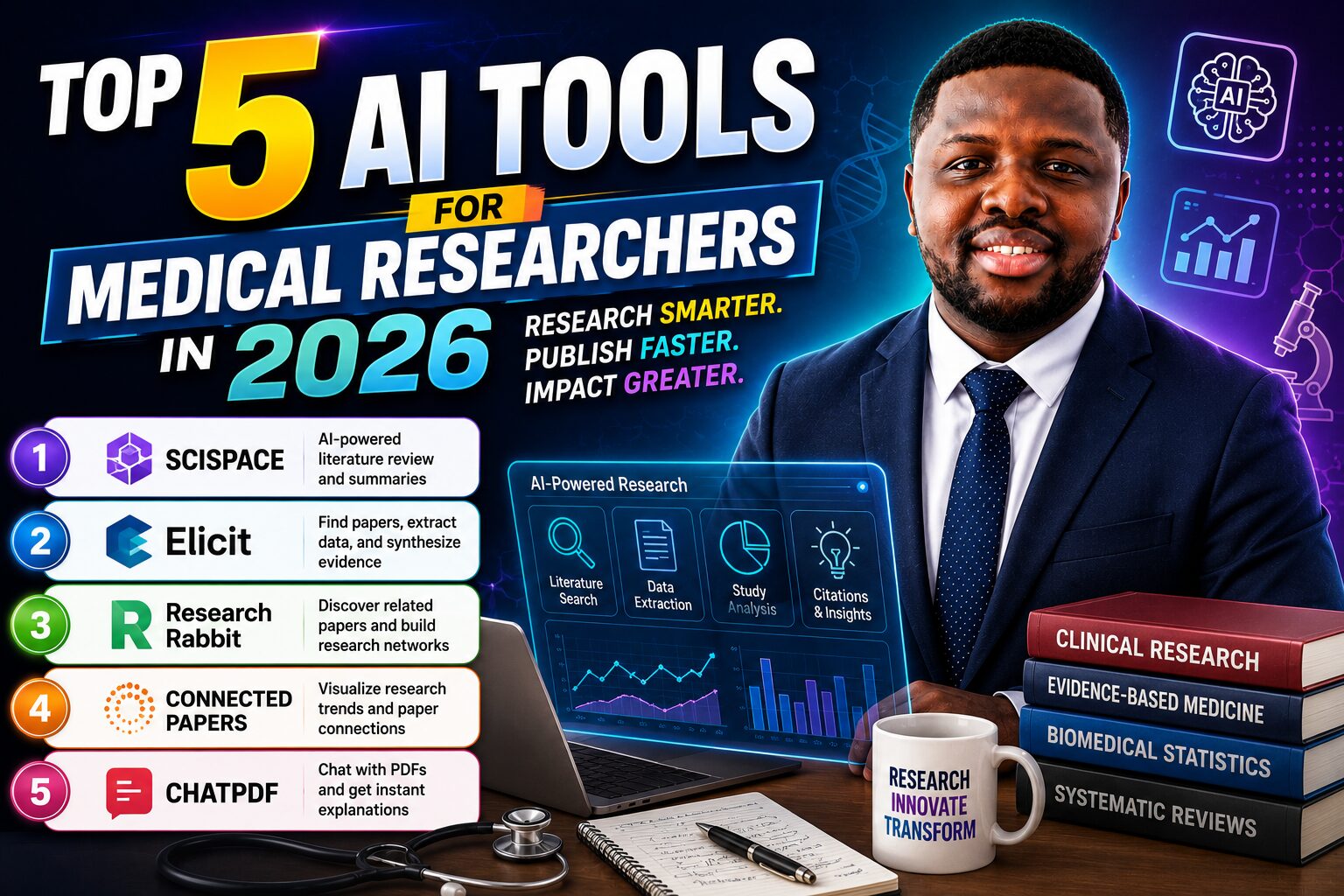
Top 5 AI Tools for Medical Researchers in 2026: The Complete Researcher’s Guide
By Dr Festus Kaasung Kunde, MD | Stavropol State Medical University
Medical Doctor | AI in Healthcare Advocate | Founder, AI Doctor Africa & Ghana Vitals
Published: June 2026 | Reading Time: 18–22 minutes | Category: AI for Research
Quick Summary
PubMed alone lists more than 39 million citations. AI has not made the volume problem smaller — it has given researchers tools to navigate it. This article reviews the five best AI tools specifically for medical researchers in 2026: Elicit, Consensus, Semantic Scholar, Scite, and ResearchRabbit. Each tool is reviewed in full — what it does, where it fits in the research workflow, what it costs, and how to use it in the African research context. A complete 8-phase workflow table and a proven prompt library are included.
The Research Volume Problem Has a New Solution
Let me be honest about what medical research actually feels like most of the time. It is not the exciting moment of discovery that journal articles describe in their discussion sections. It is mostly searching — searching for papers, reading abstracts to decide if they are relevant, downloading PDFs, trying to organise them, extracting data, checking whether the findings still hold up, and eventually trying to write something coherent from a pile of evidence that often points in different directions.
Furthermore, the volume is genuinely overwhelming. PubMed alone now lists more than 39 million citations. Semantic Scholar indexes over 200 million papers across all scientific fields. Every week, new studies are published on every clinical topic. Staying current is not a discipline problem — it is a structural impossibility without tools.
Current Situation
AI has not solved this problem. However, it has made it significantly more manageable. Tools built specifically for academic research — not general chatbots dressed up as research assistants, but purpose-built platforms designed around the specific needs of researchers — now cover every phase of the research workflow. As a result, systematic reviews that previously took 67 weeks can now be completed in as little as ten days. Literature searches that previously required specialist database training now take minutes.
I know this from personal experience. During my final year at Stavropol State Medical University, my research partner, Dr Ama Dufie Opare and I wrote our thesis on malaria, a tropical disease that was dramatically underrepresented in the Russian-language literature available to us. The research tools I describe in this article did not exist in the same form then. Consequently, we navigated that research largely manually, relying on ChatGPT and Grammarly to bridge the gaps.
Knowing What I Know Now
If I were writing that thesis today, the process would look completely different. Moreover, the quality of the evidence base would be significantly stronger — not because I would be smarter or more dedicated, but because the tools available now make a thorough, rigorous literature review accessible in a way it simply was not before.
This article covers the five tools that I now consider essential for any medical researcher — whether you are writing a final-year thesis, conducting a systematic review for publication, building the evidence base for a grant application, or developing the research foundation for a health technology venture like Ghana Vitals.
Important distinction: The five tools in this article are research discovery and verification tools — not general AI chatbots. They find and analyse real, verifiable academic papers. They do not generate summaries from training data. Consequently, their hallucination risk is significantly lower than that of general AI tools like Claude or ChatGPT for research-specific tasks.
The Top 5 AI Research Tools at a Glance
Before reviewing each tool in detail, here is the complete overview. All five tools are accessible in Ghana and across Africa, most of them for free:
| # | Tool | Best For | Free Tier | Paid Plan | African Access |
| 1 | Elicit | Systematic reviews, data extraction, screening | Yes (limited) | $12/mo (Plus) | ✓ Yes |
| 2 | Consensus | Quick evidence-based Q&A, hypothesis testing | Yes (limited) | $11.99/mo | ✓ Yes |
| 3 | Semantic Scholar | Free paper discovery, citation mapping | Free — fully | $0 | ✓ Yes |
| 4 | Scite | Citation context verification, reliability checking | Limited | $20/mo | ✓ Yes |
| 5 | ResearchRabbit | Visual citation networks, related paper discovery | Free — fully | $0 | ✓ Yes |
Each tool in this list serves a specific role in the research workflow. Therefore, the most effective research strategy is not to choose one tool and use it for everything — it is to understand what each tool does best and use them in sequence. The complete 8-phase workflow at the end of this article shows exactly how to do this.
Tool #1: Elicit — The Systematic Review Specialist
What Elicit Actually Does
Elicit is an AI research assistant developed specifically for academic literature workflows. It allows researchers to describe what they are looking for in plain language — for example, ‘What community-based interventions improve hypertension control in sub-Saharan Africa?’ — and returns relevant papers with key data points automatically extracted into a structured table.
This is Elicit’s defining feature: structured data extraction. Instead of reading each paper manually to find the sample size, the methodology, the primary outcome, and the key limitation, Elicit reads them for you and presents the extracted information in a spreadsheet-like view that makes cross-paper comparison immediate. Furthermore, the extraction columns are customisable — you specify exactly what data points you need, and Elicit extracts them from every paper in your results set simultaneously.
In February 2026, Elicit was credited with reducing systematic review times from weeks to days, earning a 9.2 out of 10 rating for workflow capability. Additionally, Elicit’s Pro plan supports screening up to 5,000 papers — the scale required for serious systematic review work.
Where Elicit Fits in the Research Workflow
Elicit is strongest in the middle phases of a research project — after you have identified your research question and the general landscape of the literature, and before you begin writing. Specifically, it excels at:
- Semantic search — finding papers relevant to your question even when they do not use your exact search terms
- Systematic screening — applying inclusion and exclusion criteria across large paper sets to identify those worth reading in full
- Data extraction — pulling comparable fields from multiple papers into one table for evidence synthesis
- Research gap identification — surfacing themes and contradictions across multiple studies
How to Use Elicit as an African Researcher
For African researchers working on NCD burden, infectious diseases, or health systems topics, Elicit’s semantic search is particularly valuable because it finds papers based on conceptual relevance rather than keyword matching. This matters because African health research often uses different terminology than the dominant Western literature — ‘community health officer’ versus ‘community health worker’, or ‘district hospital’ versus ‘primary care facility’. Elicit’s semantic search closes this terminological gap.
“Search for papers on predictors of hypertension treatment non-adherence in Ghana and West Africa. Extract from each paper: country, study design, sample size, the primary predictors identified, and any interventions tested. Present results as a comparison table ranked by publication year.”
Cost: Free tier with limited daily searches and extractions. The Plus plan at $12 per month provides full extraction capability and systematic review workflow tools, including integration with PRISMA flow diagram generation.
Tool #2: Consensus — Evidence-Based Answers, Instantly
What Consensus Actually Does
Consensus is an AI search engine that answers research questions using peer-reviewed evidence. However, it works differently from Elicit. Rather than asking you to search and then presenting a list of papers, Consensus answers your question directly — synthesising what the literature says and presenting an evidence quality rating alongside the answer.
The tool’s signature feature is the Consensus Meter — a visual indicator that shows whether the evidence on a specific question is strongly supportive, mixed, or contradictory. This is enormously useful at the beginning of a research project, when you need to understand the current state of evidence quickly before committing to a specific research question or methodology.
Additionally, Consensus scored an 8.8 out of 10 in 2026 evaluations for speed in synthesising evidence, making it the fastest tool in this article for getting a high-level answer to a research question. Consequently, it is ideal for the early scoping phase of any research project.
The Critical Distinction: Consensus vs Elicit
New researchers sometimes confuse Consensus and Elicit because both are described as AI research tools. However, they serve different purposes in the workflow. Consensus gives you a synthesised answer to a research question — it tells you what the field currently believes. Elicit gives you the raw materials to conduct your own analysis — it extracts the underlying data from individual papers so you can draw your own conclusions.
Therefore, the correct workflow is to use Consensus first for orientation and Elicit later for rigorous analysis. Think of Consensus as the overview and Elicit as the deep dive.
“Is there strong evidence that community health workers can effectively manage hypertension in rural sub-Saharan Africa? What is the quality of this evidence? Summarise the key findings and flag any significant gaps or contradictions in the literature.”
Cost: Free tier with a limited number of daily searches. The premium plan at $11.99 per month provides unlimited searches, advanced filtering, and access to the full evidence synthesis features.
Tool #3: Semantic Scholar — The Foundation of Free Research
What Semantic Scholar Actually Does
Semantic Scholar is a free, AI-powered academic search engine developed by the Allen Institute for AI. It indexes over 200 million papers across all scientific fields and uses machine learning to understand the conceptual relationships between them — not just keyword matches.
This semantic understanding is what distinguishes it from PubMed or Google Scholar. When you search Semantic Scholar for ‘predictive risk scoring hypertension Ghana’, it returns papers that are conceptually related to that topic, even if they use different terminology. Furthermore, it provides citation metrics — highly cited papers, influential references, papers that cited each other — that help you identify the foundational work in any research area quickly.
Moreover, Semantic Scholar is completely free. There is no paid tier, no usage limit, and no registration required. Consequently, it is the single most accessible professional research tool available to African doctors and students — and it is genuinely powerful.
Semantic Scholar’s Unique Value: Citation Context
Beyond search, Semantic Scholar provides citation context that most researchers underuse. For any paper, you can see not just how many papers cited it, but which papers cited it, in what context, and whether those papers are themselves influential. This allows you to trace how ideas have developed across the literature — identifying the seminal papers that every subsequent study built on, and the more recent papers that have challenged or extended those foundations.
For African researchers building a literature review, this citation tracing function is particularly valuable for establishing the intellectual genealogy of your research area — the foundational papers, the key debates, and the current frontier. Importantly, this level of analysis was previously only available through expensive database subscriptions. Semantic Scholar provides it for free.
“Search Semantic Scholar for the most influential papers on non-communicable disease burden in Ghana published in the last five years. For each paper, note the citation count, the journal, and the key finding. Then identify which papers are most frequently cited by other highly-cited papers — these are likely the most foundational for my literature review.”
Cost: Completely free. No account required for basic searches. A free account unlocks personalised paper recommendations, reading lists, and alerts for new papers in your research area.
Tool #4: Scite — The Truth About What a Paper Actually Claims
The Problem Site Solves
Here is a scenario that every researcher has encountered. You find a paper with compelling findings. The abstract is well-written. The journal is reputable. The citation count is reasonable. You include it in your literature review and build part of your argument on its findings. Three months later — after your paper has been submitted — a reviewer points out that the paper’s key claim was contradicted by a large meta-analysis published two years after the original study.
This is not a failure of intelligence or diligence. It is a failure of access to information. Without Scite, there was no easy way to know that the paper you trusted had been substantially challenged by subsequent research. With Scite, you know in seconds.
How Scite Works
Scite analyses over 1.2 billion citation statements across 200 million sources and classifies each one as supporting, contrasting, or mentioning — depending on whether the citing paper agrees with, challenges, or merely references the original finding. This is called Smart Citations.
Furthermore, Scite provides a dashboard for any paper showing the ratio of supporting to contrasting citations. A paper with 45 supporting citations and 2 contrasting citations is on very solid evidential ground. A paper with 8 supporting citations and 12 contrasting citations should be treated with significant caution — regardless of how prestigious the original journal was.
For medical researchers, this is not a minor convenience. It is a fundamental quality control step. Clinical guidelines change because new evidence contradicts old findings. Drug safety profiles are revised when post-marketing studies reveal risks that pre-approval trials missed. Research built on papers that have since been challenged — without knowing the challenge exists — may be built on sand.
“Run this paper through Scite: [paper title or DOI]. Tell me: (1) how many papers support its main findings, (2) how many papers contradict them, (3) what the most significant contradicting paper found, and (4) whether I should still use this paper as a key reference in my systematic review on hypertension management.”
Cost: Limited free tier. Full access at $20 per month. Importantly, Scite accepts international payments, including PayPal and cards linked to mobile money platforms in Ghana. For serious researchers — particularly those conducting systematic reviews or writing for publication — the $20 monthly investment is justified by the quality assurance it provides.
Tool #5: ResearchRabbit — Finding the Papers You Didn’t Know You Were Missing
The Citation Network Problem
Traditional literature searches have a well-known limitation: they find papers that use the terms you searched for. They do not find papers that address the same question using different terminology, papers that are conceptually related but published in a different field, or papers that are foundational to your topic but predate the terminology you are using.
ResearchRabbit solves this by approaching literature discovery from a completely different angle. Instead of keyword search, it uses citation networks. You upload or identify a seed paper — one highly relevant paper you have already found — and ResearchRabbit maps every paper that cites it, every paper it cites, and every paper that is conceptually related to it. The result is a visual citation graph that shows you the entire intellectual landscape of your research area at a glance.
Why ResearchRabbit Finds Papers Others Miss
The reason ResearchRabbit is so effective at finding papers that keyword searches miss is structural. When a researcher in Australia publishes a paper on hypertension management in remote communities, they may not use the term ‘low-resource settings’ — the phrase that African researchers typically use to refer to the same concept. However, if that paper cites the same foundational papers that African hypertension research builds on, ResearchRabbit will surface it through the citation network. Consequently, your literature becomes more complete.
Additionally, ResearchRabbit is completely free. Furthermore, it has no paid tier — the full feature set is available at no cost to every researcher worldwide, including those in Ghana, Nigeria, and across Africa. This makes it one of the most democratically accessible research tools currently available.
Workflow tip: Find one highly-cited, highly relevant paper on your research topic using Semantic Scholar or PubMed. Upload it to ResearchRabbit as your seed paper. Within seconds, you will have a visual map of 30–50 related papers — organised by their relationship to your seed paper and colour-coded by publication year. This step consistently reveals papers that keyword searches miss.
Cost: Completely free. No paid tier exists as of 2026. No usage limits.
How the Five Tools Compare: Feature-by-Feature Breakdown
The following table compares all five tools across the dimensions that matter most for medical researchers. Use it to make quick tool selection decisions during your research workflow:
| Feature | Elicit | Consensus | Semantic Scholar | Scite | ResearchRabbit |
| Paper database | 125M+ papers | 300M+ papers | 200M+ papers | 200M+ sources | PubMed + Semantic Scholar |
| Search style | Natural language / semantic | Natural language/evidence Q&A | Keyword + semantic | Keyword + citation filter | Seed paper + citation graph |
| Data extraction | Yes — structured tables | Limited | No | No | No |
| Citation context | No | No | Basic (cites/is cited) | Full (support/contrast/mention) | Visual citation graph |
| Systematic review | Excellent — PRISMA workflow | Limited | Limited | Useful for quality check | Discovery only |
| Evidence synthesis | Good — with extraction | Excellent — yes/no meters | No | No | No |
| Hallucination risk | Low — paper-grounded | Low — paper-grounded | Very low — links to papers | Very low — citation-based | Very low — graph-based |
| Cost | Free / $12 Plus | Free / $11.99 Premium | Free | $20/mo | Free |
| Best workflow phase | Screening + extraction | Quick literature scan | Discovery + mapping | Quality + verification | Discovery + network |
The key insight from this comparison is that no single tool covers everything. Consequently, the most effective research practice combines tools across phases — using each one where its specific strengths apply. The complete workflow table in the next section shows exactly how to do this.
How I Use These Tools: Personal Workflows From Clinical Research
The Malaria Thesis and What I Wish I Had Known
When Dr Ama Dufie Opare and I wrote our malaria thesis at Stavropol State Medical University, we were working with a significant handicap. The Russian-language literature on tropical diseases was thin. The English-language literature was rich but scattered across databases we accessed inconsistently. We did not have systematic tools to map the citation landscape, efficiently extract data from papers, or verify whether the papers we were building our argument on had been challenged by subsequent research.
We worked with what we had — ChatGPT for synthesis and explanation, Grammarly for language quality, and Gamma AI for presentation design — and earned a grade of 5 (Excellent). However, I now recognise that our literature review was significantly less complete than it could have been, not because we were not thorough, but because we were thorough within the limitations of the tools available to us at the time.
If I were writing that thesis today, the approach would be fundamentally different. My recommendation is to start with Semantic Scholar to map the citation landscape of malaria epidemiology in sub-Saharan Africa. I would seed ResearchRabbit with the most influential paper I found to discover papers that keyword searches missed, and run my research question through Consensus to quickly understand what the literature generally says about the specific aspects of malaria management I was focusing on. I would use Elicit to extract structured data from the 15–20 most relevant papers. And I would run every paper I planned to cite through Scite to verify that its findings had not been substantially challenged since publication.
The thesis would have been stronger. The evidence base would have been more complete. And the process would have taken significantly less time — not because I would have been less rigorous, but because I would have been more efficient in my rigour.
Using These Tools for Ghana Vitals Research
The research foundation I am building for Ghana Vitals — the preventive health data platform designed to identify NCD risk before complications develop — relies on exactly these tools. The evidence base for predictive analytics in hypertension management in Ghana is sparse. The existing papers are scattered across African health journals, international epidemiology publications, and WHO technical reports. Building a comprehensive picture of what is known, what is contested, and where the genuine research gaps are requires systematic tools.
My current workflow starts with Semantic Scholar to identify the landscape. I then use ResearchRabbit to discover papers that the initial searches missed. Consensus gives me a quick sense of what the evidence currently shows on specific questions — for example, whether mobile health interventions have demonstrated effectiveness in managing hypertension in Africa. Elicit handles the structured extraction when I am building comparison tables for a literature review section. And Scite tells me which foundational papers I can cite with confidence and which I should treat cautiously.
This workflow has not made the research easy. Nothing makes original research easy. However, it has made the process significantly more efficient — and the output significantly more rigorous — than manual approaches alone would permit.
The Complete 8-Phase AI Research Workflow
The following table presents the complete AI-assisted research workflow for medical researchers. Each phase specifies which tool to use, how to use it, and what output it produces. Use this as a practical checklist for any research project, from scoping to manuscript submission:
| Research Phase | Primary Tool | Supporting Tool | What You Do |
| 1. Scoping — What research exists? | Semantic Scholar | ResearchRabbit | Search your topic; seed ResearchRabbit with the best paper found; map the citation network |
| 2. Discovery — Which papers are most relevant? | Semantic Scholar | Elicit | Use Semantic Scholar citation metrics to prioritise papers; Elicit for semantic relevance search |
| 3. Quick evidence scan — What does the field say? | Consensus | Perplexity AI | Run your research question through Consensus; verify with Perplexity for broader context |
| 4. Screening — Which papers meet your criteria? | Elicit | Rayyan | Upload up to 5,000 papers to Elicit; apply inclusion/exclusion filters; export to Rayyan for PRISMA |
| 5. Data extraction — What did each paper find? | Elicit | NotebookLM | Use Elicit’s extraction tables; upload shortlisted PDFs to NotebookLM for cross-paper analysis |
| 6. Citation quality check — Can I trust this paper? | Scite | Semantic Scholar | Run key papers through Scite; check support vs contradiction balance; verify seminal claims |
| 7. Synthesis — What does it all mean? | Claude / NotebookLM | ChatGPT | Upload verified papers to Claude or NotebookLM; synthesise with citations; draft review sections |
| 8. Writing — Manuscript preparation | Claude + Grammarly | Zotero | Claude outlines and drafts; Grammarly polishes; Zotero manages all references throughout |
Time estimate: A traditional systematic review workflow takes an average of 67 weeks. With AI tools across all eight phases, the same workflow can be completed in 10–14 days for a well-scoped research question with an accessible literature base. For African researchers balancing research with clinical responsibilities, this compression is not just convenient — it makes rigorous research genuinely compatible with a full clinical schedule.
Proven Prompts for Each Research Tool
The following table provides copy-paste-ready prompts for each of the five tools. Adapt them to your specific research question and context:
| Tool | Task | Proven Prompt |
| Elicit | Systematic review search | Search for randomised controlled trials on community health worker interventions for hypertension management in sub-Saharan Africa. Extract: study design, sample size, primary outcome, country, effect size. |
| Elicit | Multi-paper extraction | I have uploaded 12 papers on the prevalence of diabetes in Ghana. Extract from each: study year, study design, population, prevalence estimate, and key limitations. Present as a comparison table. |
| Consensus | Evidence Q&A | Does community-based hypertension screening improve blood pressure control in low-income settings? Provide a synthesised answer with a supporting evidence quality rating. |
| Consensus | Hypothesis testing | Is there strong evidence that mobile health interventions improve medication adherence among African patients with hypertension? Summarise the strength of evidence. |
| Semantic Scholar | Focused discovery | Search Semantic Scholar for: ‘predictive analytics non-communicable diseases Ghana sub-Saharan Africa’. Sort by citation count. Identify the three most influential papers and explain why they are foundational. |
| Scite | Citation verification | Run this paper through Scite: [DOI or title]. Tell me: how many papers support its main findings, how many contradict them, and whether the supporting-to-contrasting ratio suggests the findings are reliable. |
| ResearchRabbit | Network mapping | I have found this seed paper on hypertension epidemiology in Ghana: [paper title]. Use ResearchRabbit to identify: (1) the papers that most influenced this work, (2) the most cited papers that this paper influenced, and (3) the three most recent papers in the same research cluster. |
| Claude + papers | Synthesis after research | I have completed my literature review using Elicit, Semantic Scholar, and Scite. I have uploaded my 15 shortlisted papers. Synthesise the evidence on lost-to-follow-up among hypertensive patients in Ghana, organise it by theme, and identify the three most significant research gaps. Cite each paper throughout. |
A Note for African Researchers: Why These Tools Matter Especially for You
The Access Problem Is Real — And These Tools Address It
Most research methodology guides assume that you have access to institutional databases, a research supervisor with time to mentor you, and a well-funded university library. For many African researchers — including doctors working in district hospitals, medical students at universities with limited library budgets, and clinician-researchers without institutional research support — none of these assumptions apply.
The five tools in this article were not specifically designed for African researchers. However, they address almost every structural disadvantage that African researchers face. Three of them are completely free. All five are accessible from a standard laptop or smartphone with an internet connection. None of them requires institutional access credentials. Furthermore, they collectively provide research capabilities that were only available to researchers at well-funded universities five years ago.
As a result, an African doctor in a district hospital in Ghana now has access to the same literature discovery, evidence synthesis, and citation verification capabilities as a researcher at Oxford or Johns Hopkins. The remaining gap — the peer network, the mentorship relationships, the institutional support for grant applications and publication — is real and significant. However, the tools gap has largely closed.
Addressing the African Disease Literature Gap
There is a specific challenge that African researchers face with these tools: the African disease literature is underrepresented in the global academic databases they search. Consequently, searching Semantic Scholar for ‘community hypertension screening’ will return a literature dominated by studies from the US, UK, and Europe — not from Ghana, Nigeria, or Kenya.
The practical implication is that African researchers must be deliberate about searching African databases in addition to the major international ones. The African Journals Online (AJOL) and the African Index Medicus are not fully indexed by Semantic Scholar or Elicit. Therefore, supplement your AI-assisted searches with direct searches of these African databases to ensure your literature review captures Africa-specific evidence that may not surface automatically.
Additionally, when using Consensus to get a quick overview of the evidence, always check whether the synthesised answer reflects African population data or is predominantly based on Western studies. This distinction often affects the strength of evidence applicable to African clinical practice — a point that is directly relevant to the research I am conducting for Ghana Vitals.
Recommendation for African researchers: Build two parallel literature searches for every research question — one through Elicit and Semantic Scholar for the international literature, and one through AJOL, African Index Medicus, and direct PubMed searches filtering by African country terms for the Africa-specific literature. Only by combining both will you have a complete picture of the evidence relevant to your research question.
Key Takeaways
- Elicit is the strongest tool for systematic review workflows — semantic search across 125M+ papers, structured data extraction, and screening support at scale
- Consensus provides the fastest high-level answer to a research question — synthesised from peer-reviewed evidence with an evidence quality meter
- Semantic Scholar is completely free and genuinely powerful — 200M+ papers, citation metrics, and semantic search that finds conceptually related papers without exact keyword matches
- Scite is non-negotiable for quality research — it tells you whether a paper’s key claims have been supported or contradicted by subsequent research, preventing you from building arguments on challenged foundations
- ResearchRabbit discovers papers that keyword searches miss — by mapping the citation network around a seed paper, it consistently surfaces 20–30 relevant papers that standard searches would not find
- The correct workflow is to use tools in sequence — Semantic Scholar and ResearchRabbit for discovery, Consensus for orientation, Elicit for extraction, Scite for verification, then Claude or ChatGPT for synthesis and writing
- Three of the five tools are completely free — Semantic Scholar, ResearchRabbit, and Elicit’s basic tier — making professional-grade research capability accessible to every researcher in Ghana and across Africa
- AI tools reduce systematic review time from an average of 67 weeks to as little as 10 days — making rigorous research compatible with clinical schedules
- African researchers must supplement AI-assisted searches with direct searches of African databases — AJOL and African Index Medicus — to capture the Africa-specific literature that international databases underrepresent
- Never use AI summaries as a substitute for reading the actual papers — use AI to find papers efficiently, then read and evaluate them properly before citing them in academic work
Frequently Asked Questions
The following questions reflect what medical researchers most commonly ask about AI tools for academic work:
Question |
Answer |
| Are these tools free for researchers in Ghana and Africa? | Three of the five are completely free — Semantic Scholar, ResearchRabbit, and the core functionality of Elicit’s free tier. Consensus and Scite have free tiers with limited daily usage. All paid tiers accept international debit cards and virtual cards from mobile money platforms, including MTN Mobile Money and Telecel Cash in Ghana. Consequently, cost is not a genuine barrier to accessing professional-grade research tools from Ghana or anywhere across Africa. |
| Can I use these tools for a systematic review? | Yes — and they are specifically designed to help. Elicit handles the most demanding systematic review workflows: semantic search across 125M+ papers, structured data extraction, and screening support. Furthermore, Elicit integrates with Rayyan for PRISMA-compliant title and abstract screening. Scite is essential for the quality assessment phase, as it reveals whether each paper’s key claims have been supported or challenged by subsequent research. For full Cochrane-standard reviews, Covidence remains the gold standard platform — but the five tools in this article cover every phase before and after. |
How do these tools differ from Claude or ChatGPT? |
Claude and ChatGPT are general large language models — they draw on broad training data and can produce detailed, fluent responses on any topic. However, they are not grounded in verified academic literature at present, which poses a risk of hallucinations for research use. Elicit, Consensus, Scite, Semantic Scholar, and ResearchRabbit are purpose-built research tools — they only surface real, verifiable papers, and every claim they make can be traced back to a specific publication. The correct workflow is to use the five research tools in this article to find and verify your sources, then use Claude or ChatGPT to synthesise and write. |
| Can AI tools replace manual systematic review screening? | They can significantly reduce the workload — but not eliminate the requirement for human judgment in high-quality systematic reviews. Elicit’s AI screening can reduce the number of papers requiring manual review by 60–80% by automatically filtering clearly irrelevant results. However, all systematic reviews intended for peer-reviewed publication still require human screening of all included papers against predefined inclusion and exclusion criteria. AI accelerates the process; it does not replace methodological rigour. |
| What is the biggest mistake researchers make with these tools? | Trusting AI-generated summaries without verifying the underlying papers. Elicit, Consensus, and Semantic Scholar are reliable — but researchers sometimes use the AI synthesis layer as a substitute for reading the actual papers. This is particularly risky in medical research, where nuanced methodological details, patient population characteristics, and statistical approaches can significantly affect how findings should be interpreted and applied. Use AI tools to find papers efficiently. Then read the papers properly. |
How do I cite these tools in my research paper? |
For the papers themselves, cite the original published paper — not the AI tool that helped you find it. For the methods section of a systematic review, disclose the databases searched (including AI-assisted tools such as Elicit and Semantic Scholar) alongside traditional databases such as PubMed and Embase. For example: ‘Literature searches were conducted in PubMed, Embase, and Semantic Scholar, supplemented by AI-assisted screening using Elicit.’ Follow your target journal’s specific policy on AI tool disclosure. |
Related Articles on AI Doctor Africa
- How Medical Doctors Can Use Claude AI for Research, Clinical Learning, and Productivity in 2026
- 100 ChatGPT Prompts for Medical Students: The Complete 2026 Prompt Library
- Best AI Tools for Medical Students in 2026: The Complete Guide
- ChatGPT vs Claude for Medical Doctors: Which AI Is Better in 2026?
- NotebookLM for Doctors: The Complete 2026 Guide for Healthcare Professionals
- How Doctors Can Use AI to Make Money Beyond the Salary: 10 Real Income Streams in 2026
About the Author
Dr Festus Kaasung Kunde is a Medical Doctor, AI in Healthcare Advocate, and Founder of AI Doctor Africa and Ghana Vitals. He holds an MD from Stavropol State Medical University, Russia (2025), and completed an internship at Korle-Bu Teaching Hospital in Accra. His mission is to help African healthcare professionals adopt AI responsibly to improve learning, research, and patient outcomes.
AI Doctor Africa | aidoctorafrica.com
Medical Disclaimer: For educational and informational purposes only. Tool features, pricing, and availability change — verify current information on each platform’s website before subscribing.

Dr. Festus K. Kunde
Dr. Festus Kaasung Kunde is a medical doctor, Content creator, healthcare technology writer, and digital health innovator specializing in Artificial Intelligence in Medicine, Healthcare Systems Innovation, and Health Data Science in Africa. He is the founder of AI Doctor Africa (AIDoctorAfrica.com), an educational platform dedicated to helping healthcare professionals—including doctors, medical students, nurses, and researchers—understand and responsibly apply artificial intelligence in clinical practice, medical education, medical research, and healthcare innovation. He is also the creator of Ghana Vitals, a health data and predictive analytics initiative focused on collecting and analyzing key health indicators such as blood pressure, blood glucose, and BMI to support early disease detection, preventive healthcare, and data-driven decision-making in Ghana and across Africa. The project reflects his long-term vision of building scalable, AI-powered public health systems for African populations. Dr. Kunde’s work focuses on the practical integration of AI tools such as ChatGPT, Claude, and emerging clinical AI systems into real-world healthcare workflows. His content emphasizes improving clinical documentation, accelerating medical education, strengthening research productivity, and supporting healthcare decision-making in resource-limited settings. Through AI Doctor Africa, he publishes evidence-informed, practice-oriented resources including AI workflows, clinical use cases, medical education guides, and tutorials designed specifically for African healthcare professionals. Through Ghana Vitals, he extends this mission into population health innovation, aiming to leverage real-world health data and predictive models to improve early intervention, reduce preventable disease burden, and strengthen health systems across Africa. His overall mission is to bridge the gap between traditional clinical medicine, artificial intelligence, and data-driven public health, empowering African healthcare professionals to work smarter, diagnose earlier, and deliver better care through technology. Areas of Expertise Artificial Intelligence in Clinical Medicine Digital Health & Healthcare Innovation in Africa Health Data Analytics & Predictive Health Systems Medical Education and Exam Preparation AI for Medical Research and Scientific Writing Clinical Workflow Optimization using AI Tools Public Health Data Systems (Ghana Vitals Initiative) Professional Focus Dr. Kunde’s work sits at the intersection of clinical medicine, artificial intelligence, and population health systems, with a strong focus on scalable solutions for African healthcare challenges. His initiatives emphasize ethical AI use, data-driven decision-making, and practical implementation in real-world clinical and public health environments.
View author profile →