
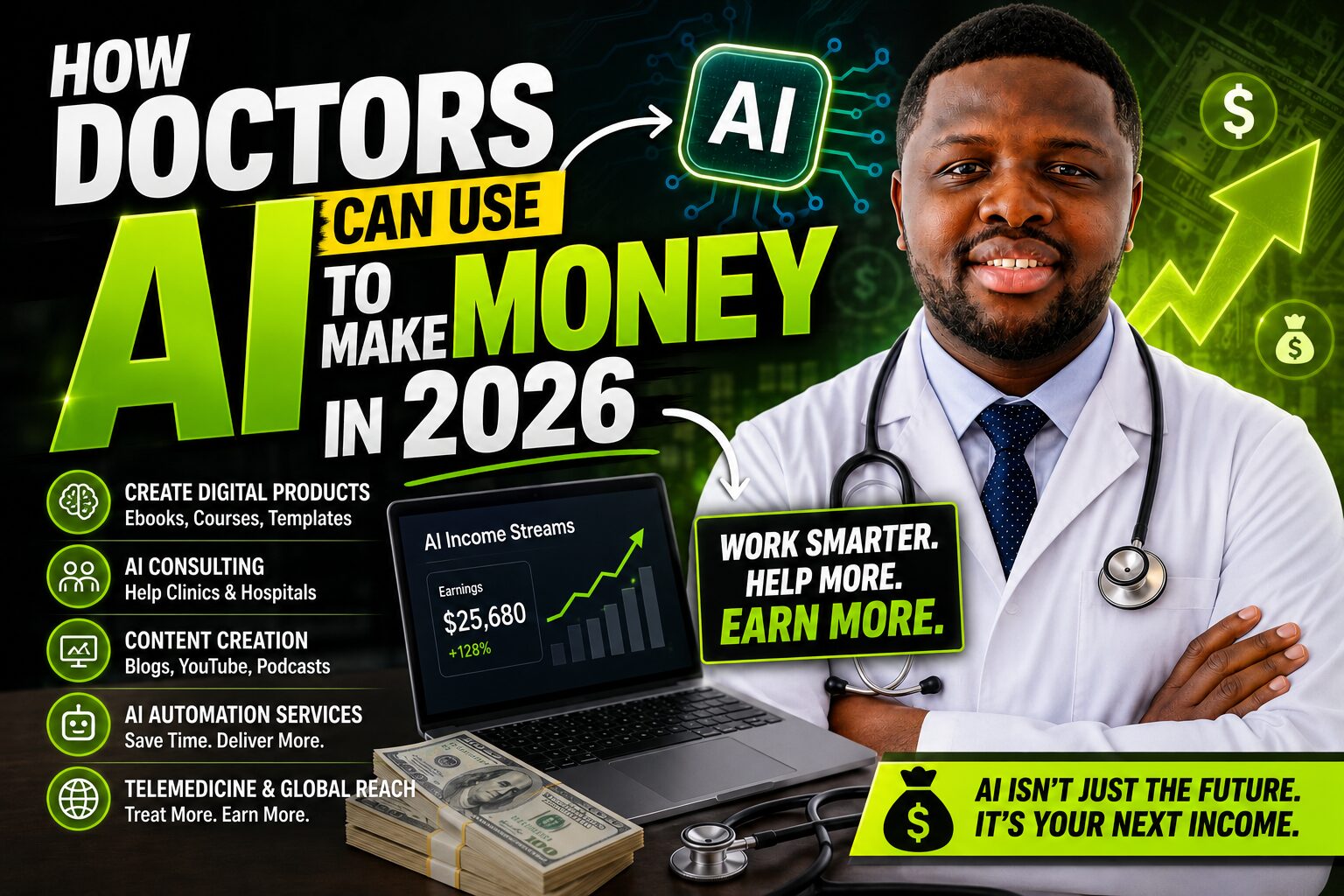
How Doctors Can Use AI to Make Money Beyond the Salary: 10 Real Income Streams in 2026
By Dr Festus Kaasung Kunde, MD | Stavropol State Medical University
Medical Doctor | AI in Healthcare Advocate | Founder, AI Doctor Africa & Ghana Vitals
Published: June 2026 | Reading Time: 20–25 minutes | Category: AI for Doctors
Quick Summary
Your medical degree is one of the most credible professional assets in the world. In 2026, AI has made it more financially productive than ever — outside the hospital. This article covers 10 real, proven ways African doctors can use AI to generate income beyond their salaries: from training AI models at $130–$275 per hour to building a health blog, launching online courses, practising telemedicine, writing for medical publishers, and building a health startup. Every strategy is honest, practical, and written from the perspective of a doctor who is actively building multiple income streams right now.
Let’s Be Honest About Doctor Salaries in Africa
Nobody goes to medical school to get rich. I know that. You know that. Medicine is a calling, not a career calculation.
But let’s also be honest about something else. Doctor salaries in Africa — in Ghana, Nigeria, Kenya, most of sub-Saharan Africa — do not reflect the years of training, the clinical responsibility, or the sheer weight of what we carry every day. A junior doctor in Ghana earns a salary that, in terms of purchasing power, puts them well below what their peers in Europe or North America earn straight out of medical school. Meanwhile, the cost of living in Accra keeps climbing. Student loans exist. Family responsibilities are real. Ambitions don’t stop at the hospital gate.
Beyond The Salary
So the question of how to earn more — beyond the salary — is not a shameful one. It is a smart one. And in 2026, AI has made it more answerable than ever.
This isn’t written from theory. I am a medical doctor with a portfolio of ventures: AI Doctor Africa, Ghana Vitals, SwiftAfrika, Eduti Consult, and a YouTube content platform. I use AI every day — not just to be a better clinician, but to build things that generate income independently of whether I am physically present in a hospital. What I am sharing in this article is not a list of side hustles I read about online. It is a map of the income landscape I am personally navigating.
Difference in Africa and Abroad
Furthermore, I want to be specific about the African context. Several income streams that work brilliantly for doctors in the US or UK require adaptation for Ghana or Nigeria. I will call those out explicitly. Consequently, by the end of this article, you should have a clear picture of what is actually accessible to you — not just what sounds exciting in a LinkedIn post.
Key mindset shift: Your medical degree is not just a licence to practise. It is a credibility asset that the world is willing to pay for — in ways that go far beyond the consulting room. AI is what makes monetising that asset at scale realistic for the first time.
The Income Landscape: What AI Actually Changes
What Was Hard Before? What Is Easy Now?
Before AI, a doctor who wanted to build income outside their salary faced a brutal trade-off: time. Writing a health blog required hours of research per article. Creating an online course required weeks of production. Building a YouTube channel required a constant stream of content. Medical writing required hours of drafting, editing, and formatting per piece. Most doctors tried one of these things, got overwhelmed, and went back to just being a doctor.
AI changes the maths. Not completely — you still need to show up, think, and apply your medical knowledge. But the time cost drops dramatically. An article that previously took four hours now takes forty-five minutes. A course outline that previously took a week to develop now takes an afternoon. A presentation that took three hours now takes thirty minutes. As a result, income streams that were previously incompatible with a full clinical schedule become genuinely manageable.
Additionally, AI changes the floor for quality. Before, a doctor writing their first blog post or recording their first YouTube video would produce amateur-quality work simply because they lacked the production skills. Now, AI tools handle the structure, research, SEO, editing suggestions, and even thumbnail design. The doctor provides the medical expertise and the personal voice. AI handles everything else.
This is not just theory. According to a 2026 survey by the AMA, over 81% of doctors now use AI in their professional work — more than double the rate in 2023. The doctors who are building income outside their salaries are the ones who figured out this equation early.
The 10 Income Streams at a Glance
Before going deep on each one, here is the full picture. Use this table to identify the streams most relevant to your situation right now — your speciality, your available time, and your financial goals:
| Income Stream | AI Role | Est. Monthly Earnings | Start-Up Effort |
| AI Training / Medical Annotation | Core work — you are the product | $500–$3,000+ | Low — apply online |
| Health Blog (AI-Assisted) | Content creation, SEO, research | $200–$5,000+ | Medium — build over months |
| YouTube Health Channel | Script writing, thumbnail, research | $100–$3,000+ | Medium — consistency required |
| Online Courses / E-books | Course structure, content, design | $300–$10,000+ | Medium — one-time build |
| Telemedicine Consultations | Scheduling, patient prep, follow-up | $500–$4,000+ | Low — join a platform |
| Medical Writing & Freelance | Research, drafting, editing | $300–$3,000+ | Low — pitch to editors |
| AI Health Startups | Product development, fundraising prep | Variable — equity + salary | High — long-term play |
| Paid Medical Surveys | None needed — just your opinion | $50–$500/month | Very Low — sign up online |
| Speaking & Consulting | Presentation prep, research | $200–$5,000/event | Medium — build reputation first |
| Social Media / Health Creator | Captions, hooks, research, repurposing | $100–$2,000+ | Low — start immediately |
Notice that none of these requires you to quit medicine, move abroad, or have existing wealth to invest. Most of them can be started with nothing more than an internet connection, a Google account, and the medical knowledge you already have. Let’s go through each one properly.
Income Stream 1: Getting Paid to Train AI Models
The Most Immediately Accessible Income Stream for African Doctors
This is the one that genuinely surprised me when I first encountered it. AI companies — including OpenAI, Anthropic, Google, and Meta — need qualified doctors to train, evaluate, and improve their medical AI models. Someone is needed to write clinical prompts, grade AI responses for accuracy, identify dangerous errors, and teach models how to reason correctly about medical situations.
This can’t be done with general workers. They specifically need board-certified clinicians. And they are paying a significant amount of money for that expertise.
According to current platform data, primary care physicians earn between $130 and $175 per hour on platforms like Mercor. Specialist physicians — particularly in radiology, cardiology, and neurology — earn up to $400 per hour for certain annotation tasks. Furthermore, a 2026 report found that Mercor alone was paying over $1.5 million per day to its network of approximately 30,000 professional contractors, including doctors, lawyers, and engineers.
Dr Melania Poonacha, an internist in San Francisco who already earns $375,000 per year, signed up with Mercor as a side source of income. Her reason? The work is flexible, intellectually interesting, and genuinely valuable — she is shaping how AI reasons about medicine. If a doctor earning nearly $400,000 annually is adding AI training work to her schedule, the income and the intellectual value are clearly real.
How the Work Actually Works
The work varies by platform and project, but generally falls into three categories. First, prompt writing — you write clinical questions, case scenarios, and patient dialogues that teach the AI what real medical consultations look like. Second, response evaluation — the AI generates a clinical response, and you grade it for accuracy, safety, relevance, and appropriate tone. Third, red teaming — you deliberately try to get the AI to produce dangerous, incorrect, or harmful medical information, so the developers can fix it before deployment.
Most of this work is asynchronous. You log in when you have time, complete tasks, and log out. There are no meetings, no commute, and no patient emergencies. Consequently, it fits naturally into the margins of a clinical week — evenings, weekends, or the quiet periods between ward rounds.
The Platforms — and How to Get Started
The following table covers the main platforms paying doctors for AI training work in 2026. All of them pay internationally via PayPal or Payoneer, which work in Ghana and across most of Africa:
| Platform | Who It’s For | Pay Rate | How to Apply |
| Mercor | Doctors across all specialities, radiology up to $400/hr | $130–$275/hr (general); up to $400/hr (radiology) | mercor.com — complete evaluation test |
| Outlier AI (Scale AI) | General and specialist doctors; flexible hours | $30–$80/hr depending on task | outlier.ai — apply as a domain expert |
| Mindrift | Doctors with postgraduate degrees | $20–$55/hr | mindrift.ai — apply as an AI tutor |
| Surge AI | Specialist physicians — cardiology, neurology, oncology | Up to $500/hr for senior specialists | surgehq.ai — invitation or referral |
| Appen | General medical knowledge tasks | $15–$40/hr | appen.com — open applications |
| Cohere / Anthropic / OpenAI (Direct) | Board-certified clinicians for model safety review | Project-based; competitive rates | Apply via the company’s careers pages |
Honest caveat: These platforms are selective. Most require you to pass a screening evaluation before being accepted. Furthermore, project availability fluctuates — you may work intensively for three months, then have a gap while waiting for the next project. Treat it as high-value variable income, not a fixed salary replacement.
Income Stream 2: Building a Health Blog With AI
The Long Game That Pays Indefinitely
You are reading an article on a health blog right now. AI Doctor Africa is my own answer to this income stream. And I can tell you from direct experience that it works — not overnight, but it works.
A health blog generates income through multiple channels simultaneously. Google AdSense places adverts on your pages and pays you per click and per impression. Affiliate links to medical products, books, AI tool subscriptions, and health devices earn you a commission when readers purchase through your link. Sponsored posts and brand partnerships come once your audience reaches a credible size. Additionally, your own products — courses, guides, consultation bookings — can be sold directly through the blog.
AI changes
What AI changes about this is the content production side. Before AI, producing one high-quality medical article typically required three to five hours of research, writing, and editing. With AI, that same article — structured, SEO-optimised, with proper citations and transition words — can be produced in forty-five minutes to an hour. Multiply that by two articles per week, and you have a content machine that builds compounding passive income over time.
AI Doctor Africa
My own workflow for AI Doctor Africa involves using Claude for deep article structure and clinical content, ChatGPT for SEO headline variations and meta descriptions, and Grammarly for final polish. Each article goes through Yoast SEO before publication. The result is content that both readers and search engines treat as authoritative, which is what generates long-term traffic and income.
For AdSense approval, you need approximately 15–20 high-quality published articles, a Privacy Policy page, an About page with your credentials, a Contact page, and a medical disclaimer. Your medical degree is a significant advantage here — Google’s quality guidelines specifically reward health content written by credentialled professionals under what they call E-E-A-T: Experience, Expertise, Authoritativeness, and Trustworthiness.
Realistic timeline: A health blog typically takes three to six months to start generating meaningful income. However, the income is passive and compounds over time. An article you write today can earn money for years.
Income Stream 3: YouTube Health Channel
Video Is Where the African Health Audience Is Going
I run the Nana Kundeson YouTube channel, so I have a firsthand perspective on what this income stream looks like in practice. YouTube is growing faster in Africa than almost anywhere else in the world — and health content, when it comes from a credentialled doctor, attracts exactly the kind of engaged audience that both AdSense and brand partnerships pay well for.
The traditional barrier to YouTube for doctors was production. Writing a script, recording, editing, adding graphics, uploading, optimising — it was a multi-hour production pipeline that most busy doctors simply could not sustain. AI has broken down every part of that pipeline.
ChatGPT writes your script from a topic and an audience brief. Claude researches and adds clinical depth. Canva AI or Adobe Firefly creates thumbnail graphics. CapCut AI auto-captions your video and suggests edits. VidIQ or TubeBuddy, with AI features, suggests your title, description, and tags for maximum search visibility. Consequently, what previously took a full evening now takes ninety minutes.
Moreover, the content you are already creating for your blog can be repurposed into videos. An article on how African doctors can use AI in daily practice becomes a fifteen-minute YouTube video with minimal additional effort. One piece of content becomes two income-generating assets.
YouTube monetisation threshold: You need 1,000 subscribers and 4,000 watch hours in the past 12 months to join the YouTube Partner Programme. For a doctor creating genuinely useful health content with AI-assisted production, this is typically achievable within six to twelve months of consistent posting.
Income Stream 4: Online Courses and Digital Products
Build It Once. Sell It Indefinitely.
This is arguably the most scalable income stream available to doctors in 2026. An online course is a digital product you create once and sell indefinitely — with no additional time investment for each sale. Given that doctors have credentialed expertise that many people genuinely want to learn from, the potential is significant.
Consider the demand for courses on topics such as understanding your blood pressure and how to manage it, preparing for medical licensing examinations, AI tools for healthcare students, nutrition and disease prevention in African contexts, and mental health and the high-achieving professional. All of these are areas where a doctor’s expertise is directly marketable to audiences willing to pay.
AI accelerates course creation at every stage. Claude outlines your course structure in minutes. ChatGPT writes the lesson scripts. Gamma AI converts your content into professional slide decks. Tools like Canva AI produce the course graphics and workbook designs. Furthermore, once the course is listed on platforms like Udemy, Gumroad, or Teachable, the platform handles payment processing, delivery, and customer support — leaving you free to focus on clinical work.
E-books and guides are the lower-effort entry point. A 30-page PDF guide on managing hypertension for Ghanaian patients, sold for GHS 50 through your website or Selar (an African digital product platform), is a genuine income stream with almost zero production cost once it is written. AI writes the first draft. You verify, personalise, and publish.
Real example: A doctor in Nigeria built a USMLE study guide using AI assistance and sold it for $29 on Gumroad. Within six months, organic Google traffic was generating 40–60 sales per month. That is $1,200–$1,800 per month, based on a document written over one weekend.
Income Stream 5: Telemedicine and Online Consultations
Your Clinical Expertise, Delivered Anywhere
Telemedicine is not new, but AI has made it significantly more productive and financially viable for individual doctors. The core proposition is simple: patients will pay for direct access to qualified doctors, particularly for second opinions, chronic disease management, health coaching, and specialist consultations.
In the African context, telemedicine is growing rapidly. According to recent data, telemedicine platforms in Nigeria alone are projected to reach a $500 million market by 2026. The demand from diaspora Ghanaians and Nigerians who want to consult doctors in their home countries — in their language and within their cultural context — is genuinely underserved. Furthermore, rural Ghanaians who cannot easily access specialists at teaching hospitals constitute another large, underserved market.
AI makes telemedicine practice more efficient in several specific ways. Before each consultation, Claude can prepare a structured summary of the patient’s stated symptoms and history. After each consultation, ChatGPT drafts the consultation note, the prescription letter, and the follow-up instructions. Scheduling, reminders, and payment processing are all automated through the telemedicine platform itself. As a result, the doctor’s time is focused entirely on the clinical interaction — the part that actually requires a doctor.
Platforms accessible in Ghana: Babylon Health (active in Ghana), MyDoc, and international platforms like Doxy.me, which accept Ghanaian doctors. Additionally, some doctors simply use a professional WhatsApp number, a Google Form intake questionnaire, and Paystack for payments — a low-tech but functional starting point that requires no platform fee.
Important: Always practise telemedicine within the scope of your MDC licence. Consult the MDC Ghana guidelines on telemedicine practice before setting up any remote consultation service. Never prescribe for patients you have not assessed appropriately — the clinical and legal responsibility remains entirely yours.
Income Stream 6: Medical Writing and Freelance Content
Your Clinical Pen Has Commercial Value
Medical writing is one of the oldest secondary income streams for doctors — and AI has made it dramatically more accessible and more productive. Pharmaceutical companies, health technology companies, medical education platforms, academic journals, and consumer health publications all need medically qualified writers. Most of them cannot find enough.
The range of paid medical writing work is broader than most doctors realise. It includes clinical trial summaries and regulatory documents, patient education materials, medical journal supplements and review articles, health technology white papers and product descriptions, CME content for medical education platforms, and health content for consumer publications and digital media.
AI assists with every part of the writing process: research, outlining, drafting, editing, and formatting. Consequently, a doctor who might previously produce one article per week can now produce three or four at the same level of quality. Furthermore, because AI handles the structural and research-heavy lifting, you can take on more complex, higher-paying assignments without proportionally more time.
Where to find medical writing work: Upwork and Fiverr both have active markets for medical writers — build a profile, attach your credentials, and start with competitive pricing to build reviews. The American Medical Writers Association (AMWA) lists international opportunities. Health technology companies in Ghana and Nigeria increasingly commission medical content — approach them directly. Additionally, your AI Doctor Africa blog itself is a portfolio that demonstrates your writing and medical communication ability.
Pay range: Entry-level medical writing pays $50–$150 per article. Regulatory and pharmaceutical writing pays $75–$200 per hour. CME content development pays $100–$300 per hour. With AI assistance, your effective hourly earnings are significantly higher than the headline rate because each piece takes less time to produce.
Income Stream 7: Building a Health Tech Startup
The Highest Risk. The Highest Reward.
This one is not for everyone. But if you have an idea — a genuine clinical problem you have observed that technology could solve — 2026 is the best time in history to try to build something about it.
I am building two ventures that started from clinical observations: Ghana Vitals, which came from watching patients at a national health screening exercise discover hypertension and diabetes only after complications had started. And SwiftAfrika, which addresses a different problem in financial infrastructure. Neither started with funding. Both started with a clear problem, a proposed solution, and the willingness to use AI to build faster than would otherwise be possible.
AI Cost Reduction
AI dramatically reduces the cost of the early stages of startup development. Claude and ChatGPT write your pitch deck narrative, your business plan, your market analysis, and your grant applications. Gamma AI produces the investor-ready slides. ChatGPT writes your landing page copy, your social media content, and your email outreach. Perplexity searches for competitors and market data. As a result, what previously required a co-founder with business skills or an expensive consultant can now be done by a doctor alone — at least in the early phases.
Furthermore, your medical credentials give you something that no technology-only founder has: clinical credibility. Investors in health technology specifically want doctor founders. They want someone who understands the clinical problem from the inside, who has seen patients suffer from the gap the startup is trying to close, and who can speak to clinical advisors, hospital procurement committees, and health ministry officials with authority.
Where to look for early-stage funding in Ghana:
Ghana Innovation Hub, mFarm Africa Fund, WHO and Gates Foundation grants for global health, Y Combinator (accepts African founders), and the growing ecosystem of African health technology investors, including Merck Foundation, Wellcome Trust, and Novatek.
The truth about startups: Most fail. However, the process of trying — building your pitch, researching your market, testing your idea with real users — creates skills, networks, and credibility that advance your career regardless of whether the venture succeeds. The cost of trying, with AI tools available, has never been lower.
Income Stream 8: Paid Medical Surveys and Market Research
The Lowest Effort Income Stream on This List
Pharmaceutical companies, medical device manufacturers, and healthcare consulting firms are willing to pay doctors for their clinical opinions. They do this through paid medical surveys — short questionnaires about prescribing habits, disease management approaches, new product awareness, and clinical decision-making.
These surveys pay anywhere from $50 to $500 per completion, depending on the survey length, your speciality, and the sponsoring company. They require no AI assistance, no audience, no setup, and no ongoing commitment. You simply register with the platform, complete surveys when they are available, and receive payment.
The main platforms: InCrowd pays doctors via PayPal and is internationally accessible. ZoomRx is another well-regarded platform. M3 Global Research, Sermo, and Medscape Surveys are also active. Most of these pay instantly on completion via PayPal or direct deposit.
The income is not transformative on its own — perhaps $100–$500 per month, depending on your speciality and survey availability. However, it requires almost no time and zero AI involvement. Consequently, it is the easiest entry point for any doctor wanting to immediately generate supplementary income without building anything.
Income Stream 9: Speaking, Consulting, and Workshop Delivery
Your Voice Has Commercial Value Too
As AI literacy becomes more important across industries, qualified doctors who can explain AI in healthcare — practically, honestly, and from clinical experience — are increasingly in demand as speakers, consultants, and workshop facilitators. Hospitals, medical schools, pharmaceutical companies, health NGOs, and corporate wellness programmes all pay for qualified speakers and clinical consultants.
The investment required to position yourself for this income stream is primarily reputational. A published blog, an active social media presence, a YouTube channel, and a track record of delivering health talks — which I already have through secondary school and university outreach in Accra — together constitute a speaker’s portfolio that opens doors.
AI dramatically accelerates the preparation for every speaking engagement. ChatGPT outlines your presentation in minutes. Gamma AI produces professional slides from your outline. Claude researches and adds clinical depth. Canva AI handles the graphic design. As a result, you can accept speaking invitations that would previously have required three to five hours of preparation and complete the preparation in forty-five minutes.
Rates: Corporate wellness speaking in Ghana typically pays GHS 500–2,000 per session. International conference keynotes pay significantly more. Consulting engagements for health technology companies — advising on clinical product design, reviewing content for accuracy, serving on medical advisory boards — typically pay $100–$300 per hour internationally. These roles are increasingly found on LinkedIn, in your blog audience, and in the networks you build by being visibly active in the AI in healthcare space.
Income Stream 10: Building a Social Media Health Brand
The Fastest Way to Build an Audience — and a Business
Social media is not just vanity metrics. A doctor with a genuine following on Instagram, TikTok, LinkedIn, or X (Twitter) has built a distribution channel — an audience of people who trust their medical expertise and who will buy their courses, read their blog, book their consultations, and purchase their products. That distribution channel is a business asset.
AI makes consistent social media content creation realistic for a busy doctor. Tools like ChatGPT generate post captions, educational thread structures, and content calendars in minutes. Canva AI creates professional medical infographics. CapCut AI edits short-form video content with captions and effects. Buffer or Hootsuite schedules posts automatically. As a result, a doctor can maintain a consistent posting schedule — two to three pieces of content per day — in approximately thirty minutes of AI-assisted work.
The content strategy is straightforward: educate, not entertain. Doctor social media accounts that grow most reliably in the African context focus on practical health information — blood pressure facts for Ghanaian audiences, diabetes prevention tips, understanding your NHIS benefits, and what to expect at your antenatal visit. This kind of content genuinely improves public health literacy, builds trust, and attracts a loyal audience that values your expertise.
Once the audience exists, monetisation follows naturally: AdSense on your linked blog, affiliate commissions on health product recommendations, sponsored content from health brands, and direct sales of your digital products.
Personal note: My Nana Kundeson YouTube channel and the AI Doctor Africa blog are both expressions of this strategy. The goal is not fame. The goal is a platform that generates income from the expertise I have already spent years building — while simultaneously contributing something genuinely useful to the people who engage with it.
Building a Portfolio Income Model: How to Combine These Streams
The Strategy That Actually Works
The doctors who build the most financially resilient lives beyond their salaries are not the ones who go all in on a single income stream. They are the ones who build a portfolio — two or three complementary streams that reinforce each other and compound over time.
Here is the portfolio model I recommend for African doctors starting:
Phase 1 — Immediate income (Month 1–3): Apply to Mercor or Outlier for AI training work. Sign up for medical survey platforms. Both require no setup, minimal time investment, and pay within days of completing work. This generates cash immediately while you build the longer-term streams.
Phase 2 — Building the platform (Month 2–6): Start your health blog or YouTube channel. Publish consistently — two pieces of content per week minimum. Use AI to handle the production side so consistency can be sustained alongside a clinical schedule. Apply for Google AdSense once you reach 15–20 published articles.
Phase 3 — Scalable income (Month 6–12): Create your first digital product — a course, a guide, or an e-book — based on the topics your audience engages with most. This is income that requires no ongoing time investment per sale. Simultaneously, begin positioning yourself to speak and consult through your growing online presence.
Phase 4 — Compounding returns (Year 2+): By year two, a consistently built portfolio typically includes passive blog income, course sales, a growing YouTube audience, periodic consulting engagements, and ongoing AI training work when projects are available. Each stream reinforces the others — your blog audience buys your courses, your speaking engagements drive blog traffic, your AI training income funds your startup experiments.
None of this requires leaving medicine. All of it is compatible with a full clinical schedule when AI handles the production work. Furthermore, all of it becomes more valuable over time — unlike clinical overtime, which pays once and stops.
The Ethics Question: What Every Doctor Needs to Address Honestly
I want to address this directly because it matters.
Building income outside your clinical salary is not unethical. Doctors have always written books, given lectures, run private practices, consulted for pharmaceutical companies, and built businesses. The medical profession has never required a vow of poverty.
However, there are clear ethical lines that cannot be crossed, regardless of the income opportunity.
- Never let external income commitments compromise your clinical availability or decision-making — your patients come first, always
- Never allow commercial relationships to bias your clinical advice or your public health content — disclose all affiliations transparently
- Never publish health content that is inaccurate, sensationalised, or commercially motivated over clinically accurate — your credentials give your voice authority; misusing that authority causes real harm
- Never use patient information, even anonymised, in content or products without appropriate ethical approval
- Always check your employment contract for conflict-of-interest clauses before building income streams — some hospital contracts restrict private practice or outside work
Beyond those lines, building financial independence is not just permissible — it is wise. A doctor who is not financially stressed is a more present, more focused, more sustainable clinician. Taking care of your own financial well-being is not selfishness. It is sustainability.
Key Takeaways
- Your medical degree is a credibility asset that the world is willing to pay for — in ways that go far beyond the consulting room
- AI compresses the time cost of every secondary income stream by 50–70%, making them genuinely compatible with a full clinical schedule
- AI training platforms like Mercor pay doctors $130–$275 per hour for evaluating and training medical AI models — accessible in Africa via PayPal and Payoneer
- Health blogging with AI assistance generates compounding passive income through AdSense, affiliates, and digital products — AI Doctor Africa is a working example
- YouTube, online courses, and digital products are scalable income streams that earn indefinitely from a one-time creation effort
- Telemedicine, medical writing, speaking, and consulting all leverage your existing clinical expertise and are significantly more productive with AI assistance
- The most financially resilient model is a portfolio of two or three complementary income streams that reinforce each other over time
- The Phase 1 recommendation: apply to Mercor, sign up for medical surveys, and start your health blog — all three can be started this week
- None of this requires leaving medicine or compromising patient care — it requires using the margins of your professional week more intentionally
- Building financial independence is not selfish. It is sustainable. A financially stable doctor is a better doctor.
Frequently Asked Questions
Here are the questions doctors most commonly ask when they start thinking seriously about income beyond their salary:
| Question | Answer |
| Can doctors in Ghana and Africa access these income streams? | Yes — most of them. AI training platforms like Mercor and Outlier pay internationally via PayPal, Payoneer, or bank transfer, which work in Ghana. Health blogging, YouTube, online courses, and telemedicine are all accessible. Medical writing and freelance platforms accept international applications. |
| Do I need a lot of followers or an audience to start? | No. AI training and annotation require no audience — just your medical credentials. Medical writing and freelance work require a portfolio, not followers. Online courses can be sold on Udemy or Gumroad with zero existing audience. |
| Is AI training income stable and reliable? | It varies by platform and project. Some projects run for months with consistent hours. Others are short bursts of high-intensity work that end without notice. |
| How much time do these income streams realistically require? | AI training typically requires at least 10 hours per week per active project. Health blogging with AI assistance can be managed in 3–5 hours per week once a system is established. |
| What about the ethics of doctors creating online health content? | Online health content creation by doctors is not only ethical — it is a form of community service when done responsibly. |
| Can I combine multiple income streams? | Absolutely — and this is the recommended approach. The most financially resilient doctors build what is called a portfolio income model: a primary clinical salary supplemented by two or three AI-assisted income streams that compound over time. For example: AI training for immediate cash, a health blog for growing passive income, and an online course for scalable income. AI makes managing multiple streams simultaneously more realistic than it would otherwise be. |
Related Articles on AI Doctor Africa
- How Medical Doctors Can Use Claude AI for Research, Clinical Learning, and Productivity in 2026
- ChatGPT vs Claude for Medical Doctors: Which AI Is Better in 2026?
- How Doctors Can Use AI to Save 10 Hours Every Week
- Best AI Tools for Medical Students in 2026: The Complete Guide
- How Doctors and Medical Students Can Use AI for Medical Research in 2026
- 100 ChatGPT Prompts for Medical Students: The Complete 2026 Prompt Library
- NotebookLM for Doctors: The Complete 2026 Guide for Healthcare Professionals
About the Author
Dr Festus Kaasung Kunde is a Medical Doctor, AI in Healthcare Advocate, and Founder of AI Doctor Africa and Ghana Vitals. He holds an MD from Stavropol State Medical University, Russia (2025) and completed an internship at Korle-Bu Teaching Hospital, Accra. He is actively building multiple AI-assisted income streams alongside his clinical career and shares what he learns — honestly — on AI Doctor Africa.
AI Doctor Africa | aidoctorafrica.com
Disclaimer: This article is for informational purposes only and does not constitute financial or legal advice. Income figures are estimates based on publicly available data. Individual results vary. Always consult a qualified financial adviser before making significant financial decisions.
Dr. Festus K. Kunde
Dr. Festus Kaasung Kunde is a medical doctor, Content creator, healthcare technology writer, and digital health innovator specializing in Artificial Intelligence in Medicine, Healthcare Systems Innovation, and Health Data Science in Africa. He is the founder of AI Doctor Africa (AIDoctorAfrica.com), an educational platform dedicated to helping healthcare professionals—including doctors, medical students, nurses, and researchers—understand and responsibly apply artificial intelligence in clinical practice, medical education, medical research, and healthcare innovation. He is also the creator of Ghana Vitals, a health data and predictive analytics initiative focused on collecting and analyzing key health indicators such as blood pressure, blood glucose, and BMI to support early disease detection, preventive healthcare, and data-driven decision-making in Ghana and across Africa. The project reflects his long-term vision of building scalable, AI-powered public health systems for African populations. Dr. Kunde’s work focuses on the practical integration of AI tools such as ChatGPT, Claude, and emerging clinical AI systems into real-world healthcare workflows. His content emphasizes improving clinical documentation, accelerating medical education, strengthening research productivity, and supporting healthcare decision-making in resource-limited settings. Through AI Doctor Africa, he publishes evidence-informed, practice-oriented resources including AI workflows, clinical use cases, medical education guides, and tutorials designed specifically for African healthcare professionals. Through Ghana Vitals, he extends this mission into population health innovation, aiming to leverage real-world health data and predictive models to improve early intervention, reduce preventable disease burden, and strengthen health systems across Africa. His overall mission is to bridge the gap between traditional clinical medicine, artificial intelligence, and data-driven public health, empowering African healthcare professionals to work smarter, diagnose earlier, and deliver better care through technology. Areas of Expertise Artificial Intelligence in Clinical Medicine Digital Health & Healthcare Innovation in Africa Health Data Analytics & Predictive Health Systems Medical Education and Exam Preparation AI for Medical Research and Scientific Writing Clinical Workflow Optimization using AI Tools Public Health Data Systems (Ghana Vitals Initiative) Professional Focus Dr. Kunde’s work sits at the intersection of clinical medicine, artificial intelligence, and population health systems, with a strong focus on scalable solutions for African healthcare challenges. His initiatives emphasize ethical AI use, data-driven decision-making, and practical implementation in real-world clinical and public health environments.
View author profile →