ChatGPT vs Claude for Medical Doctors: Which AI Is Better in 2026?
By Dr Festus Kaasung Kunde, MD | Stavropol State Medical University
Medical Doctor | AI in Healthcare Advocate | Founder, AI Doctor Africa & Ghana Vitals
Published: June 2026 | Reading Time: 12–15 minutes | Category: AI for Doctors
Quick Answer
ChatGPT is faster, more versatile, and better for generating content and practice questions. Claude is stronger in research analysis, long-document review, and structured academic writing. The most effective healthcare professionals use both together. This article explains exactly when to use each — and how.
The Question Every Doctor Is Asking
If you have spent any time exploring artificial intelligence in healthcare, you have almost certainly encountered the same debate:
Should I use ChatGPT or Claude?
It is one of the most common questions I receive from doctors, medical students, researchers, and healthcare professionals across Africa and beyond.
Most online comparisons are written by tech reviewers, content creators, or AI enthusiasts who have never managed patients, prepared for ward rounds, sat professional medical examinations, or conducted clinical research under real pressure.
As a medical doctor who completed an internship at Korle-Bu Teaching Hospital and actively uses both tools, my perspective is different. I am less interested in which AI wins internet debates. I am more interested in which AI helps doctors become better learners, researchers, clinicians, and educators.
During my internship, I used AI tools daily to prepare for ward rounds, organise medical knowledge, review clinical guidelines, generate learning materials, and prepare for the Medical and Dental Council licensing examinations. Both Claude and ChatGPT played important roles — but I quickly discovered they excelled in entirely different situations.
This article is not a generic technology review. It is a detailed, evidence-based comparison written specifically for healthcare professionals — with real examples, a complete task-by-task breakdown, and clear guidance on when to use each tool.
Complete Task-by-Task Comparison: ChatGPT vs Claude for Doctors
Before diving into the details, here is the full comparison. Use this as a quick reference whenever you need to decide which tool to open:
| Task | ChatGPT | Claude | Winner |
| MCQ Generation | Excellent – fast, varied | Good | ChatGPT |
| Flashcard Creation | Excellent | Good | ChatGPT |
| Deep Concept Explanation | Good | Excellent – thorough | Claude |
| Case Discussion | Good | Excellent | Claude |
| OSCE Practice | Excellent | Good | ChatGPT |
| Research Brainstorming | Excellent – fast | Good | ChatGPT |
| Paper/Guideline Analysis | Good | Excellent – detailed | Claude |
| Academic Writing | Good – fast drafts | Excellent – polished | Claude |
| Coding / Data Analysis | Excellent | Good | ChatGPT |
| Quick Summaries | Excellent | Excellent | Tie |
| Long Document Review | Good | Excellent | Claude |
| Differential Diagnosis Support | Good | Excellent | Claude |
| Email / Letter Drafting | Excellent | Good | ChatGPT |
| Presentation Outlines | Excellent | Good | ChatGPT |
Now let us break down why each tool performs the way it does — and exactly how to use them in your daily medical workflow.
How AI Became a Daily Tool for Healthcare Professionals
Five years ago, many doctors viewed artificial intelligence as a futuristic technology. Something that existed in research papers and Silicon Valley announcements — not in the wards of teaching hospitals in Accra, Kumasi, or Lagos.
Today, the reality is different. The healthcare profession faces significant and compounding challenges:
- Information overload — the volume of new research published weekly makes it impossible for any clinician to stay fully current
- Documentation burden — administrative tasks consume hours of clinical time daily
- Continuing medical education — doctors are expected to maintain competency across rapidly evolving fields
- Workforce shortages — particularly acute across sub-Saharan Africa
- Research demands — evidence-based medicine requires understanding and applying research that many clinicians struggle to access
Artificial intelligence is increasingly helping healthcare professionals navigate these challenges. The question is no longer whether doctors will use AI. The question is which AI tools to use, for which tasks, and how to use them responsibly.
Understanding ChatGPT: What It Does and Why Doctors Use It
ChatGPT was developed by OpenAI and is currently one of the most widely used AI platforms worldwide, with hundreds of millions of users across industries. For healthcare professionals, ChatGPT functions as a medical tutor, writing assistant, productivity tool, research brainstorming partner, and content generator.
Key Strengths of ChatGPT for Healthcare Professionals
Speed and versatility. ChatGPT processes requests and generates outputs faster than most competing platforms. For busy doctors who need rapid responses, this matters.
Large ecosystem. ChatGPT supports custom GPTs, integrations, and specialised workflows. Healthcare professionals can access medical-focused tools built on top of the platform.
Coding and data analysis. For doctors involved in epidemiology, public health analytics, or research automation, ChatGPT is often the stronger choice for Python scripting, statistical analysis, and data visualisation.
Content generation. ChatGPT generates large volumes of content quickly — MCQs, flashcards, study plans, presentation outlines, and social media posts — with minimal prompting.
Multimodal capabilities. ChatGPT supports images, documents, voice interaction, and increasingly web browsing, expanding its range of potential clinical and educational applications.
Understanding Claude: What It Does and Why Researchers Prefer It
Claude was developed by Anthropic and has become particularly popular among researchers, academics, and professionals who work extensively with large volumes of text. For healthcare professionals, Claude often feels like a research analyst, medical editor, and writing coach combined into one platform.
Key Strengths of Claude for Healthcare Professionals
Long document analysis. This is Claude’s most significant advantage for clinical professionals. Healthcare workers regularly encounter lengthy clinical guidelines, systematic reviews, policy documents, and public health reports. Claude handles these documents with exceptional depth and accuracy.
Research synthesis. When comparing multiple studies, identifying conflicting evidence, finding research gaps, or summarising bodies of literature, Claude consistently produces more structured and insightful analysis.
Academic writing quality. Claude’s writing style is more formal, logical, and structured than ChatGPT’s by default. Responses feel closer to a reviewed academic paper than a blog post.
Reasoning and explanation. Claude tends to explain its reasoning step by step, which is valuable for medical education and for verifying whether an AI output is logically sound.
Safety-conscious outputs. Anthropic has built Claude with a strong emphasis on responsible AI outputs, which is relevant in a medical context where harmful or misleading information can have real consequences.
READ ALSO: How Medical Doctors Can Use Claude AI for Research, Clinical Learning, and Productivity in 2026
ChatGPT vs Claude for Medical Students and Exam Preparation
Medical students represent one of the groups that benefit most from AI assistance. The volume of information required — anatomy, physiology, pharmacology, pathology, clinical medicine, surgery, and more — is enormous. AI tools can meaningfully accelerate the learning process when used responsibly.
Exam Preparation and MCQ Practice
ChatGPT is exceptional at generating large numbers of multiple-choice questions rapidly. Give it a topic, a difficulty level, and a format, and it will produce realistic MCQs with explanations almost instantly. For the Medical and Dental Council (MDC) licensing examinations in Ghana, this is particularly useful for generating high-yield practice question banks.
Claude is stronger in understanding. When a student genuinely does not understand why a specific answer is correct — the underlying pathophysiology, the mechanism of action, the clinical reasoning — Claude’s explanations are typically more thorough, more logical, and more educational.
My personal workflow: Use Claude to deeply understand a concept. Then use ChatGPT to test yourself aggressively on that same concept. This combination is far more effective than relying on either platform alone.
Example Prompts for Medical Students
- ChatGPT: “Generate 20 MDC-style MCQs on the management of severe malaria with detailed explanations for each answer.”
- Claude: “Explain the pathophysiology of cerebral malaria and why dexamethasone is contraindicated. Walk me through the reasoning step by step.”
- ChatGPT: “Create an OSCE station for a patient presenting with acute severe asthma. Include the examiner’s mark sheet.”
- Claude: “I uploaded the WHO 2023 malaria treatment guidelines. Summarise the key changes from the 2015 version and highlight what is most relevant for doctors practising in Ghana.”
ChatGPT vs Claude for Clinical Learning
One of the most valuable uses of AI in medicine is accelerating clinical education. Doctors constantly encounter unfamiliar presentations, rare conditions, or evolving guidelines. The ability to learn quickly and accurately is a core clinical skill.
Consider a doctor who encounters a patient with suspected autoimmune vasculitis — a condition seen infrequently in general practice. Specialist input may not be immediately available. Guidelines may be lengthy and technical.
Claude, in this scenario, provides rich, educational explanations. It reads more like a thoughtful consultant who sat down and reviewed the literature. It contextualises the condition, explains the diagnostic criteria, discusses treatment approaches, and highlights what to monitor.
ChatGPT provides a faster, more structured summary. It gets to the key points quickly and is excellent for a rapid orientation before a patient review or ward round.
AI would not make the diagnosis. The clinician makes the diagnosis. But AI meaningfully accelerates the learning process — particularly in resource-limited environments where specialist expertise is not immediately accessible.
ChatGPT vs Claude for Medical Research: The Difference Is Clear
If there is one area where most doctors underestimate AI, it is research. Every doctor should understand evidence-based medicine — and a significant portion of research work is actually information management rather than original thinking. Searching for papers, reading papers, comparing papers, organising papers, and summarising papers.
This is exactly where AI creates enormous value.
Using ChatGPT for Research
ChatGPT is faster and more energetic. Use it when you need to generate ideas rapidly:
- Brainstorming research topics and questions
- Generating study designs and methodology frameworks
- Creating survey instruments and data collection tools
- Explaining statistical concepts and analysis approaches
- Drafting research proposals and funding applications
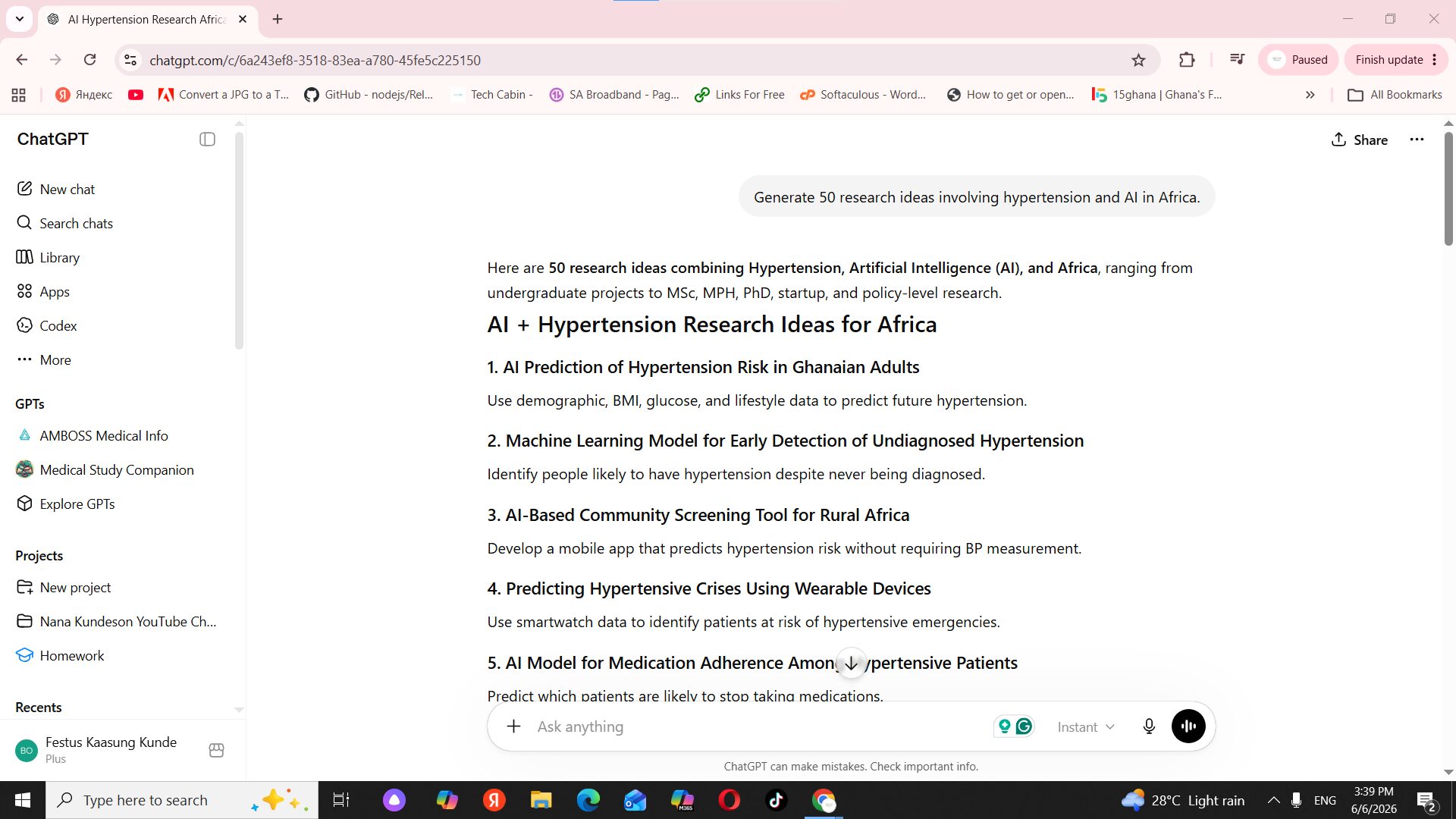
Practical example: “Generate 30 original research questions at the intersection of artificial intelligence and hypertension screening in sub-Saharan Africa.” ChatGPT will produce a comprehensive list in under a minute.
Using Claude for Research
Claude feels more like a careful senior research analyst. Use it when you need analytical depth:
- Uploading and analysing full-length papers, systematic reviews, and clinical guidelines
- Identifying patterns, contradictions, and gaps across multiple studies
- Summarising evidence with structured, academic precision
- Drafting literature reviews and discussion sections
- Evaluating the methodology and quality of individual studies
Practical example: Upload three hypertension screening papers to Claude and prompt: “Compare the methodology, findings, and limitations of these three studies. Identify areas of agreement, areas of conflict, and the most significant research gaps.” The output will often feel like a genuine academic analysis.
Research recommendation: Use ChatGPT for generation. Use Claude for analysis. Together, they form a research workflow that would previously have required a full research team.
How I Use Both AI Tools in Building Ghana Vitals
Ghana Vitals began with a simple observation made during a national health screening exercise across all 16 regions of Ghana. Too many people discover they have hypertension, diabetes, or obesity only after complications have already developed. Stroke. Kidney failure. Diabetic neuropathy. Conditions that could have been identified — and potentially prevented — years earlier.
The question that kept occurring to me was: What if we could identify risk before complications begin?
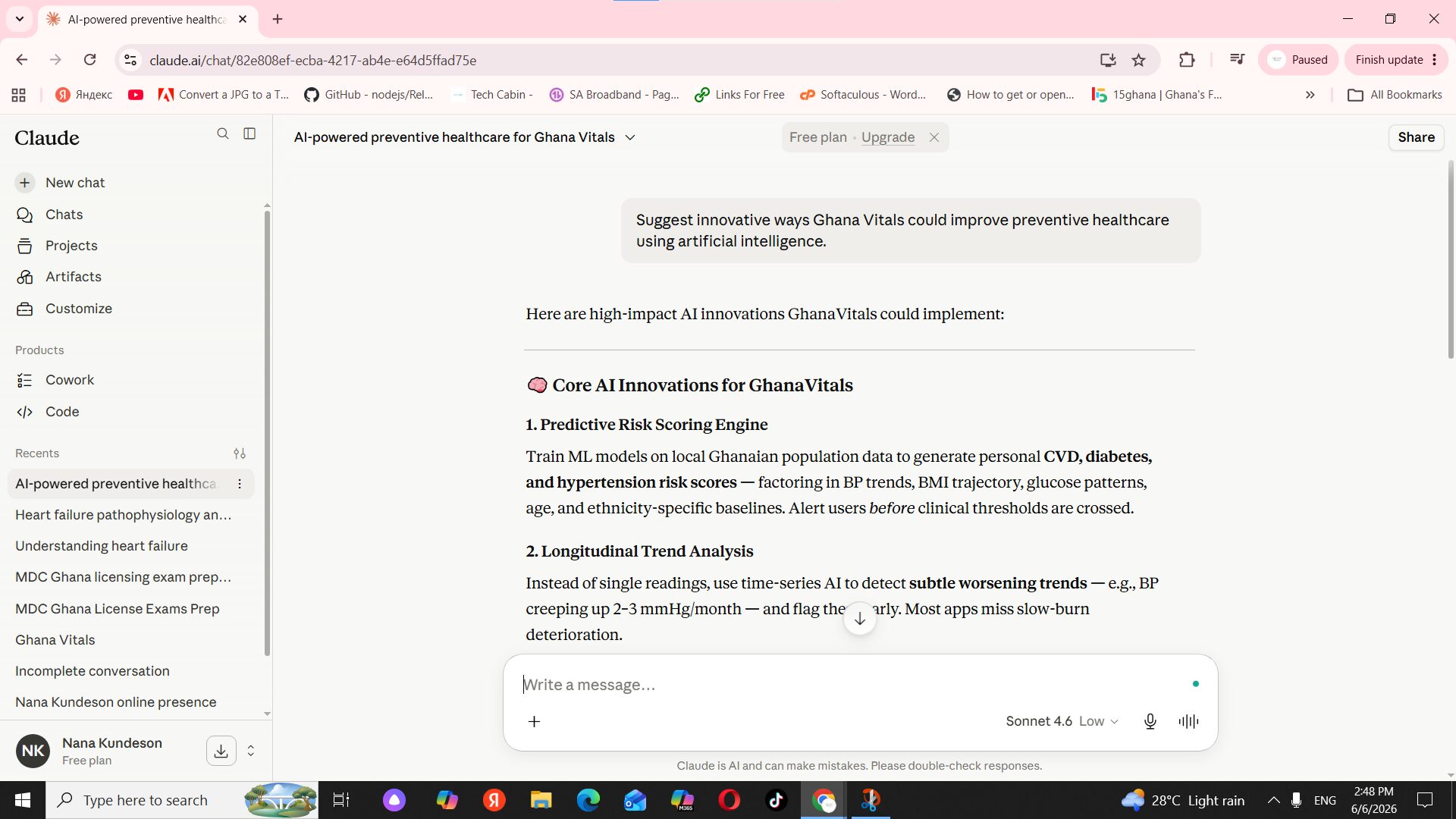
That question eventually became Ghana Vitals — a preventive health data platform designed to monitor blood pressure, glucose, and BMI trends across populations, using predictive analytics to flag individuals at elevated risk before they present to emergency departments.
ChatGPT’s role in this project: brainstorming product features, generating community outreach program ideas, drafting public health campaign concepts, and rapidly producing content for social media and health education materials.
Claude’s role: evaluating the platform’s strategic strengths and weaknesses, analysing relevant public health literature, improving the rigour of proposals, and thinking through the long-term implications of different implementation approaches.
One gives breadth. The other gives depth. Together, they function as a powerful thinking system for healthcare innovation.
What Every Doctor Must Know About AI Hallucinations
This section is essential reading for any healthcare professional using AI tools in a clinical or educational context.
AI hallucination refers to the phenomenon in which an AI system produces outputs that are factually incorrect, fabricated, or misleading — yet presented with the same confidence as accurate information. Both ChatGPT and Claude hallucinate. All current large language models do. The rate and nature of hallucinations differ between tools and tasks, but no AI platform is immune.
In a general productivity context, hallucinations are an inconvenience. In a medical context, they can be genuinely dangerous.
Specific Risks for Healthcare Professionals
- Drug dosages — AI may state incorrect doses, particularly for paediatric patients or in renal or hepatic impairment
- Drug interactions — AI may miss significant interactions or mischaracterise their severity
- Guideline versions — AI may cite outdated guidance as current, particularly for rapidly evolving fields such as oncology or infectious disease
- Fabricated references — AI tools, especially ChatGPT, sometimes generate plausible-sounding citations that do not exist
- Rare disease information — for uncommon conditions, AI is more likely to produce inaccurate or incomplete information
How to Protect Yourself and Your Patients
- Never use AI as a final authority for clinical decisions — always verify against primary sources
- Cross-reference any drug information with the BNF, local formulary, or manufacturer guidance
- Verify citations before using them in academic work — search PubMed directly
- When Claude or ChatGPT cites a guideline, locate the original document and read the relevant section yourself
- Never enter identifiable patient information into any external AI platform — this is a patient confidentiality violation
Critical rule: AI accelerates access to information. Clinical judgment, not AI, makes the decision. Always verify. Always apply critical appraisal.
ChatGPT vs Claude for Daily Medical Productivity
Doctors are time-poor. Every minute saved on administrative tasks is a minute available for patient care, learning, or rest. Both AI tools offer meaningful productivity gains — in different ways.
Where ChatGPT Saves Time
- Drafting referral letters and discharge summaries (starting template, then personalise)
- Generating patient education materials in plain language
- Creating presentation outlines for grand rounds or teaching sessions
- Writing social media posts and health awareness content
- Generating meeting agendas and structured email responses
Where Claude Saves Time
- Reviewing and summarising lengthy clinical guidelines before implementing new protocols
- Producing polished first drafts of academic papers and case reports
- Synthesising multiple research papers into a coherent evidence summary
- Reviewing and improving the quality of written proposals and reports
- Creating comprehensive, structured study notes from uploaded lecture materials
A Practical Workflow Example
Imagine preparing a grand rounds presentation on hypertension management in West Africa:
- Step 1 — Use ChatGPT to rapidly generate a presentation structure: slide titles, learning objectives, and key talking points
- Step 2 — Upload the relevant WHO and Ghana Health Service guidelines to Claude and ask it to extract the most important clinical updates
- Step 3 — Use ChatGPT to generate case vignettes for audience engagement
- Step 4 — Use Claude to review your draft slides for accuracy, coherence, and academic rigour
This workflow produces higher-quality output in significantly less time than using either tool alone or neither tool.
Which AI Should Doctors Subscribe to? (Honest Advice)
This is the most practical question in the article. Both ChatGPT Plus and Claude Pro cost approximately $20 USD per month. If the budget allows only one subscription, the decision depends on your primary use case.
Choose ChatGPT Plus if you primarily need:
- High volume content generation — questions, flashcards, presentations
- Coding, data analysis, and statistical assistance
- Quick, versatile outputs across many different task types
- Access to the broader ecosystem of custom GPTs
- Voice interaction and multimodal features
Choose Claude Pro if you primarily need:
- Research support — uploading and analysing long documents
- Academic writing — polished, well-structured long-form outputs
- Evidence synthesis — comparing and summarising multiple papers
- Educational explanations with deeper reasoning
- Higher reliability for nuanced, detailed analytical tasks
If You Can Afford Both
Use both. Many serious professionals in medicine and other fields eventually arrive at this conclusion. The two platforms are genuinely complementary. The workflow of using ChatGPT for generation and Claude for analysis is more powerful than any single tool alone.
African doctors should note that both platforms are accessible in Ghana and across most of sub-Saharan Africa with a standard international debit card or virtual card from mobile money platforms.
A Note for African Doctors: Your Context Matters
Most AI content is written for doctors in North America or Europe. It does not account for the realities of medical practice in Ghana, Nigeria, Kenya, Uganda, or Senegal.
African healthcare professionals face specific challenges that change how AI should be used:
- High burden of tropical and infectious diseases — malaria, TB, typhoid, sickle cell disease, HIV — that are underrepresented in AI training data
- Limited access to specialists requires general practitioners to manage complex cases
- Resource-limited settings where expensive investigations may not be available
- Rapidly evolving local guidelines from the Ghana Health Service, the Nigeria Centre for Disease Control, and other national bodies
- Internet connectivity challenges that affect real-time AI access
Both ChatGPT and Claude can be prompted to adjust their outputs for African clinical contexts. For example:
“Explain the differential diagnosis of acute febrile illness in an adult presenting to a district hospital in Ghana where malaria rapid tests are available, but CT scanning is not.”
This level of contextual prompting produces significantly more relevant clinical information than generic queries. The AI tools are only as useful as the prompts you provide. As African doctors, we must learn to prompt for our context — not accept generic outputs designed for resource-rich environments.
The Future of AI in Clinical Medicine
We are still in the early stages of AI integration in healthcare. The most significant developments are ahead of us, not behind us.
By 2030, I expect AI to be deeply embedded in medical education, clinical documentation, research workflows, public health surveillance, and preventive healthcare systems. The vision that drives Ghana Vitals — identifying hypertension and diabetes risk before complications develop — will become mainstream across well-resourced health systems.
The doctors who benefit most from this transition will not necessarily be the most technically sophisticated. They will be the ones who learn how to combine their clinical expertise with AI tools intelligently — using AI to process information at scale while applying human judgment to everything that matters clinically.
Africa has an opportunity here. We are not burdened by decades of legacy health IT infrastructure. We can adopt and adapt these tools in ways that fit our disease burden, our resource context, and our communities.
My Final Verdict
If you forced me to choose only one platform today, I would struggle to answer. Not because the question is unanswerable — but because the question itself may be wrong.
The right question is not “ChatGPT or Claude?”
The right question is: How do I use ChatGPT and Claude together to become a more effective doctor, researcher, and learner?
ChatGPT is excellent. Claude is excellent. They are excellent in different ways, for different tasks, at different moments in your workflow.
The doctors and healthcare professionals who will lead in the AI era are not those who pick the right tool. They are those who learn how to combine tools intelligently — the way great clinicians have always combined knowledge, judgment, and the right instruments for each clinical situation.
The winner is not the platform. The winner is the healthcare professional who learns how to use both.
Key Takeaways
- ChatGPT and Claude are both powerful tools with distinct strengths for healthcare professionals
- ChatGPT excels in speed, versatility, content generation, coding, and brainstorming
- Claude excels in research synthesis, long-document analysis, academic writing, and educational depth
- Medical students benefit from using ChatGPT to test and Claude to understand
- Researchers should use ChatGPT for idea generation and Claude for evidence analysis
- Both tools hallucinate — always verify clinical information against primary sources
- Never enter identifiable patient information into any external AI platform
- African doctors should prompt AI tools for their specific clinical context
- AI accelerates learning and productivity — it does not replace clinical judgment
- The most effective clinicians will learn to combine both tools strategically
Frequently Asked Questions
The following questions are among the most commonly searched for by healthcare professionals seeking guidance on AI tools in medicine.
Question |
Answer |
| Is ChatGPT or Claude better for medical doctors? | Neither is universally better. ChatGPT excels at speed, versatility, and the ability to generate practice questions. Claude excels at research synthesis, long document analysis, and structured academic writing. The most effective doctors use both strategically, depending on the task. |
Can doctors use AI to make diagnoses? |
No. AI tools like ChatGPT and Claude are not diagnostic instruments and should never replace clinical judgment. They can help doctors explore differentials, review guidelines, and organise information — but final diagnostic and treatment decisions remain entirely the responsibility of the qualified clinician. |
| Is Claude AI accurate for medical information? | Claude performs well in summarising guidelines, explaining pathophysiology, and synthesising research. However, like all AI tools, it can produce errors or ‘hallucinate’ information. Always verify clinical information against primary sources such as PubMed, WHO guidelines, and institutional protocols. |
| Which AI is best for medical research? | For research, use both. ChatGPT is excellent for brainstorming research questions, generating study designs, and rapidly generating ideas. Claude is excellent for uploading and analysing long papers, identifying patterns across studies, and synthesising evidence. Together, they form a powerful research workflow. |
| Can medical students use ChatGPT to study? | Yes, responsibly. ChatGPT is excellent for generating MCQs, creating flashcards, simulating OSCE stations, and producing study plans. However, students should use it to accelerate learning — not to bypass understanding. Always verify AI explanations against textbooks and verified medical resources. |
| What are the risks of using AI in clinical medicine? | The main risks include hallucinations (plausible but incorrect information), outdated knowledge, overconfidence in AI outputs, and breaches of patient confidentiality if clinical data is entered. Doctors must maintain a critical appraisal of all AI outputs and never share identifiable patient information with external AI tools. |
About the Author
Dr Festus Kaasung Kunde is a Medical Doctor, AI in Healthcare Advocate, and Founder of AI Doctor Africa and Ghana Vitals. He graduated from Stavropol State Medical University in Russia in 2025 and completed a clinical internship at Korle-Bu Teaching Hospital in Accra.
Dr Kunde is passionate about Artificial Intelligence in Clinical Medicine, Digital Health, Healthcare Innovation in Africa, Medical Education, Health Data Analytics, and Preventive Health Systems. He is currently preparing for the Medical and Dental Council (MDC) licensing examinations in Ghana.
Mission
His mission is to help healthcare professionals across Africa understand, adopt, and responsibly use artificial intelligence to improve learning, research, productivity, and patient outcomes.
READ ALSO:
- How Medical Doctors Can Use Claude AI for Research, Clinical Learning, and Productivity in 2026
- 100 ChatGPT Prompts for Medical Students: The Complete 2026 Prompt Library
- Best AI Tools for Medical Students in 2026: The Complete Guide
- How Doctors Can Use AI to Make Money in 2026
- NotebookLM for Doctors: The Complete 2026 Guide for Healthcare Professionals
AI Doctor Africa | aidoctorafrica.com
Medical Disclaimer: This article is for educational purposes only. It does not constitute medical advice. Always consult qualified clinical professionals for medical decisions.