
100 ChatGPT Prompts for Medical Students
The Complete 2026 Prompt Library
By Dr Festus Kaasung Kunde, MD | Stavropol State Medical University
Medical Doctor | AI in Healthcare Advocate | Founder, AI Doctor Africa & Ghana Vitals
Published: June 2026 | Reading Time: 25–30 minutes | Category: AI for Medical Students
What This Article Contains
This article provides 100 ready-to-use ChatGPT prompts specifically written for medical students. The prompts cover ten categories: anatomy and physiology, pathology, pharmacology, clinical medicine, exam preparation, medical research, productivity, communication skills, African clinical context, and professional development. Every prompt is copy-paste-ready and works with both ChatGPT and Claude. This is the prompt library I wish I had during medical school in Russia and during my internship at Korle-Bu Teaching Hospital.
Why Medical Students Need a Prompt Library
AI has entered medical education — and it is not leaving. According to research published in JMIR Human Factors in 2026, over 90% of medical students now use AI tools regularly, with an average usage frequency exceeding five times per week. Yet most students use AI far below its potential. They ask vague questions and receive generic answers. They treat AI like a search engine when it is actually a tutor, an examiner, a research assistant, and a writing coach — all in one.
The difference between a medical student who benefits from AI and one who does not usually comes down to one thing: the quality of the prompt.
Well-constructed prompt
A vague prompt produces a vague answer. A specific, well-constructed prompt produces a response that is targeted, educational, clinically relevant, and genuinely useful. Moreover, a great prompt can turn a single AI session into the equivalent of an hour with a knowledgeable consultant — available at any time, at no cost beyond a subscription.
I learned this during my final year at Stavropol State Medical University in Russia, when my research partner, Dr Opare and I used ChatGPT to bridge the gap between the Russian-language resources available to us and the English-language tropical medicine literature we needed for our malaria thesis. We passed with a score of 5 — Excellent — not because AI did the work, but because AI removed the barriers that were standing between our knowledge and our ability to express it.
My internship at Korle-Bu
Later, during my internship at Korle-Bu Teaching Hospital, I used prompts daily — to prepare for ward rounds, to understand unfamiliar conditions, to generate practice questions before assessments, and to navigate clinical cases that fell outside my immediate experience.
This article contains the 100 prompts I wish I had compiled from the start. Furthermore, I have organised them into ten categories that cover every major area of medical student life. Each prompt is copy-paste-ready and works with both ChatGPT and Claude. Use them as written, or adapt them to your specific curriculum, examination system, and clinical context.
Key rule: Always add your context. Replace ‘medical student’ with ‘final-year student preparing for the MDC licensing exam in Ghana’ wherever relevant. Contextualisation consistently produces better outputs.
How to Get the Best Results From These Prompts
The Anatomy of a High-Quality Medical Prompt
Before diving into the 100 prompts, it is worth understanding what makes a medical prompt effective. A strong prompt has four components:
Role assignment. Tell the AI who to act as. ‘Act as a consultant physician’ or ‘act as an experienced medical examiner’ frames the response in the right register and depth.
Context. Specify your level, your examination system, your location, and your purpose. A prompt written for a first-year student should produce different output than one for a final-year intern.
Specific task. State exactly what you want — an explanation, a list of questions, a case vignette, a comparison table, a study plan. Vague tasks produce vague outputs.
Output format. Specify whether you want bullet points, a numbered list, a table, a narrative explanation, or a combination. Format instructions significantly improve usability.
Poor prompt: ‘Explain heart failure.’ Strong prompt: ‘Act as a consultant cardiologist. Explain heart failure to a final-year medical student preparing for the MDC licensing exam in Ghana. Cover: definition, pathophysiology, Framingham criteria, NYHA classification, investigations, management (including NHIS-available medications), and three high-yield exam pearls. Use bullet points throughout.’
Which Tool to Use for Which Category
Both ChatGPT and Claude work with all 100 prompts in this library. However, certain categories produce consistently better results on specific platforms:
- ChatGPT: Exam preparation (MCQ generation, OSCE stations, flashcards), productivity prompts, communication skills, and any task requiring rapid, high-volume output
- Claude: Anatomy and physiology explanations, pathology deep-dives, clinical reasoning discussions, research prompts, African context analysis, and any prompt involving long document uploads
- Either platform: Pharmacology, professional development, and all prompts where you provide your own notes or case summaries for analysis
The 100 Prompts: Category Overview
The following table summarises all ten categories covered in this article. Use it as a quick navigation guide:
| Category | Prompt Range | Use Case | Primary Tool |
| Anatomy & Physiology | #1–10 | Understanding body systems, mechanisms | Claude / ChatGPT |
| Pathology & Disease | #11–20 | Disease processes, pathophysiology | Claude |
| Pharmacology | #21–30 | Drug mechanisms, side effects, interactions | ChatGPT / Claude |
| Clinical Medicine | #31–40 | Case-based learning, differential diagnosis | Claude |
| Exam Preparation | #41–50 | MCQs, OSCEs, study plans, licensing prep | ChatGPT |
| Medical Research | #51–60 | Literature, methodology, writing, analysis | Claude / Elicit |
| Productivity & Learning | #61–70 | Note-taking, schedules, workflow, summaries | ChatGPT |
| Communication Skills | #71–80 | History taking, patient education, referrals | ChatGPT |
| African Clinical Context | #81–90 | Ghana/Africa-specific cases, guidelines, NCD | Claude |
| Professional Development | #91–100 | Career, ethics, AI literacy, research writing | Claude |
Each category includes 10 prompts, a brief introduction explaining its value, and a usage tip from clinical or academic experience. All prompts are immediately usable — copy, paste, and adapt as needed.
Category 1: Anatomy and Physiology Prompts (Prompts 1–10)
Anatomy and physiology form the foundation of every clinical decision a doctor will ever make. However, they are also the subjects that most students find hardest to retain over the long term. Traditional learning often involves passive memorisation of structures and functions without connecting them to clinical relevance. As a result, students frequently struggle to recall anatomical knowledge during clinical examinations when they need it most.
The prompts in this category use AI to connect anatomical and physiological knowledge directly to clinical scenarios, thereby making retention significantly more effective.
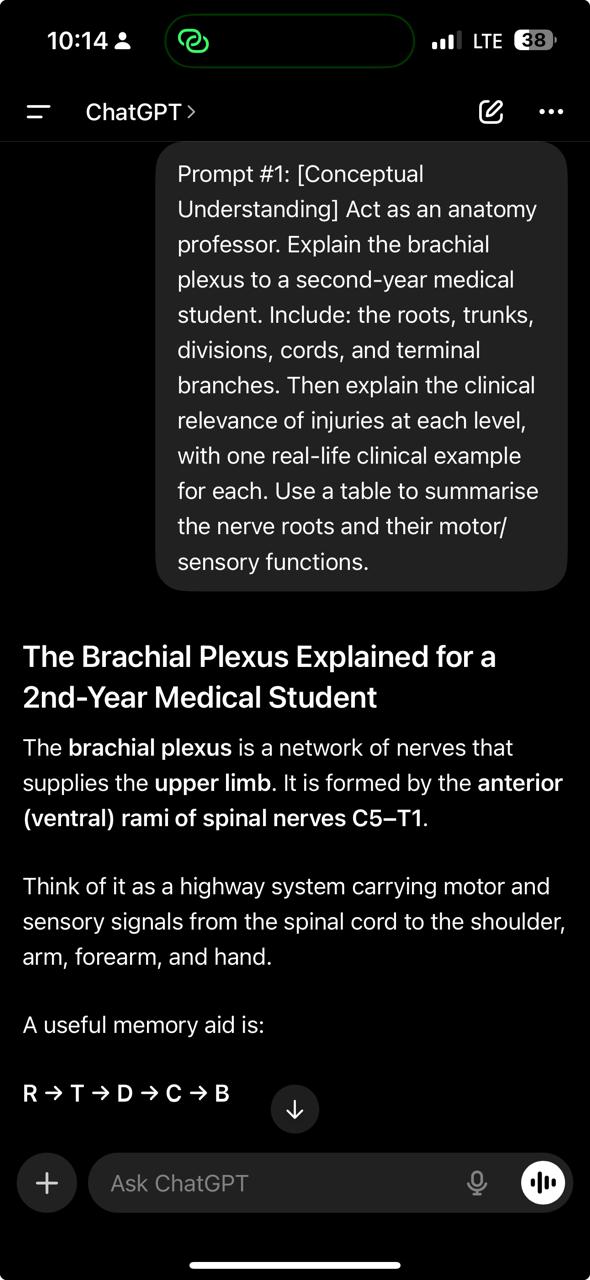
First 10 Prompts
Prompt #1: [Conceptual Understanding] Act as an anatomy professor. Explain the brachial plexus to a second-year medical student. Include: the roots, trunks, divisions, cords, and terminal branches. Then explain the clinical relevance of injuries at each level, with one real-life clinical example for each. Use a table to summarise the nerve roots and their motor/sensory functions.
Prompt #2: [Clinical Connection] Act as a consultant surgeon. Explain the clinical anatomy of the inguinal canal to a medical student preparing for finals. Include: boundaries, contents, differences between direct and indirect hernias, and why the inguinal canal is a common site for herniation in males. Relate the anatomy to the clinical examination findings.
Prompt #3: [Mechanism of Action] Explain the cardiac cycle to a final-year medical student. Include: the sequence of events from atrial systole to ventricular relaxation, the pressure-volume relationship, the role of heart sounds, and how abnormalities in the cycle produce specific clinical signs such as murmurs and added sounds.
Prompt #4: [System Integration] Act as a physiology tutor. Explain the renin-angiotensin-aldosterone system (RAAS) to a medical student. Cover: the trigger for activation, each step of the cascade, the physiological effects on blood pressure and fluid balance, and how each step is targeted by specific antihypertensive medications. Include a flow diagram description I can recreate.
Prompt #5: [Visual Description] Describe the cross-sectional anatomy of the spinal cord to a medical student. Include: the arrangement of grey and white matter, the major ascending and descending tracts, their functions, and what deficits result from lesions at specific cord levels. Explain the difference between upper and lower motor neuron signs.
Prompt #6: [Comparative Learning] Compare the portal and systemic venous circulations. Explain the clinical consequences of portal hypertension, including portosystemic anastomoses and the signs doctors look for on clinical examination. Relate each anatomical anastomosis to a specific clinical finding.
Prompt #7: [Applied Physiology] Explain oxygen-haemoglobin dissociation curve shifts to a medical student. Cover: what causes left and right shifts, the physiological and clinical significance of each shift, and give three clinical scenarios where understanding the shift is essential for patient management.
Prompt #8: [Examination Focus] Generate 15 high-yield anatomy and physiology multiple-choice questions at the final-year medical student level. Focus on clinically relevant anatomy that commonly appears in licensing examinations. For each question, provide four answer options, the correct answer, and a brief explanation.
Prompt #9: [Memory Aid Creation] Create memorable mnemonics and memory aids for the following: (1) cranial nerve names and numbers, (2) the branches of the facial nerve, (3) carpal bones, and (4) the rotator cuff muscles. For each mnemonic, explain how it maps to the actual anatomical structure.
Prompt #10: [Weak Area Targeting] I am a medical student who struggles with understanding the lymphatic system. Explain it from first principles — what it is, why it exists, how it works, its relationship to immunity, and what happens when it fails. Then give me five clinical conditions resulting from lymphatic dysfunction, with brief explanations for each.
Category 2: Pathology and Disease Process Prompts (Prompts 11–20)
Pathology is the bridge between basic science and clinical medicine. Understanding why a disease behaves the way it does — the cellular and molecular mechanisms underlying symptoms, signs, and laboratory findings — is what separates doctors who understand medicine from those who simply memorise it. Moreover, pathophysiology is consistently the most heavily tested domain in licensing examinations.
These prompts use AI to build pathophysiological understanding through mechanism-first explanations, case-based learning, and examination-focused summaries.
Next 11-20 Prompts
Prompt #11: [Mechanism First] Act as a pathologist. Explain the pathophysiology of type 2 diabetes mellitus from first principles. Cover: insulin resistance at the cellular level, beta cell dysfunction, the consequences of chronic hyperglycaemia on major organ systems, and the pathological basis of each diabetic complication. Use a structured format with subheadings.
Prompt #12: [Cascade Explanation] Explain the pathophysiology of sepsis to a final-year medical student. Include: the initial infectious trigger, the systemic inflammatory response, the coagulation cascade involvement, end-organ failure mechanisms, and why the management focuses on source control, fluids, and early antibiotics.
Prompt #13: [Comparison Table] Create a comparison table of the four types of hypersensitivity reactions (Types I–IV). For each type: include the mechanism, mediators involved, time course, classic clinical examples, and the treatment principle. Format as a clear table I can use for revision.
Prompt #14: [Disease Progression] Explain the progression from normal liver to cirrhosis. Cover: the common causes, the cellular injury mechanisms, the role of stellate cells in fibrosis, the consequences of portal hypertension, and the major clinical complications a student must know for examinations.
Prompt #15: [Oncology Basics] Explain the hallmarks of cancer to a medical student. For each hallmark, give a brief mechanistic explanation and one clinical or pharmacological implication. Then explain how this understanding informs modern oncology treatments such as targeted therapy and immunotherapy.
Prompt #16: [Inflammatory Conditions] Act as a consultant rheumatologist. Explain the pathophysiology of rheumatoid arthritis versus osteoarthritis to a medical student. Cover: the difference in underlying mechanisms, the characteristic histological and radiological findings, the clinical differences in presentation, and the treatment rationale for each.
Prompt #17: [Renal Pathology] Explain the pathophysiology of acute kidney injury (AKI) to a final-year student. Cover: the three categories (pre-renal, intrinsic, post-renal), the mechanisms in each category, the urine findings that distinguish them, and the management priorities for each type. Include the criteria used to diagnose and stage AKI.
Prompt #18: [Respiratory Pathology] Compare the pathophysiology of asthma and COPD. For each condition, cover: the underlying cellular mechanisms, the reversibility of airflow obstruction, the spirometry findings, the key differences in management, and why the same treatment does not apply to both.
Prompt #19: [MCQ Generation] Generate 20 pathology MCQs at the final-year licensing examination level. Focus on pathophysiology, disease mechanisms, and laboratory findings. For each question, include four answer options, the correct answer, and a one-paragraph explanation covering the underlying mechanism.
Prompt #20: [Tropical Disease Focus] Act as an infectious disease specialist. Explain the pathophysiology of cerebral malaria to a doctor working in sub-Saharan Africa. Cover: the mechanism of Plasmodium falciparum sequestration, the blood-brain barrier disruption, the clinical presentation, the diagnostic criteria, and the evidence-based treatment approach.
Category 3: Pharmacology Prompts (Prompts 21–30)
Pharmacology is one of the most feared subjects in medical school — and one of the most clinically consequential. Therefore, understanding not just what a drug does but why it works, when to use it, when not to, and what to watch for is a clinical imperative.
These prompts are designed to build pharmacological understanding through mechanism-first teaching, drug comparison tables, and clinical application scenarios.
Next 21-30 Prompts
Prompt #21: [Mechanism Deep-Dive] Act as a clinical pharmacologist. Explain the mechanism of action, pharmacokinetics, clinical uses, major side effects, and contraindications of metformin to a medical student. Then explain why metformin is preferred over other antidiabetic agents as first-line therapy in type 2 diabetes without renal impairment.
Prompt #22: [Drug Class Overview] Create a structured overview of beta-blockers for a final-year medical student. Cover: the classification (selective vs non-selective), mechanism of action, cardiovascular indications, respiratory contraindications, common side effects, and three high-yield clinical pearls that frequently appear in licensing examinations.
Prompt #23: [Comparison Table] Create a comparison table of the five main classes of antihypertensive agents: ACE inhibitors, ARBs, calcium channel blockers, thiazide diuretics, and beta-blockers. For each class: include mechanism of action, preferred clinical scenarios, key side effects, and contraindications. Highlight which classes are preferred in specific populations such as diabetics, pregnant women, and patients with heart failure.
Prompt #24: [Antibiotic Stewardship] Explain the principles of antibiotic selection and stewardship to a final-year medical student. Cover: the main antibiotic classes and their mechanisms; the concept of spectrum (narrow vs broad); empirical vs targeted therapy; the mechanisms of antibiotic resistance; and the clinical situations where antibiotic use should be questioned rather than automatic.
Prompt #25: [Adverse Effects Focus] I am a medical student studying drug adverse effects. Explain the most clinically important adverse effects of the following drugs, including the mechanism behind each effect: (1) aspirin, (2) ACE inhibitors, (3) aminoglycosides, (4) methotrexate, and (5) corticosteroids. Focus on effects that carry a significant clinical risk.
Prompt #26: [Drug Interactions] Explain the most clinically important drug interactions that a final-year medical student must know for examinations and clinical practice. Organise by mechanism: pharmacokinetic interactions (absorption, distribution, metabolism, excretion) and pharmacodynamic interactions (additive, synergistic, antagonistic). Give three examples of each with clinical consequences.
Prompt #27: [Special Populations] Explain the principles of prescribing in special populations: (1) renal impairment, (2) hepatic impairment, (3) pregnancy, and (4) elderly patients. For each population, explain the pharmacokinetic changes, give examples of drugs that require dose adjustment or avoidance, and provide a clinical reasoning framework for prescribing decisions.
Prompt #28: [Pain Management] Act as a consultant in pain management. Explain the WHO analgesic ladder to a final-year medical student. Cover: the three steps of the ladder, the drugs used at each step, their mechanisms, their side effects, the concept of opioid titration, and the specific considerations for pain management in resource-limited settings.
Prompt #29: [Emergency Pharmacology] Create a high-yield summary of emergency pharmacology for a medical student. Cover: the drugs used in anaphylaxis, acute asthma, hypertensive emergency, status epilepticus, and acute MI. For each emergency, provide the drug name, dose, route of administration, and mechanism of action.
Prompt #30: [Pharmacology MCQs] Generate 20 pharmacology MCQs at the final-year licensing examination standard. Focus on the mechanism of action, drug interactions, adverse effects, and clinical applications. For each question, provide four answer options, the correct answer, and an explanation covering the key pharmacological concept being tested.
Category 4: Clinical Medicine Prompts (Prompts 31–40)
Clinical medicine is where knowledge becomes practice. These prompts simulate the case-based learning environment that consultants use during ward rounds and bedside teaching — arguably the most effective form of medical education. Furthermore, case-based prompts help students develop the clinical reasoning skills that examinations test and patients depend on.
During my internship at Korle-Bu, I used prompts like these almost daily to prepare for consultant ward rounds. They consistently revealed knowledge gaps I did not know I had — before those gaps became apparent to senior colleagues.
Next 31-40 Prompts
Prompt #31: [Case Presentation] Act as a consultant physician. Present a clinical case of a 58-year-old male with progressive breathlessness, orthopnoea, and ankle swelling. Guide me through the differential diagnosis, the key history and examination findings that would distinguish between the main diagnoses, the investigations I would order, and the initial management plan.
Prompt #32: [Differential Diagnosis] I am a medical student on a clinical rotation. A patient presents with an acute onset of right iliac fossa pain in a 22-year-old female. Help me build a structured differential diagnosis, ranked by probability. For each diagnosis, explain the distinguishing features I should look for on history, examination, and investigation.
Prompt #33: [Clinical Examination] Act as a clinical skills tutor. Walk me through a systematic cardiovascular examination as if I were a student about to sit my final OSCE. Include: the correct order of examination, what I am looking for at each step, the clinical signs I might find, and their diagnostic significance. Highlight the ten most commonly tested cardiovascular signs in licensing examinations.
Prompt #34: [Investigation Interpretation] Teach me how to interpret an arterial blood gas result systematically. Provide a step-by-step framework, then give me five ABG scenarios to interpret — including a respiratory acidosis, metabolic alkalosis, mixed picture, compensated respiratory alkalosis, and anion gap metabolic acidosis. Explain the clinical context for each.
Prompt #35: [ECG Interpretation] Act as a cardiologist. Teach me a systematic approach to ECG interpretation. Then provide descriptions of five ECG patterns I should be able to identify for licensing examinations: normal sinus rhythm, AF, complete heart block, STEMI, and left bundle branch block. For each, describe the key features and immediate clinical action required.
Prompt #36: [Ward Round Preparation] I am an intern preparing for a ward round on a patient with newly diagnosed pulmonary tuberculosis. Act as a consultant and generate the five questions you are most likely to ask me. Then provide model answers at the level of a junior doctor. Also, list the key clinical, laboratory, and radiological findings I should know for this case.
Prompt #37: [Clinical Pearls] Give me 20 high-yield clinical pearls in internal medicine that frequently appear in final-year licensing examinations. For each pearl, explain the clinical scenario, the key finding or concept, and why it matters in practice. Focus on the pearls that distinguish excellent students from average ones.
Prompt #38: [Surgical Emergencies] Act as a consultant surgeon. Explain the clinical approach to a patient presenting with an acute abdomen. Cover: the systematic history and examination approach, the key differential diagnoses, the red flag signs that indicate immediate surgical intervention, and the investigations required before theatre.
Prompt #39: [Paediatric Medicine] Act as a consultant paediatrician. Explain the clinical approach to a child presenting with fever and neck stiffness. Cover: the differential diagnosis, the clinical signs that distinguish bacterial meningitis from viral meningitis, the immediate management steps, and the specific considerations for this presentation in a Ghanaian district hospital setting.
Prompt #40: [Clinical Case MCQs] Generate 15 clinical medicine MCQs in extended matching question format. Each question should present a short clinical vignette and ask the student to select the most likely diagnosis, most appropriate investigation, or most appropriate next management step. Include answer explanations.
Category 5: Exam Preparation Prompts (Prompts 41–50)
Examination performance in medicine is not simply a measure of knowledge — it is a measure of how efficiently that knowledge can be accessed and applied under pressure. Consequently, active recall practice, spaced repetition, and simulated examination conditions consistently outperform passive reading in preparing students for high-stakes assessments.
These prompts transform AI into a personalised examiner — available at any time, infinitely patient, and capable of generating unlimited practice material tailored to your specific examination and knowledge gaps.
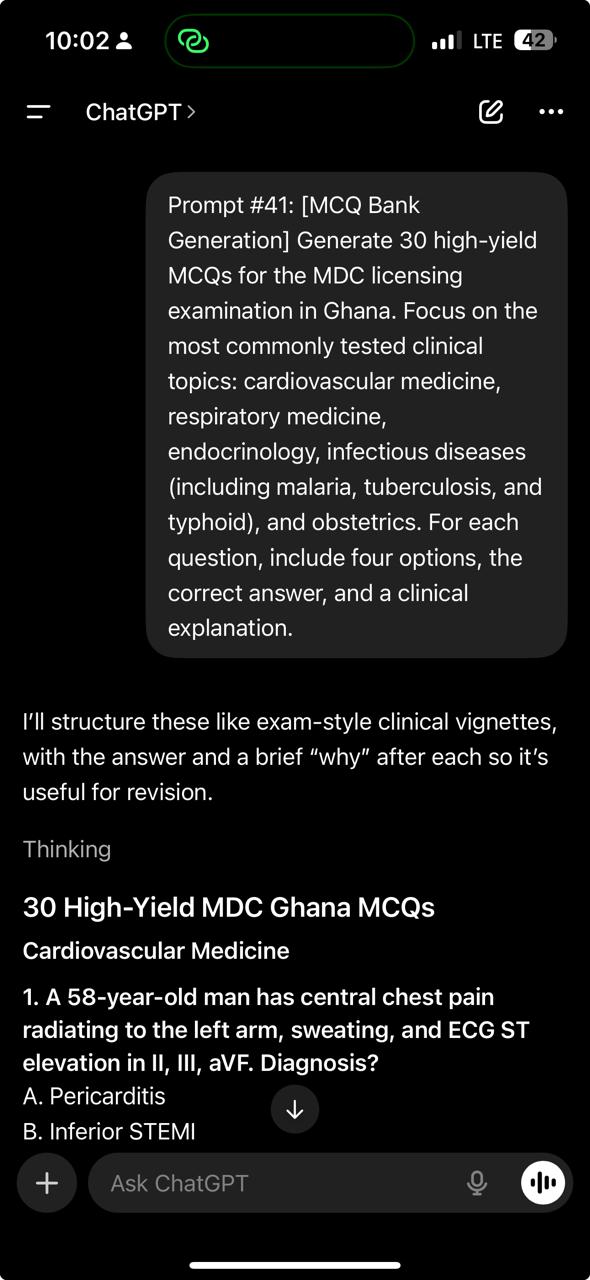
Next 41-50 Prompts
Prompt #41: [MCQ Bank Generation] Generate 30 high-yield MCQs for the MDC licensing examination in Ghana. Focus on the most commonly tested clinical topics: cardiovascular medicine, respiratory medicine, endocrinology, infectious diseases (including malaria, tuberculosis, and typhoid), and obstetrics. For each question, include four options, the correct answer, and a clinical explanation.
Prompt #42: [OSCE Station Creation] Create a complete OSCE station for a patient presenting with an acute onset of unilateral visual loss. Include: the clinical scenario, the examiner’s mark sheet with allocated marks, the key history questions, the examination findings to elicit, the differential diagnosis, and the immediate management plan. Write it at the level of a final-year medical student examination.
Prompt #43: [Spaced Repetition Cards] Convert the following topic into 20 Anki-style flashcards suitable for spaced repetition: the management of hypertensive emergencies. Each card should have a clear question on the front and a concise, accurate answer on the back. Include pharmacological and non-pharmacological management, and flag any items that have changed with recent guideline updates.
Prompt #44: [Weak Area Analysis] I consistently struggle with questions in renal medicine. Act as an experienced medical examiner. Identify the ten most commonly tested renal medicine concepts in final-year licensing examinations. For each concept, provide a brief explanation, the key fact students most often get wrong, and one high-yield MCQ with an explanation.
Prompt #45: [Study Plan Generation] I have six weeks until my MDC licensing examination in Ghana. I need to cover: medicine, surgery, obstetrics and gynaecology, paediatrics, psychiatry, and public health. Create a structured six-week study plan with daily targets, weekly review sessions, and a final two-week revision strategy. Include AI-assisted study methods for each subject.
Prompt #46: [High-Yield Summary] Create a high-yield examination summary of the ten most important conditions in each of the following specialities: cardiology, respiratory medicine, gastroenterology, and neurology. For each condition, include the classic presentation, the key investigation, and the first-line management. Format as a revision table.
Prompt #47: [Past Question Analysis] Act as an experienced medical examiner. I will give you a topic, and you will predict the ten questions most likely to appear in the MDC Ghana licensing examination on that topic, based on common examination themes. Topic: management of acute MI. For each predicted question, provide the question, the answer, and a brief explanation.
Prompt #48: [Self-Assessment Quiz] Quiz me on respiratory medicine. Ask me ten questions, one at a time. After I answer each question, tell me whether I am correct or incorrect, provide the correct answer with an explanation, and then ask the next question. Start with question one now.
Prompt #49: [Rapid Revision Notes] Create rapid revision notes on stroke management for a student with two days before their examination. Include: definition, classification (ischaemic vs haemorrhagic), clinical features, the FAST mnemonic, investigations, time-sensitive management (thrombolysis criteria), secondary prevention, and five key exam facts. Keep each section to five bullet points maximum.
Prompt #50: [Post-Exam Reflection] I have just completed a practice examination and scored 58%. I got the following topics wrong: renal medicine, haematology, and dermatology. Act as a study coach. Analyse my performance, identify any likely knowledge gaps, create a targeted revision plan for the next two weeks, and recommend specific AI prompts and tools to use for each weak area.
Category 6: Medical Research Prompts (Prompts 51–60)
Research literacy is increasingly essential for modern medical practice. Every doctor makes clinical decisions based on evidence — and understanding where that evidence comes from, how reliable it is, and how to find it efficiently is a core professional skill. Additionally, for students with academic ambitions, early exposure to research tools and workflows builds capabilities that pay dividends throughout a career.
These prompts draw on the research workflows I described in detail in the AI for Medical Research article on this site. They are specifically designed for students beginning their research journey with limited institutional support.
Next 51-60 Prompts
Prompt #51: [Research Question Framing] I have observed that many hypertensive patients in Ghana do not return for follow-up after their initial diagnosis. Help me frame this observation as a formal research question using the PICO framework. Then suggest three different study designs that could answer the question — a cross-sectional survey, a retrospective cohort study, and a qualitative study — and explain the advantages and limitations of each.
Prompt #52: [Literature Search Strategy] Help me build a comprehensive Boolean search strategy for PubMed on the following topic: the effectiveness of community health worker interventions for hypertension management in sub-Saharan Africa. Include MeSH terms, free text terms, and Boolean operators. Suggest at least three additional databases I should search in addition to PubMed.
Prompt #53: [Paper Analysis] I have uploaded a research paper on the prevalence of hypertension in Ghana. Provide a structured critical appraisal covering: (1) research question and study design, (2) methodology strengths and weaknesses, (3) key findings and statistical significance, (4) limitations acknowledged by the authors, (5) limitations NOT acknowledged by the authors, and (6) clinical implications for Ghana.
Prompt #54: [Systematic Review Guidance] Act as a research methodologist. Explain the steps required to conduct a systematic review on AI-assisted diagnosis in resource-limited settings. Cover: defining the review question, building the search strategy, the PRISMA flow diagram, inclusion and exclusion criteria, data extraction, quality assessment tools (GRADE, Cochrane Risk of Bias), and synthesis methods.
Prompt #55: [Statistical Concepts] Explain the following statistical concepts to a medical student with no formal statistics training: (1) p-value and statistical significance, (2) confidence intervals, (3) relative risk vs odds ratio, (4) number needed to treat, and (5) sensitivity and specificity. For each concept, give a clinical example that illustrates why it matters for interpreting research.
Prompt #56: [Research Proposal Writing] Help me write a structured research proposal outline on the following topic: predictors of lost-to-follow-up among hypertensive patients attending a district hospital in Ghana. Include sections for: background and rationale, research objectives, methodology, ethical considerations, expected outcomes, and limitations. Use academic language appropriate for a grant application.
Prompt #57: [Abstract Writing] Help me write a structured abstract for a research paper with the following findings: a cross-sectional study of 500 patients attending a hypertension clinic in Accra found a prevalence of uncontrolled hypertension of 67.4%, with younger age and rural origin being the strongest predictors of poor control. The abstract should follow IMRAD format and be under 300 words.
Prompt #58: [Thesis Structure] I am a final-year medical student writing a thesis on the burden of non-communicable diseases in Ghana. Help me create a detailed chapter-by-chapter outline for the thesis. Each chapter should include a list of subsections with brief descriptions of what each section should cover. The thesis is expected to be 8,000–12,000 words.
Prompt #59: [Reference Management] Explain how to use Zotero to manage references for a medical research paper. Cover: how to install the browser plugin, how to capture citations from PubMed and journal websites, how to organise references into folders, how to insert citations into Microsoft Word, and how to generate a formatted reference list in Vancouver style.
Prompt #60: [AI Ethics in Research] Explain the ethical principles that medical students and doctors must follow when using AI tools in research. Cover: AI disclosure requirements for academic journals, patient confidentiality when using AI for data analysis, the problem of citation hallucination, limitations of AI authorship, and best practice guidelines from the ICMJE.
Category 7: Productivity and Learning Prompts (Prompts 61–70)
Medical students face one of the heaviest information loads of any educational programme in the world. Consequently, the ability to manage time, organise knowledge, and maintain sustained productivity over a multi-year course is as important as raw academic ability. These prompts help students use AI as a personal productivity system — transforming how they take notes, manage their schedule, and approach self-directed learning.
Next 61-70 Prompts
Prompt #61: [Lecture Summarisation] I am going to paste the notes from a two-hour cardiology lecture. Summarise them into a structured revision document with the following sections: key definitions, core mechanisms, clinical relevance, high-yield exam facts, and five questions I should be able to answer after studying this topic.
Prompt #62: [Mind Map Creation] Create a detailed text-based mind map of the management of type 2 diabetes mellitus. Include branches for: lifestyle modification, pharmacological management (first-line through fourth-line), monitoring targets, complication screening, and emergency management of hypoglycaemia and DKA. Format it so I can recreate it visually.
Prompt #63: [Personalised Study Schedule] Act as an academic coach for a medical student. I have the following subjects to cover before my end-of-year examination in eight weeks: medicine (40% of exam), surgery (25%), obstetrics and gynaecology (20%), and public health (15%). I study best in the mornings and have approximately three hours available daily. Create a personalised eight-week study schedule.
Prompt #64: [Note Reorganisation] I have unstructured notes on the management of acute coronary syndromes from three different sources. I will paste them below. Reorganise the information into a single, structured clinical summary with: definition and classification, pathophysiology, clinical presentation, investigations, management (STEMI vs NSTEMI), and post-discharge management.
Prompt #65: [Concept Simplification] I do not understand the complement system despite reading about it multiple times. Explain it to me as if I were completely new to the topic. Start with the simplest possible explanation, then gradually add complexity. Use analogies, clinical examples, and memory aids. By the end of the explanation, I should understand the three pathways and their clinical relevance.
Prompt #66: [Productivity Audit] Act as a productivity coach for a medical student. I will describe my current weekly study routine: [describe your routine here]. Analyse my routine, identify the three biggest inefficiencies, and recommend specific AI-assisted strategies to improve my output without increasing my total study hours.
Prompt #67: [Comparison Table] Create a comprehensive comparison table of the major causes of anaemia. Include: the type of anaemia, the mechanism, the blood film findings, the key investigation results (MCV, MCHC, reticulocyte count), the clinical features, and the treatment. Format as a table I can use for revision.
Prompt #68: [Teaching Preparation] I have been asked to give a 15-minute teaching session to junior medical students on the clinical approach to a patient with jaundice. Help me create a structured teaching plan with learning objectives, a clinical case to open the session, key teaching points, an interactive question to engage students, and a summary take-home message.
Prompt #69: [Revision Timetable for Weak Areas] I have four weeks until my pharmacology examination. My weakest areas are cardiovascular pharmacology, antibiotic prescribing, and adverse drug effects. Create a four-week revision timetable that prioritises these areas while maintaining coverage of the full pharmacology curriculum. Include specific AI prompt suggestions for each revision session.
Prompt #70: [End-of-Day Reflection] Act as an academic mentor. I will describe what I studied today. Identify what I understood well, what I likely understood superficially, and what I should revise tomorrow. Generate three self-test questions I should answer before bed to consolidate today’s learning, and three questions to start with tomorrow morning.
Category 8: Communication Skills Prompts (Prompts 71–80)
Clinical communication is a skill that is both highly tested in medical examinations and critically important in clinical practice. Yet it receives less structured practice time than clinical knowledge in most medical school curricula. These prompts use AI to simulate the communication challenges medical students face — from breaking bad news to writing referral letters — in a low-stakes environment where mistakes are learning opportunities rather than patient safety events.
Next 71-80 Prompts
Prompt #71: [History Taking Practice] Act as a simulated patient. You are a 45-year-old woman who presents to a GP clinic with a six-week history of fatigue and weight gain. Respond only to questions I ask you — do not volunteer information unprompted. I will practice taking a full history. When I have finished, provide feedback on my history-taking technique, noting what I covered well, what I missed, and what I could improve.
Prompt #72: [Breaking Bad News] Act as a communication skills tutor. Walk me through the SPIKES protocol for breaking bad news to a patient. Then simulate a scenario where I need to tell a 52-year-old patient that their biopsy result has confirmed colorectal cancer. Provide a model script I can use as a reference, then give me feedback on the key principles I must demonstrate.
Prompt #73: [Patient Education] I need to explain type 2 diabetes management to a newly diagnosed 60-year-old patient with low health literacy in Ghana. Write a patient-friendly explanation of: what diabetes is, why blood sugar control matters, the lifestyle changes required, how to take their medication, and the warning signs that require immediate medical attention. Use simple language.
Prompt #74: [Referral Letter Writing] Help me write a formal referral letter from a district hospital to a teaching hospital. The patient is a 38-year-old male with a three-month history of progressively worsening headaches, papilledema on fundoscopy, and a recent onset of early morning vomiting, suggesting raised intracranial pressure. Include all essential clinical information a receiving specialist would need.
Prompt #75: [Difficult Conversations] Act as a communication coach. A patient on your ward is refusing a blood transfusion on religious grounds despite a haemoglobin of 5.2 g/dL. Help me understand: the ethical principles involved, the patient’s right to informed refusal, the required documentation, how to communicate compassionately with the patient, and when escalation to a senior clinician is required.
Prompt #76: [Discharge Summary] Help me write a structured discharge summary for the following patient: a 68-year-old male admitted with decompensated heart failure, who was managed with IV furosemide and had his antihypertensive medications adjusted. He is being discharged on new medications and requires follow-up in four weeks. Include all standard components of a discharge summary.
Prompt #77: [Informed Consent] Explain the principles of informed consent to a final-year medical student. Cover: the three components of valid consent (information, understanding, voluntariness), capacity assessment, the standard of information disclosure, consent in emergencies, consent for minors, and documentation requirements. Give one clinical scenario for each principle.
Prompt #78: [Multidisciplinary Communication] Act as a communication skills tutor. Teach me how to present a patient case effectively in a multidisciplinary team meeting. Cover: the correct structure for an MDT presentation, what information each team member needs, how to summarise complex clinical information concisely, and how to advocate effectively for a patient’s needs in a team setting.
Prompt #79: [Telephone Consultation] Act as a clinical supervisor. I need to call a consultant at night to discuss a deteriorating patient on the ward. Teach me the SBAR (Situation, Background, Assessment, Recommendation) communication framework. Then simulate a telephone consultation where I present a patient using SBAR, and you respond as the consultant, asking follow-up questions.
Prompt #80: [Health Education Talk] I am a medical student who has been asked to give a health education talk on hypertension prevention to a community group in Accra. Help me create a 20-minute talk outline. Include: an engaging opening, key messages about risk factors and prevention, practical advice tailored to a Ghanaian audience, and a Q&A strategy. Use language appropriate for a non-medical community audience.
Category 9: African Clinical Context Prompts (Prompts 81–90)
Most AI-generated medical content is calibrated for Western clinical environments. As a result, the outputs often fail to reflect the disease burden, resource constraints, and clinical realities facing doctors and students in Ghana and across Africa. These prompts are specifically designed to generate clinically relevant content for the African context.
I developed this category directly from my experience conducting health screenings across all 16 regions of Ghana and from my internship at Korle-Bu, where the conditions I managed every day were often underrepresented in the standard English-language medical curriculum.
Next 81-90 Prompts
Prompt #81: [Tropical Disease Management] Act as a consultant tropical medicine physician working in Ghana. Explain the clinical approach to a patient presenting with fever, rigours, and thrombocytopaenia. Cover: the differential diagnosis in a malaria-endemic setting, the diagnostic approach using RDT and blood film, the management of uncomplicated versus severe malaria according to current WHO and Ghana Health Service guidelines, and the criteria for hospital admission.
Prompt #82: [NCD Burden Context] Explain the burden of non-communicable diseases in Ghana to a medical student. Cover: the epidemiology of hypertension, diabetes, stroke, and obesity in the Ghanaian population, the healthcare system challenges in managing NCDs, the role of the NHIS in treatment access, and what evidence-based prevention strategies are most relevant for the Ghanaian context.
Prompt #83: [Resource-Limited Investigations] Act as a clinician in a district hospital in Ghana where CT scanning, MRI, and echocardiography are not immediately available. A patient presents with heart failure. How do I diagnose and manage this patient using only clinical examination and the investigations available in a typical Ghanaian district hospital? What are my management priorities?
Prompt #84: [Sickle Cell Disease] Explain the management of sickle cell disease to a final-year medical student in Ghana, where sickle cell disease is one of the most common genetic conditions. Cover: the pathophysiology of sickling, the clinical complications (painful crisis, acute chest syndrome, splenic sequestration, stroke, infections), the management of acute crises, and long-term preventive strategies.
Prompt #85: [Maternal Health] Act as a consultant obstetrician. Explain the management of pre-eclampsia in a district hospital in Ghana. Cover: the diagnostic criteria, the difference between pre-eclampsia and eclampsia, the immediate management priorities, the use of magnesium sulphate, the antihypertensive options available in Ghana, and the decision-making around timing of delivery.
Prompt #86: [CHPS System Integration] Explain the role of the Ghana Community-based Health Planning and Services (CHPS) system in managing non-communicable diseases. How should a community health officer use available AI tools and mobile health technologies to improve hypertension screening, medication adherence, and follow-up in a rural CHPS zone? Give practical implementation suggestions.
Prompt #87: [Infectious Disease in Africa] Explain the clinical approach to HIV management in Ghana to a final-year medical student. Cover: the epidemiology in Ghana, the clinical staging, the criteria for initiating ART, the first-line and second-line regimens available through the NHIS, the management of common opportunistic infections, and the principles of HIV/TB co-infection management.
Prompt #88: [Nutrition and Health] Explain the clinical approach to malnutrition in children in Ghana. Cover: the WHO classification of acute malnutrition (SAM and MAM), the clinical features distinguishing kwashiorkor from marasmus, the F-75 and F-100 therapeutic feeding protocols, the criteria for community versus in-patient management, and the role of ready-to-use therapeutic food (RUTF).
Prompt #89: [Mental Health in Africa] Explain the burden and management of mental health conditions in Ghana to a medical student. Cover: the epidemiology of depression, anxiety, and psychosis in Ghana, the barriers to mental health care, the current framework of the Mental Health Act, the role of the community psychiatric nurse, and the evidence-based treatments available within the NHIS.
Prompt #90: [Preventive Health Screening] Design a community hypertension and diabetes screening programme for a peri-urban community in Ghana with a population of 20,000. Include: the target population, the screening tools, the referral cut-off values, the follow-up pathway within the NHIS system, the data collection approach, and how AI tools could be used to identify high-risk individuals before clinical manifestation.
Category 10: Professional Development Prompts (Prompts 91–100)
Medicine is a profession, not just a job. Consequently, the non-clinical skills — ethical reasoning, career planning, self-care, leadership, and professional writing — matter as much as clinical knowledge in the long run. These prompts help medical students develop the professional identity, habits, and capabilities that will define their careers beyond the examination hall.
Furthermore, this category includes prompts specifically for students interested in health technology, digital health, and AI in medicine — areas that will shape the future of healthcare in Africa and globally.
Next 91-100 Prompts
Prompt #91: [Medical Ethics Case Analysis] Act as a medical ethics tutor. Analyse the following ethical dilemma using the four principles of medical ethics (autonomy, beneficence, non-maleficence, justice): A 16-year-old patient presents requesting contraception without parental knowledge. The doctor believes the patient is at risk of an unintended pregnancy. What are the competing ethical obligations, and how should the doctor proceed?
Prompt #92: [Career Planning] Act as a career mentor for a medical doctor in Ghana who has recently completed an internship. I want to understand the pathways available for specialist training in Ghana. Explain: the major specialities available through the Ghana College of Physicians and Surgeons, the entry requirements, the typical duration, the examination structure, and how to make a competitive application.
Prompt #93: [Reflective Writing] Help me write a structured reflective piece on a challenging clinical experience from my internship. I will describe the experience, and you will help me use Gibbs’ Reflective Cycle to structure my reflection: description, feelings, evaluation, analysis, conclusion, and action plan. Guide me through each stage with questions to prompt my thinking.
Prompt #94: [Leadership in Medicine] Explain the qualities of effective clinical leadership to a junior doctor. Cover: the difference between management and leadership, the key leadership styles relevant to clinical medicine, the role of emotional intelligence in clinical leadership, how to lead effectively in a multidisciplinary team, and the specific leadership challenges facing junior doctors in resource-limited African healthcare settings.
Prompt #95: [AI Literacy for Doctors] Act as an AI literacy educator. Explain to a final-year medical student the key concepts they need to understand about AI in healthcare: what large language models are, how they differ from clinical decision support systems, the concept of hallucination and its clinical risks, the current regulatory landscape for AI medical devices in Africa, and three practical ways to stay updated on AI developments in medicine.
Prompt #96: [Grant Application Writing] Help me write the introduction and rationale section of a small research grant application. The project aims to evaluate the feasibility of using mobile health technology for hypertension monitoring in rural Ghana. The funder is interested in projects that address healthcare gaps in low-resource settings. The maximum length for this section is 500 words.
Prompt #97: [Portfolio Building] Act as a career advisor. I am a junior doctor in Ghana interested in academic medicine and public health. Help me build a professional portfolio strategy for the next three years. Include: research publications I should aim for, conferences I should attend or present at, skills I should develop, online presence strategies, and how to position myself for an MPH application.
Prompt #98: [Self-Care and Wellbeing] Act as a wellbeing coach for medical students. Explain the evidence base for burnout in medical education and its specific risk factors in African medical schools. Then provide a practical, evidence-based self-care framework that a medical student can realistically implement during a demanding clinical rotation, including strategies for sleep, physical activity, social connection, and psychological recovery.
Prompt #99: [Digital Health Innovation] I am a medical doctor in Ghana interested in building a digital health application to improve medication adherence among hypertensive patients. Help me think through: the key user needs, the minimum viable product features, the data privacy considerations under Ghana’s Data Protection Act, the potential integration with the NHIS system, and the AI features that could add the most clinical value.
Prompt #100: [Personal Mission Statement] Act as a personal development coach. Help me write a clear, authentic professional mission statement as a medical doctor in Ghana who is passionate about AI in healthcare, preventive medicine, and improving health outcomes across Africa. The mission statement should be concise (under 100 words), memorable, and reflect both clinical and technological aspirations.
How I Used These Prompts: A Personal Note
From Stavropol to Korle-Bu — AI as a Learning Partner
The 100 prompts in this article are not theoretical constructs. They represent the evolution of my personal use of AI throughout medical school in Russia and during my internship at Korle-Bu Teaching Hospital in Accra.
In Russia, the challenge was access. As an African student studying tropical diseases in a country where those diseases do not exist, I often found the most relevant clinical resources unavailable in Russian. Prompts in the anatomy, pathology, and pharmacology categories were particularly valuable during that period — they helped me connect knowledge from Russian-language textbooks to the English-language clinical guidelines I would eventually need in practice.
The challenge
At Korle-Bu, the challenge changed. There, the challenge was speed. Every morning began with ward rounds. Consequently, every evening ended with preparation — reading about conditions I had encountered, generating practice questions on topics I had found difficult, and reviewing management protocols for cases I expected the following day. The clinical medicine and exam preparation prompts became part of my daily routine.
Furthermore, the African context prompted the Category 9 prompts, born of a specific frustration: generic AI outputs on conditions such as malaria, sickle cell disease, and pre-eclampsia often failed to reflect the resource constraints, guideline differences, and clinical realities of a Ghanaian teaching hospital. Adding context — specifying the setting, available resources, and national treatment guidelines — consistently produced more relevant and useful responses.
The single most important principle in this entire prompt library: always add your context. A prompt written for a medical student in New York will produce different output than one written for a final-year student preparing for the MDC exam in Ghana. The AI does not know your context unless you tell it.
Building AI Literacy as a Professional Skill
Looking ahead, AI literacy will become as fundamental a professional skill for doctors as clinical reasoning or communication skills. Moreover, the doctors who develop this skill early — who learn to prompt effectively, evaluate AI outputs critically, and integrate AI tools into their clinical and research workflows — will have a significant advantage throughout their careers.
However, AI literacy is not simply knowing which tools exist. It is about understanding what they can and cannot do, when to trust their outputs and when to verify them, and how to use them in ways that enhance rather than replace your own thinking.
Not A Shortcut
Therefore, use this prompt library not as a shortcut to understanding, but as an accelerant for it. Use prompts to explore concepts more deeply than a textbook alone allows. Generate the practice questions that convert passive knowledge into active recall. Utilise them to simulate the clinical conversations that build communication skills. And use them to develop the research habits that will make you a better doctor and a more credible voice in your clinical community.
That is the purpose of AI Doctor Africa. Not to replace the hard work of becoming a doctor, but to ensure that African medical students and doctors have access to the same tools, workflows, and learning strategies that are accelerating medical education everywhere else in the world.
Key Takeaways
- The quality of a ChatGPT prompt determines the quality of the output — specificity, context, and format instructions consistently produce better results
- All 100 prompts in this library work on both ChatGPT and Claude — Claude is stronger for deep explanations and research; ChatGPT is stronger for rapid content generation and MCQs
- Always add your clinical context: ‘final-year student preparing for the MDC exam in Ghana’ produces far more relevant output than generic prompts
- Category 9 (African Context) addresses the specific disease burden, resource constraints, and clinical guidelines relevant to doctors in Ghana and across sub-Saharan Africa
- AI prompts should accelerate learning — they should never replace active engagement with textbooks, clinical experience, and supervisor feedback
- Never enter real patient information into any AI platform, and never apply AI clinical outputs without verification against authoritative sources
- Combine these prompts with Anki spaced repetition for maximum long-term retention — AI generates the content, Anki ensures you remember it
- AI literacy — knowing how to prompt effectively and evaluate outputs critically — is an emerging professional skill as important as any clinical competency
- The African clinical context requires deliberate contextualisation of AI prompts — generic global outputs frequently fail to reflect local disease burden, resources, and guidelines
- Building a consistent AI-assisted study habit now will compound into a significant professional advantage over the course of a medical career
Frequently Asked Questions
The following questions address the most common concerns medical students raise about using ChatGPT prompts for study and clinical learning:
Question |
Answer |
| Are these prompts safe for medical students to use? | Yes, when used responsibly. These prompts help with learning, revision, and understanding — not clinical decision-making. Always verify AI outputs against your textbooks, approved guidelines, and supervisors before applying any information in a clinical setting. |
| Which AI tool works best with these prompts? | Claude works best for prompts that require deep explanation, long-document analysis, research synthesis, and academic writing. ChatGPT works best for generating MCQs, study plans, flashcards, and quick structured outputs. Many prompts work excellently on both platforms. |
Can I use these prompts during clinical rotations? |
Yes, with important caveats. These prompts help you prepare for cases, understand unfamiliar conditions, and review management plans.
However, never enter real patient information into any AI platform, and never use AI outputs as a substitute for senior clinical supervision during rotations. |
| Can African medical students access ChatGPT and Claude? | Yes. Both platforms are accessible in Ghana and across most of Africa. ChatGPT and Claude both offer free tiers that require no payment.
Paid tiers accept international debit cards and virtual cards from mobile money platforms, including MTN Mobile Money and Telecel Cash in Ghana. |
| Can I use these prompts to prepare for the MDC licensing exam? | Absolutely. Several categories in this article are specifically designed for licensing examination preparation, including MCQ generation, OSCE simulation, case-based learning, and high-yield concept revision.
Combine AI-generated content with Anki spaced repetition for maximum retention. |
What is the biggest mistake students make with AI prompts? |
Being too vague. A prompt like ‘explain hypertension’ produces a generic response.
A prompt like ‘explain hypertension to a final-year medical student preparing for the MDC licensing exam in Ghana, including pathophysiology, JNC 8 vs ACC/AHA classification, first-line treatment, and three clinical pearls’ produces a genuinely useful, targeted response. |
| Can these prompts replace textbooks? | No. AI prompts accelerate your engagement with textbook content — they do not replace it. Use prompts to clarify concepts you have read, generate practice questions on what you have studied, and identify gaps in your knowledge.
The depth and reliability of authoritative medical textbooks remain essential. |
| How do I adapt these prompts for my specific curriculum? | Add context to every prompt that mentions your medical school, country, or examination system.
For example, replace ‘licensing exam’ with ‘MDC exam in Ghana’, or add ‘in the context of a district hospital in Ghana with limited investigation resources’. Contextualisation consistently improves output quality. |
Related Articles on AI Doctor Africa
- How Medical Doctors Can Use Claude AI for Research, Clinical Learning, and Productivity in 2026
- ChatGPT vs Claude for Medical Doctors: Which AI Is Better in 2026?
- How Doctors Can Use AI to Save 10 Hours Every Week
- Best AI Tools for Medical Students in 2026: The Complete Guide
- How Doctors and Medical Students Can Use AI for Medical Research in 2026
About the Author
Dr Festus Kaasung Kunde is a Medical Doctor, AI in Healthcare Advocate, and Founder of AI Doctor Africa and Ghana Vitals. MD| Stavropol State Medical University, Russia (2025) and completed a clinical internship at Korle-Bu Teaching Hospital, Accra, Ghana.
Dr Kunde has conducted health screening exercises across all 16 regions of Ghana, delivered evidence-based health talks at secondary schools and universities in Accra, and is building Ghana Vitals — a preventive health data platform designed to identify chronic disease risk before complications develop.
He is currently preparing for the Medical and Dental Council (MDC) licensing examinations in Ghana.
His mission is to help healthcare professionals across Africa understand, adopt, and responsibly use artificial intelligence to improve learning, research, productivity, and patient outcomes
AI Doctor Africa | aidoctorafrica.com
Medical Disclaimer: This article is for educational purposes only. AI-generated content should never replace clinical judgment, verified medical references, or qualified healthcare supervision.