
50 Claude AI Prompts Every Medical Doctor Should Save in 2026
One of the biggest misconceptions about artificial intelligence is that people think the AI tool itself determines the quality of the output.
It doesn’t. The quality of the prompt often determines the quality of the result. This is especially true in healthcare. Two doctors can use the same AI platform and receive completely different outcomes. One receives a generic answer. The other receives an incredibly useful educational resource.
The difference is usually the prompt.
During my internship at Korle-Bu Teaching Hospital in Ghana, I quickly realised that AI became far more useful when I stopped asking simple questions and started providing context.
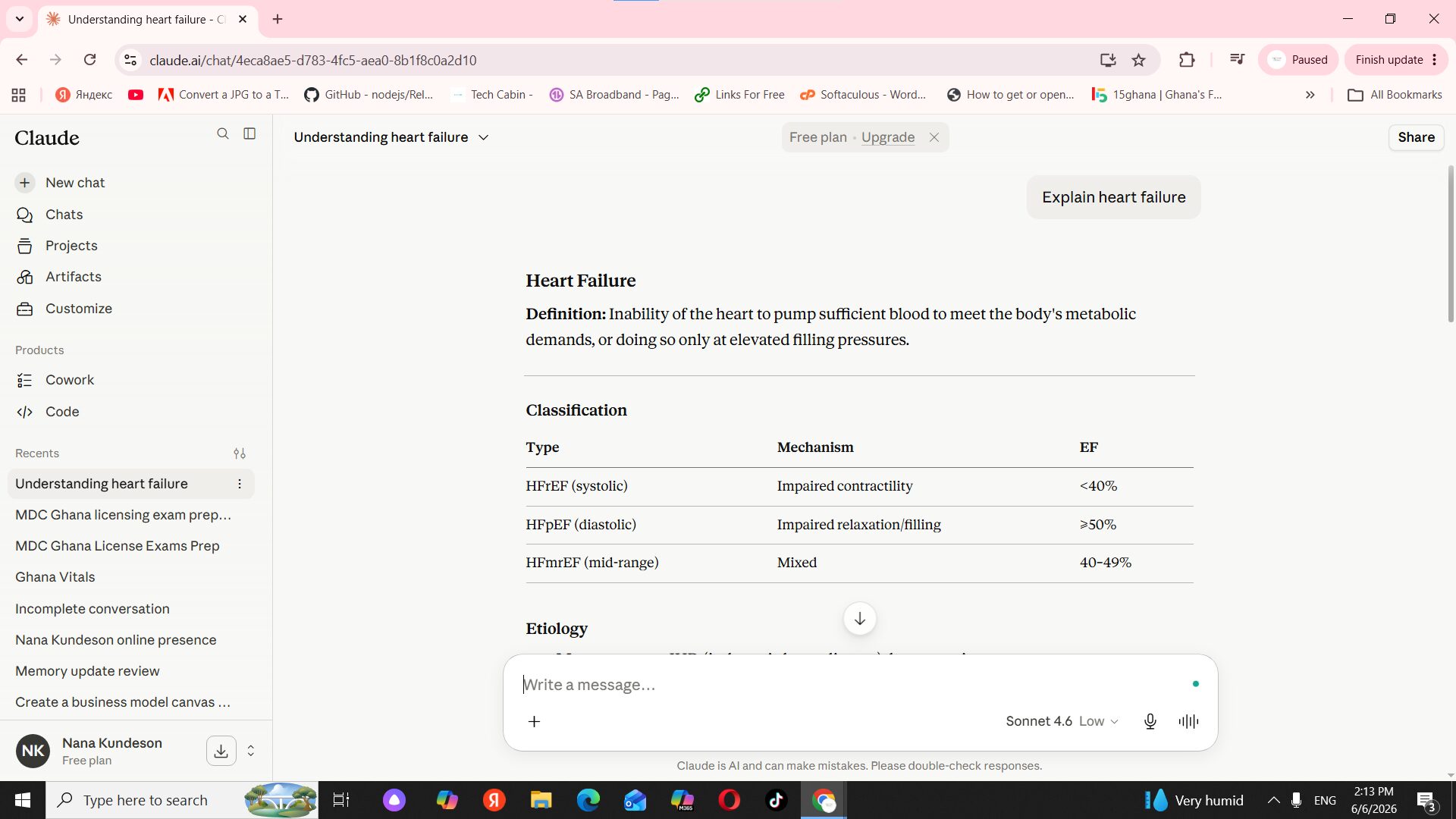
Instead of asking:
“Explain heart failure.”
I learned to ask:
“Act as a consultant cardiologist. Explain heart failure to a final-year medical student preparing for the Ghana Medical and Dental Council licensing examinations. Include pathophysiology, diagnosis, management, common viva questions, and clinical pearls.”
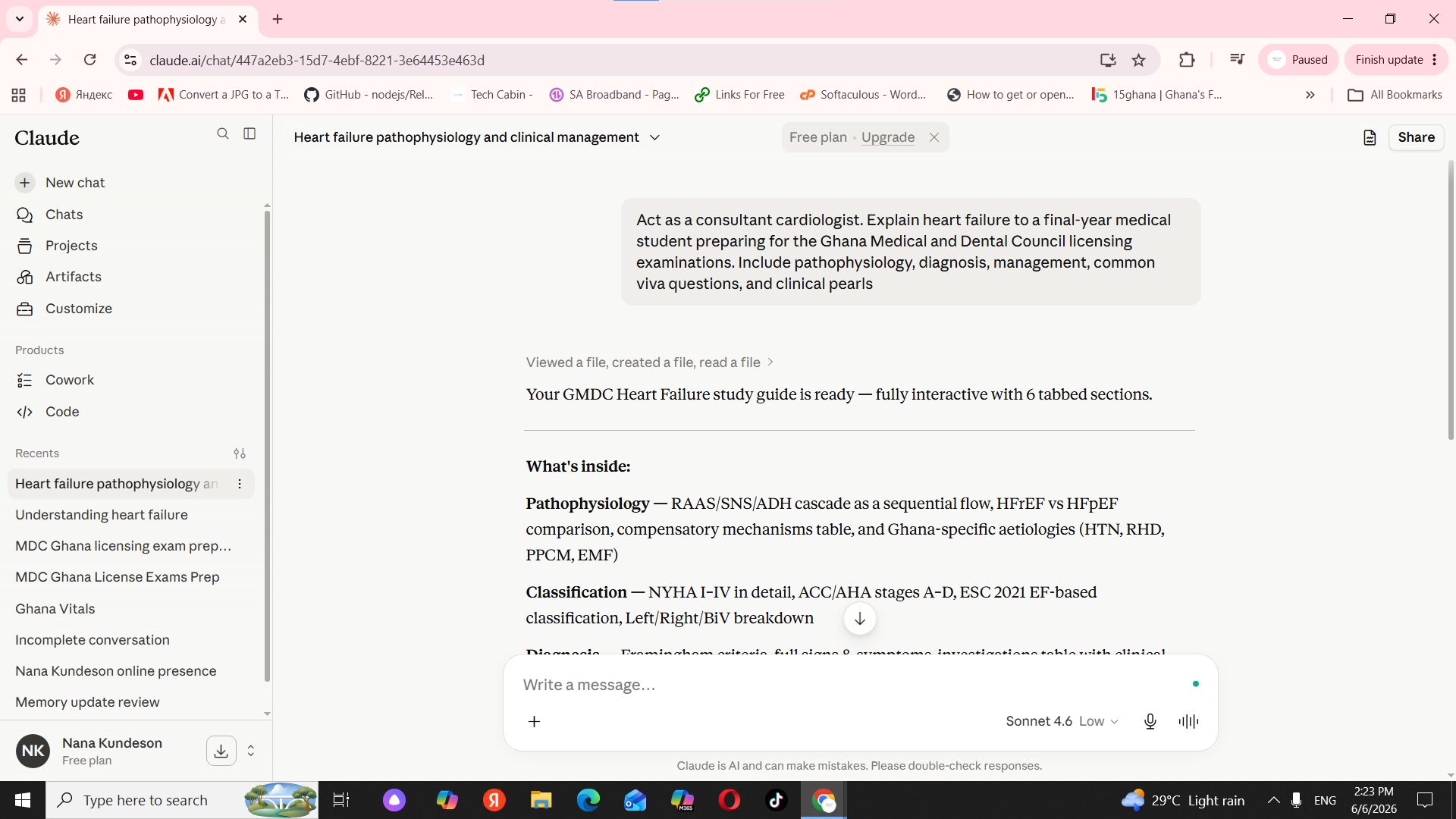
The difference was dramatic.
The second prompt produced a much richer educational experience. Straight to the Point answers that save you time from learning more information that you might not retain.
This article contains 50 practical Claude AI prompts that doctors, medical students, researchers, nurses, and healthcare professionals can begin using immediately.
These prompts are designed to:
- Improve learning
- Enhance productivity
- Support research
- Assist with education
- Accelerate professional development
The Anatomy of a Perfect Medical AI Prompt
Before diving into the prompts, let’s discuss a simple framework.
The best medical prompts usually contain five components:
1. Role
Tell Claude who it should act as.
Examples:
- Consultant physician
- Cardiologist
- Medical educator
- Public health specialist
- Research mentor
2. Task
What exactly do you want done?
Examples:
- Summarize
- Explain
- Compare
- Critique
- Generate
3. Context
Who is the audience?
Examples:
- Medical student
- Resident doctor
- Consultant physician
- Nurse
- Researcher
4. Output Format
Examples:
- Table
- Bullet points
- Flashcards
- MCQs
- Case discussion
5. Constraints
Examples:
- Maximum 500 words
- Include references
- Use simple language
- Focus on African healthcare settings
Example of a Weak Prompt
Explain diabetes.
Example of a Strong Prompt
Act as an endocrinology consultant. Explain Type 2 Diabetes Mellitus to a final-year medical student preparing for licensing examinations. Include pathophysiology, diagnosis, management, complications, clinical pearls, and 10 viva questions. Present the information in bullet-point format.
The second prompt is dramatically more effective.
SECTION 1:
Claude AI Prompts for Clinical Learning
Clinical learning is one of the most valuable uses of Claude AI.
Medicine is not simply about memorisation.
It is about understanding.
These prompts help doctors learn more efficiently.
Prompt #1
Learn Any Disease Quickly
Act as a consultant physician. Explain [Disease] to a final-year medical student. Include epidemiology, pathophysiology, risk factors, clinical presentation, investigations, management, complications, and clinical pearls.
Best for:
- Exam preparation
- Quick revision
- Ward round preparation
Prompt #2
Differential Diagnosis Masterclass
Create a differential diagnosis table for a patient presenting with [symptom]. Include distinguishing features, investigations, and red flags.
Example:
Chest pain
Shortness of breath
Abdominal pain
Headache
Prompt #3
Consultant-Level Teaching
Teach me [Topic] as if I am a first-year resident doctor. Use clinical examples and common examination questions.
Prompt #4
Clinical Pearls Generator
Generate 20 high-yield clinical pearls on [Disease].
Perfect before exams.
Prompt #5
Viva Examination Simulator
Act as an examiner and conduct a viva examination on [Topic]. Ask one question at a time and provide feedback.
Prompt #6
Case Discussion Prompt
Create a realistic patient case involving [Disease]. Allow me to work through diagnosis and management step by step.
Prompt #7
Guideline Simplifier
Summarize the latest guideline on [Topic] into practical points for a busy clinician.
Prompt #8
Compare Similar Diseases
Compare Disease A and Disease B in a table including symptoms, investigations, and management.
Example:
Crohn’s Disease vs Ulcerative Colitis
Prompt #9
Pathophysiology Deep Dive
Explain the pathophysiology of [Disease] from cellular mechanisms to clinical manifestations.
Prompt #10
Clinical Reasoning Trainer
Explain how an experienced consultant would approach a patient presenting with [Clinical Scenario].
SECTION 2:
Claude AI Prompts for Medical Students
Medical students represent one of the groups that can benefit most from AI.
The volume of information is enormous.
The right prompts can dramatically improve efficiency.
Prompt #11
30 High-Yield MCQs
Generate 30 licensing examination MCQs on [Topic] with explanations.
Prompt #12
Flashcard Generator
Convert this chapter into 50 flashcards suitable for active recall.
Prompt #13
Study Timetable Creator
Create a 14-day study timetable for [Subject].
Prompt #14
Anatomy Simplifier
Explain the anatomy of [Structure] using simple language and clinical correlations.
Prompt #15
Pharmacology Revision
Summarize the most important drugs used in [Disease] including mechanism, indications, side effects, and contraindications.
Prompt #16
OSCE Practice Station
Create an OSCE station for [Condition] including marking scheme and examiner expectations.
Prompt #17
Mnemonic Generator
Create memorable mnemonics for [Topic].
Prompt #18
Lecture Note Summarizer
Summarize these lecture notes into a one-page revision guide.
Prompt #19
Medical Image Learning
Explain how to interpret common findings seen in [Imaging Modality].
Example:
Chest X-rays
CT scans
MRI
Prompt #20
Licensing Exam Mentor
Based on MDC Ghana licensing examinations, identify high-yield concepts that students frequently struggle with in [Subject].
My Personal Workflow at Korle-Bu Teaching Hospital
One of the prompts I found most valuable during the internship was:
Act as a consultant physician. Based on these educational patient summaries, identify likely follow-up questions my consultant might ask during ward rounds. Explain the answers and suggest additional topics I should revise before presentation.
This single prompt often revealed knowledge gaps I would otherwise have missed.
Instead of being surprised during ward rounds, I arrived better prepared.
The goal was never to avoid learning.
The goal was to learn more effectively.
SECTION 3:
Claude AI Prompts for Medical Research
Research is one of the areas where Claude AI can provide the highest return on investment for doctors.
Many clinicians want to conduct research but struggle with:
- Literature reviews
- Research questions
- Protocol development
- Statistical interpretation
- Academic writing
The following prompts can dramatically reduce the time spent on these activities.
Prompt #21
Literature Review Assistant
Summarize this research paper and provide:
- Research objective
- Methodology
- Key findings
- Strengths
- Limitations
- Clinical implications
Prompt #22
Research Gap Finder
Based on these 20 studies, identify important research gaps that remain unanswered.
Perfect for:
- Master’s students
- Residents
- Early-career researchers
Prompt #23
Research Question Generator
Generate 30 research questions related to hypertension screening in Ghana.
Prompt #24
Protocol Builder
Act as a research mentor and create a research protocol outline for the following topic.
Prompt #25
Systematic Review Assistant
Compare these studies and organize findings according to common themes.
Prompt #26
Journal Club Preparation
Critically appraise this paper and prepare discussion points for a journal club presentation.
Prompt #27
Abstract Generator
Create a structured scientific abstract from these study findings.
Prompt #28
Grant Proposal Helper
Suggest objectives, outcomes, and impact statements for this grant proposal.
Prompt #29
Statistical Interpretation Assistant
Explain these statistical results in simple language suitable for clinicians.
Prompt #30
Manuscript Reviewer
Critique this manuscript and suggest improvements before journal submission.
SECTION 4:
Claude AI Prompts for Productivity
Most doctors underestimate how much time they spend on non-clinical activities.
The reality is that administrative work contributes significantly to physician burnout.
Claude can help reclaim valuable time.
Prompt #31
Professional Email Writer
Draft a professional email requesting collaboration on a research project.
Prompt #32
Meeting Summary Generator
Summarize these meeting notes and identify key action items.
Prompt #33
Medical Presentation Builder
Create a 20-slide presentation outline on [Topic].
Prompt #34
Conference Preparation Assistant
Help me prepare a conference presentation including likely audience questions.
Prompt #35
Healthcare Project Planner
Create a project plan for implementing a community screening program.
Prompt #36
Patient Education Material Creator
Create a patient-friendly educational leaflet about hypertension.
Prompt #37
Public Speaking Coach
Help me prepare a 10-minute speech on AI in healthcare.
Prompt #38
Content Creation Assistant
Generate 30 content ideas for doctors interested in AI and healthcare innovation.
Prompt #39
Newsletter Creator
Write a monthly healthcare innovation newsletter for medical professionals.
Prompt #40
Productivity Coach
Analyze my weekly workload and identify areas where AI could save time.
SECTION 5:
Claude AI Prompts for Public Health and Ghana Vitals
This is where AI becomes particularly exciting for Africa.
Many African countries face challenges involving:
- Chronic diseases
- Workforce shortages
- Limited resources
- Health data gaps
AI can help improve prevention, planning, and population health management.
Prompt #41
Community Screening Program Design
Design a hypertension screening program for a rural district in Ghana.
Prompt #42
Health Trend Analysis
Analyze this blood pressure dataset and identify population-level trends.
Prompt #43
Public Health Campaign Builder
Develop a public awareness campaign on diabetes prevention.
Prompt #44
Population Risk Assessment
Identify major cardiovascular risk factors in this population dataset.
Prompt #45
Disease Prediction Brainstorming
Suggest how AI could be used to predict disease risk using BP, glucose, and BMI data.
Prompt #46
Ghana Vitals Expansion Planner
Suggest innovative ways Ghana Vitals could improve preventive healthcare using artificial intelligence.
Prompt #47
Healthcare Policy Assistant
Propose policy recommendations for integrating AI into community healthcare programs.
Prompt #48
NGO Proposal Generator
Draft a proposal seeking funding for a preventive health screening initiative.
Prompt #49
Public Health Research Generator
Suggest research projects using community screening data.
Prompt #50
Health Intelligence Dashboard Planner
Design a dashboard for tracking population health indicators using AI analytics.
The 5 Claude Prompts I Personally Use Most
After experimenting extensively with AI tools, these are the prompts I find most useful.
#1 Preparing for Ward Rounds
Act as a consultant physician. Based on these educational patient summaries, identify likely follow-up questions a consultant might ask and explain the expected answers.
This was invaluable during the internship.
#2 Licensing Examination Preparation
Generate high-yield licensing examination questions on this topic and explain why each answer is correct.
#3 Research Review
Summarize this paper and explain its clinical significance.
#4 Educational Content Creation
Create a structured article outline on this topic suitable for healthcare professionals.
This is one of the workflows I use for AI Doctor Africa.
#5 Ghana Vitals Planning
Suggest ways artificial intelligence can improve preventive healthcare using population-level health data.
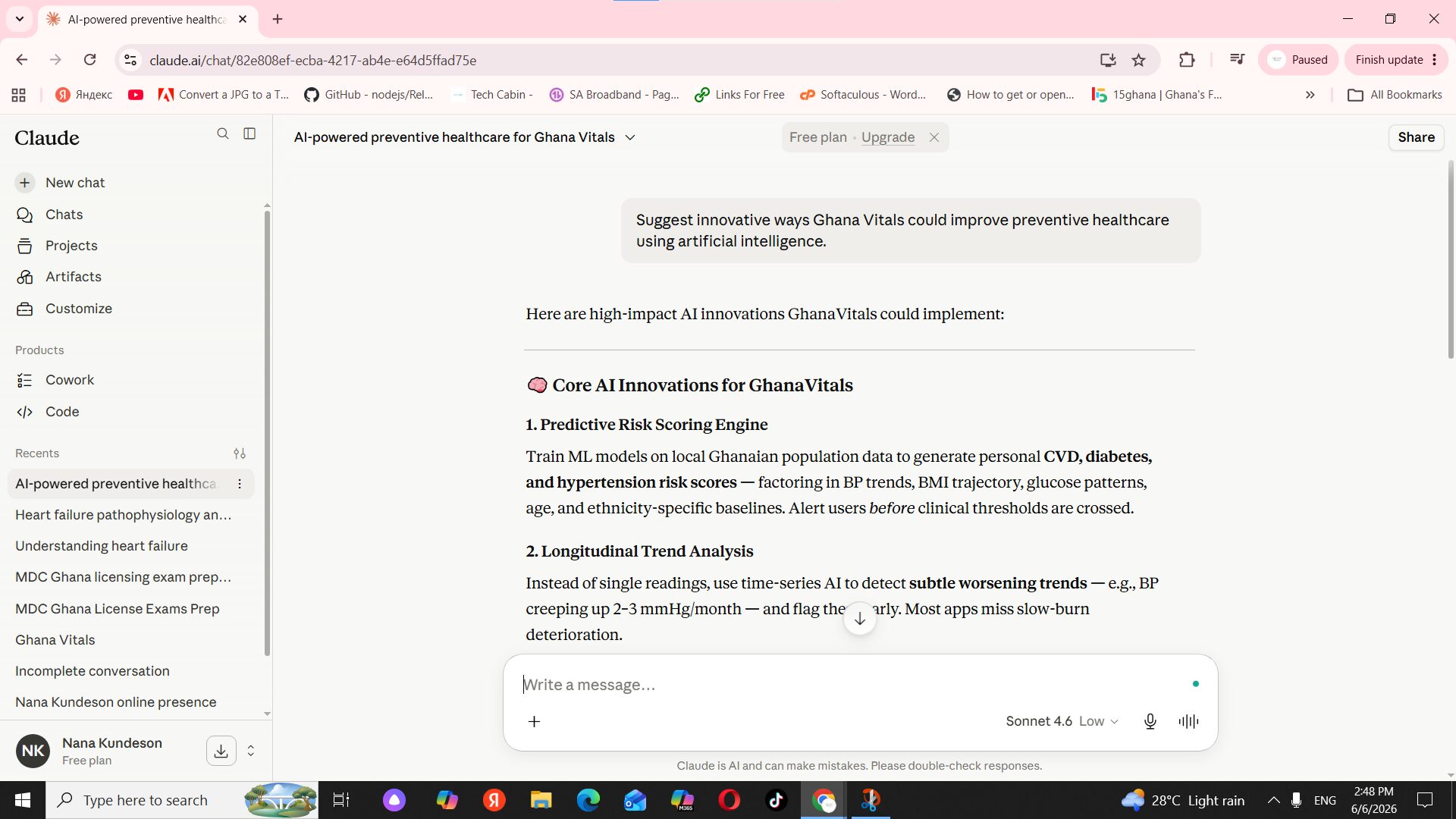
This helps me think strategically about the future of Ghana Vitals.
Common Mistakes Doctors Make When Using Claude AI
Many healthcare professionals fail to get value from AI because they make avoidable mistakes.
Mistake #1
Asking vague questions.
Bad:
Explain diabetes.
Good:
Explain diabetes to a final-year medical student preparing for licensing examinations.
Mistake #2
Not providing context.
Context dramatically improves results.
Mistake #3
Treating AI as an authority.
AI is an assistant.
Always verify important information.
Mistake #4
Ignoring follow-up questions.
The best results often come from multiple rounds of refinement.
Mistake #5
Uploading identifiable patient information.
Patient confidentiality must always be protected.
Claude AI vs ChatGPT Prompts
Many doctors ask:
Should I use Claude or ChatGPT?
My answer:
Use both.
For example:
Research Papers
Claude often performs exceptionally well.
Coding
ChatGPT usually has advantages.
Writing
Both perform strongly.
Medical Education
Both are excellent.
Long Clinical Guidelines
Claude often shines.
The goal is not choosing a winner.
The goal is to choose the right tool for the task.
How African Healthcare Professionals Can Use These Prompts
Healthcare professionals in Africa face unique realities.
These include:
- Limited specialist support
- Workforce shortages
- Resource constraints
- Educational access challenges
AI can help bridge some of these gaps.
For example:
A doctor in a district hospital can use Claude to:
- Review guidelines
- Learn about uncommon conditions
- Create teaching materials
- Prepare presentations
- Improve research productivity
This does not replace expertise.
It amplifies it.
Key Takeaways
- Claude AI is one of the most useful AI tools for doctors.
- The quality of your prompt determines the quality of your output.
- Research is one of the highest-value use cases.
- Medical students can dramatically improve learning efficiency.
- Doctors can reduce administrative workload.
- Public health professionals can use AI for population health planning.
- AI should accelerate learning, not replace learning.
- Patient confidentiality remains essential.
- Africa has significant opportunities to leverage AI responsibly.
- Doctors who master prompting will gain a major professional advantage.
Frequently Asked Questions
What is the best Claude AI prompt for doctors?
The best prompt depends on the task, but prompts that provide clear roles, context, and output requirements generally produce superior results.
Can Claude AI help with licensing examinations?
Yes. Claude can generate MCQs, OSCE scenarios, viva questions, and revision notes.
Is Claude useful for research?
Extremely useful for literature reviews, protocol development, and manuscript preparation.
Can Claude generate differential diagnoses?
Yes, but outputs must always be reviewed by qualified healthcare professionals.
Is Claude better than ChatGPT?
Each platform has strengths. Many healthcare professionals benefit from using both.
Can medical students use Claude?
Absolutely. It is one of the most powerful educational tools currently available.
Can nurses use these prompts?
Yes. Most prompts can be adapted for nursing education and professional development.
Can public health professionals use Claude?
Yes. Public health is one of the most promising areas for AI adoption.
Is patient information safe?
Never upload identifiable patient information.
What is the biggest limitation?
AI can occasionally generate inaccurate information and should always be verified.
Read Also
- How Medical Doctors Can Use Claude AI for Research, Clinical Learning, and Productivity in 2026
- ChatGPT vs Claude for Medical Doctors: Which AI Is Better in 2026?
- Best AI Tools for Medical Students in 2026
- AI for Medical Research: The Complete Guide
- How AI Is Transforming Healthcare in Africa
- AI Opportunities for African Doctors
- Best AI Tools for Public Health Professionals
- Ghana Vitals: The Future of Preventive Healthcare
About the Author
Dr Festus Kaasung Kunde is a Medical Doctor, AI in Healthcare Advocate, and Founder of AI Doctor Africa and Ghana Vitals.
A graduate of Stavropol State Medical University (Russia, 2025), he has interests in Artificial Intelligence in Clinical Medicine, Digital Health, Healthcare Innovation in Africa, Health Data Analytics, Medical Education, AI for Medical Research, and Predictive Health Systems.
Download the Free Bonus Resource
100 AI Prompts Every Healthcare Professional Should Save
Want even more prompts?
Subscribe to the AI Doctor Africa newsletter and receive:
- Advanced Claude prompts
- ChatGPT workflows
- Research templates
- Medical education resources
- Healthcare AI updates
Final Thoughts
The doctors who benefit most from AI will not necessarily be those with the strongest technical backgrounds. They will be the ones who learn how to ask better questions. In the age of artificial intelligence, prompting is becoming a professional skill. And for healthcare professionals, mastering that skill may become just as important as mastering the tools themselves.