
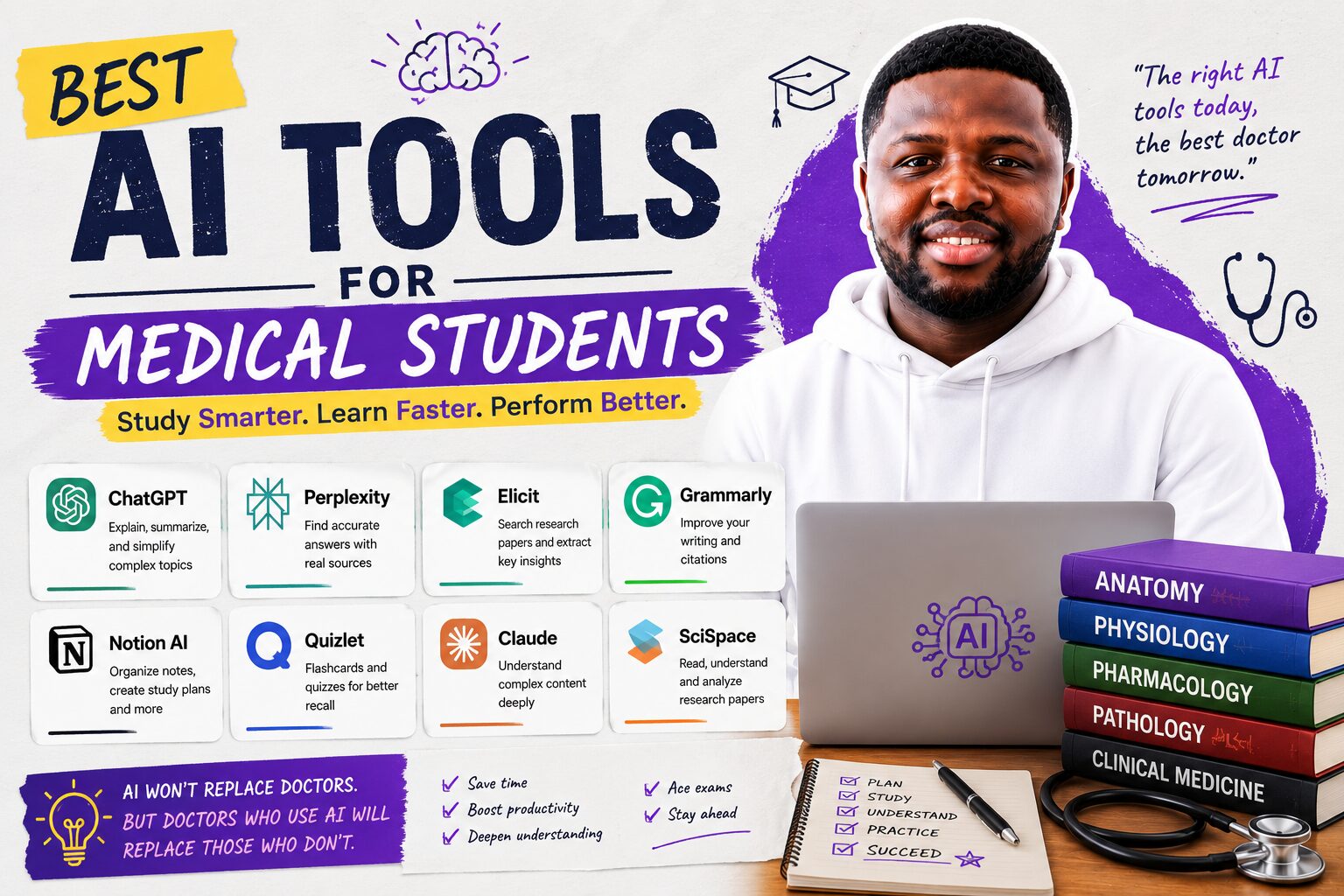
Best AI Tools for Medical Students in 2026: The Complete Guide
By Dr Festus Kaasung Kunde, MD | Stavropol State Medical University
Medical Doctor | AI in Healthcare Advocate | Founder, AI Doctor Africa & Ghana Vitals
Published: June 2026 | Reading Time: 14–16 minutes | Category: AI for Medical Students
Quick Summary
Over 90% of medical students now use two or more AI tools regularly (JMIR Human Factors, 2026). This article reviews the 10 best AI tools specifically for medical students in 2026 — covering exam preparation, clinical learning, research, and daily productivity. Each tool is evaluated for effectiveness, cost, African accessibility, and practical use cases. A recommended tool stack and budget guide is included.
Why Medical Students Need AI Tools Now
Medical school is one of the most information-intensive educational experiences in the world. In the first year alone, students are expected to memorise over 15,000 new terms — and that number only grows as preclinical knowledge transitions into clinical reasoning, pharmacology, pathology, and applied medicine.
The challenge is not intelligence. It is volume, and the pace at which that volume must be absorbed and applied.
I graduated from Stavropol State Medical University in 2025 and completed an internship at Korle-Bu Teaching Hospital in Accra. Throughout medical school and during my internship, I used AI tools continuously — for exam preparation, clinical learning, research, and productivity. I made mistakes, tested many platforms, and discovered which tools genuinely save time and which are overhyped.
This guide reflects that experience, updated with the best tools available in 2026. It is written specifically for medical students in Africa and globally who want a clear, honest, and practical breakdown of what to use and why.
One important note before we begin: AI tools accelerate learning. They do not replace it. The students who benefit most from AI are those who use it to deepen understanding, practise more actively, and manage information more efficiently — not those who try to bypass the learning process entirely.

The State of AI in Medical Education in 2026
The adoption of AI tools in medical education has accelerated dramatically. According to a 2026 study published in JMIR Human Factors, over 90% of medical students now use two or more AI platforms, with an average usage frequency of more than five times per week. A separate survey found that 45.3% of medical students now prefer AI-powered learning aids over traditional instructor-led sessions, and 42.2% prefer them over textbooks for initial concept exploration.
This is not a passing trend. AI is becoming embedded in how the next generation of doctors learns, researches, and prepares for clinical practice.
The students who are thriving are not those who use the most tools — they are those who use the right tools strategically. The goal of this article is to help you build that strategy.
The 10 Best AI Tools for Medical Students in 2026: Complete Overview
The table below summarises all ten tools reviewed in this article. Detailed analysis of each tool follows.
| # | Tool | Best For | Free Tier? | Est. Cost/Month | African Access |
| 1 | Claude AI | Deep learning, research, long docs | Yes | $20 (Pro) | ✓ Yes |
| 2 | ChatGPT (GPT-4o) | MCQs, content, speed, versatility | Yes | $20 (Plus) | ✓ Yes |
| 3 | Anki + AnKing Deck | Spaced repetition, memorisation | Free | $0 | ✓ Yes |
| 4 | AMBOSS | Qbank, clinical reference, Step prep | Limited | $29–39 | ✓ Yes |
| 5 | Osmosis AI | Visual pathophysiology, video | Limited | $29 | ✓ Yes |
| 6 | Elicit | Research paper analysis, lit review | Yes | $12 (Plus) | ✓ Yes |
| 7 | Consensus | Evidence-based answers, quick search | Yes | $11 | ✓ Yes |
| 8 | Perplexity AI | Cited search, quick clinical facts | Yes | $20 (Pro) | ✓ Yes |
| 9 | Neural Consult | Lecture-to-flashcard, MCQ gen | Yes | Free/$15 | ✓ Yes |
| 10 | Semantic Scholar | Literature discovery, citation mapping | Free | $0 | ✓ Yes |
Tool #1: Claude AI — Best for Deep Learning and Research
Developer: Anthropic | Free tier available | Pro: $20/month
Claude is developed by Anthropic and has become one of the most capable AI assistants available for medical students who need to understand complex concepts, analyse research papers, and produce high-quality academic writing. Unlike general search engines or basic chatbots, Claude is designed for nuanced, long-form reasoning — which makes it particularly well-suited to the demands of medical education.
Where Claude excels for medical students: Claude is outstanding for uploading long documents — clinical guidelines, research papers, textbook chapters — and receiving structured, educational summaries. When you need to understand why a disease behaves the way it does, not just memorise what it does, Claude provides the depth of explanation that shorter AI tools cannot match.
Proven Prompts for Medical Students
“Act as a consultant physician. Explain the pathophysiology of diabetic ketoacidosis to a third-year medical student. Include: mechanism, clinical presentation, investigations, management, and three clinical pearls that examiners frequently test.”
“I have uploaded the WHO guidelines on the management of severe acute malnutrition. Summarise the key diagnostic criteria, treatment phases, and specific considerations for paediatric patients in low-resource settings.”
Best used for: Concept understanding, research paper analysis, academic writing, OSCE preparation notes, long document summarisation, and clinical reasoning discussions.
Limitation: Claude does not have a dedicated medical Qbank. For structured board exam question practice, combine with AMBOSS or use ChatGPT to generate MCQs.
Tool #2: ChatGPT (GPT-4o) — Best for MCQ Generation and Speed
Developer: OpenAI | Free tier available | Plus: $20/month
ChatGPT remains the most widely used AI platform in medical education globally. Its speed, versatility, and ability to generate large volumes of structured content quickly make it an essential tool for medical students — particularly for exam preparation and active recall practice.
Where ChatGPT excels for medical students: ChatGPT generates high-quality MCQs, OSCE stations, study plans, flashcard content, and presentation outlines rapidly. It is the most effective tool for creating active recall practice materials on demand.
Proven Prompts for Medical Students
“Generate 25 board-style MCQs on the pharmacology of antihypertensive agents. For each question, provide four answer options, the correct answer, and a detailed explanation covering the mechanism of action, side effects, and contraindications.”
“Create an OSCE station for a patient presenting with acute chest pain. Include: the clinical scenario, examiner’s mark sheet, key history questions, examination findings to elicit, and the top three differential diagnoses.”
Best used for: MCQ generation, OSCE practice, study schedule creation, flashcard drafting, brainstorming, email drafting, and presentation outlines.
Limitation: ChatGPT can hallucinate references and occasionally produce plausible but incorrect clinical information. Always verify drug dosages, management protocols, and cited guidelines against primary sources.
Tool #3: Anki with the AnKing Deck — Best for Memorisation and Long-Term Retention
Developer: Open source | Free | AnKing Deck: Free download
Anki is not a new tool — but in 2026, it remains the single most evidence-based study platform available to medical students. Research published in BMC Medical Education demonstrates a strong effect size of 0.8 for spaced repetition in medical student populations, meaning students who use spaced repetition consistently perform significantly better on examinations than those who do not.
The AnKing deck is a community-maintained, high-yield Anki deck specifically designed for USMLE Step 1 and Step 2 preparation. It contains thousands of pre-made flashcards covering the full breadth of preclinical and clinical medicine, with regular updates to reflect guideline changes.
Why Anki is irreplaceable: No AI tool currently replicates the long-term retention benefits of spaced repetition. You can use Claude or ChatGPT to understand a concept — but to ensure you remember it three months later under examination pressure, Anki remains the gold standard.
2026 update: Tools like Neural Consult (reviewed below) now allow medical students to automatically generate Anki-style flashcards from their own lecture materials, making the Anki workflow significantly more efficient than manual card creation.
Best used for: Daily spaced repetition, USMLE Step 1 and Step 2 preparation, pharmacology memorisation, anatomy landmarks, diagnostic criteria, and high-yield clinical facts.
Tool #4: AMBOSS — Best Qbank and Clinical Reference for Board Exams
Developer: AMBOSS GmbH | Limited free tier | Student: $29–39/month
AMBOSS is one of the most comprehensive medical education platforms available. It combines a Qbank of over 13,900 board-calibrated questions with an integrated clinical library covering more than 1,500 preclinical and clinical topics. In 2026, AMBOSS launched an AI mode (AMBOSS GPT) that allows students to ask medical questions and receive referenced answers drawn directly from the AMBOSS library — significantly reducing the risk of hallucinated information.
What makes AMBOSS different from general AI tools: Unlike Claude or ChatGPT, AMBOSS questions are written and reviewed by qualified physicians. Every answer explanation links directly to the AMBOSS library article, and performance data is tracked to identify weak areas and generate targeted study recommendations.
Key features: 13,900+ USMLE and COMLEX questions; integrated clinical library; AMBOSS Anki add-on that enriches your existing Anki cards with AMBOSS library content; Score Predictor for USMLE performance benchmarking; mobile app with offline access.
Best used for: USMLE Step 1 and Step 2 dedicated preparation, clinical clerkship reference, shelf exam revision, and bedside clinical decision support.
African student note: Some African medical schools have institutional AMBOSS access. Check with your library or academic office before purchasing a personal subscription.
Tool #5: Osmosis AI — Best for Visual Learners and Pathophysiology
Developer: Osmosis (Elsevier) | Limited free tier | Premium: $29/month
Osmosis is a medical education platform built around high-quality animated videos, visual summaries, and integrated question banks. In 2026, Osmosis launched AI-enhanced features that adapt learning content to individual student performance and learning style. For students who learn best through visual explanation of pathophysiology — how a disease actually unfolds mechanistically — Osmosis is one of the most effective platforms available.
Where Osmosis stands out: The animated explanations of pathophysiology are among the clearest available for complex conditions — endocrinology, nephrology, immunology, and haematology in particular. The visual format helps convert abstract mechanisms into memorable mental models.
Best used for: Pathophysiology understanding, visual reinforcement of complex mechanisms, preclinical foundational learning, and supplementary revision during clinical rotations.
Limitation: Osmosis works best as a supplement to Anki and a primary Qbank — not as a standalone exam preparation tool.
Tool #6: Elicit — Best for Research Paper Analysis
Developer: Elicit | Free tier available | Plus: $12/month
Elicit is an AI research assistant specifically designed to help students and researchers work with academic literature more efficiently. Rather than summarising individual papers, Elicit enables users to upload multiple papers simultaneously and ask analytical questions across the entire collection — identifying patterns, comparing findings, and extracting specific data points.
For medical students conducting literature reviews, preparing research proposals, or trying to understand the current evidence base for a clinical topic, Elicit represents a significant time saving over manual paper-by-paper reading.
Proven Workflow
Upload 10–15 papers on your research topic to Elicit. Ask: “What are the primary outcomes measured across these studies? Where do the findings agree, and where do they conflict? What are the most significant methodological limitations?” Elicit reads all papers and builds a structured comparative table.
Best used for: Literature reviews, systematic reviews, research gap identification, evidence-based learning, and MPH or postgraduate research preparation.
Tool #7: Consensus — Best for Quick Evidence-Based Answers
Developer: Consensus | Free tier available | Premium: $11/month
Consensus is an AI search engine that answers questions using peer-reviewed research. Unlike general AI tools that may generate plausible-sounding information without verified citations, Consensus always grounds its answers in actual published studies. For medical students trying to quickly verify whether a clinical intervention has evidence behind it, or to understand the current state of research on a topic, Consensus is one of the most reliable tools available.
Key advantage: Every answer links to the specific papers it was derived from, making it easy to verify claims and retrieve sources for academic writing.
Best used for: Evidence-based medicine learning, quick literature checks, verifying clinical claims before including them in academic work, and understanding the strength of evidence behind specific interventions.
Tool #8: Perplexity AI — Best for Cited Search and Quick Clinical Facts
Developer: Perplexity AI | Free tier available | Pro: $20/month
Perplexity AI functions as an AI-powered search engine that provides cited, real-time answers by searching the web and academic databases simultaneously. For medical students, Perplexity is particularly useful when you need a fast, referenced answer to a clinical question — without the risk of uncited AI hallucination.
How it differs from Claude and ChatGPT: Perplexity searches live sources and provides links to every claim it makes. This makes it significantly more reliable than standard AI chatbots for questions where currency and citation matter — such as recent guideline updates, drug approvals, or emerging clinical evidence.
Best used for: Quick clinical fact checking, recent guideline updates, drug information, understanding new research developments, and verified answers during clinical rotations.
Tool #9: Neural Consult — Best for Converting Lectures to Flashcards
Developer: Neural Consult | Free tier available | Premium: ~$15/month
Neural Consult is a medical-specific AI platform that specialises in converting uploaded lecture slides, PDFs, and study materials into high-quality Anki-style flashcards and board-style MCQs. For medical students who spend hours manually creating flashcards from lecture content, Neural Consult removes that friction almost entirely.
Real-World Performance
In documented student workflows, uploading a 90-slide cardiology lecture to Neural Consult generated 45 usable flashcards and 20 board-style MCQs in under 10 minutes — content that would have taken 60 to 90 minutes to create manually. The generated cards are reported to capture high-yield points more reliably than general AI tools prompted to do the same task.
Best used for: Converting your own lecture materials into active recall tools, generating topic-specific MCQs from uploaded content, and building a personalised flashcard deck aligned with your specific curriculum.
Tool #10: Semantic Scholar — Best for Literature Discovery
Developer: Allen Institute for AI | Completely Free
Semantic Scholar is a free, AI-powered academic search engine that indexes over 200 million scientific papers. Unlike Google Scholar, Semantic Scholar uses machine learning to surface the most relevant papers, identify citation relationships, and highlight key findings across large bodies of literature. For medical students beginning a literature review or trying to map the research landscape on a topic, it is one of the most powerful free tools available.
Key features: Semantic search (finds conceptually related papers, not just keyword matches); citation context (shows how papers cite each other — supportive, contradictory, or neutral); paper summaries; and research topic clustering.
Best used for: Starting a literature review, identifying foundational papers on a topic, mapping citation networks, and discovering high-impact research in a new clinical area.
Which Tool to Use for Each Medical Student Task
Use this quick reference to select the right tool for any specific task:
| Task | Best Tool(s) |
| Generating MCQs for exams | ChatGPT, Neural Consult |
| Deep concept understanding | Claude, Osmosis AI |
| Spaced repetition & memorisation | Anki (AnKing Deck) |
| Board exam Qbank (USMLE/MDC) | AMBOSS, UWorld |
| Analysing research papers | Elicit, Claude |
| Quick evidence-based answers | Consensus, Perplexity AI |
| Visual pathophysiology | Osmosis AI |
| Lecture-to-flashcard conversion | Neural Consult |
| Literature discovery | Semantic Scholar, Elicit |
| Academic writing & proposals | Claude, ChatGPT |
| OSCE practice | ChatGPT |
| Drug references & dosages | AMBOSS, OpenEvidence |
| Research brainstorming | ChatGPT, Perplexity AI |
| Citation verification | Semantic Scholar, scite.ai |
My Personal AI Stack as a Medical Doctor: What I Actually Used
During medical school and internship at Korle-Bu Teaching Hospital, my core AI stack evolved through trial and error. Here is what I actually used — and why:
- Amboss
- For understanding: Claude. When I encountered a condition I did not understand deeply — particularly rare presentations or complex pathophysiology — Claude was my first tool. The explanations were more thorough and educationally structured than any other platform.
- For practice questions: ChatGPT. I used ChatGPT to generate MCQs and OSCE stations on demand. Before clinical assessments, I would generate 20 to 30 questions on the relevant topic and work through them actively.
- For research: Elicit and Semantic Scholar. Any time I needed to understand the evidence base for a clinical area or prepare a research proposal, Elicit and Semantic Scholar were my starting points.
The most important lesson: No single tool covers everything. The students who perform best build a small, focused stack — and use each tool for what it does best.
A Special Note for African Medical Students
Most AI tool reviews are written for medical students in the United States, the United Kingdom, or Europe. They do not address the specific realities facing students in Ghana, Nigeria, Kenya, Uganda, South Africa, or other African countries.
Here is what African medical students specifically need to know:
All ten tools in this article are accessible across Africa. Claude, ChatGPT, Elicit, Semantic Scholar, Consensus, and Perplexity all offer free tiers that require no payment. AMBOSS, Osmosis, and Neural Consult accept international debit cards, and most accept virtual cards from mobile money platforms, including MTN Mobile Money and Telecel Cash in Ghana.
Prompt for your context. African medical students face a different disease burden than students in Europe or North America. Malaria, typhoid, sickle cell disease, tuberculosis, schistosomiasis, and tropical infections are daily clinical realities. Generic AI outputs may not reflect this. Always specify your context in prompts — ‘in a district hospital in Ghana with limited investigation resources’ produces far more relevant clinical information than generic queries.
Check your institution’s AMBOSS access. Some African medical schools have institutional agreements with AMBOSS. Before purchasing a personal subscription, contact your library or academic office.
Use offline-capable tools where connectivity is limited. Anki works fully offline. The AMBOSS mobile app also has offline functionality for downloaded content. For areas with unreliable internet, prioritise tools that do not require continuous connectivity. You can download the GPT version from OpenAI’s CHATGPT.
Africa does not need to import AI workflows designed for Western medical education. We need to build prompting habits and tool stacks that reflect our disease burden, our resource environment, and our clinical realities. That is part of what AI Doctor Africa is working to address.
AI Tool Budget Guide for Medical Students
Medical school is expensive. Here is how to build an effective AI tool stack at every budget level:
| Budget Level | Tools to Use | Est. Monthly Cost |
| Zero Budget | Claude (free), ChatGPT (free), Anki, Semantic Scholar, Elicit (free), Consensus (free) | $0 |
| Low Budget ($20/month) | Claude Pro OR ChatGPT Plus + all free tools above | ~$20 |
| Medium Budget ($40–50/month) | Claude Pro + AMBOSS + all free tools | ~$49 |
| Full Stack ($70–80/month) | Claude Pro + ChatGPT Plus + AMBOSS + Osmosis | ~$69–79 |
The zero-budget stack is genuinely powerful. Claude’s free tier, ChatGPT’s free tier, Anki, Elicit’s free tier, Semantic Scholar, and Consensus together cover the full range of medical student AI needs. The paid upgrades (Claude Pro, AMBOSS) add significant value — but they are not prerequisites for effective AI-supported studying.
Common Mistakes Medical Students Make With AI Tools
Having observed many students begin using AI tools, the same errors appear consistently:
- Using AI to read textbooks for you — AI summaries accelerate access, but do not replace the depth of engagement that textbook reading builds. Use summaries to orient yourself, then read the relevant sections actively.
- Trusting AI drug dosages without verification — always cross-reference against the BNF, local formulary, or manufacturer data. AI can produce plausible but incorrect dosages, particularly for paediatric patients.
- Submitting AI-generated content in graded work without disclosure — check your institution’s academic integrity policy before using AI in assessed work.
- Entering patient information into AI tools — never input identifiable patient data into any external AI platform. This is a patient confidentiality violation regardless of your intent.
- Using too many tools at once — build a focused stack of three to four tools and master them, rather than using ten platforms superficially.
- Relying on AI for clinical decisions during rotations — AI is a learning and reference tool. Clinical decisions remain the responsibility of qualified supervising clinicians.
Key Takeaways
- Over 90% of medical students now use two or more AI tools regularly — strategic tool selection matters more than tool quantity
- No single AI tool covers everything — the most effective students build a focused, complementary stack
- Anki with the AnKing Deck remains the most evidence-based tool for long-term retention — spaced repetition is irreplaceable
- Claude is strongest for deep conceptual learning and research; ChatGPT for MCQ generation and speed
- AMBOSS offers the most rigorous, physician-reviewed Qbank for board examination preparation
- Elicit and Semantic Scholar are the most effective free tools for medical research and literature review
- All tools reviewed are accessible to African medical students — most offer meaningful free tiers
- Always verify AI-generated clinical information against primary sources before applying it in study or practice
- Prompt AI tools for your specific African clinical context — generic prompts produce generic outputs
- AI accelerates learning. It does not replace the understanding, judgment, and clinical skill that medical school is designed to build
Frequently Asked Questions
The following questions address the most common queries from medical students considering AI tools:
| Question | Answer |
| Are AI tools safe for medical students? | Yes, when used responsibly. AI tools are safe for learning, studying, and research. They are not safe for making real clinical decisions. Always verify AI-generated clinical information against textbooks, PubMed, and official guidelines. Never use AI output as your sole reference for patient management. |
| Can AI tools replace textbooks for medical students? | No. AI tools accelerate information processing and support active learning — they do not replace the depth, accuracy, and clinical integration of authoritative medical textbooks. Use AI to organise and test knowledge from your textbooks, not to bypass them. |
| Which AI tool is best for USMLE Step 1 preparation? | The most effective USMLE Step 1 combination is AMBOSS (for the Qbank and clinical library), Anki with the AnKing deck (for spaced repetition), and Claude or ChatGPT (for concept explanation and active recall practice). Elicit is useful if your preparation involves reviewing primary research. |
| Which AI tools work best for African medical students? | All tools listed in this article are accessible in Ghana and across most of Africa with a standard international debit or credit card, or virtual cards from mobile money platforms. Claude, ChatGPT, Anki, Elicit, Semantic Scholar, Consensus, and Perplexity all have free tiers that provide significant value with no payment required. AMBOSS offers institutional access at some African medical schools — check with your institution. |
| Do medical schools allow the use of AI tools? | Policies vary significantly between institutions. Most medical schools permit AI tools for self-directed study, research, and exam preparation. Many prohibit AI-generated content in graded assessments without disclosure. Always check your institution’s specific academic integrity policy before using AI for assessed work. |
| Can AI tools help with clinical rotations? | Yes. During clinical rotations, AMBOSS is particularly valuable as a bedside clinical reference. Claude and ChatGPT can help you prepare case presentations, review unfamiliar conditions, and understand investigations and management plans. Perplexity and Consensus are useful for quickly checking evidence behind clinical decisions. Never enter real patient information into any external AI platform. |
| Is Anki still worth using in 2026? | Absolutely. Anki with the AnKing deck remains one of the most evidence-based study tools available to medical students. Research consistently shows a strong effect size (0.8) for spaced repetition in medical education. AI tools like Neural Consult now make it easier to create Anki cards from your own materials, making the Anki workflow even more powerful in 2026. |
| How many AI tools should a medical student use? | Research shows that over 90% of medical students now use two or more AI tools regularly. The most effective approach is building a focused stack rather than using every available tool. For most students, a combination of one general AI assistant (Claude or ChatGPT), one spaced repetition tool (Anki), one question bank (AMBOSS), and one research tool (Elicit or Consensus) covers the full range of medical school needs. |
Related Articles on AI Doctor Africa
- How Medical Doctors Can Use Claude AI for Research, Clinical Learning, and Productivity in 2026
- 50 Claude AI Prompts Every Medical Doctor Should Save
- ChatGPT vs Claude for Medical Doctors: Which AI Is Better?
- How Doctors Can Use AI to Save 10 Hours Every Week
- Can Doctors Trust AI? Benefits, Risks, and Best Practices
About the Author
Dr Festus Kaasung Kunde is a Medical Doctor, AI in Healthcare Advocate, and Founder of AI Doctor Africa and Ghana Vitals. He graduated from Stavropol State Medical University in Russia in 2025 and completed a clinical internship at Korle-Bu Teaching Hospital in Accra, Ghana.
Dr Kunde is passionate about Artificial Intelligence in Clinical Medicine, Digital Health, Healthcare Innovation in Africa, Medical Education, Health Data Analytics, and Preventive Health Systems. He is currently preparing for the Medical and Dental Council (MDC) licensing examinations in Ghana.
His mission is to help healthcare professionals across Africa understand, adopt, and responsibly use artificial intelligence to improve learning, research, productivity, and patient outcomes.
AI Doctor Africa | aidoctorafrica.com
Medical Disclaimer: This article is for educational and informational purposes only. AI tools should never replace clinical judgment, verified medical references, or qualified healthcare supervision.