
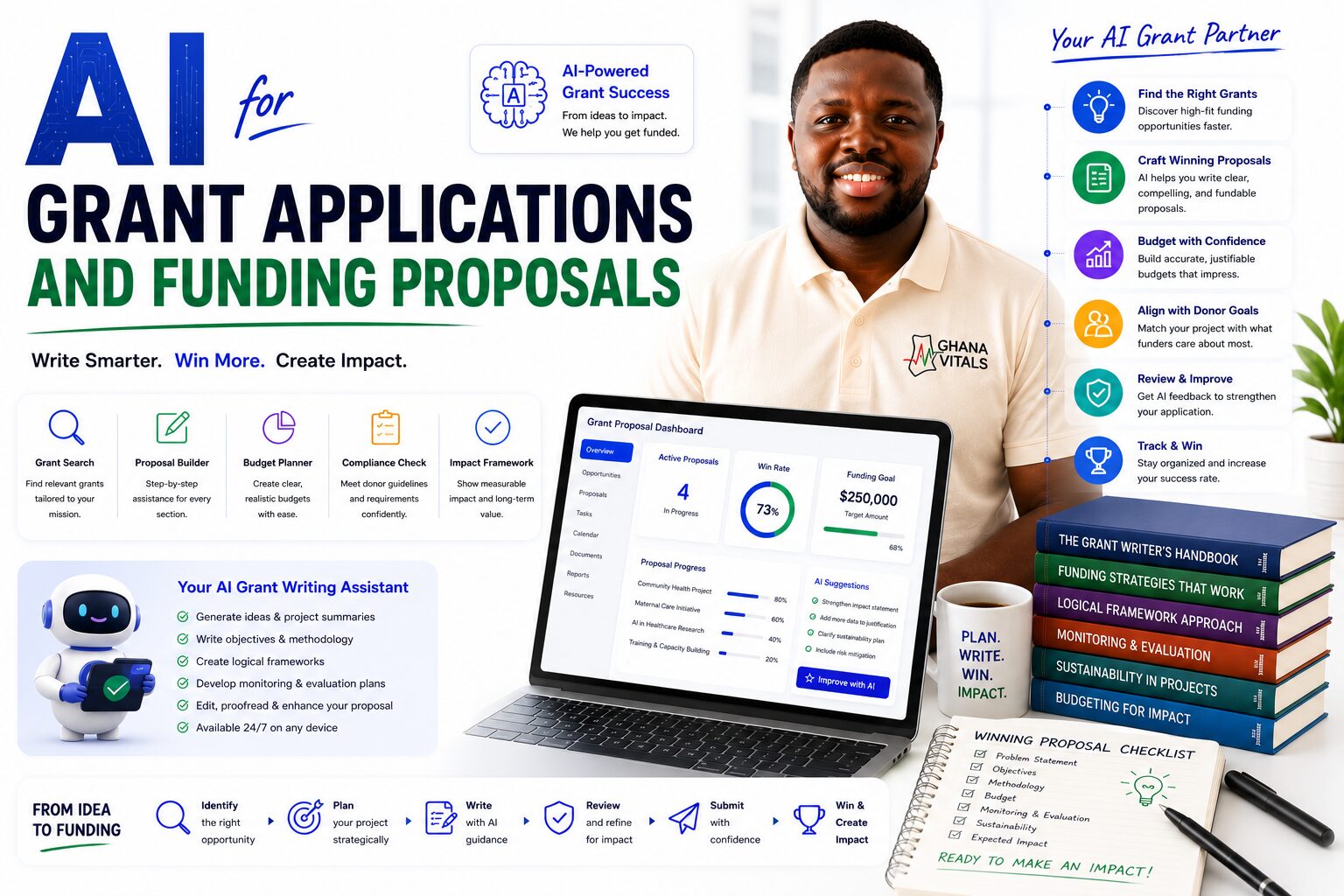
AI for Grant Applications and Funding Proposals: How Researchers Can Win More Grants in 2026
By Dr Festus Kaasung Kunde, MD
Medical Doctor | AI in Healthcare Advocate | Founder, AI Doctor Africa & Ghana Vitals
Category: AI for Grant Applications
Great Ideas Don’t Change the World—Funded Ideas Do
One of the biggest surprises I encountered after medical school was realising that solving a healthcare problem isn’t always the hardest part. Finding funding often is. Whether you’re a medical researcher, public health professional, postgraduate student, healthcare startup founder, or NGO leader, you’ve probably experienced the same frustration.
You have a meaningful idea, and it addresses a genuine healthcare need. You know it could improve lives. Yet turning that idea into reality requires resources. Those resources usually come in the form of grants. Unfortunately, grant writing has a reputation for being intimidating. Many researchers spend weeks preparing proposals, only to receive rejection letters with little explanation. Others never apply because they believe they lack the experience.
I understand that feeling.
As the founder of Ghana Vitals, a preventive health initiative that combines community screening, health data, and artificial intelligence to improve preventive healthcare across Africa, I have spent countless hours refining project ideas, developing implementation strategies, and exploring sustainable funding.
One lesson has become increasingly clear. Artificial intelligence cannot win grants for you. But it can dramatically improve how you prepare for them. Used responsibly, AI can help researchers develop stronger ideas, identify funding opportunities, improve proposal quality, and spend less time formatting documents and more time thinking strategically.
This guide explains exactly how.
Why Grant Writing Feels Difficult
Grant applications require far more than good writing.
Funders want evidence.
Funders want feasibility.
They want measurable outcomes.
They want confidence that your project will succeed.
Most proposals require applicants to explain clearly:
- The healthcare problem
- Why the problem matters
- Existing evidence
- Project objectives
- Methodology
- Budget
- Timeline
- Expected outcomes
- Evaluation plan
- Sustainability strategy
That is a tremendous amount of work.
Especially for early-career researchers.
The Biggest Mistake Grant Applicants Make
Many people believe grants are awarded to the best ideas.
In reality, grants are usually awarded to the best-developed ideas. Two researchers may identify the same public health problem.
One proposal receives funding. The other does not.
Why?
Often, it is because one applicant communicates the idea more clearly. AI helps improve that communication.
What AI Can—and Cannot—Do
Artificial intelligence should never fabricate data, invent references, or write misleading proposals.
Instead, it should help researchers:
- Brainstorm ideas
- Improve clarity
- Organize information
- Strengthen arguments
- Edit language
- Summarize literature
- Generate timelines
- Improve readability
Ultimately, the proposal remains your responsibility.
Why Grant Reviewers Reject Applications
Many proposals fail because they suffer from common weaknesses:
- Poor problem definition
- Weak literature review
- Unclear objectives
- Unrealistic methodology
- Missing evaluation plans
- Weak budgets
- Lack of sustainability
AI can help identify these weaknesses before submission.
10 Practical Ways to Use AI for Grant Applications
1. Refining Your Research Idea
Many researchers begin with broad ideas.
For example:
Improve hypertension screening.
AI can help refine that into a more fundable project.
Prompt:
Help refine this idea into a measurable public health project suitable for international funding.
2. Identifying Knowledge Gaps
Funders want projects that solve unmet needs.
Prompt:
What knowledge gaps currently exist regarding hypertension prevention in Sub-Saharan Africa?
This helps strengthen the rationale.
3. Strengthening the Problem Statement
Weak:
Hypertension is common.
Better:
Hypertension remains one of the leading contributors to cardiovascular disease in Africa, yet millions remain undiagnosed until complications develop.
AI can help improve clarity while ensuring the researcher verifies all factual claims with reliable sources.
4. Developing SMART Objectives
Many proposals contain vague objectives.
AI can help convert them into SMART objectives that are:
- Specific
- Measurable
- Achievable
- Relevant
- Time-bound
5. Creating Project Timelines
Prompt:
Create a 12-month implementation timeline for a community hypertension screening project.
AI generates structured timelines that researchers can customise.
6. Building Logic Models
Funders appreciate clear project frameworks.
AI can help outline:
Inputs → Activities → Outputs → Outcomes → Impact
This makes proposals easier to understand.
7. Budget Planning
AI can help identify common budget categories, such as:
- Personnel
- Equipment
- Training
- Transportation
- Monitoring
- Data collection
- Dissemination
Researchers must always prepare realistic, evidence-based budgets that reflect actual project needs.
8. Editing for Clarity
Many proposals fail because they are difficult to read.
Prompt:
Rewrite this paragraph using clear, concise language while preserving the original meaning.
This improves readability without changing the scientific content.
9. Preparing for Reviewer Questions
Prompt:
Act as a grant reviewer and identify weaknesses in this proposal.
This often uncovers issues before submission.
10. Writing Executive Summaries
Many reviewers read the executive summary first.
AI can help draft concise summaries highlighting:
- Problem
- Innovation
- Expected impact
- Sustainability
My Perspective: Ghana Vitals and the Importance of Funding
Developing Ghana Vitals taught me that innovation alone is not enough.
Preventive healthcare requires:
- Funding
- Technology
- Partnerships
- Data systems
- Community engagement
AI has helped me organise ideas, explore implementation strategies, and think more critically about how projects can scale sustainably.
But every important decision still depends on human judgment.
AI is a thinking partner.
Not a project leader.
ChatGPT vs Claude for Grant Writing
ChatGPT
Best for:
- Brainstorming
- Timelines
- Budget categories
- Proposal outlines
- Editing
Claude
Best for:
- Long-form writing
- Logical structure
- Research synthesis
- Detailed explanations
- Reviewing proposal flow
My Recommendation
Use Claude to build the proposal.
Use ChatGPT to refine and challenge it.
20 AI Prompts Every Grant Applicant Should Save
- Improve my problem statement.
- Develop SMART objectives.
- Identify research gaps.
- Build a logical framework.
- Create a Gantt chart.
- Draft an executive summary.
- Suggest measurable outcomes.
- Suggest evaluation indicators.
- Identify proposal weaknesses.
- Improve readability.
- Generate risk mitigation strategies.
- Suggest stakeholder engagement plans.
- Build a monitoring framework.
- Improve sustainability planning.
- Compare funding priorities.
- Generate dissemination strategies.
- Explain innovation clearly.
- Create implementation milestones.
- Prepare reviewer questions.
- Summarise the entire proposal.
Common Mistakes Researchers Make
- Writing before understanding funder priorities.
- Ignoring evaluation methods.
- Weak sustainability plans.
- Unrealistic budgets.
- Copying generic templates.
- Overusing AI without reviewing the output.
Remember:
Funders support people they trust.
Authenticity matters.
Ethical Considerations
AI should never be used to:
- Fabricate preliminary data.
- Invent collaborators.
- Generate fake references.
- Misrepresent previous achievements.
- Conceal conflicts of interest.
Researchers remain responsible for every statement submitted.
The Future of AI in Research Funding
Over the next decade, AI will likely become part of nearly every stage of grant development.
Researchers may increasingly use AI to:
- Search funding opportunities.
- Analyse funder priorities.
- Improve proposal quality.
- Simulate reviewer feedback.
- Strengthen project design.
Those who learn to use these tools responsibly will likely become more efficient grant writers.
Key Takeaways
- Great ideas require strong communication.
- AI can improve proposal quality, but cannot replace expertise.
- Problem statements should be evidence-based.
- SMART objectives strengthen proposals.
- Reviewer simulations help identify weaknesses.
- Budgets must remain realistic.
- Ethical use of AI is essential.
- Human judgment remains the most important factor.
Frequently Asked Questions
Can AI write an entire grant proposal?
AI can assist with drafting and editing, but the researcher is responsible for the final proposal and must ensure accuracy, originality, and compliance with funder requirements.
Can AI help identify funding opportunities?
Yes. It can help summarise eligibility criteria and funding priorities, although you should always confirm details from the official funder.
Should researchers disclose AI use?
Follow the policies of the funding organisation and your institution. Some funders may have specific guidance regarding AI-assisted writing.
Is AI useful for NGOs?
Absolutely. NGOs can use AI to improve project design, monitoring plans, and proposal clarity.
Related Articles
- AI for Medical Research in 2026
- Top AI Tools for Medical Researchers
- AI for Public Health Professionals
- AI for Academic Writing
- AI for Literature Reviews
About the Author
Dr Festus Kaasung Kunde is a Medical Doctor, AI in Healthcare Advocate, and Founder of AI Doctor Africa and Ghana Vitals. He holds an MD from Stavropol State Medical University, Russia (2025), and completed an internship at Korle-Bu Teaching Hospital in Accra. His mission is to help African healthcare professionals adopt AI responsibly to improve learning, research, and patient outcomes.
AI Doctor Africa | aidoctorafrica.com
Medical Disclaimer: For educational purposes only. AI tools do not replace clinical supervision, verified study resources, or your medical school’s academic guidance. Always verify clinical facts against authoritative primary sources.
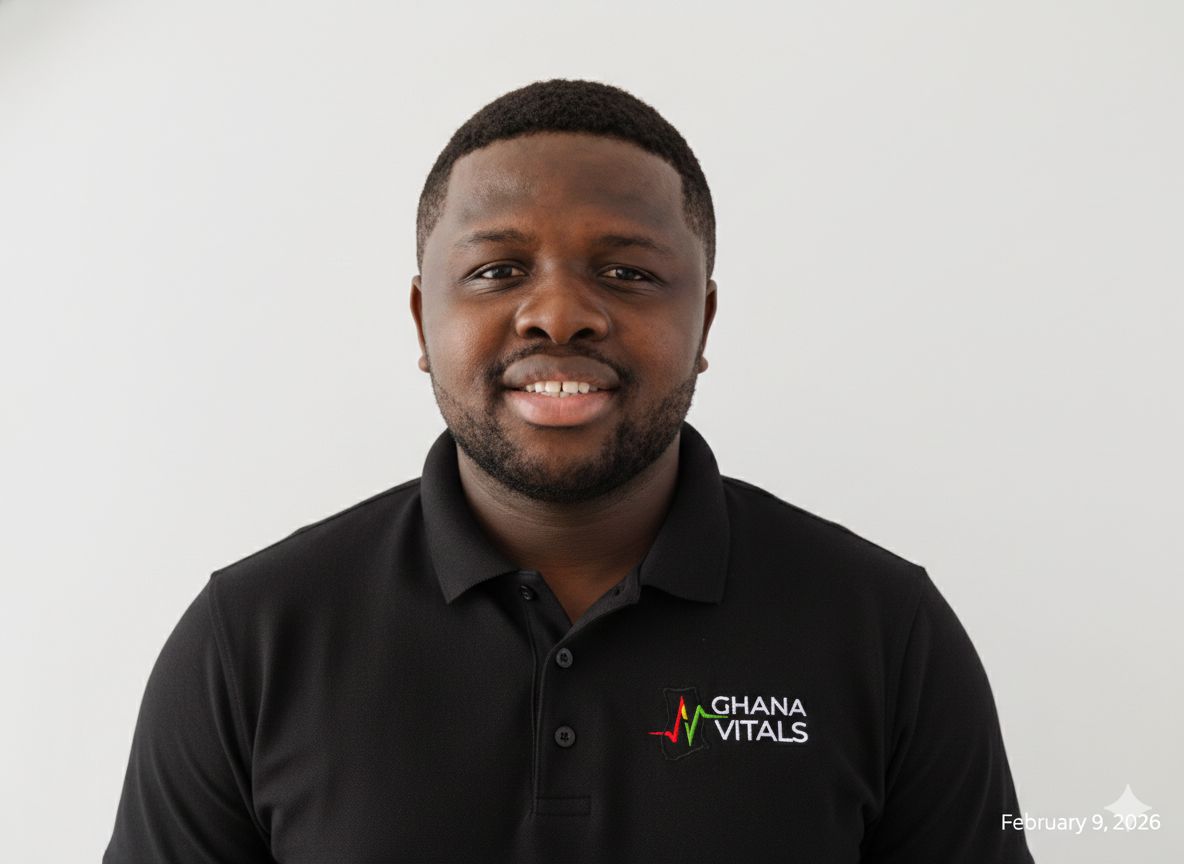
Dr. Festus K. Kunde
Dr. Festus Kaasung Kunde is a medical doctor, Content creator, healthcare technology writer, and digital health innovator specializing in Artificial Intelligence in Medicine, Healthcare Systems Innovation, and Health Data Science in Africa. He is the founder of AI Doctor Africa (AIDoctorAfrica.com), an educational platform dedicated to helping healthcare professionals—including doctors, medical students, nurses, and researchers—understand and responsibly apply artificial intelligence in clinical practice, medical education, medical research, and healthcare innovation. He is also the creator of Ghana Vitals, a health data and predictive analytics initiative focused on collecting and analyzing key health indicators such as blood pressure, blood glucose, and BMI to support early disease detection, preventive healthcare, and data-driven decision-making in Ghana and across Africa. The project reflects his long-term vision of building scalable, AI-powered public health systems for African populations. Dr. Kunde’s work focuses on the practical integration of AI tools such as ChatGPT, Claude, and emerging clinical AI systems into real-world healthcare workflows. His content emphasizes improving clinical documentation, accelerating medical education, strengthening research productivity, and supporting healthcare decision-making in resource-limited settings. Through AI Doctor Africa, he publishes evidence-informed, practice-oriented resources including AI workflows, clinical use cases, medical education guides, and tutorials designed specifically for African healthcare professionals. Through Ghana Vitals, he extends this mission into population health innovation, aiming to leverage real-world health data and predictive models to improve early intervention, reduce preventable disease burden, and strengthen health systems across Africa. His overall mission is to bridge the gap between traditional clinical medicine, artificial intelligence, and data-driven public health, empowering African healthcare professionals to work smarter, diagnose earlier, and deliver better care through technology. Areas of Expertise Artificial Intelligence in Clinical Medicine Digital Health & Healthcare Innovation in Africa Health Data Analytics & Predictive Health Systems Medical Education and Exam Preparation AI for Medical Research and Scientific Writing Clinical Workflow Optimization using AI Tools Public Health Data Systems (Ghana Vitals Initiative) Professional Focus Dr. Kunde’s work sits at the intersection of clinical medicine, artificial intelligence, and population health systems, with a strong focus on scalable solutions for African healthcare challenges. His initiatives emphasize ethical AI use, data-driven decision-making, and practical implementation in real-world clinical and public health environments.
View author profile →