
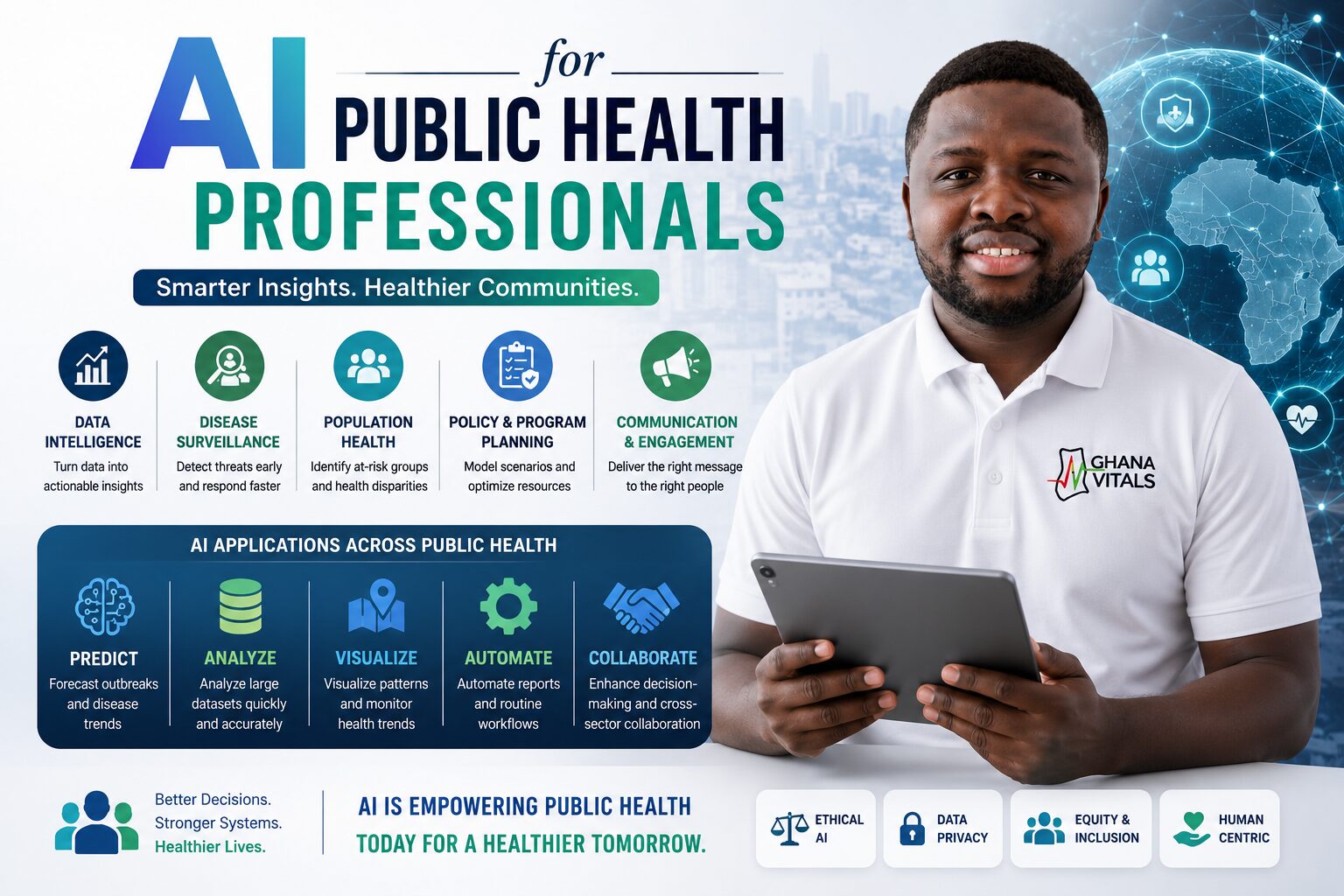
AI for Public Health Professionals: How Artificial Intelligence Is Transforming Population Health in 2026
By Dr Festus Kaasung Kunde, MD
Medical Doctor | AI in Healthcare Advocate | Founder, AI Doctor Africa & Ghana Vitals
Published: 2026 | Reading Time: 20–25 Minutes | Category: AI in Public Health
Quick Summary
Public health has always been a data problem. The challenge has never been the lack of data. The challenge has been collecting it, organising it, interpreting it, and turning it into action before people become sick. Artificial Intelligence is beginning to change that reality. Today, AI can help public health professionals detect disease outbreaks earlier, identify at-risk populations, improve vaccination campaigns, optimise healthcare resources, accelerate research, and support preventive healthcare at a scale previously impossible.
Yet despite the excitement, many public health professionals remain uncertain about where AI truly fits into their work. This article explores how AI is transforming public health in 2026, the opportunities it creates for Africa, the risks professionals must understand, and why AI may become one of the most important public health tools of the next decade.
The Question That Led Me to Public Health AI
One of the questions that eventually led to the creation of Ghana Vitals was surprisingly simple: Why do so many people only discover they have hypertension, diabetes, or obesity after complications have already started? As a doctor in Ghana, I repeatedly encountered patients who had lived with elevated blood pressure, abnormal blood sugar levels, or unhealthy weight for years without knowing it. By the time many of them arrived at the hospital, the disease had already progressed. Some presented with stroke. Others presented with heart failure with complications that might have been prevented if risk factors had been detected earlier.
The frustrating part was that many of these conditions are not difficult to identify.
- A simple blood pressure measurement.
- A blood glucose test.
- A BMI calculation.
These are inexpensive tools. Yet millions of people still go unscreened. That observation stayed with me. I began asking myself:
- What if we could identify risk before disease develops?
- What if we could use data to predict health problems before they become emergencies?
- What if public health could become proactive instead of reactive?
Those questions eventually contributed to the creation of Ghana Vitals. Today, artificial intelligence may provide part of the answer.
Public Health Has Always Been a Data Science
When people hear the term “public health,” they often think about hospitals, vaccinations, or disease outbreaks. Those are certainly part of public health. But at its core, public health is about information. Public health professionals ask questions such as:
- Who is getting sick?
- Where are they getting sick?
- Why are they getting sick?
- How can we prevent it?
- Which interventions work best?
Answering those questions requires data. Large amounts of data. Historically, collecting and analyzing that information has been slow, expensive, and labor-intensive. Artificial intelligence changes that equation. For the first time, public health professionals can rapidly analyse enormous datasets and identify patterns that would be difficult for humans to detect on their own.
What Is Artificial Intelligence in Public Health?
Artificial Intelligence in public health refers to the use of machine learning, predictive analytics, natural language processing, and other computational techniques to improve population health outcomes. Unlike clinical AI, which focuses on individual patients, public health AI focuses on populations.
Clinical AI
Examples include:
- Radiology interpretation
- Clinical decision support
- Diagnostic assistance
- Drug interaction checking
Public Health AI
Examples include:
- Disease surveillance
- Outbreak prediction
- Population health analysis
- Vaccination planning
- Resource allocation
- Preventive healthcare
The difference is important. One focuses on individuals. The other focuses on communities.
Why Public Health Professionals Should Care About AI
Many public health systems face similar challenges. Whether in Ghana, Nigeria, Kenya, South Africa, the United Kingdom, or the United States, professionals often struggle with:
Information Overload
Healthcare data is growing faster than human capacity to analyse it.
Workforce Shortages
Many public health departments remain understaffed.
Disease Surveillance Challenges
Outbreak detection often happens too late.
Resource Constraints
Budgets are limited. Needs are not.
Health Inequalities
Resources are rarely distributed evenly.
Preventive Healthcare Gaps
Many diseases remain undetected until complications occur. AI offers potential solutions in each of these areas.
The Public Health Shift From Reactive to Predictive
Historically, public health has often been reactive.
- An outbreak occurs.
- Authorities respond.
- People become sick.
- Interventions are deployed.
- This approach has saved countless lives.
However, AI introduces something different:
Prediction. Instead of waiting for disease outbreaks to occur, AI systems can identify warning signs earlier.
Examples include:
- Environmental changes
- Mobility patterns
- Social media trends
- Weather data
- Healthcare utilization patterns
These signals may help identify emerging threats before traditional surveillance systems detect them. Our goal is not simply a faster response. The goal is prevention.
AI Use Case #1: Disease Surveillance
Disease surveillance is one of the most important functions of public health. Every country needs systems capable of identifying:
- Cholera outbreaks
- Malaria outbreaks
- Tuberculosis clusters
- Influenza trends
- Emerging infectious diseases
Traditional surveillance relies heavily on:
- Manual reporting
- Laboratory confirmation
- Administrative systems
While effective, these approaches often involve delays.
AI can accelerate detection.
Traditional Surveillance vs AI Surveillance
| Traditional Approach | AI-Powered Approach |
|---|---|
| Reactive | Predictive |
| Manual reporting | Automated analysis |
| Slower identification | Faster detection |
| Limited data sources | Multiple data sources |
| Human-intensive | Scalable |
COVID-19 Changed Everything
The COVID-19 pandemic demonstrated both the strengths and weaknesses of global public health systems.
Many countries struggled to:
- Detect outbreaks quickly
- Track transmission patterns
- Predict healthcare demand
AI tools were used to:
- Analyse case data
- Model spread patterns
- Forecast hospital capacity needs
- Support vaccine deployment planning
Although not perfect, these systems demonstrated the potential value of AI-assisted public health surveillance.
AI Use Case #2: Predicting Disease Outbreaks
One of the most exciting applications of AI is outbreak prediction. Imagine being able to predict:
- Cholera outbreaks
- Malaria surges
- Dengue outbreaks
- Influenza waves
before they occur. This is no longer science fiction.
Researchers are increasingly using AI models that combine:
- Climate data
- Rainfall patterns
- Population movement
- Environmental indicators
- Historical disease trends
to forecast disease risk.
Example: Malaria
Malaria remains a major public health challenge across Africa. Mosquito populations are influenced by:
- Temperature
- Rainfall
- Humidity
These environmental variables can be analysed by AI systems. The result is improved malaria risk forecasting.
Public health officials can then:
- Prepare supplies
- Target interventions
- Deploy resources earlier
This can potentially save lives and reduce costs.
AI Use Case #3: Population Health Analytics
Public health professionals collect enormous amounts of data.
Examples include:
- Blood pressure measurements
- Blood glucose levels
- BMI data
- Vaccination records
- Mortality statistics
- Hospital utilization data
Historically, much of this information remained underutilised.
AI changes that.
Instead of merely storing data, systems can identify:
- Risk patterns
- Geographic hotspots
- High-risk populations
- Emerging trends
This is where I see enormous potential for projects such as Ghana Vitals.
The Ghana Vitals Opportunity
Ghana Vitals was built around a simple idea: Prevention is cheaper than treatment. Safer than treatment.
And often more effective than treatment. Imagine screening 100,000 Ghanaians.
Collecting:
- Blood pressure
- Blood glucose
- BMI
- Now imagine using AI to identify:
- Communities at highest cardiovascular risk
- Areas with increasing obesity rates
- Regions likely to experience future diabetes burdens
That information could support:
- Public health planning
- Preventive interventions
- Resource allocation
This is one reason I believe AI will become increasingly important in public health. Not because AI is replacing professionals. But it also helps professionals make better decisions.
Public Health Professionals Have a Unique Opportunity
Doctors often focus on individual patients. Public health professionals focus on populations.
- The scale is different.
- The impact is different.
- A clinician may improve one life at a time.
- A public health intervention can improve the lives of thousands.
- Artificial intelligence has the potential to multiply that impact.
- The challenge now is learning how to use it responsibly.
AI Use Case #4: Vaccination Programs and Immunisation Planning
Few public health interventions have saved more lives than vaccination.
Vaccines have dramatically reduced the burden of:
- Smallpox
- Polio
- Measles
- Diphtheria
- Tetanus
- Hepatitis B
Yet despite decades of success, immunisation programs still face major challenges.
Public health teams must answer difficult questions:
- Which communities have low vaccine coverage?
- Which children missed scheduled vaccines?
- Where should resources be deployed?
- Which populations are most at risk?
Traditionally, answering these questions requires significant manual analysis. Artificial intelligence can accelerate the process.
Smarter Immunisation Campaigns
Imagine a district health director responsible for vaccine delivery.
- Thousands of records exist.
- Coverage rates vary.
- Resources are limited.
AI systems can analyse:
- Historical vaccine uptake
- Population demographics
- Geographic access challenges
- Health facility performance
to identify areas requiring immediate attention. Instead of treating every community the same, public health teams can target interventions where they are most needed. This approach is often called:
Precision Public Health
The right intervention.
For the right population.
At the right time.
AI Use Case #5: Resource Allocation
One of the biggest challenges in healthcare is deciding where resources should go. Resources are always limited. Needs are always greater than budgets.
Public health leaders must decide:
- Where to build clinics
- Where to deploy staff
- Which programs to fund
- Which interventions to prioritise
These decisions are often made using incomplete information.
Artificial intelligence can improve this process.
A Practical Example
Imagine two districts.
District A has:
- Increasing hypertension rates
- Rising obesity prevalence
- Growing diabetes burden
District B remains relatively stable.
Traditional planning may distribute resources equally. AI-driven analysis may reveal that District A requires greater investment in preventive services.
The result is better decision-making, but not because AI is making decisions. Because decision-makers have better information.
AI Use Case #6: Public Health Research
Research remains one of the most important responsibilities of public health professionals. Unfortunately, research can also be extremely time-consuming. Many researchers spend more time organizing information than generating knowledge.
This is where AI can help.
Literature Reviews
Public health researchers routinely review:
- Journal articles
- Reports
- Government documents
- Policy papers
A single review may involve dozens or even hundreds of sources.
AI can help by:
- Summarizing findings
- Identifying themes
- Highlighting disagreements
- Revealing evidence gaps
This allows researchers to focus on interpretation rather than information management.
Research Question Development
One challenge many young researchers face is identifying meaningful research questions.
AI can assist by helping explore:
- Emerging trends
- Knowledge gaps
- Population needs
- Policy priorities
The final question remains the researcher’s responsibility.
But AI can accelerate the discovery process.
AI Use Case #7: Health Education and Risk Communication
Information saves lives. Yet public health professionals often struggle with communication.
Many campaigns fail because information is:
- Too technical
- Poorly targeted
- Difficult to understand
Artificial intelligence can help create more effective communication strategies.
Example: Hypertension Awareness
Consider a campaign encouraging blood pressure screening.
AI can help create:
- Educational messages
- Social media content
- Community outreach materials
- Frequently asked questions
It can also adapt messaging for different audiences.
A message designed for:
- Teenagers
- Adults
- Older populations
may require different languages and approaches.
AI can support this process.
AI and Public Health Policy
Policy decisions affect millions of people. Good policy depends on good evidence. Public health leaders often face questions such as:
- Which intervention provides the greatest impact?
- Which program offers the best value?
- Which population requires immediate attention?
Artificial intelligence can support policy development by helping analyse:
- Population trends
- Healthcare utilization
- Cost-effectiveness data
- Program outcomes
Again, AI should inform policy.
Not replace policymakers.
The African Opportunity
Whenever I discuss AI, I often hear the same concern:
Isn’t AI only for wealthy countries?
I understand why people ask that question.
Many African countries face:
- Funding challenges
- Infrastructure limitations
- Workforce shortages
However, I believe Africa may actually have unique opportunities. Africa is richer than most other continents in mineral resources.
Why Africa Could Leap Forward
Africa has several advantages:
Mobile Technology Adoption
Mobile technology has spread rapidly across the continent.
Young Population
Africa has one of the youngest populations in the world.
Growing Digital Health Ecosystem
Digital health innovation is expanding rapidly.
Urgent Healthcare Needs
Necessity often drives innovation.
Many challenges create opportunities for new solutions.
Challenges Public Health Professionals Must Understand
Artificial intelligence is powerful. But it is not magic.
There are real limitations. Ignoring them would be irresponsible.
Data Quality Problems
AI systems depend on data. Poor data produces poor results. A common phrase in data science is:
Garbage in. Garbage out.
If data is inaccurate, incomplete, or biased, AI outputs will also be flawed.
Algorithmic Bias
Many AI systems are trained primarily using data from:
- Europe
- North America
- Other high-income settings
African populations may not always be adequately represented. This creates risk. Public health professionals must ensure that AI tools are validated within local contexts.
Privacy Concerns
Health data is sensitive. Public trust depends on the responsible handling of information. Strong safeguards are essential. Public health professionals must prioritise:
- Privacy
- Security
- Transparency
- Ethical governance
Overreliance on Technology
One of the greatest dangers is assuming AI is always correct.
It is not. AI can make mistakes. Public health expertise remains essential. Technology should support professionals. Do not replace them.
The Ghana Vitals Vision for Africa
When I think about the future of Ghana Vitals, I do not simply think about screening. I think about intelligence.
Health intelligence. Imagine a future where community screening programs generate real-time insights about population health.
Imagine identifying:
- Hypertension hotspots
- Diabetes trends
- Obesity patterns
before crises develop. Imagine helping governments allocate resources more effectively. Imagine helping individuals understand risk before disease develops. That is the direction I believe preventive healthcare is moving. And AI will be a major part of that journey.
The Future of AI in Public Health (2026–2035)
Over the next decade, I expect several developments.
Predictive Public Health
Instead of reacting to disease, systems will increasingly predict risk.
Personalized Prevention
Recommendations may become increasingly tailored to specific populations.
Real-Time Population Monitoring
Health systems may gain better visibility into emerging trends.
Smarter Resource Allocation
Governments may make more evidence-driven decisions.
AI-Assisted Public Health Research
Researchers will spend less time processing information and more time generating insights.
My Perspective as a Ghanaian Doctor
As someone practising medicine in Africa, I am optimistic about AI.
But I am also realistic.
Artificial intelligence will not solve every healthcare problem.
It will not replace healthcare workers.
AI will not eliminate funding challenges.
Nor will it magically fix weak health systems.
However, it can help.
It can help us:
- Learn faster
- Analyze better
- Predict earlier
- Plan smarter
And in public health, those advantages matter. Better decisions at the population level can affect millions of lives.
Key Takeaways
- Public health has always been a data-driven field.
- AI can help transform data into actionable insights.
- Disease surveillance is one of AI’s strongest public health applications.
- Outbreak prediction is becoming increasingly possible.
- Vaccination programs can benefit from AI-assisted planning.
- Population health analytics can improve preventive care.
- Public health research can become more efficient.
- Resource allocation can become more evidence-driven.
- Data quality remains critical.
- Ethical governance is essential.
- Africa has unique opportunities to benefit from AI.
- AI should support—not replace—public health professionals.
Frequently Asked Questions
Can AI predict disease outbreaks?
In some situations, yes. AI can identify patterns that may indicate an increased risk of outbreaks.
Is AI replacing public health professionals?
No. AI supports decision-making but does not replace professional expertise.
Can AI improve vaccination programs?
Yes. AI can help identify gaps in coverage and optimise resource allocation.
What is precision public health?
Precision public health uses data and technology to deliver interventions to the populations that need them most.
Can AI help with public health research?
Absolutely. Literature reviews, evidence synthesis, and data analysis are major use cases.
Is AI useful in low-resource settings?
Yes, particularly when applied to surveillance, education, and preventive healthcare.
What are the biggest risks?
Bias, poor-quality data, privacy concerns, and overreliance on technology.
How does AI relate to Ghana Vitals?
AI can help transform screening data into actionable health intelligence and preventive insights.
Will AI reduce healthcare costs?
Potentially, particularly through earlier detection and better resource allocation.
What should public health professionals learn first?
Start with AI literacy, data analysis fundamentals, and practical use cases relevant to your work.
Related Articles on AI Doctor Africa
- How Medical Doctors Can Use Claude AI for Research, Clinical Learning, and Productivity in 2026
- 50 Claude AI Prompts Every Medical Doctor Should Save
- ChatGPT vs Claude for Medical Doctors: Which AI Is Better?
- How Doctors Can Use AI to Save 10 Hours Every Week
- Can Doctors Trust AI? Benefits, Risks, and Best Practices
- Best AI Tools for Doctors in 2026
About the Author
Dr Festus Kaasung Kunde is a Medical Doctor, AI in Healthcare Advocate, and Founder of AI Doctor Africa and Ghana Vitals. He holds an MD from Stavropol State Medical University in Russia (2025) and completed an internship at Korle-Bu Teaching Hospital in Accra. His mission is to help African healthcare professionals adopt AI responsibly to improve learning, research, and patient outcomes.
AI Doctor Africa | aidoctorafrica.com
Medical Disclaimer: For educational purposes only. Nothing in this article constitutes clinical advice or endorsement of any specific AI product. Clinical decisions must be made by qualified healthcare professionals.

Dr. Festus K. Kunde
Dr. Festus Kaasung Kunde is a medical doctor, Content creator, healthcare technology writer, and digital health innovator specializing in Artificial Intelligence in Medicine, Healthcare Systems Innovation, and Health Data Science in Africa. He is the founder of AI Doctor Africa (AIDoctorAfrica.com), an educational platform dedicated to helping healthcare professionals—including doctors, medical students, nurses, and researchers—understand and responsibly apply artificial intelligence in clinical practice, medical education, medical research, and healthcare innovation. He is also the creator of Ghana Vitals, a health data and predictive analytics initiative focused on collecting and analyzing key health indicators such as blood pressure, blood glucose, and BMI to support early disease detection, preventive healthcare, and data-driven decision-making in Ghana and across Africa. The project reflects his long-term vision of building scalable, AI-powered public health systems for African populations. Dr. Kunde’s work focuses on the practical integration of AI tools such as ChatGPT, Claude, and emerging clinical AI systems into real-world healthcare workflows. His content emphasizes improving clinical documentation, accelerating medical education, strengthening research productivity, and supporting healthcare decision-making in resource-limited settings. Through AI Doctor Africa, he publishes evidence-informed, practice-oriented resources including AI workflows, clinical use cases, medical education guides, and tutorials designed specifically for African healthcare professionals. Through Ghana Vitals, he extends this mission into population health innovation, aiming to leverage real-world health data and predictive models to improve early intervention, reduce preventable disease burden, and strengthen health systems across Africa. His overall mission is to bridge the gap between traditional clinical medicine, artificial intelligence, and data-driven public health, empowering African healthcare professionals to work smarter, diagnose earlier, and deliver better care through technology. Areas of Expertise Artificial Intelligence in Clinical Medicine Digital Health & Healthcare Innovation in Africa Health Data Analytics & Predictive Health Systems Medical Education and Exam Preparation AI for Medical Research and Scientific Writing Clinical Workflow Optimization using AI Tools Public Health Data Systems (Ghana Vitals Initiative) Professional Focus Dr. Kunde’s work sits at the intersection of clinical medicine, artificial intelligence, and population health systems, with a strong focus on scalable solutions for African healthcare challenges. His initiatives emphasize ethical AI use, data-driven decision-making, and practical implementation in real-world clinical and public health environments.
View author profile →