
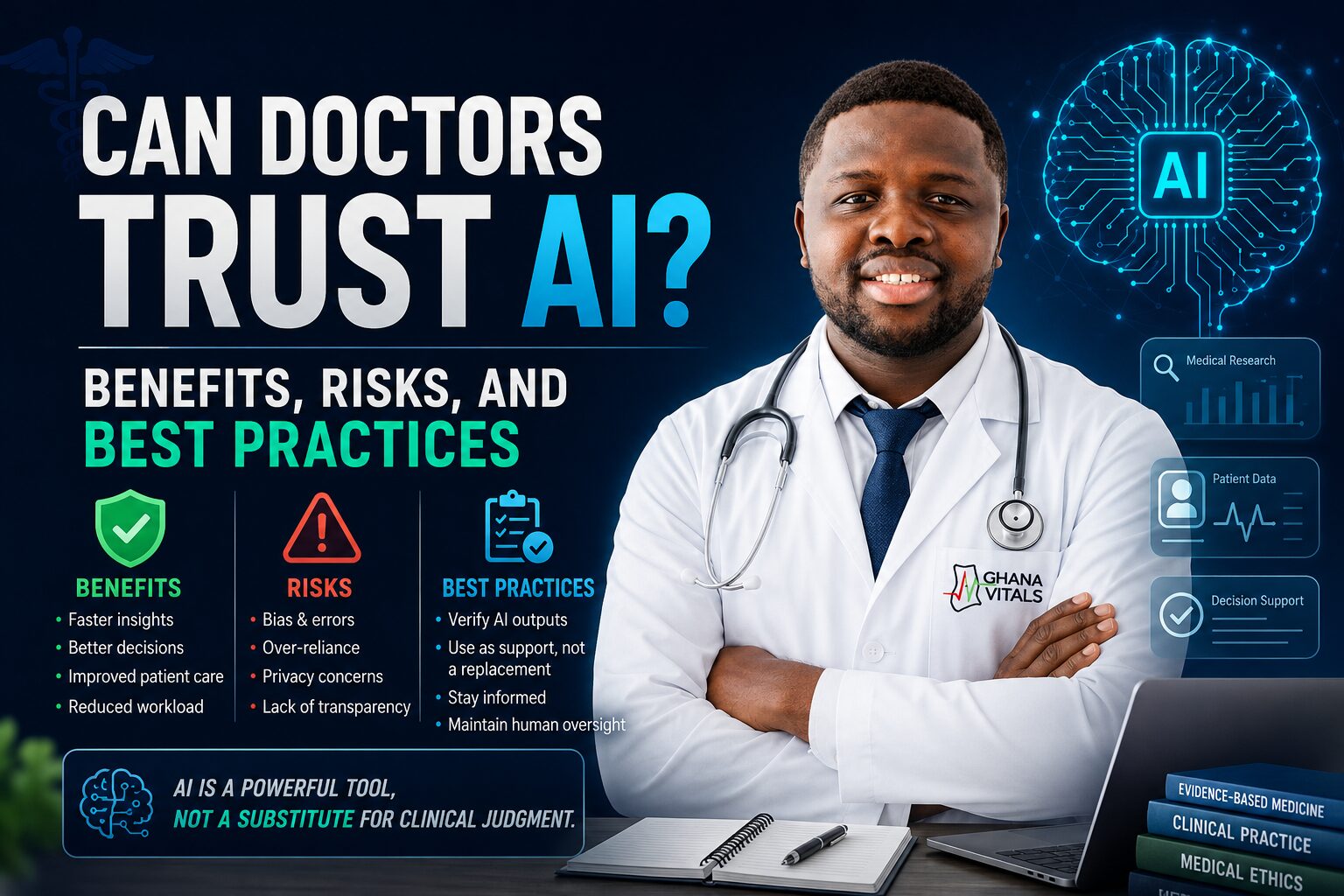
Can Doctors Trust AI? Benefits Risks and Best Practices: 2026
By Dr Festus Kaasung Kunde, MD | Stavropol State Medical University
Medical Doctor | AI in Healthcare Advocate | Founder, AI Doctor Africa & Ghana Vitals
Published: June 2026 | Reading Time: 18–22 minutes | Category: AI for Doctors
Quick Summary
81% of doctors now use AI in clinical practice — more than double the rate in 2023. And yet, a 2026 study found AI undertriaged half of healthcare emergencies. Both facts are true simultaneously. That tension is what this article is about. Can doctors trust AI? The honest answer is: yes, conditionally. This article explains what the conditions are — the real benefits, the real risks, the specific failures to know about, and the best practices that make AI genuinely safe in clinical use. Written from the perspective of an African doctor who uses these tools daily. Can Doctors Trust AI? Benefits Risks and Best Practices
The Question Every Doctor Is Asking — But Nobody Is Answering Honestly
Can doctors trust AI? It is a question I get asked regularly — by medical students at the universities and secondary schools where I give health talks in Accra, by colleagues at Korle-Bu Teaching Hospital, and by doctors who read this blog from across Africa. And I want to answer it honestly because I think most of the answers out there now aren’t.
On one side, you have the enthusiasts. AI is transforming medicine by matching specialists in dermatology, radiology, and pathology. This reduces burnout. It accelerates research. It will save millions of lives. All of this is true. Furthermore, the data backs it up: 81% of physicians in the 2026 AMA survey now use AI in their practices — more than double the 38% who used it in 2023. Moreover, more than three-quarters believe it improves their ability to care for patients.
AI hallucinates
On the other side, you have the sceptics. AI hallucinates. It gets clinical facts wrong. A 2026 study published in Nature Medicine found that ChatGPT undertriaged approximately half of healthcare emergencies in structured testing. Additionally, in January 2026, Sharp HealthCare was sued following an investigation that revealed AI ambient scribes were recording patient consultations without proper consent at major health systems across the US. These failures are also real.
Both sides are right. Consequently, the question ‘Can doctors trust AI?’ does not have a simple yes-or-no answer. It has a conditional answer — and the conditions are the most important thing any doctor can learn about AI right now.
AI tools have been part of my daily routine throughout my internship at Korle-Bu and in building AI Doctor Africa and Ghana Vitals. I have seen what these tools do well. I have also encountered their failures. Moreover, I have spent significant time reading the research on AI safety in clinical settings. This article is my attempt to give you the full picture — benefits, risks, and a practical framework for using AI in ways that are genuinely trustworthy.
The honest answer to ‘Can doctors trust AI?’ is this: you can trust it the way you trust a knowledgeable colleague who has not yet been licensed. Intelligent, often right, sometimes confidently wrong — and never accountable in your place. The clinical responsibility is always yours.
What the 2026 Research Actually Says About AI in Medicine
The Adoption Reality
The scale of AI adoption in medicine in 2026 is genuinely remarkable. According to the 2026 AMA Physician Survey on Augmented Intelligence — the most comprehensive annual survey of AI use in clinical practice — more than four in five physicians now use AI professionally. Furthermore, the average number of AI use cases per physician has grown from 1.1 in 2023 to 2.3 in 2026. The most common uses are medical research summarisation and clinical documentation.
AMA Physician Survey on Augmented Intelligence
Additionally, physician confidence in AI is growing alongside adoption. More than three-quarters of surveyed physicians believe AI improves their ability to care for patients — up from 65% in 2023. The greatest expected advantages, according to the same survey, are diagnostic accuracy and work efficiency. This cautious optimism reflects a profession that is engaging with AI pragmatically, not uncritically.
In the African context, these trends are playing out somewhat differently. AI adoption among doctors in Ghana, Nigeria, and South Africa is growing, but from a lower baseline. Consequently, the learning curve is steeper, the institutional support is thinner, and the risk of unsupported adoption — doctors using AI tools without the training or the critical framework to use them safely — is higher. This is part of why AI Doctor Africa exists.
The Trust Gap That Threatens Everything
Here is the finding that concerns me most about AI in medicine in 2026. The 2026 Philips Future Health Index — a global survey covering clinicians and patients across multiple countries — found that AI is transforming clinical care, but that a deepening trust deficit is slowing adoption and, more seriously, threatening patient safety.
The specific data is striking. Among patients, 74% express high confidence in AI-generated health answers — despite 69% acknowledging concern about hallucinations. That combination — high confidence and known risk — is dangerous. It suggests patients are using AI as if it were a trusted clinical authority, without the critical appraisal skills to evaluate what it tells them.
Among clinicians, the picture is different but equally concerning. More than half of doctors and nurses in the 2026 Wolters Kluwer Future Ready Healthcare survey agree that AI tools for clinical use should be built by trusted medical sources rather than general technology companies. Additionally, 77% say they always or often independently validate AI-generated health information. This is encouraging — but it also means that 23% do not consistently validate AI outputs before acting on them.
Furthermore, the Stanford and Harvard State of Clinical AI report, released in January 2026, drew a clear distinction between what AI performs well in controlled studies and what holds up in real clinical settings. The gap between controlled study performance and real-world clinical performance is the most important safety challenge in clinical AI right now.
[OUTBOUND LINK: Link ‘Stanford and Harvard State of Clinical AI report’ to https://medicine.stanford.edu — authoritative academic medical institution outbound link]
The Real Benefits of AI for Doctors: What the Evidence Shows
Before discussing the risks, it is important to clearly and honestly name the benefits. The benefits of AI in clinical practice are real, measurable, and in many cases, well-evidenced. Furthermore, dismissing them to appear appropriately cautious does a disservice to doctors who could genuinely improve their practice and their patients’ outcomes by using these tools effectively.
| Benefit | Evidence / Data | Clinical Impact |
| Reduced physician burnout | AI ambient scribes cut burnout by 21% (Mass General Brigham & UCLA, 2026) | Doctors spend less time on documentation and more time on patients |
| Faster medical research | 81% of physicians use AI for research summarisation (AMA, 2026) | Literature review compressed from hours to minutes |
| Improved diagnostic accuracy | AI matches or exceeds specialist performance on dermatology, radiology, and pathology tasks (multiple 2025–2026 RCTs) | Earlier detection of conditions in settings without immediate specialist access |
| Clinical documentation support | AI scribes accurately capture patient encounters in real time | Reduced errors from dictated or handwritten notes; better records |
| CME and clinical learning | Doctors using AI for CME report higher engagement and retention vs passive methods | More current clinical knowledge applied at the bedside |
| Drug interaction checking | AI tools check interactions across polypharmacy lists faster than manual review | Reduced prescribing errors, especially in complex elderly patients |
| Patient education | AI generates plain-language education materials adapted to literacy level | Better patient understanding and medication adherence |
| Research access in Africa | Free AI tools provide access to NEJM, BMJ, and guideline evidence without institutional subscriptions | Reduced the evidence gap between African and high-income country clinicians |
These benefits are not hypothetical. They are demonstrated in peer-reviewed research across multiple clinical settings. Moreover, for African doctors specifically, several of these benefits address structural gaps that have persisted in African healthcare for decades — the access gap, the evidence gap, the documentation burden — in genuinely meaningful ways.
Most significant benefit for African doctors: free AI tools now provide access to clinical evidence from NEJM, BMJ, and WHO sources that institutional subscriptions at many African hospitals do not cover. Consequently, a doctor in a district hospital in Ghana has access to the same evidence base as a doctor at a teaching hospital in London — for the first time, and at no cost.
The Real Risks of AI in Clinical Practice: What You Must Know
The Eight Risks Every Doctor Needs to Understand
The risks of AI in clinical practice are not rare edge cases or theoretical concerns. They are documented, recurring, and in some cases, already causing patient harm. Therefore, every doctor who uses AI tools — regardless of how experienced they are with the technology — needs to understand these risks in a specific, concrete way.
Important: The risks in this section are based on published research and documented events from 2025 and 2026. They are not hypothetical. Treating them seriously is a patient safety obligation.
| Risk | Evidence / Example | Clinical Consequence |
| Hallucination — plausible but false information | Nature Medicine study (2026): ChatGPT undertriaged approximately half of healthcare emergencies | Wrong triage decisions; delayed treatment; patient harm |
| Outdated clinical knowledge | General AI models have training cutoffs; they may present old guidelines as current | Incorrect management based on superseded protocols |
| Algorithmic bias | AI trained predominantly on Western, white-majority datasets underperforms on African, South Asian, and other non-Western populations | Diagnostic errors disproportionately affect already-underserved populations |
| Patient confidentiality breach | Uploading clinical case details to external AI platforms violates data protection law | Legal liability, regulatory sanction, patient harm |
| AI ambient scribe consent failures | Sharp HealthCare lawsuit (January 2026); Medscape investigation (June 2026) reveals widespread consent failures at major US health systems | Patients recorded without knowledge or consent |
| Over-reliance reduces clinical vigilance | ECRI Institute: AI diagnostic shortcomings top patient safety concern in 2026 | Doctors accepting AI output without independent clinical assessment |
| Fabricated research citations | ChatGPT and Claude generate plausible-sounding but non-existent paper references | Academic fraud; clinical decisions based on non-existent evidence |
| Unequal access amplifying health disparities | AI benefits concentrate in well-resourced settings; Africa and low-income countries lag | Widens the gap between high-income and low-income healthcare quality |
The Hallucination Problem — Why It Matters More in Medicine Than Anywhere Else
AI hallucination deserves special attention in a clinical context because the stakes are different from those in other domains. When an AI hallucinates a restaurant recommendation or a historical fact, the consequence is inconvenience or mild embarrassment. When an AI hallucinates a drug dose, a diagnostic criterion, or a clinical management step, the consequence can be patient harm.
The 2026 Nature Medicine study that found ChatGPT undertriaged approximately half of healthcare emergencies is the most alarming recent data point on this specific risk. Furthermore, the confidence with which AI presents wrong answers is often indistinguishable from the confidence with which it presents right ones. Consequently, the dangerous failure mode is not that an AI answer obviously looks wrong — it is that it looks completely right.
This is why citation-grounded tools like Perplexity, NotebookLM, and Elicit represent a meaningful safety improvement over general chatbots for clinical use. When every claim is cited, the doctor can verify. When answers are generated without citation, verification requires additional work that, under clinical time pressure, may not happen.
The practical rule is simple: for any AI-generated clinical fact that could affect a patient management decision, trace it back to a primary source before acting on it. This does not have to be time-consuming. If the AI cites a source, check that the citation takes you to a real document that says what the AI claims it says. If the AI does not cite a source, search PubMed or the relevant guideline body directly.
The Bias Problem — Why African Doctors Must Pay Special Attention
Algorithmic bias in clinical AI is not a hypothetical future problem. It is a present, documented reality that African doctors need to understand specifically.
Most clinical AI systems — including diagnostic AI for imaging, dermatology, and cardiology — were trained predominantly on data from North American and European patient populations. Furthermore, these populations are predominantly white, and the medical presentations, genetic risk factors, and comorbidity patterns that appear in these datasets may not accurately represent African patient populations.
As a result, AI tools that perform well on benchmark datasets may perform significantly less well on African patients. Skin conditions may be misclassified on darker skin tones. Cardiovascular risk tools calibrated on Western populations may underestimate or overestimate risk in Ghanaian or Nigerian patients. Drug response predictions based on pharmacogenomic data from European populations may not apply to West African patients whose genetic profiles differ significantly.
This does not mean African doctors should avoid AI. It means they should use it with an additional layer of critical appraisal — always asking whether the AI output is likely to be as reliable for their patient population as it is for the populations the AI was trained on.
Critical question for African doctors: Before acting on any AI diagnostic or management recommendation, ask yourself — was this AI trained on data from populations like mine? If you cannot answer “yes” with confidence, verify it against clinical evidence specific to your patient population.
Best Practices for Doctors Using AI: A Practical Framework
The Eight Principles of Safe AI Use in Clinical Practice
These best practices are not aspirational guidelines. They are practical rules that I apply personally — and that every doctor using AI tools in clinical or educational contexts should implement consistently.
| Best Practice | What It Means in Clinical Reality | Tools That Help |
| Verify every clinical claim against primary sources | Never apply an AI-generated drug dose, diagnosis, or management recommendation without checking the guideline or BNF | PubMed, WHO guidelines, Ghana Standard Treatment Guidelines |
| Use source-grounded tools for clinical facts | Choose tools that cite their sources so you can verify — not just generate fluent text | Perplexity Pro, NotebookLM, Elicit, Consensus |
| Never enter patient-identifiable information | No names, hospital numbers, dates of birth, or clinical details that could identify a specific patient | Use anonymised or hypothetical cases for all AI-assisted learning |
| Check the guideline currency explicitly | Ask the AI when the guideline was published; verify against the issuing body’s website | Perplexity (real-time search), official WHO, GHS, and MDC websites |
| Disclose AI use in academic and research work | Include a clear AI disclosure statement in the methods section of any research paper | Follow your target journal’s specific AI disclosure policy |
| Maintain clinical judgment as the final decision | AI informs reasoning; the qualified clinician makes the decision and carries the responsibility | No tool or platform changes this — ever |
| Report AI errors when you see them | Clinical AI errors are a patient safety issue — report them through your hospital’s safety reporting system | Most hospitals use structured adverse event reporting systems |
| Build AI literacy progressively | Start with low-stakes tasks (CME, research) before using AI in clinical decision support | AI Doctor Africa articles on this site; AMA AI guidelines |
A Framework for Deciding How Much to Trust Any AI Output
Six Questions That Determine Trust
Rather than making a blanket judgment about whether AI can be trusted, a more useful approach is to evaluate each AI output against a set of specific questions. The following framework gives you a structured way to make that evaluation quickly — in the time available during a clinical shift.
| Question to Ask | Why It Matters | What Good Looks Like |
| Is the AI’s output cited? | Uncited outputs cannot be verified, and unverified clinical information is dangerous | Tool cites the specific guideline, paper, or source for each claim |
| When was this AI last updated? | Training cutoffs mean clinical guidance may be months or years out of date | The tool uses real-time search (Perplexity), or you can verify currency independently |
| Was this AI validated in a clinical setting? | Academic performance on benchmarks does not equal real-world clinical reliability | The tool has peer-reviewed evidence of clinical performance in populations like yours |
| Does the AI acknowledge uncertainty? | An AI that always sounds confident is more dangerous than one that says ‘I am not sure’ | Tool expresses appropriate epistemic humility; flags complex or ambiguous cases |
| Who is accountable if the AI is wrong? | AI cannot be held professionally accountable — only the clinician who acted on its output | You understand that using AI does not transfer clinical responsibility |
| Is patient data protected? | External AI platforms may store, process, or use input data in ways that violate privacy law | Only anonymised or hypothetical cases are used; no patient data is entered |
Furthermore, this framework applies equally to AI used in learning, research, and clinical practice. The questions are the same whether you are evaluating an AI-generated study summary, a drug interaction check, or a differential diagnosis suggestion. Consequently, developing the habit of asking these questions automatically — rather than accepting AI outputs at face value — is the most important single change any doctor can make in their approach to AI.
My Personal Perspective: Honest Reflections From Daily AI Use
What I Have Learned Using AI at Korle-Bu
To be transparent about my own relationship with AI in clinical practice, because I think personal honesty is more useful than abstract principles.
AI tools are incorporated into my daily schedule. I use them for clinical learning, research, content creation, exam preparation, and building Ghana Vitals and AI Doctor Africa. In all of these contexts, I have found AI genuinely valuable. Furthermore, I have found specific tools — Claude for reasoning and explanation, Perplexity for current, cited evidence, NotebookLM for guideline review — to be consistently more reliable for clinical use than general chatbots used without structure.
However, I have also encountered failures when I asked AI tools clinical questions and received confident, plausible, incorrect answers. It gave me the impression that the cited references did not say what the AI claimed they said. I have noticed AI using management protocols from superseded guidelines. Each of these experiences has reinforced the same lesson: AI is powerful and fallible, and the doctor who understands both simultaneously is the one who uses it safely.
Additionally, I am aware of something that nobody in the AI enthusiasm space talks about enough: the cognitive offloading risk. The more readily available AI assistance is, the easier it becomes to reach for the AI answer before engaging your own clinical reasoning. For a doctor-in-training — which I still am, in many respects — this is a genuine risk. Clinical reasoning is a skill. Skills atrophy without practice. Therefore, AI should be used to test and extend your reasoning, not to bypass it.
The relationship I try to maintain with AI tools is that I use them as a knowledgeable research assistant and a sparring partner for clinical reasoning. I never use them as an authority. The authority in any clinical decision is the trained clinician with professional responsibility for the patient — and that is me, not the AI.
What This Means for African Doctors Specifically
For African doctors, the question of trusting AI carries additional weight. We are building our clinical careers in an environment where AI adoption is accelerating faster than regulatory frameworks, training infrastructure, and institutional support structures can keep pace. Consequently, African doctors are making individual judgments about AI use without the institutional guardrails that doctors in well-resourced health systems have.
This makes individual AI literacy more important, not less. When the institution lacks an AI governance policy, the individual doctor’s critical appraisal skills are the primary safety mechanism. When there is no clinical AI validation committee reviewing the tools being used, the clinician’s own framework for evaluating AI outputs is all that stands between an AI error and a patient outcome.
Therefore, the most important thing an African doctor can do regarding AI in 2026 is not to decide whether to use it. That decision has effectively already been made by the profession globally. The most important thing is to build critical AI literacy — the specific knowledge of what these tools can and cannot do, and the practical habits of verification and clinical judgment — that makes using AI genuinely safe.
That is the mission of AI Doctor Africa. Not to promote uncritical AI adoption. Rather, to build the informed, critical AI literacy that African doctors need to use these tools in ways that serve their patients, advance their careers, and contribute to the evidence base that African healthcare needs.
Key Takeaways: Can Doctors Trust AI?
- 81% of physicians now use AI in practice (AMA, 2026) — but a deepening trust deficit and documented safety failures mean that adoption without critical literacy is genuinely dangerous
- The honest answer to ‘Can doctors trust AI?’ is: conditionally — with verification, with appropriate tools, and with clinical judgment always in the lead
- AI hallucination is documented, recurring, and clinically significant — in 2026, ChatGPT undertriaged approximately half of healthcare emergencies in structured Nature Medicine testing
- Algorithmic bias is a specific risk for African doctors — most clinical AI was trained on Western, white-majority populations and may underperform on African patients
- Source-grounded tools (Perplexity, NotebookLM, Elicit, Consensus) are significantly safer for clinical use than general chatbots because every claim can be traced to a verifiable source
- The eight best practices — verify clinical claims, use cited tools, never enter patient data, check guideline currency, disclose AI in research, maintain clinical judgment, report errors, build literacy progressively — form the non-negotiable framework for safe AI use
- AI ambient scribe consent failures (Sharp HealthCare lawsuit, January 2026) demonstrate that even well-resourced institutions can fail at AI governance — individual critical appraisal is essential
- Patient AI use is already prevalent — 52% of patients use AI to research their conditions — making doctor AI literacy a patient safety issue as much as a professional one
- For African doctors specifically, individual AI literacy is the primary safety mechanism in the absence of institutional AI governance frameworks
- AI should extend and test clinical reasoning — never bypass it. The clinical responsibility is always the doctor’s, regardless of what any AI tool outputs
Frequently Asked Questions: Can Doctors Trust AI?
These are the questions doctors most commonly ask when thinking seriously about AI in clinical practice:
| Question | Answer |
| Can doctors legally use AI in clinical practice? | Yes — but with important caveats. AI tools used for clinical decision support are not currently regulated as medical devices in most African jurisdictions, including Ghana, at the time of writing. However, the doctor who uses an AI output in clinical practice remains fully legally and professionally responsible for the outcome. AI does not transfer liability. If an AI tool provides incorrect information that influences a clinical decision that harms a patient, the doctor — not the AI — bears professional and legal accountability. |
| Does AI replace clinical judgment? | No. AI is a tool that processes information and generates outputs — it does not examine patients, take a history, weigh competing values, or carry professional accountability. Every clinical decision remains the responsibility of the qualified clinician. Furthermore, research published in Nature Medicine (2026) found that AI systems under-triaged approximately half of healthcare emergencies in structured testing — a finding that underscores why human clinical judgment remains essential at every decision point. |
| Is AI accurate enough to trust for drug dosing? | Not without independent verification. AI tools — including Claude, ChatGPT, and Perplexity — can produce incorrect drug doses, miss renal or hepatic adjustment requirements, and present outdated dosing guidance as current. For drug dosing in clinical practice, always verify against the BNF, local formulary, manufacturer guidance, or the Ghana Standard Treatment Guidelines. Use AI to understand dosing principles and drug-class behaviour — not as a sole reference for specific doses for individual patients. |
| What is the biggest risk of AI in African clinical practice? | Two risks are particularly acute in the African context. The first is algorithmic bias: most clinical AI has been trained predominantly on data from Western, white-majority populations. Consequently, performance may be less reliable for African patients with different disease presentations, genetic profiles, and comorbidity patterns. The second is the access gap: AI benefits are currently concentrated in well-resourced settings with reliable internet and modern devices. Without deliberate effort to make AI tools accessible and relevant for African clinical practice, AI risks widening existing health disparities rather than closing them. |
| Can patients use AI to self-diagnose? | Patients already do — 52% of patients in the 2026 Wolters Kluwer survey reported using AI to research conditions or diagnoses. However, 74% of those same patients expressed high confidence in AI answers despite 69% acknowledging concern about hallucinations. This combination — high confidence, known risk, without clinical oversight — is dangerous. Doctors should proactively discuss AI use with patients, explain its limitations, and position themselves as the trusted source for clinical interpretation of any AI-generated health information patients bring to consultations. |
| How should African doctors stay up to date on AI safety in medicine? | Several reliable sources publish current evidence on AI safety in clinical practice: the AMA Physician Survey on Augmented Intelligence (annual), the ECRI Institute’s patient safety reports, and the Stanford/Harvard State of Clinical AI report (annual, starting in 2026). In Africa, AI Doctor Africa publishes regular, contextualised updates on AI in African healthcare. Additionally, Perplexity AI provides real-time cited summaries of recent AI safety literature — useful for a weekly fifteen-minute evidence scan. |
Related Articles on AI Doctor Africa
- How African Doctors Can Use AI in Daily Practice: The Complete 2026 Guide
- How Doctors Can Use AI for Continuous Medical Education in 2026
- Perplexity AI for Doctors: The Cited Search Tool Every Clinician Needs
- Top 5 AI Tools for Medical Researchers in 2026
- How Doctors and Medical Students Can Use AI for Medical Research in 2026
- ChatGPT vs Claude for Medical Doctors: Which AI Is Better in 2026?
About the Author
Dr Festus Kaasung Kunde is a Medical Doctor, AI in Healthcare Advocate, and Founder of AI Doctor Africa and Ghana Vitals. He holds an MD from Stavropol State Medical University in Russia (2025) and completed an internship at Korle-Bu Teaching Hospital in Accra. His mission is to help African healthcare professionals adopt AI responsibly to improve learning, research, and patient outcomes.
AI Doctor Africa | aidoctorafrica.com
Medical Disclaimer: For educational purposes only. Nothing in this article constitutes clinical advice or endorsement of any specific AI product. Clinical decisions must be made by qualified healthcare professionals.

Dr. Festus K. Kunde
Dr. Festus Kaasung Kunde is a medical doctor, Content creator, healthcare technology writer, and digital health innovator specializing in Artificial Intelligence in Medicine, Healthcare Systems Innovation, and Health Data Science in Africa. He is the founder of AI Doctor Africa (AIDoctorAfrica.com), an educational platform dedicated to helping healthcare professionals—including doctors, medical students, nurses, and researchers—understand and responsibly apply artificial intelligence in clinical practice, medical education, medical research, and healthcare innovation. He is also the creator of Ghana Vitals, a health data and predictive analytics initiative focused on collecting and analyzing key health indicators such as blood pressure, blood glucose, and BMI to support early disease detection, preventive healthcare, and data-driven decision-making in Ghana and across Africa. The project reflects his long-term vision of building scalable, AI-powered public health systems for African populations. Dr. Kunde’s work focuses on the practical integration of AI tools such as ChatGPT, Claude, and emerging clinical AI systems into real-world healthcare workflows. His content emphasizes improving clinical documentation, accelerating medical education, strengthening research productivity, and supporting healthcare decision-making in resource-limited settings. Through AI Doctor Africa, he publishes evidence-informed, practice-oriented resources including AI workflows, clinical use cases, medical education guides, and tutorials designed specifically for African healthcare professionals. Through Ghana Vitals, he extends this mission into population health innovation, aiming to leverage real-world health data and predictive models to improve early intervention, reduce preventable disease burden, and strengthen health systems across Africa. His overall mission is to bridge the gap between traditional clinical medicine, artificial intelligence, and data-driven public health, empowering African healthcare professionals to work smarter, diagnose earlier, and deliver better care through technology. Areas of Expertise Artificial Intelligence in Clinical Medicine Digital Health & Healthcare Innovation in Africa Health Data Analytics & Predictive Health Systems Medical Education and Exam Preparation AI for Medical Research and Scientific Writing Clinical Workflow Optimization using AI Tools Public Health Data Systems (Ghana Vitals Initiative) Professional Focus Dr. Kunde’s work sits at the intersection of clinical medicine, artificial intelligence, and population health systems, with a strong focus on scalable solutions for African healthcare challenges. His initiatives emphasize ethical AI use, data-driven decision-making, and practical implementation in real-world clinical and public health environments.
View author profile →