
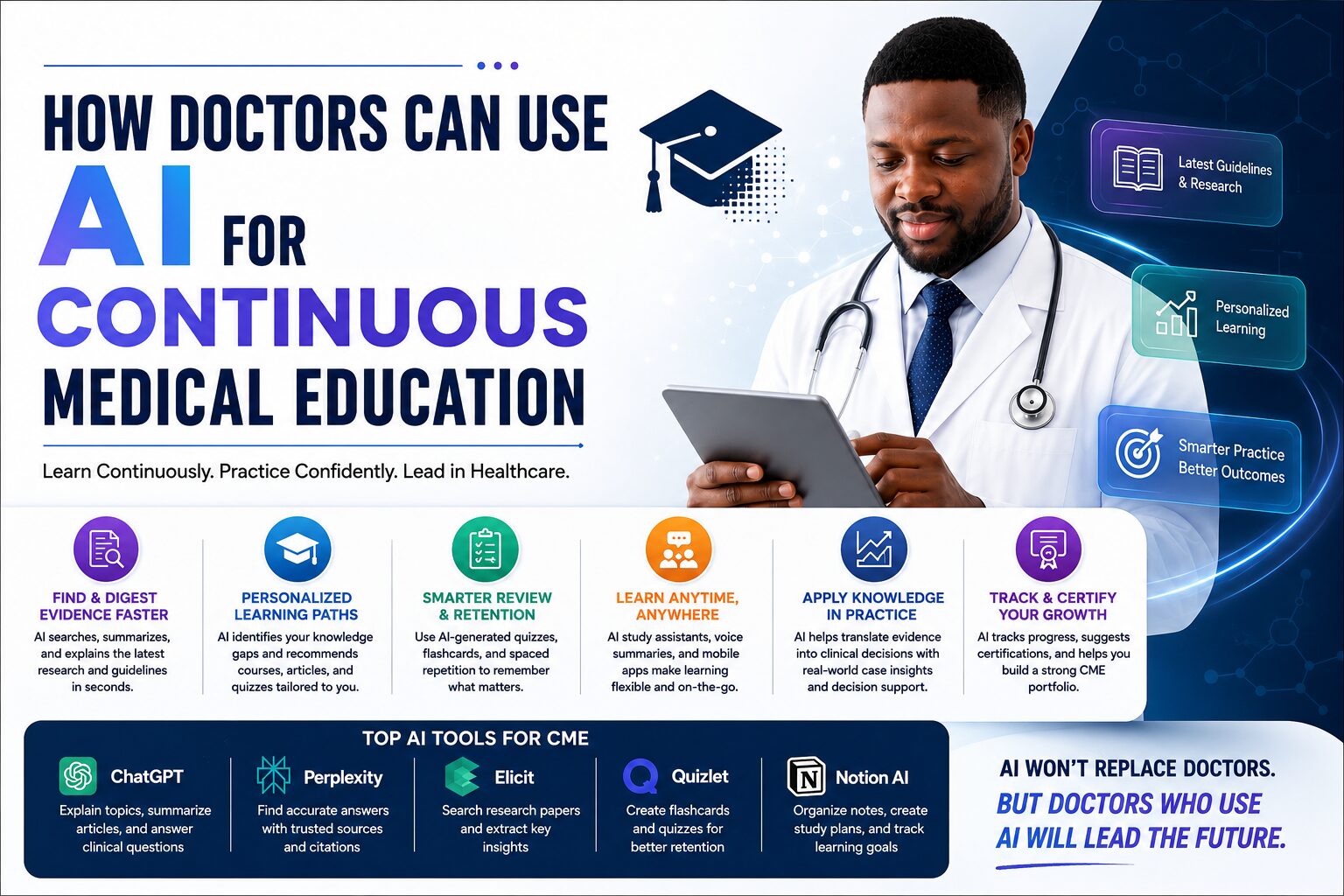
How Doctors Can Use AI for Continuous Medical Education in 2026
By Dr Festus Kaasung Kunde, MD | Stavropol State Medical University
Medical Doctor | AI in Healthcare Advocate | Founder, AI Doctor Africa & Ghana Vitals
Published: June 2026 | Reading Time: 18–22 minutes | Category: AI for Doctors
Quick Summary
AI for continuous medical education is not a future concept — it is available right now, mostly for free, and it fits around a clinical schedule. This article explains exactly how doctors can use AI tools to stay current, review guidelines, practise clinical reasoning, and fulfil their CME obligations more efficiently than ever. The focus keyphrase throughout this article is ‘AI for continuous medical education’ — and by the time you finish reading, you will have a complete system built around it.
Why AI for Continuous Medical Education Is No Longer Optional
AI for continuous medical education has moved from an interesting experiment to a practical necessity. Doctors have always been obligated to stay current with guidelines, with evidence, with new treatments and diagnostic approaches. However, the volume of information that professional currency now requires is genuinely overwhelming. The New England Journal of Medicine alone publishes more than 3,500 articles per year. WHO clinical guidelines run to hundreds of pages. Drug approvals, safety updates, and treatment protocol changes arrive continuously. No individual clinician can track all of it manually.
Furthermore, the way most doctors have tried to meet this obligation — attending a conference once a year, flipping through a journal when time allows, reading guidelines reactively when a specific patient question arises — has never been sufficient. Therefore, using AI for continuous medical education is not just about being modern. It is about being safe. Outdated clinical knowledge leads to outdated clinical practice. And in medicine, that has consequences.
I think about this personally every week. I completed my MD at Stavropol State Medical University in Russia in 2025 and began my internship at Korle-Bu Teaching Hospital in Accra, one of West Africa’s largest clinical institutions. The clinical environment at Korle-Bu moves fast. Guidelines change. Tropical disease management protocols evolve. New evidence is emerging about the conditions I manage daily. Staying current is not an aspiration — it is a clinical responsibility.
Consequently, I built an AI-assisted CME routine that fits around my actual schedule. It takes approximately 90 minutes per week. It is mostly free. And it has changed how I engage with evidence, with guidelines, and with my own clinical learning in ways I did not expect. This article shares that routine in full — and explains how any doctor can build their own version of it.
Key principle for AI for continuous medical education: The goal is not to read less. The goal is to learn more efficiently so that the time you do have goes toward the evidence that matters most for your patients.
The CME Problem That AI for Continuous Medical Education Solves
The Three Gaps Every Doctor Recognises
Before discussing how AI for continuing medical education works, it is worth clearly naming the actual problem. Most doctors I talk to identify the same three CME gaps — and they have been naming them for decades, which tells you the traditional solution is not working.
The first gap is time. Clinical schedules leave very little room for structured learning. Ward rounds, outpatient clinics, administrative tasks, documentation, and on-call responsibilities consume the working day. The remaining hours are genuinely limited. Consequently, CME tends to get compressed into occasional intensive periods — a conference, a study week before an examination — rather than the consistent, incremental engagement that actually produces sustained knowledge.
The second gap is relevance. Traditional CME — lectures at conferences, journal subscription services, online modules — covers broad topics that may or may not be relevant to the specific clinical situations a doctor encounters that week. The irony is that the learning most needed is often the most specific: what does this guideline say about this specific patient population? What does current evidence show for this particular management decision? Generic CME modules rarely answer these questions directly.
The third gap is retention. Passive reading and conference attendance produce weak long-term retention. Research published in Medical Education consistently shows that passive learning methods — reading, watching, listening without active engagement — produce retention rates of 10–20% after one week. Active learning methods — practice questions, case discussions, self-testing — produce retention rates of 50–80%. Yet most traditional CME is passive.
AI for continuous medical education addresses all three gaps simultaneously. It is available in ten-minute windows. It can be made precisely relevant to your specific clinical context. And it actively supports interactive, retrieval-based learning rather than passive consumption. Furthermore, most of the tools that make this possible are free.
What Changes When You Use AI for Continuous Medical Education
The shift from traditional CME to AI-assisted continuous medical education is not just a change in tools. It is a change in the relationship between a doctor and their own learning.
Traditional CME is episodic — you attend an event, complete a module, log the credits, and move on. AI for continuous medical education is continuous — it integrates learning into the working week rather than separating it out as a distinct activity. Moreover, it is responsive — you can direct your learning toward the exact topic you need right now, rather than waiting for the next scheduled programme to cover it.
Additionally, the data behind this shift is compelling. A 2026 systematic review in the Journal of Medical Internet Research found that AI-assisted learning interventions in postgraduate medical education yielded significantly better knowledge retention than traditional methods, particularly when AI tools supported active recall and case-based reasoning. Furthermore, doctors who used AI tools for CME reported higher engagement in ongoing learning than those relying solely on traditional methods.
Artificial Intelligence Adoption Tiers Across Clinical and Operational Domains in US Hospitals
This is not surprising. AI for continuous medical education works better because it applies the same learning science principles that have always produced better outcomes — active retrieval, spaced repetition, immediate feedback — but does so in a format that fits a doctor’s actual life rather than requiring them to carve out special time for it.
AI for Continuous Medical Education: The Tools That Work Best
NotebookLM — The Guideline Learning System
NotebookLM is the tool I reach for first when a new clinical guideline is published. Instead of reading a 100-page document from start to finish — a process that, realistically, gets interrupted, compressed, or skipped altogether — I upload the guideline as a source and let NotebookLM do three things: generate a structured study guide covering the key recommendations, create flashcards for the most important clinical thresholds and drug choices, and produce an Audio Overview that I listen to on my commute.
That last feature deserves special attention in the context of AI for continuous medical education. The Audio Overview is a two-host AI podcast generated from your uploaded documents. In 2026, it supports Interactive Mode — you can pause the audio and ask questions mid-podcast, then resume. Consequently, the twenty-minute drive to Korle-Bu becomes a structured CME session on the latest hypertension guidelines or the WHO tuberculosis management updates. No additional time. No additional effort. Just a better use of time that was previously unproductive.
Furthermore, NotebookLM‘s source-grounded chat means every answer it gives cites the specific passage in the guideline it came from. When you ask, “What is the recommended first-line treatment for stage 2 hypertension in a diabetic patient according to this guideline?’, the answer references the exact section, so you can verify it directly rather than trusting the AI blindly.
Claude — For Deep Understanding in AI-Assisted CME
There is a difference between knowing what a guideline recommends and understanding why it recommends it. AI for continuous medical education is most valuable when it builds the latter, not just the former. This is where Claude becomes essential.
Claude is the tool I use when I encounter something in a guideline or a clinical case that I want to understand more deeply. The mechanism. The evidence base. The reasoning behind a specific recommendation. Claude explains at exactly the depth I ask for — and it does not just tell me the answer. With the right prompt, it walks me through the reasoning step by step, which produces understanding rather than just information.
Additionally, Claude supports case-based learning that is particularly effective for CME. Present it with a clinical case, tell it you want to be guided through the differential diagnosis rather than given the answer, and it will ask you questions, challenge your reasoning, and correct your errors — exactly the way a good clinical supervisor does, but available at any hour and infinitely patient.
Proven CME prompt for Claude: ‘Act as a consultant physician. Walk me through the management of a 62-year-old patient with newly diagnosed heart failure with reduced ejection fraction. Do not give me the answer directly — guide me through the reasoning, ask me questions at each decision point, and tell me where my thinking is correct or incomplete.’
ChatGPT — MCQs and Self-Assessment for Continuous Medical Education
Self-assessment is one of the most underused CME activities among practising doctors. It is also one of the most effective. Research consistently shows that testing yourself on clinical knowledge — not just reading about it — produces retention rates three to four times higher than passive review. AI for continuous medical education with ChatGPT makes self-assessment effortless.
I use ChatGPT to generate MCQ banks on whatever topic I have been working with that week. After uploading a guideline to NotebookLM and listening to the Audio Overview, I open ChatGPT, generate 20 questions on the same topic, answer them, and then review my wrong answers. I identify the specific knowledge gaps they reveal. Then I take those gaps back to Claude for a deeper explanation.
This three-tool sequence — NotebookLM for structured content review, ChatGPT for active self-assessment, Claude for gap-filling — is the core loop of my personal AI CME routine. Moreover, the entire loop takes approximately 45 minutes per topic. Therefore, it is compatible with even the busiest clinical week.
Perplexity AI — Staying Current With Real-Time Evidence
One limitation of traditional AI tools for continuous medical education is knowledge currency. Claude and ChatGPT work from training data with a cutoff date, so they may present outdated guidelines as current. Perplexity addresses this directly by searching the web in real time and citing every source with a date.
For AI for continuous medical education specifically, Perplexity’s value is in weekly evidence scanning. Every Monday, I spend fifteen minutes asking Perplexity about recent developments in my clinical areas of focus. For example: ‘What significant clinical guideline updates or drug safety communications have been published in cardiology and infectious disease in the last four weeks? Cite each source.’ The result is a current, cited overview of what has changed in my clinical areas — information that would otherwise require manual monitoring of journals across multiple publications.
Furthermore, Perplexity’s Premium Health Sources integration — which now includes NEJM, BMJ, and AHA — means that clinical answers are increasingly drawn from authoritative medical journals rather than general websites. Consequently, the evidence it provides is genuinely clinically reliable.
Gamma AI — CME Presentations in Minutes
Many doctors contribute to CME through teaching — departmental presentations, grand rounds, and CME workshops for colleagues. This is valuable for both the learners and the presenter, because teaching is one of the most effective ways to consolidate your own understanding. However, preparing a CME presentation traditionally takes two to four hours — time that most busy clinicians struggle to find.
Gamma AI reduces this to twenty to thirty minutes. You provide the clinical topic and the key content points. Gamma generates a professional presentation structure with slides, visual hierarchy, and speaker notes. Your role is then to verify the clinical content, add your personal clinical examples, and present. The preparation friction disappears. As a result, contributing to CME through teaching becomes realistic rather than aspirational.
AI Tools for Continuous Medical Education: Complete Overview
The following table maps every major CME task to the best AI tool for that task, with a brief explanation of how AI helps and how much time it saves:
| CME Task | Best AI Tool | How AI Helps | Time Saved |
| Guideline review and updates | NotebookLM + Claude | Upload guideline PDF; get structured summary, audio overview, and flashcards | 45–90 min per guideline |
| CME quiz preparation | ChatGPT | Generate unlimited MCQs on any topic with explanations | 1–2 hrs per topic |
| Journal article analysis | Elicit + Claude | Structured paper summary with clinical implications and limitations | 30–60 min per paper |
| CME presentation creation | Gamma AI + ChatGPT | Outline, slides, and speaker notes from any clinical topic in minutes | 2–3 hrs per session |
| Literature scanning for updates | Perplexity AI | Real-time cited summaries of the latest evidence on any topic | 1–2 hrs per week |
| Case-based learning | Claude | Simulated case discussions with clinical reasoning feedback | Unlimited case practice |
| Podcast-style content review | NotebookLM (Audio Overview) | Converts any uploaded guideline or paper into a learning podcast | Passive — zero additional time |
| Tracking learning gaps | ChatGPT | Self-assessment quizzes; identify weak areas; create targeted plans | Continuous learning system |
Notice that most of these tools are free. Furthermore, the time savings are not marginal — they represent hours per week that can be redirected toward patient care, research, or personal recovery. That is the real value of AI for continuous medical education: not just better learning, but a more sustainable professional life.
How I Built My AI for Continuous Medical Education Routine
Starting From a Real Problem at Korle-Bu
I want to be honest about how this started. When I began my internship at Korle-Bu Teaching Hospital, I encountered conditions, presentations, and management decisions that my training in Russia had covered — but not always in the depth or the local context that Ghanaian clinical practice required. Malaria presentations at the severe end of the spectrum. Tropical disease co-infections. Hypertension management in patients who had never been consistently monitored. Sickle cell complications in young adults.
Furthermore, the pace of Korle-Bu left little time for the kind of extended reading that medical school had allowed. Ward rounds started early. Patient loads were high. By the evening, the cognitive energy for three hours of textbook study was simply not there. Consequently, I needed a CME approach that worked in the margins of the day — not one that required the day to have margins it did not have.
AI for continuous medical education filled that gap. Not perfectly — nothing is perfect. But practically. The Audio Overview on the commute. The twenty MCQs over lunch. The fifteen minutes of Perplexity scanning on Wednesday evening. Together, these small, consistent sessions added up to genuine learning currency. Moreover, they compounded over time — each week building on the previous one in a way that occasional intensive study never managed.
The Weekly AI CME Routine — A Practical System
The following table shows the exact weekly AI CME routine I use. It is built around the reality of a clinical schedule — short sessions, flexible timing, tools that work on a smartphone. Adapt it to your speciality, your schedule, and your specific learning priorities:
| Day | AI CME Activity | Tool | Time Required |
| Monday | Upload one new guideline; generate an Audio Overview for the commute | NotebookLM | 5 min setup; 20 min listening |
| Tuesday | Generate 20 MCQs on the guideline topic; review wrong answers with Claude | ChatGPT + Claude | 25 min |
| Wednesday | Scan the latest clinical updates on your speciality using Perplexity | Perplexity AI | 15 min |
| Thursday | Upload one key paper from the week’s reading; get a structured analysis | Elicit or Claude | 20 min |
| Friday | Review flashcards generated from the week’s CME materials | NotebookLM Flashcards | 10 min |
| Weekend | Prepare one CME case or presentation outline for the following week | Gamma AI + ChatGPT | 30–45 min |
The total active time in this routine is approximately 90 minutes per week. Additionally, the Monday Audio Overview and Friday flashcard review can both happen during activities that would otherwise be unproductive — commuting, waiting, exercising. Consequently, the net time cost to your clinical schedule is closer to 45 minutes per week.
Personal observation after six months of this routine: the most significant change is not how much more I know. It is that I know what I do not know — and I have a system to address it. That metacognitive awareness is itself a clinical safety improvement.
AI for Continuous Medical Education in the African Context
Why This Matters Especially for African Doctors
AI for continuing medical education is valuable to every doctor, everywhere. However, it is particularly important for African doctors — and for reasons that go beyond the usual discussion of resource constraints.
The first reason is the specificity problem. Much of the CME content available through traditional channels — conferences, journal subscriptions, online modules — is designed for doctors practising in high-income, well-resourced health systems. The guidelines often assume access to investigative resources, specialists, and healthcare infrastructure that many African clinical environments lack. Therefore, AI for continuous medical education allows African doctors to contextualise their learning, prompting AI tools to apply guidelines to district hospital settings, to Ghana Health Service protocols, to the disease burden of West Africa rather than North America.
The second reason is the guideline gap. African clinical practice draws on WHO guidelines, Ghana Health Service protocols, and national treatment guidelines that are updated periodically — but not always reflected in the training data of AI tools or the content of international CME programmes. Consequently, using NotebookLM and Claude with uploaded local guidelines ensures that your AI CME is grounded in the protocols used in your clinical setting, rather than a generic international equivalent.
The third reason is cost. Traditional CME — conferences, accredited modules, specialist courses — is expensive. For doctors in Ghana and across Africa, the financial barrier to formal CME is real. AI for continuous medical education addresses this directly: the tools described in this article are free or very low-cost, globally accessible, and more flexible than any formal programme. Furthermore, the quality of learning is genuinely high when the tools are used correctly.
Ghana Health Service protocols
AI for Continuous Medical Education and the MDC Ghana Requirements
Doctors registered with the Medical and Dental Council of Ghana are required to engage in continuing professional development as a condition of licence renewal. The specific CPD framework and credit requirements are outlined by the MDC Ghana. At the time of writing, the MDC does not yet formally recognise AI-assisted self-study as a creditable CPD activity in the way that accredited conferences and courses are recognised.
However, this does not diminish the value of AI for continuous medical education for MDC-registered doctors. Rather, it means that AI-assisted learning should be understood as the foundation that makes your formal CPD activities more effective — not as a replacement for them. When you attend an accredited conference with three months of AI-assisted guideline review behind you, you engage more deeply, retain more, and apply more. The AI CME supports the formal CPD. The formal CPD satisfies the regulatory requirement.
Moreover, medical councils globally are actively developing frameworks for digital and AI-assisted learning credits. Therefore, regulatory recognition of AI in continuing medical education is likely to expand significantly over the next two to three years. Doctors who build these habits now will be well-positioned when that recognition arrives.
Using AI for Continuous Medical Education Responsibly
What You Must Know Before You Start
AI for continuous medical education is powerful. However, it requires the same critical appraisal that good clinical practice always has. Several important principles apply.
Verify clinical facts before applying them. AI tools can occasionally produce plausible-sounding but incorrect clinical information — a phenomenon called hallucination. This risk is lower with source-grounded tools like NotebookLM and Perplexity, but it is never zero. Therefore, always verify clinical facts that would affect patient management against the primary source — the guideline itself, PubMed, or the BNF — before acting on them.
Check the guideline currency. Ensure that the guidelines you upload to NotebookLM or reference through Perplexity are the most current versions available. Outdated guidelines, cited with AI confidence, are a specific risk in rapidly evolving areas like HIV management, antibiotic prescribing, and oncology treatment protocols.
Use anonymised cases only. All case-based AI CME learning should use anonymised or hypothetical cases. Never input real patient identifiers, specific clinical histories, or identifiable case details into any external AI platform. Patient confidentiality applies equally to CME activities as to clinical practice.
AI CME builds knowledge — not wisdom. Clinical wisdom — the judgment that comes from years of patient contact, from sitting with uncertainty, from learning from mistakes under supervision — cannot be built through AI interaction alone. Therefore, use AI for continuous medical education to build knowledge efficiently. Seek out clinical supervision, mentorship, and peer discussion to build the wisdom that knowledge alone cannot provide.
Key Takeaways: AI for Continuous Medical Education
- AI for continuous medical education is available now, mostly free, and fits around a clinical schedule — it is not a future concept
- The three gaps AI addresses in traditional CME are time, relevance, and retention — and it addresses all three simultaneously
- NotebookLM is the strongest tool for guideline review — Audio Overview converts any guideline into a podcast; flashcards and quizzes reinforce key recommendations
- Claude supports deep understanding and case-based learning — use it to build the reasoning behind clinical decisions, not just the decisions themselves
- ChatGPT generates unlimited self-assessment MCQs — active recall practice produces three to four times better retention than passive reading
- Perplexity’s real-time cited search keeps you current on recent evidence updates — fifteen minutes per week is sufficient for a meaningful weekly evidence scan
- The AI CME weekly routine described in this article requires approximately 90 minutes of active engagement per week — much of it compatible with commuting and other daily activities
- AI for continuous medical education in Africa requires deliberate contextualisation — always prompt AI tools with your local guideline context and clinical resource environment
- AI CME supplements formal CPD activities — it does not replace them for regulatory purposes, but it makes formal CPD significantly more effective
- Verify clinical facts before applying them, use only anonymised cases, and check guideline currency — the same critical standards apply to AI-assisted CME as to any other clinical information source
Frequently Asked Questions
About AI for Continuous Medical Education
These are the questions doctors most commonly ask when they begin thinking about AI for continuous medical education:
Question |
Answer |
| Does AI replace formal CME programmes? | No. AI for continuous medical education supplements — it does not replace — accredited CME programmes, professional conferences, and supervised clinical learning. Formal CME carries regulatory and professional weight that AI-assisted self-study cannot substitute. However, AI makes the in-between learning — the daily updating, the guideline reviews, the literature scanning — dramatically more efficient, which means doctors engage with evidence more consistently and more deeply. |
Can I claim CPD credits for AI-assisted learning? |
This depends on your licensing body and country. The MDC Ghana, GMC UK, and most medical councils do not currently award CPD credits directly for AI-assisted self-study. However, you can use AI tools to prepare for and deepen your engagement with accredited CPD activities — making those activities more valuable. Watch for policy changes: several medical councils globally are developing frameworks for digital and AI-assisted learning credits. |
| Which AI tool is best for CME? | No single tool covers everything. NotebookLM is strongest for guideline review and audio-based learning during commutes. ChatGPT is strongest for MCQ generation and self-assessment. Perplexity is strongest for staying current with recent evidence. Claude is strongest in deep concept explanation and case-based learning. The most effective AI CME strategy combines two or three tools rather than relying on a single tool. |
| How much time does AI-assisted CME actually require? | The weekly plan in this article requires approximately 90 minutes of active engagement per week — spread across short daily sessions. Many of those sessions, particularly the Audio Overview listening, can happen during activities that would otherwise be unproductive: commuting, exercising, or cooking. Consequently, the time cost is lower than it appears, and the learning return is significantly higher than the same time spent on passive reading. |
Is AI for continuous medical education accessible in Ghana? |
Yes. All the tools recommended in this article have free tiers accessible in Ghana and across Africa. NotebookLM, Claude (free tier), ChatGPT (free tier), Perplexity (free tier), and Elicit (free tier) all work without payment on any device with internet access. Paid upgrades add significant functionality but are not required to implement an effective AI-assisted CME routine. |
| What about patient confidentiality during CME? | Never use real patient cases, identifiable clinical details, or specific patient information in AI CME activities. All case-based AI learning should use anonymised or hypothetical cases. The clinical learning value of a well-constructed hypothetical case is identical to a real one — and it carries no confidentiality risk. |
Related Articles on AI Doctor Africa
- NotebookLM for Doctors: The Complete 2026 Guide for Healthcare Professionals
- How Doctors Can Use AI to Save 10 Hours Every Week
- Perplexity AI for Doctors: The Cited Search Tool Every Clinician Needs in 2026
- Gemini AI for Medical Students: How to Use Google’s AI to Study Smarter in 2026
- How African Doctors Can Use AI in Daily Practice: The Complete 2026 Guide
- Top 5 AI Tools for Medical Researchers in 2026
About the Author
Dr Festus Kaasung Kunde is a Medical Doctor, AI in Healthcare Advocate, and Founder of AI Doctor Africa and Ghana Vitals. He holds an MD from Stavropol State Medical University in Russia (2025) and completed an internship at Korle-Bu Teaching Hospital in Accra. His mission is to help African healthcare professionals adopt AI responsibly to improve learning, research, and patient outcomes.
AI Doctor Africa | aidoctorafrica.com
Medical Disclaimer: For educational purposes only. AI tools do not replace formal CME programmes, clinical supervision, or verified primary medical sources.