AI for Rural Healthcare in Africa
By Dr Stephanie Owusu Ankomah
Medical Doctor | Medical Writer, AI Doctor Africa
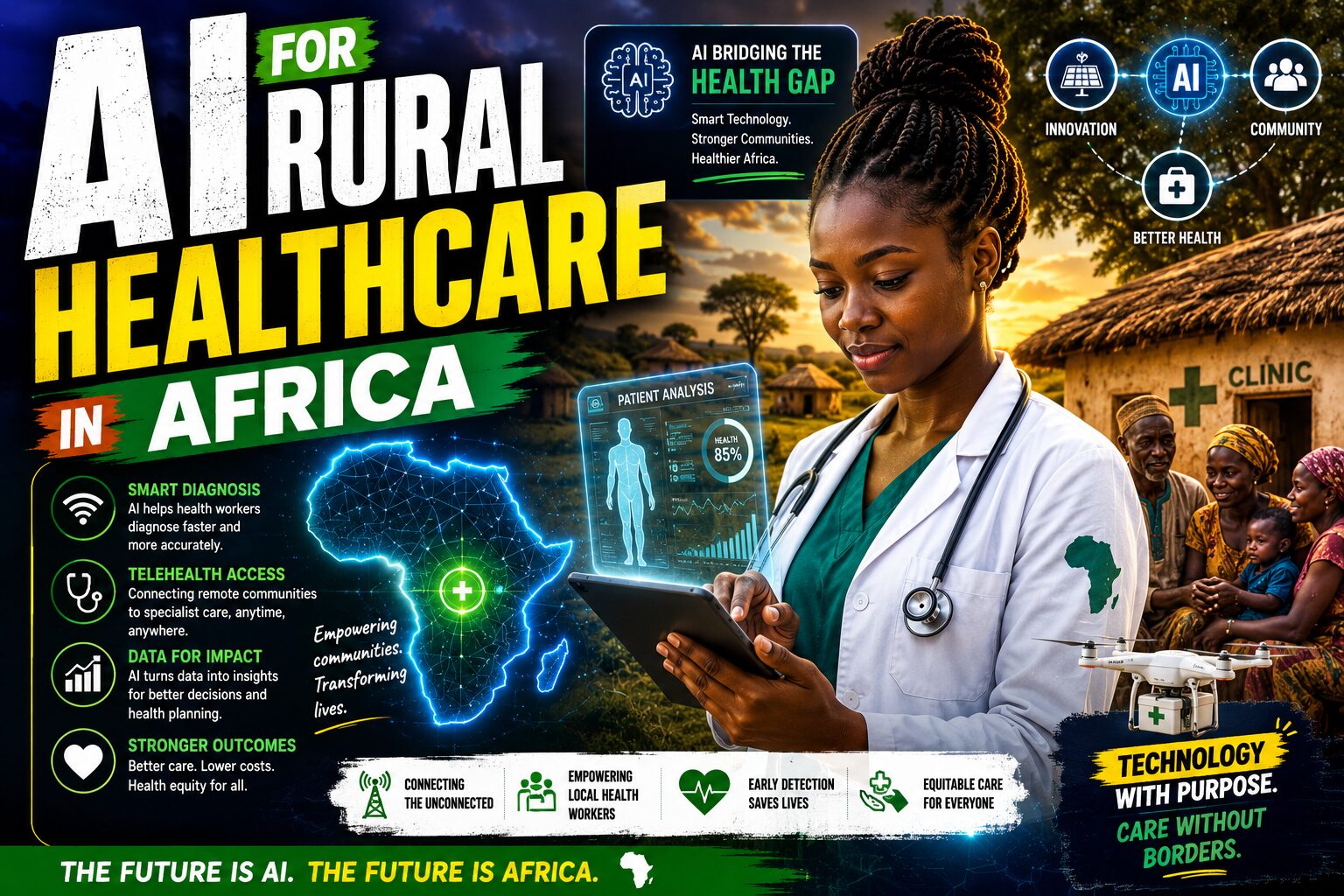
Rural healthcare remains one of Africa’s greatest health challenges. Millions of people live far from hospitals, specialists, diagnostic centres, and reliable emergency services. In many communities, a single nurse, physician assistant, community health worker, or doctor may be responsible for a large population with limited equipment and support.
Artificial intelligence will not solve every problem in rural healthcare, but it can help extend the reach of health professionals, support earlier diagnosis, improve referrals, and make limited resources more effective.
The most useful question is not whether AI can replace healthcare workers in rural Africa. It cannot. The better question is how AI can support the professionals and community workers who are already serving these populations.
The Reality of Rural Healthcare
Rural communities often face several connected barriers:
- Long distances to health facilities.
- Shortages of doctors and specialists.
- Limited laboratory and imaging services.
- Poor transport and referral systems.
- Inconsistent medicine supply.
- Weak internet and electricity infrastructure.
- Delayed diagnosis and treatment.
These challenges mean that patients may wait until symptoms become severe before seeking care. Others may visit a local facility but still require referral to a regional or teaching hospital for specialist assessment.
AI could help reduce some of these delays by bringing basic decision support closer to the patient.
Supporting Community Health Workers
Community health workers are often the first point of contact for rural patients. They provide health education, maternal and child health services, screening, follow-up, and referrals.
AI-supported mobile tools could help them:
- Recognise danger signs.
- Ask structured clinical questions.
- Identify patients requiring urgent referral.
- Provide standardised health education.
- Track missed appointments.
- Send medication and follow-up reminders.
For example, a community health worker assessing a pregnant woman could enter symptoms, blood pressure, gestational age, and other observations into a validated tool. The system could flag warning signs such as severe hypertension, bleeding, fever, or reduced fetal movement and recommend immediate escalation.
The tool should not make the final clinical decision. Its role would be to support early recognition and reduce the chance that serious symptoms are overlooked.
Improving Access to Clinical Decision Support
Healthcare workers in rural facilities may have limited access to specialists. AI-based decision-support systems could help them review possible diagnoses, choose appropriate initial investigations, and recognise situations requiring referral.
A clinician managing a child with fever, for example, may need to consider malaria, pneumonia, meningitis, sepsis, or other infections. A locally adapted AI system could help organise the clinical information and highlight red flags.
However, the system must reflect local realities.
An AI tool designed for a well-resourced hospital may recommend tests that are unavailable in a rural clinic. Useful African healthcare AI must consider:
- Local disease patterns.
- Available medicines.
- National treatment guidelines.
- Distance to referral centres.
- Cost to the patient.
- Available diagnostic tools.
Technology becomes valuable only when its recommendations can be acted upon.
AI-Enabled Telemedicine
Telemedicine can connect rural healthcare workers and patients with specialists in larger hospitals. AI can strengthen this system by helping organise clinical information before a consultation.
It may assist with:
- Summarising the patient’s history.
- Organising symptoms and vital signs.
- Preparing referral notes.
- Prioritising urgent cases.
- Translating basic health information.
- Supporting follow-up after specialist review.
This could reduce unnecessary travel while ensuring that patients who genuinely require higher-level care are identified earlier.
Telemedicine will still depend on reliable networks, affordable data, appropriate devices, and clear referral pathways. AI cannot compensate for a system in which no one is available to receive or act on the referral.
Earlier Detection of Common Diseases
Many chronic diseases remain undiagnosed in rural areas.
Hypertension, diabetes, kidney disease, anaemia, and cardiovascular risk may progress silently for years. AI-supported screening systems could help health workers identify patients who need further assessment.
By combining information such as age, blood pressure, blood glucose, body mass index, symptoms, family history, and previous medical conditions, AI may help prioritise high-risk patients.
Similar tools could support:
- Cervical cancer screening.
- Diabetic retinopathy detection.
- Tuberculosis screening.
- Interpretation of basic chest images.
- Identification of malnutrition in children.
- Detection of high-risk pregnancies.
These systems must be tested in the populations where they will be used. A model that performs well elsewhere may not perform equally well among African patients.
Strengthening Maternal and Child Health
Maternal and child health could be one of the most important areas for rural AI.
AI tools may help predict high-risk pregnancies, identify children at risk of deterioration, support immunisation tracking, and improve follow-up after delivery.
A mobile system could alert a health worker when a pregnant woman misses antenatal care, when a child is due for immunisation, or when symptoms suggest urgent review. In communities where delays can be fatal, even a simple alert system may save lives. The goal should not be to introduce complicated technology. It should be to help health workers recognise risk earlier and respond faster.
Better Management of Medicines and Supplies
Rural facilities frequently experience shortages of medicines, vaccines, test kits, and basic supplies.
AI could analyse past usage, patient attendance, disease trends, and seasonal patterns to predict demand more accurately. For example, a district health system might use previous data to estimate when malaria test kits, antihypertensive medicines, or maternal health supplies are likely to run low.
This could reduce both stock-outs and unnecessary waste. These administrative applications may be less dramatic than AI diagnosis, but they could produce immediate improvements in patient care.
The Importance of Local Languages
Language remains a major barrier in healthcare.
Patients may struggle to explain symptoms or understand medical instructions in English or French. AI systems designed for African healthcare should support local languages and culturally familiar communication.
Voice-based tools may be especially helpful for people with limited literacy.
However, medical translation must be accurate. A small error in translating dosage instructions, danger signs, or treatment advice could cause harm.
Local language systems should therefore be developed and reviewed with healthcare professionals and native speakers.
Risks That Must Be Addressed
AI in rural healthcare also creates risks.
Poorly designed systems may give incorrect recommendations. Patient data may be exposed. Algorithms may perform poorly in populations that were not included in their development.
Healthcare workers may also become overly dependent on a system that cannot examine the patient or understand the full context.
Africa must take seriously:
- Data privacy.
- Patient consent.
- Cybersecurity.
- Algorithmic bias.
- Clinical accountability.
- Validation in local populations.
- Protection of confidential health information.
AI should never be introduced simply because it is new or impressive.
It must be safe, affordable, understandable, and useful.
Build for Rural Reality
The future of AI in rural African healthcare should not depend entirely on imported solutions.
Local doctors, nurses, community health workers, engineers, researchers, patients, and policymakers must be involved in designing these tools.
Solutions should work with:
- Low-cost smartphones.
- Weak or intermittent internet.
- Limited electricity.
- Small rural health teams.
- Existing referral systems.
- National clinical guidelines.
Offline capability may be more important than advanced graphics. Simple alerts may be more useful than complex predictions.
The best technology is not always the most sophisticated. It is the one that works consistently in the environment where it is needed.
Related Articles
- How African Doctors Can Use AI in Daily Practice
- AI in African Healthcare: Opportunities and Challenges
- The Future of AI in Ghanaian Healthcare
- Can AI Solve Africa’s Healthcare Workforce Shortage?
- AI for Community Health Workers in Africa
About the Author
Dr Stephanie Owusu Ankomah is a Medical Doctor, Medical Writer at aidoctorafrica, and a Healthcare Management MSc Student. She holds an MD from Stavropol State Medical University, Russia (2024), and is currently pursuing an MSc in International Healthcare Management in Germany, with hands-on experience supporting hospital operations, patient care coordination, clinical documentation, and multidisciplinary healthcare teams across outpatient clinics, wards, emergency care, surgery, and paediatrics.
AI Doctor Africa | aidoctorafrica.com
Medical Disclaimer: For educational purposes only. AI tools do not replace clinical supervision, verified study resources, or your medical school’s academic guidance. Always verify clinical facts against authoritative primary sources.