
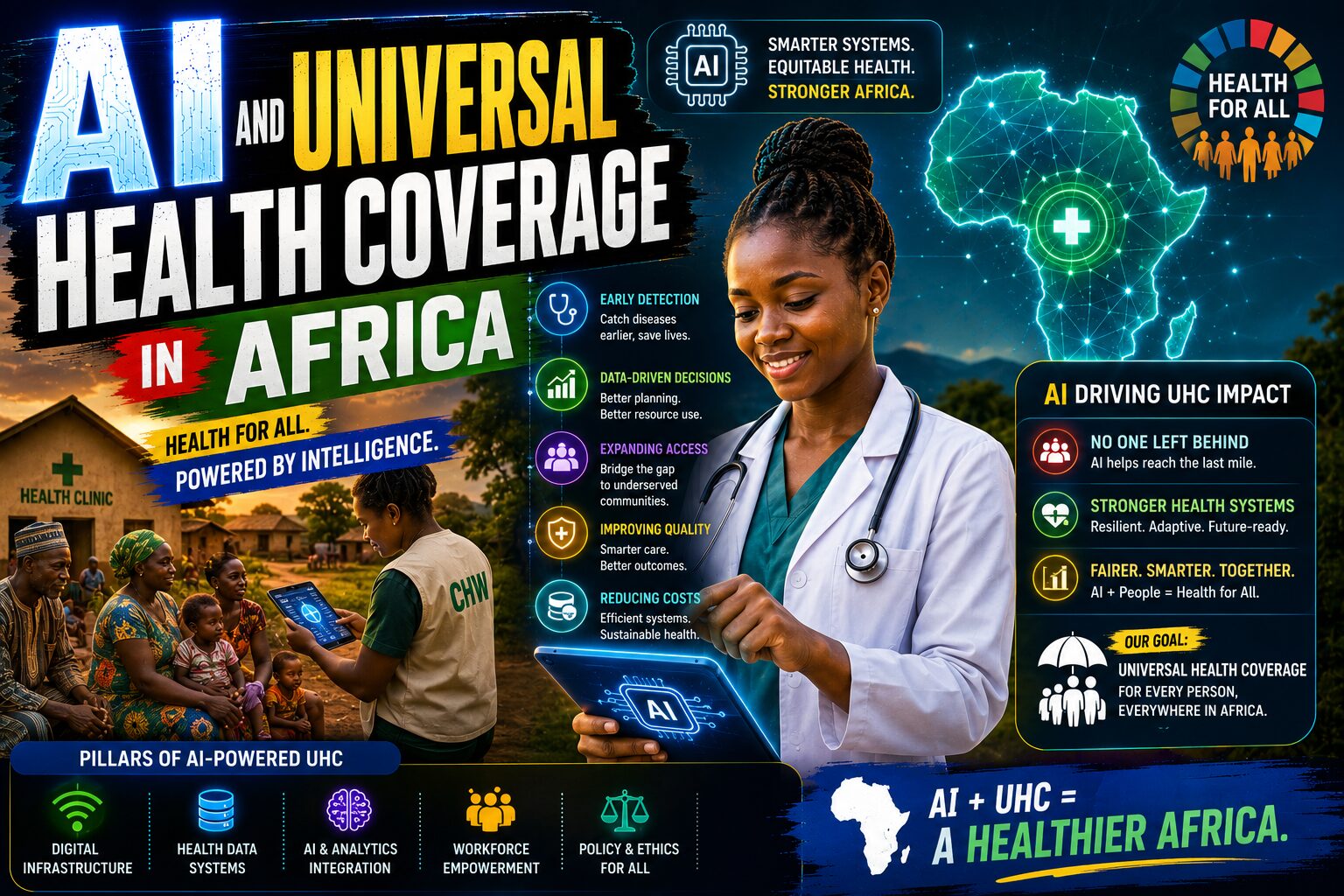
AI and Universal Health Coverage in Africa
By Dr Stephanie Owusu Ankomah
Medical Doctor | Medical Writer, AI Doctor Africa
Universal Health Coverage (UHC) means that everyone can access the healthcare services they need without suffering financial hardship. It is one of the most important global health goals and a priority for many African countries seeking to improve the health and well-being of their populations. AI and Universal Health Coverage in Africa
Despite significant progress, achieving Universal Health Coverage in Africa remains challenging. Many people still struggle to access quality healthcare because of shortages of healthcare workers, long travel distances to health facilities, limited diagnostic services, inadequate health infrastructure, and the high cost of care.
Artificial intelligence (AI) is increasingly being explored as a tool that could help address some of these barriers. While AI cannot solve every challenge facing African healthcare systems, it has the potential to improve efficiency, strengthen primary healthcare, support health workers, and expand access to essential services.
The future of Universal Health Coverage in Africa will depend not only on technology but also on how effectively AI is integrated into strong and equitable health systems.
Understanding Universal Health Coverage
Universal Health Coverage is built on three key principles:
- Access to essential healthcare services.
- Quality healthcare that improves health outcomes.
- Financial protection so that seeking care does not cause economic hardship.
Achieving these goals requires more than hospitals and clinics. It also depends on trained healthcare professionals, reliable medicine supplies, strong referral systems, health financing, disease surveillance, and accessible primary healthcare.
AI should be viewed as a tool that strengthens these existing systems rather than replacing them.
Expanding Access to Healthcare
Large sections of Africa’s population live in rural or underserved communities where access to healthcare remains limited.
AI can support access by helping healthcare workers deliver services closer to where people live.
For example, AI-powered decision-support tools can assist community health workers and primary care clinicians in recognising high-risk patients, following treatment guidelines, and identifying those who require referral.
Telemedicine supported by AI can also connect rural health facilities with specialists in larger hospitals, reducing unnecessary travel while improving access to expert advice.
These technologies cannot replace healthcare facilities, but they can help extend their reach.
Strengthening Primary Healthcare
Primary healthcare is the foundation of Universal Health Coverage.
It is where most people receive preventive care, maternal and child health services, immunisation, chronic disease management, and treatment for common illnesses.
AI can strengthen primary healthcare by supporting:
- Disease screening.
- Clinical decision-making.
- Medication management.
- Follow-up reminders.
- Health education.
- Risk assessment.
- Referral decisions.
For example, AI-supported screening programmes may help identify people at high risk of hypertension, diabetes, cervical cancer, or tuberculosis before serious complications develop.
Earlier detection often leads to earlier treatment, reducing both healthcare costs and preventable deaths.
Supporting Healthcare Workers
Africa continues to face shortages of doctors, nurses, midwives, pharmacists, laboratory professionals, and specialists.
AI cannot replace these professionals, but it can reduce some of the pressure they experience.
Healthcare workers spend considerable time completing documentation, reviewing patient records, preparing reports, and performing repetitive administrative tasks.
AI can assist with:
- Clinical documentation.
- Appointment scheduling.
- Draft referral letters.
- Discharge summaries.
- Guideline retrieval.
- Patient education materials.
Reducing administrative workload allows healthcare professionals to spend more time providing direct patient care.
Improving Public Health Planning
Universal Health Coverage depends on effective planning and resource allocation.
AI can analyse health data to identify:
- Disease trends.
- Medicine shortages.
- Service demand.
- Vaccination coverage.
- Referral patterns.
- High-risk populations.
- Areas with poor healthcare access.
These insights can help governments and health institutions allocate resources more effectively.
For example, AI may identify districts where increasing hypertension rates require additional screening programmes or where maternal health services need strengthening.
However, accurate planning depends on accurate data.
Countries must continue investing in strong health information systems alongside AI technologies.
Reducing Healthcare Costs
One of the greatest barriers to Universal Health Coverage is affordability.
AI may help reduce costs by improving efficiency across the healthcare system.
Examples include:
- Earlier disease detection.
- Better management of chronic illnesses.
- Reduced duplication of investigations.
- Improved appointment scheduling.
- More efficient supply chain management.
- Better workforce allocation.
- Reduced administrative burden.
These improvements can help health systems use limited resources more effectively while improving patient outcomes.
Cost savings should never come at the expense of quality or patient safety.
AI and Disease Prevention
Universal Health Coverage is not only about treating illness—it is also about preventing disease.
AI can support preventive healthcare through:
- Risk prediction.
- Community screening programmes.
- Lifestyle education.
- Vaccination tracking.
- Maternal health monitoring.
- Medication adherence reminders.
- Early outbreak detection.
These preventive approaches may reduce the long-term burden of non-communicable diseases and infectious diseases alike.
Investing in prevention often provides greater health benefits than focusing solely on treatment.
Equity Must Remain the Priority
AI should reduce health inequalities, not widen them.
There is a risk that advanced technologies may benefit only large urban hospitals while rural facilities continue to struggle with basic healthcare needs.
To support Universal Health Coverage, AI solutions should be designed for:
- Rural communities.
- Low-resource settings.
- Affordable smartphones.
- Limited internet connectivity.
- Multiple African languages.
- Existing primary healthcare systems.
Technology should be accessible to everyone, not only those living in major cities.
Challenges That Cannot Be Ignored
Several barriers must be addressed before AI can contribute meaningfully to Universal Health Coverage.
These include:
- Limited digital infrastructure.
- Unreliable electricity.
- Poor internet connectivity.
- Healthcare worker training.
- Data privacy and security.
- Algorithmic bias.
- Limited local validation.
- Sustainable funding.
AI systems must also be evaluated carefully to ensure they are safe, accurate, and effective within African populations.
Solutions developed elsewhere should not be adopted without local testing.
Collaboration Will Be Essential
Achieving Universal Health Coverage through AI will require collaboration between:
- Governments.
- Healthcare professionals.
- Universities.
- Technology companies.
- Researchers.
- Professional associations.
- Development partners.
- Local communities.
No single organisation can achieve this goal alone.
Successful AI implementation depends on combining clinical expertise with technological innovation while keeping patients at the centre of every decision.
Related Articles
- How African Doctors Can Use AI in Daily Practice
- AI in African Healthcare: Opportunities and Challenges
- The Future of AI in Ghanaian Healthcare
- Top African HealthTech Startups Using AI
- AI for Community Health Workers in Africa
- AI for Rural Healthcare in Africa
About the Author
Dr Stephanie Owusu Ankomah is a Medical Doctor, Medical Writer at aidoctorafrica, and a Healthcare Management MSc Student. She holds an MD from Stavropol State Medical University, Russia (2024), and is currently pursuing an MSc in International Healthcare Management in Germany, with hands-on experience supporting hospital operations, patient care coordination, clinical documentation, and multidisciplinary healthcare teams across outpatient clinics, wards, emergency care, surgery, and paediatrics.
AI Doctor Africa | aidoctorafrica.com
Medical Disclaimer: For educational purposes only. AI tools do not replace clinical supervision, verified study resources, or your medical school’s academic guidance. Always verify clinical facts against authoritative primary sources.