
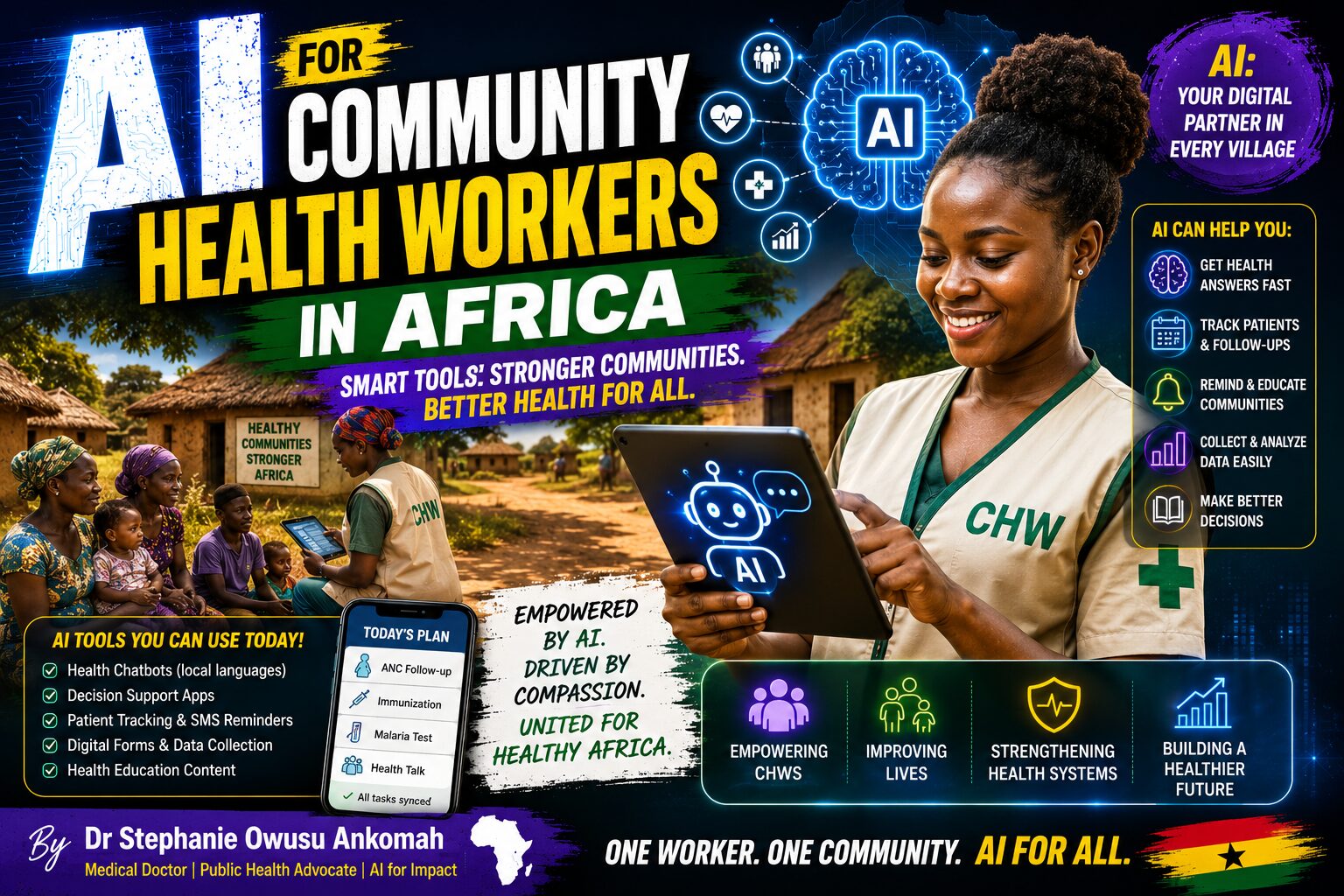
AI for Community Health Workers in Africa
By Dr Stephanie Owusu Ankomah
Medical Doctor | Medical Writer, AI Doctor Africa
Community health workers (CHWs) are the backbone of primary healthcare in many African countries. They are often the first healthcare professionals that people encounter, particularly in rural and underserved communities where hospitals and doctors may be many kilometres away.
They educate families, promote disease prevention, monitor maternal and child health, support immunisation programmes, identify illnesses early, and connect patients to formal healthcare facilities.
Despite their importance, many community health workers operate with limited resources, minimal supervision, heavy workloads, and increasing healthcare demands.
Artificial intelligence (AI) has the potential to support—not replace—community health workers by improving decision-making, strengthening referrals, reducing administrative work, and expanding access to healthcare information.
The future of community healthcare in Africa will depend on combining trusted local health workers with practical, responsible AI tools.
The Vital Role of Community Health Workers
Community health workers serve as the bridge between communities and the healthcare system.
Their responsibilities often include:
- Health education.
- Maternal and newborn care.
- Child growth monitoring.
- Immunisation follow-up.
- Household visits.
- Disease prevention.
- Basic health screening.
- Referral of sick patients.
- Follow-up of patients with chronic diseases.
Because they live and work within the communities they serve, they understand local cultures, beliefs, languages, and barriers to healthcare better than anyone else.
This trust is something AI can never replace.
Instead, AI should strengthen the work they already do.
AI as a Clinical Support Tool
Community health workers frequently manage patients with limited access to doctors or specialists.
AI-powered mobile applications could guide workers through structured assessments by asking appropriate clinical questions and highlighting warning signs.
For example, when assessing a child with fever, an AI-assisted tool could remind the health worker to check for:
- Difficulty breathing.
- Persistent vomiting.
- Convulsions.
- Poor feeding.
- Severe dehydration.
- Altered consciousness.
The system could then recommend whether the child requires urgent referral or can safely receive community-based management according to national guidelines.
Importantly, AI should provide decision support—not make independent clinical decisions.
The final responsibility always rests with the trained healthcare worker.
Earlier Detection of Chronic Diseases
Non-communicable diseases such as hypertension and diabetes are increasing across Africa.
Unfortunately, many patients remain undiagnosed until complications develop.
Community health workers already play an important role in screening programmes.
AI can make these programmes more effective by helping identify individuals at higher risk based on information such as:
- Age.
- Blood pressure.
- Blood glucose.
- Body mass index.
- Family history.
- Smoking status.
- Symptoms.
- Previous medical history.
Rather than treating every patient as having the same level of risk, AI could help prioritise those requiring urgent referral or closer follow-up.
Earlier detection means earlier treatment—and often better outcomes.
Supporting Maternal and Child Health
Maternal and child health remains a priority across much of Africa.
Community health workers routinely support:
- Antenatal care.
- Postnatal follow-up.
- Immunisation.
- Growth monitoring.
- Nutrition education.
- Family planning.
- Early childhood illness recognition.
AI could strengthen these services by generating reminders for missed antenatal appointments, identifying high-risk pregnancies based on reported symptoms, tracking childhood immunisation schedules, and recognising danger signs that require immediate referral.
For example, if a pregnant woman reports severe headache, visual disturbances, and swelling, an AI-supported tool could flag possible pre-eclampsia and recommend urgent referral.
Such systems could help reduce delays in recognising life-threatening conditions.
Improving Health Education
One of the greatest strengths of community health workers is health education.
AI can support this by providing accurate, up-to-date educational materials that are easy to understand.
Health workers could access information on topics such as:
- Malaria prevention.
- Tuberculosis treatment.
- HIV care.
- Hypertension.
- Diabetes.
- Nutrition.
- Breastfeeding.
- Family planning.
- Vaccination.
AI may also generate patient education materials tailored to different literacy levels.
This allows health workers to spend more time discussing health concerns with families rather than searching for information.
Local Languages Matter
Healthcare communication is most effective when patients understand the message.
Many people in African communities communicate primarily in local languages rather than English or French.
Future AI systems should support languages such as Twi, Ga, Ewe, Hausa, Yoruba, Swahili, Amharic, Zulu, and many others.
Voice-based AI could also benefit people with limited literacy by explaining medication instructions, appointment reminders, and preventive health advice in familiar languages.
However, medical translations must be carefully validated to avoid dangerous misunderstandings.
Strengthening Referral Systems
One of the biggest challenges in community healthcare is ensuring that patients who need higher-level care actually reach the appropriate facility.
AI can support referral systems by helping community health workers:
- Recognise high-risk patients.
- Prepare structured referral notes.
- Record vital signs.
- Prioritise urgent referrals.
- Track whether referred patients attended health facilities.
Better referral systems improve continuity of care and reduce delays that may lead to preventable complications.
Technology should strengthen existing healthcare pathways rather than create parallel systems.
Reducing Administrative Burden
Community health workers spend considerable time completing registers, reporting programme activities, documenting household visits, and recording patient information.
AI can automate parts of this documentation by organising collected information into structured digital records.
This reduces paperwork and allows health workers to devote more time to patient care.
Health programme managers may also benefit from AI-generated summaries that identify trends in disease patterns, medicine usage, vaccination coverage, and community health needs.
Challenges to Implementation
Although AI offers exciting possibilities, implementation in African communities must remain realistic.
Many areas still experience:
- Limited internet connectivity.
- Unreliable electricity.
- Shortages of smartphones or tablets.
- Limited digital literacy.
- Financial constraints.
- Inadequate technical support.
For this reason, AI tools should be designed to function offline where possible, use minimal mobile data, and operate effectively on affordable devices.
Simple solutions that work consistently are often more valuable than complex technologies that fail under real-world conditions.
Ethical Considerations
AI systems used by community health workers must protect patient privacy and maintain public trust.
Developers and healthcare organisations should ensure:
- Secure storage of patient information.
- Clear patient consent.
- Compliance with national data protection laws.
- Regular evaluation of AI performance.
- Transparency about AI recommendations.
- Human oversight of clinical decisions.
Patients should know when AI is assisting healthcare delivery, and healthcare workers should understand the limitations of the technology they use.
Related Articles
- How African Doctors Can Use AI in Daily Practice
- AI in African Healthcare: Opportunities and Challenges
- The Future of AI in Ghanaian Healthcare
- Top African HealthTech Startups Using AI
- AI for Rural Healthcare in Africa
- Can AI Solve Africa’s Healthcare Workforce Shortage?
About the Author
Dr Stephanie Owusu Ankomah is a Medical Doctor, Medical Writer at aidoctorafrica, and a Healthcare Management MSc Student. She holds an MD from Stavropol State Medical University, Russia (2024), and is currently pursuing an MSc in International Healthcare Management in Germany, with hands-on experience supporting hospital operations, patient care coordination, clinical documentation, and multidisciplinary healthcare teams across outpatient clinics, wards, emergency care, surgery, and paediatrics.
AI Doctor Africa | aidoctorafrica.com
Medical Disclaimer: For educational purposes only. AI tools do not replace clinical supervision, verified study resources, or your medical school’s academic guidance. Always verify clinical facts against authoritative primary sources.