
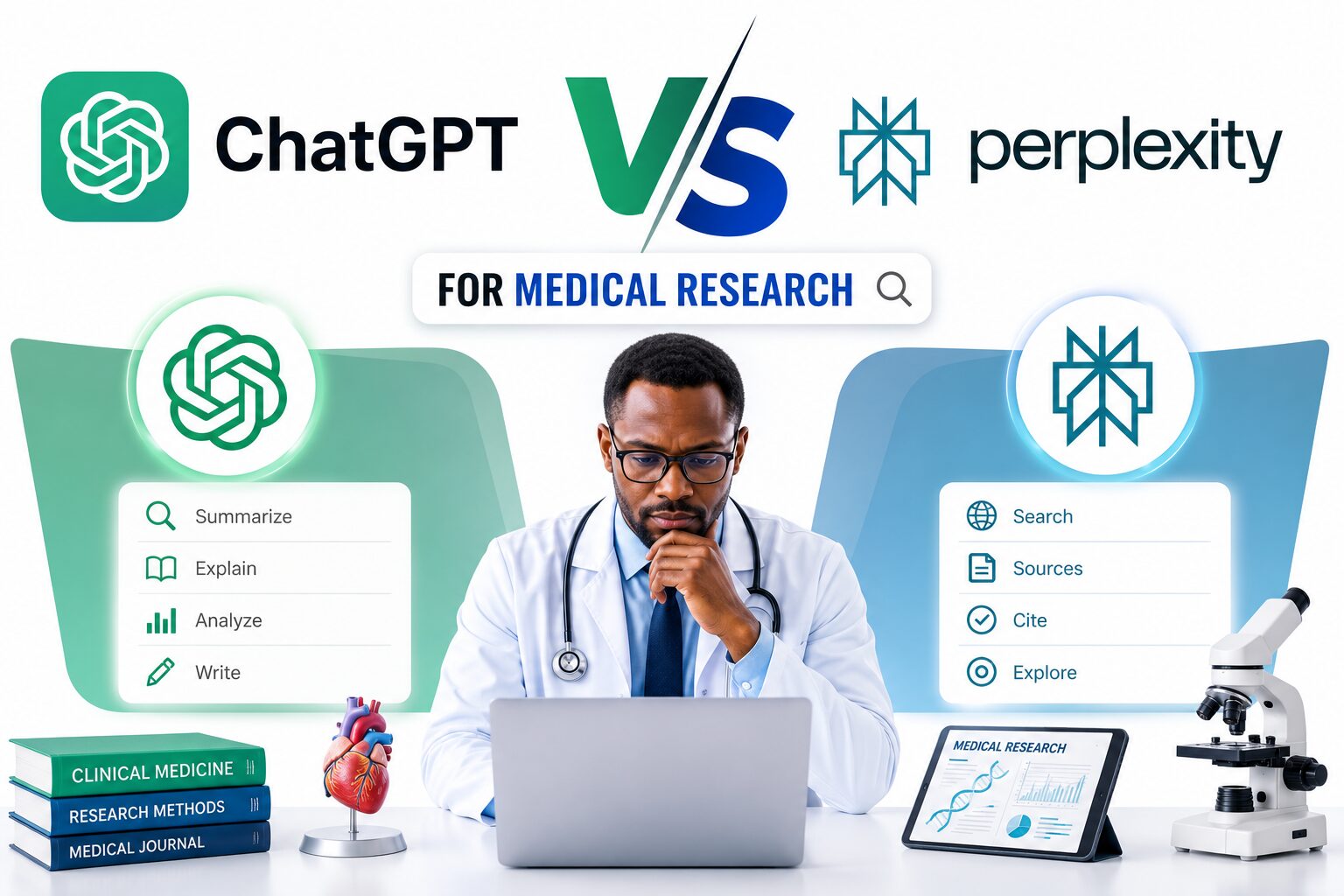
ChatGPT vs Perplexity for Medical Research: Which AI Should Researchers Choose in 2026?
By Dr Festus Kaasung Kunde, MD
Medical Doctor | AI in Healthcare Advocate | Founder, AI Doctor Africa & Ghana Vitals
AI has transformed medical research. Researchers can now identify relevant studies, summarise complex evidence, generate research ideas, analyse data, and draft manuscripts in a fraction of the time traditional methods required.
Among the most popular AI tools are ChatGPT and Perplexity. While both are powerful, they were built with different strengths in mind.
If you’re a medical student, clinician, academic researcher, or public health professional, choosing the right tool can significantly improve your research workflow.
ChatGPT for Medical Research
ChatGPT has evolved into a comprehensive research assistant capable of supporting nearly every stage of the research process.
Its Deep Research feature can perform multi-step investigations by searching the web, analysing uploaded documents, synthesising evidence into structured reports, and citing the sources it used. Users can review and adjust the research plan before it begins and export completed reports in formats such as Word, PDF, or Markdown.
Researchers commonly use ChatGPT to:
- Generate research questions.
- Develop study protocols.
- Explain complex statistical concepts.
- Analyse uploaded journal articles.
- Compare clinical guidelines.
- Draft manuscripts.
- Improve scientific writing.
- Prepare conference presentations.
- Interpret research findings.
One of ChatGPT’s greatest strengths is reasoning. It performs particularly well when analysing multiple studies, identifying patterns across evidence, and helping researchers organise complex ideas into coherent scientific writing.
Perplexity for Medical Research
Perplexity was designed with search at its core.
Unlike traditional chatbots, it automatically searches the internet, retrieves current information, and presents answers with linked sources. Its Research and Advanced Deep Research modes can conduct dozens of searches, analyse hundreds of sources, process uploaded documents, and produce shareable reports with citations.
Medical researchers frequently use Perplexity to:
- Find newly published papers.
- Search clinical guidelines.
- Locate systematic reviews.
- Identify ongoing clinical trials.
- Compare recommendations from different organisations.
- Discover grey literature and government reports.
- Verify factual claims with source links.
Because citations are central to its workflow, Perplexity is particularly useful during the literature-search phase of research.
ChatGPT vs Perplexity: Feature Comparison
| Feature | ChatGPT | Perplexity |
|---|---|---|
| Literature discovery | Excellent | Excellent |
| Real-time web search | Very good | Excellent |
| Source citations | Yes | Yes (core feature) |
| Deep research reports | Excellent | Excellent |
| Scientific writing | Excellent | Good |
| Research proposal writing | Excellent | Good |
| Critical reasoning | Excellent | Good |
| Data interpretation | Excellent | Good |
| Finding recent publications | Very good | Excellent |
| Long document analysis | Excellent | Good |
Which Is Better for Literature Reviews?
Perplexity excels at quickly identifying relevant studies from across the web and presenting them with direct source links.
ChatGPT is stronger once those studies have been collected. It can compare methodologies, identify themes, explain conflicting findings, and help synthesise evidence into a structured literature review.
Many researchers therefore use Perplexity to find papers and ChatGPT to understand them.
Which Is Better for Writing Research Papers?
ChatGPT is generally the stronger writing assistant.
It can help researchers:
- Improve scientific language.
- Rewrite awkward paragraphs.
- Generate clear introductions.
- Organise discussion sections.
- Explain reviewer comments.
- Improve logical flow.
- Adapt manuscripts to journal requirements.
Perplexity can also assist with writing, but its primary strength remains evidence retrieval rather than long-form manuscript development.
Which Is Better for Evidence-Based Medicine?
Both tools support evidence-based medicine, but they do so differently.
Perplexity focuses on rapidly locating current information with linked sources, making it ideal for answering focused clinical questions.
ChatGPT is better suited to analysing that evidence, comparing studies, and explaining the broader clinical implications.
Neither tool should replace established evidence-based resources, systematic reviews, or current clinical guidelines.
Accuracy and Verification
Neither ChatGPT nor Perplexity should be treated as infallible.
Both can:
- Misinterpret research findings.
- Omit important studies.
- Oversimplify complex evidence.
- Produce inaccurate summaries.
- Present outdated information if sources are not carefully reviewed.
Researchers remain responsible for reading original papers, verifying citations, and ensuring that conclusions accurately reflect the evidence.
A Practical Medical Research Workflow
Many experienced researchers now combine both platforms.
A practical workflow might look like this:
- Use Perplexity to locate recent literature, clinical guidelines and key papers.
- Read the original publications.
- Upload the most relevant studies to ChatGPT.
- Ask ChatGPT to compare methodologies, summarise findings and identify research gaps.
- Use ChatGPT to draft the manuscript.
- Perform a final manual review before submission.
This approach combines Perplexity’s strength in information retrieval with ChatGPT’s strength in reasoning and scientific writing.
Verdict
Choose ChatGPT if your primary goal is:
- Research planning.
- Literature synthesis.
- Scientific writing.
- Critical analysis.
- Data interpretation.
- Manuscript development.
Choose Perplexity if your primary goal is:
- Finding recent publications.
- Searching current evidence.
- Locating clinical guidelines.
- Identifying authoritative sources.
- Verifying factual claims.
For most medical researchers, the choice is not ChatGPT or Perplexity—it is ChatGPT and Perplexity.
Perplexity helps you discover the evidence. ChatGPT helps you understand it, organise it and communicate it effectively.
Used together—and combined with careful reading of the original literature—they can substantially improve the speed and quality of medical research while preserving the critical thinking that remains at the heart of good science.
Related Articles
- Best AI Tools for Doctors in 2026
- Best AI Tools for Researchers in 2026
- Claude vs Gemini for Healthcare Professionals
- Best Free AI Tools for Healthcare Professionals
About the Author
Dr Festus Kaasung Kunde is a Medical Doctor, AI in Healthcare Advocate, and Founder of AI Doctor Africa and Ghana Vitals. He holds an MD from Stavropol State Medical University, Russia (2025), and completed an internship at Korle-Bu Teaching Hospital in Accra. His mission is to help African healthcare professionals adopt AI responsibly to improve learning, research, and patient outcomes.
AI Doctor Africa | aidoctorafrica.com
Medical Disclaimer: For educational purposes only. AI tools do not replace clinical supervision, verified study resources, or your medical school’s academic guidance. Always verify clinical facts against authoritative primary sources.