
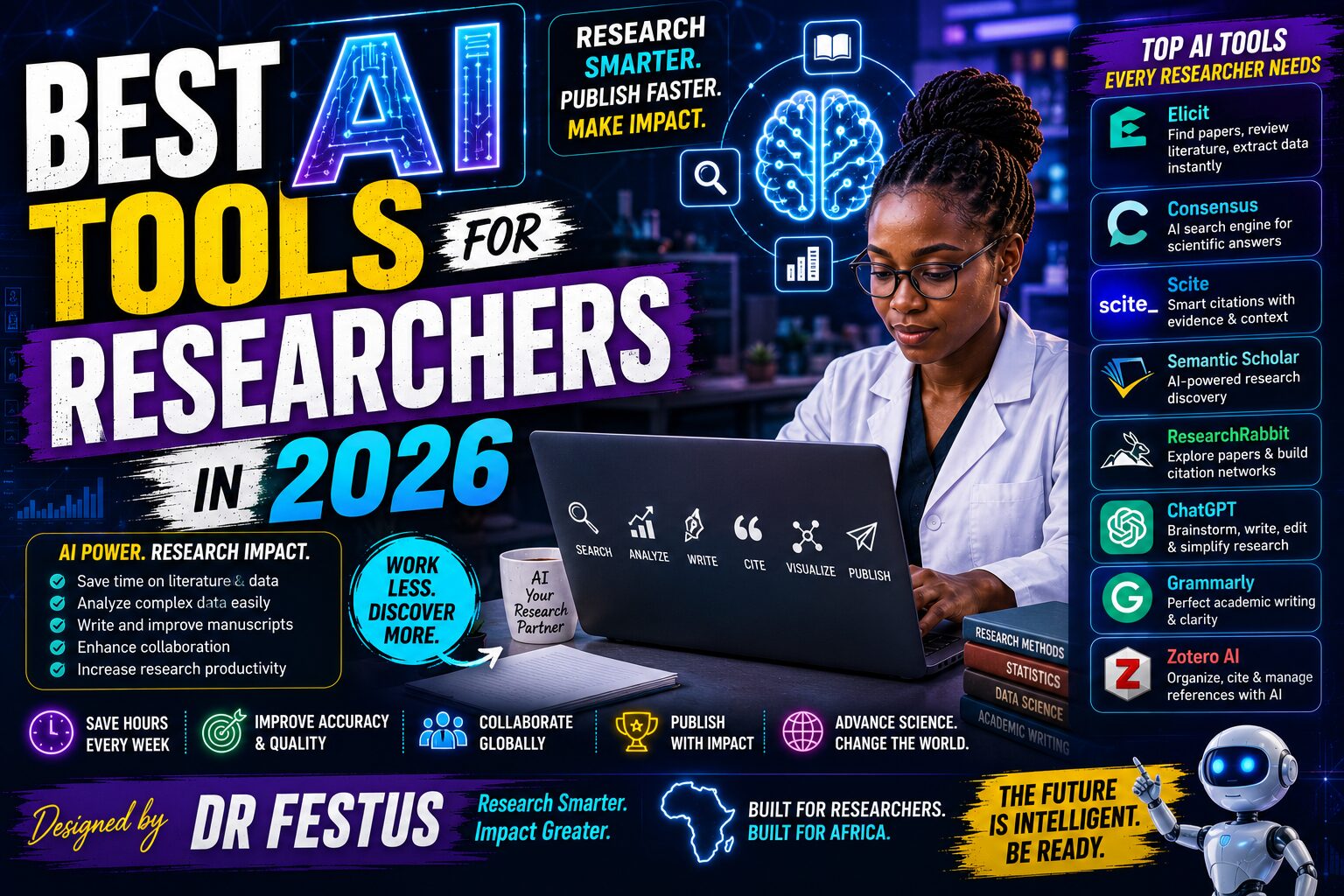
Best AI Tools for Researchers in 2026
By Dr Festus Kaasung Kunde, MD
Medical Doctor | AI in Healthcare Advocate | Founder, AI Doctor Africa & Ghana Vitals
Research has traditionally involved hours of searching databases, screening papers, extracting data, managing references and organising findings. In 2026, artificial intelligence can support almost every stage of this process.
The right AI tools can help researchers discover relevant literature, understand complex papers, analyse evidence and improve academic writing. However, they must be used as assistants—not substitutes for critical thinking, methodological rigour or research integrity.
Here are some of the best AI tools for researchers in 2026.
1. Elicit
Elicit is one of the strongest specialised platforms for literature reviews and evidence synthesis. It can search scientific literature, screen studies against eligibility criteria, extract information into structured tables and support systematic-review workflows.
Its systematic review features include auditable exclusion reasons and supporting quotations, helping researchers maintain transparency during screening.
Best for: Systematic reviews, evidence synthesis, paper screening and data extraction.
2. Consensus
Consensus is an AI-powered academic search engine designed around peer-reviewed research. Researchers can ask a question in natural language and receive an evidence-based summary linked to relevant scientific papers.
It is particularly useful during the early stages of a project when researchers need to understand what the existing literature says about a specific question.
Best for: Rapid evidence searches and understanding scientific consensus.
3. Scite
Scite helps researchers evaluate how scientific papers have been cited.
Its Smart Citations system does more than count citations. It provides context indicating whether later studies support, mention or contrast with a paper’s claims. This makes it valuable for identifying disputed evidence and avoiding reliance on studies that have been challenged.
Best for: Citation verification, evidence evaluation and checking scientific claims.
4. ResearchRabbit
ResearchRabbit turns literature discovery into a visual and connected process.
Researchers can begin with a few relevant papers and explore relationships between publications, authors and research themes through interactive citation maps. It also provides personalised recommendations and tools for organising collections.
Best for: Citation mapping, discovering related studies and tracking research trends.
5. Semantic Scholar
Semantic Scholar is a free AI-powered academic search platform developed by the Allen Institute for AI.
It helps researchers find relevant papers, organise reading lists, generate citations and receive recommendations based on saved studies. Its AI-generated summaries can also help researchers judge whether a paper deserves closer reading.
Best for: Free literature discovery, paper recommendations and reference collection.
6. ChatGPT
ChatGPT is a versatile research assistant for developing questions, refining methodology, analysing uploaded documents, explaining statistics and structuring research reports.
Its Deep Research capability can search, analyse and synthesise information from numerous online sources into a documented report with citations. Researchers can also use it with uploaded files and selected websites.
It should never be trusted to generate references without verification, as inaccurate or fabricated citations may still occur.
Best for: Research planning, data interpretation, writing support and in-depth topic exploration.
7. Claude
Claude is particularly useful for working with lengthy research papers, protocols, reports and datasets.
Its Research feature performs multiple searches, investigates different aspects of a question and produces detailed answers with citations. Anthropic has also introduced Claude Science, a scientific workbench designed to integrate commonly used research tools and produce auditable outputs.
Best for: Long-document analysis, literature synthesis, scientific writing and complex reasoning.
8. NotebookLM
NotebookLM allows researchers to create a source-grounded AI workspace using their own papers, reports, websites and notes.
The system analyses the uploaded materials and answers questions based on those sources. This makes it useful for comparing papers, summarising guidelines, identifying themes, and preparing research presentations without relying entirely on open web information.
Best for: Analysing personal research libraries and synthesising selected sources.
9. Perplexity
Perplexity combines conversational AI with web search and source citations. Researchers can use it for rapid topic exploration, locating recent publications and identifying organisations, datasets or reports that may not appear immediately in traditional academic databases.
Its answers should still be verified by opening and evaluating the sources.
Best for: Current information, preliminary searches and finding grey literature.
10. General AI Data-Analysis Assistants
Tools such as ChatGPT, Claude and specialised data-analysis platforms can assist researchers with cleaning datasets, generating code, selecting statistical approaches and interpreting results.
They can be especially helpful for researchers working with Excel, Python, R or unfamiliar statistical methods. However, every calculation, assumption and model output must be checked by someone with appropriate methodological knowledge.
Best for: Statistical support, coding, data visualisation and exploratory analysis.
A Practical AI Research Workflow
A researcher could use:
- Consensus or Semantic Scholar to begin the literature search.
- ResearchRabbit to map the research field.
- Elicit to screen and extract evidence.
- Scite to evaluate citations and conflicting findings.
- NotebookLM to analyse selected papers.
- ChatGPT or Claude to organise ideas, interpret findings and improve writing.
Related Articles
- AI for Academic Writing: Benefits, Risks, and Best Practices
- AI for Research Proposal Writing
- Can AI Write Scientific Papers?
- AI for Grant Applications and Funding Proposals
- AI for Medical Research in 2026
- Top AI Tools for Medical Researchers
About the Author
Dr Festus Kaasung Kunde is a Medical Doctor, AI in Healthcare Advocate, and Founder of AI Doctor Africa and Ghana Vitals. He holds an MD from Stavropol State Medical University, Russia (2025), and completed an internship at Korle-Bu Teaching Hospital in Accra. His mission is to help African healthcare professionals adopt AI responsibly to improve learning, research, and patient outcomes.
AI Doctor Africa | aidoctorafrica.com
Medical Disclaimer: For educational purposes only. AI tools do not replace clinical supervision, verified study resources, or your medical school’s academic guidance. Always verify clinical facts against authoritative primary sources.