
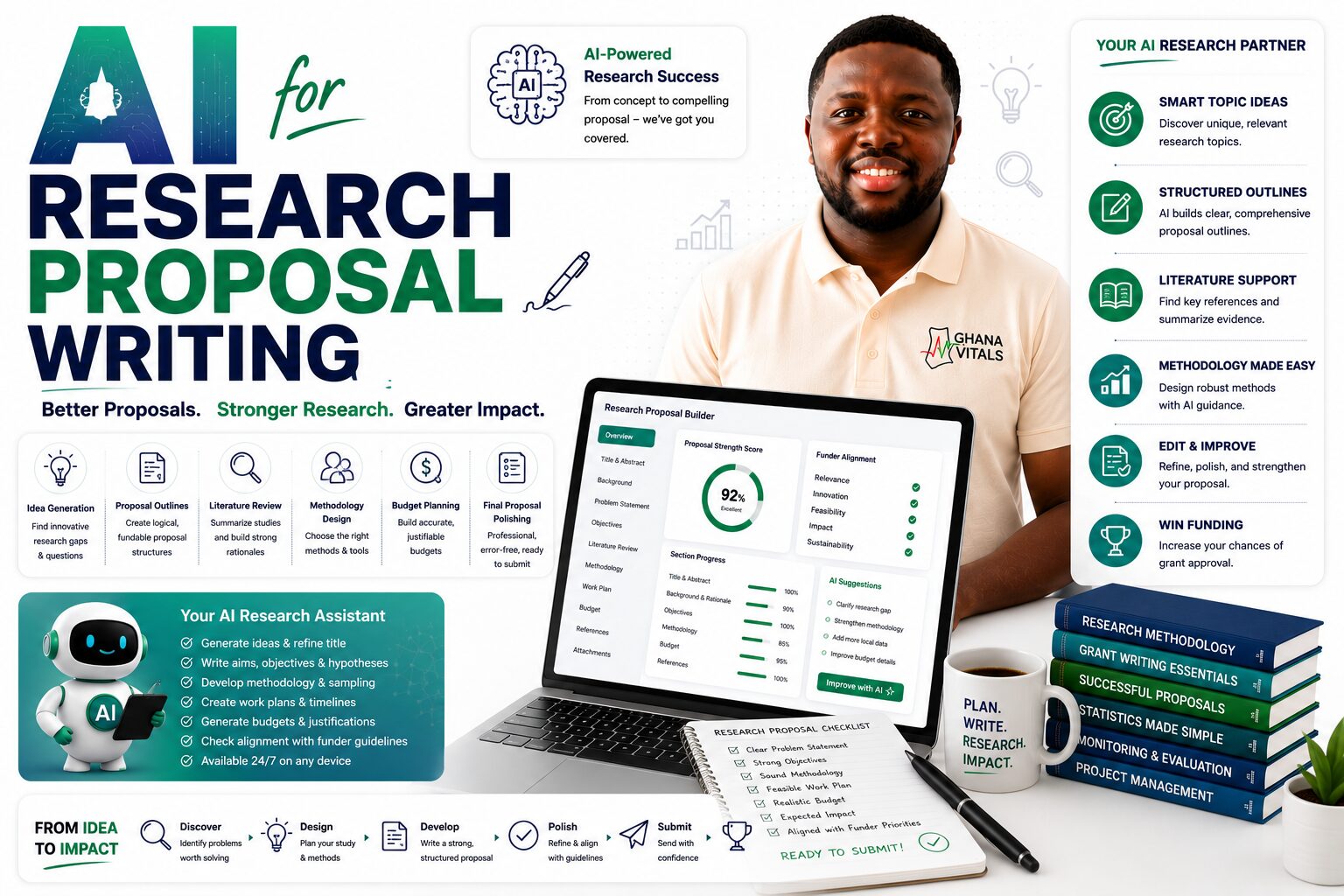
AI for Research Proposal Writing: How Researchers Can Write Better Proposals Faster in 2026
By Dr Festus Kaasung Kunde, MD
Medical Doctor | AI in Healthcare Advocate | Founder, AI Doctor Africa & Ghana Vitals
Category: AI for Research Proposal Writing
Every Great Research Project Begins With One Proposal
Every published research paper, breakthrough discovery, or funded healthcare innovation begins long before data collection. It begins with a research proposal. For many students and researchers, writing that proposal is one of the most intimidating parts of the research process.
Whether you are an undergraduate writing your first project, a master’s student preparing a thesis proposal, a PhD candidate, a clinician planning hospital-based research, or a public health professional seeking funding, you have probably faced the same questions:
- Where do I begin?
- How do I write a convincing background?
- How many objectives should I include?
- Is my methodology strong enough?
- Will supervisors approve my proposal?
I have experienced these same challenges.
Throughout medical school and later, as I developed ideas for Ghana Vitals, I realised that the hardest part was rarely having an idea.
The difficult part was translating that idea into a structured, persuasive proposal.
Today, artificial intelligence is helping researchers do exactly that.
AI cannot replace your scientific thinking.
It cannot invent valid research.
And it certainly should never fabricate references or data.
What it can do is help you organise your ideas, strengthen your arguments, improve clarity, and spend less time struggling with structure.
This article explains how researchers can use AI responsibly to write stronger research proposals in 2026.
Why Research Proposal Writing Is Difficult
A research proposal is more than a document.
It is a roadmap.
It explains:
- What problem do you want to solve?
- Why the problem matters.
- What previous researchers have discovered.
- What gap still exists?
- How do you intend to investigate it?
- Why your study deserves approval or funding.
Writing all of this requires:
- Scientific thinking
- Critical appraisal
- Logical organization
- Academic writing skills
Many students have never formally been taught these skills.
That is why proposal writing often feels overwhelming.
The Biggest Mistake Researchers Make
One misconception is that proposals are judged mainly by the topic.
In reality, reviewers often evaluate:
- Clarity
- Feasibility
- Scientific rationale
- Methodology
- Originality
- Ethical considerations
A brilliant idea presented poorly may be rejected.
An average idea presented exceptionally well often receives more attention.
AI helps improve communication—not replace scientific thinking.
What AI Can—and Cannot—Do
Artificial intelligence can assist researchers by helping them:
- Brainstorm research ideas
- Improve proposal structure
- Simplify academic writing
- Develop research questions
- Refine objectives
- Summarize literature
- Build timelines
- Suggest methodological considerations
However, AI should never be used to:
- Invent data
- Fabricate references
- Copy existing proposals
- Misrepresent previous work
- Replace ethical or scientific judgment
Researchers remain fully responsible for everything they submit.
The Standard Structure of a Research Proposal
Although institutions differ slightly, most proposals include:
- Title
- Background
- Problem Statement
- Justification
- Research Aim
- Research Objectives
- Research Questions
- Literature Review
- Methodology
- Ethical Considerations
- Timeline
- Budget (where required)
- References
AI can assist with every section.
10 Practical Ways to Use AI for Research Proposal Writing
1. Refining Your Research Topic
Many researchers begin with broad ideas.
Example:
Hypertension in Ghana.
AI can help narrow this into something more focused:
Predictors of uncontrolled hypertension among adults attending primary healthcare facilities in Greater Accra.
Focused topics lead to stronger proposals.
2. Developing Research Questions
Prompt:
Based on this topic, generate five research questions suitable for a cross-sectional study.
Well-written research questions guide the entire proposal.
3. Writing a Strong Background
A common mistake is writing backgrounds that are too broad.
AI can help organise information logically:
- Global context
- Regional context
- National context
- Local problem
- Knowledge gap
The researcher should then verify facts and update the evidence with current literature.
4. Improving the Problem Statement
Weak:
Diabetes is increasing.
Stronger:
Despite increasing diabetes prevalence in Ghana, many patients remain undiagnosed until complications occur, highlighting the need for earlier detection strategies.
AI helps improve clarity and flow.
5. Developing SMART Objectives
Objectives should be:
- Specific
- Measurable
- Achievable
- Relevant
- Time-bound
Prompt:
Rewrite these objectives as SMART objectives suitable for a master’s research proposal.
6. Brainstorming Methodology
AI can explain different study designs and their strengths and limitations.
Prompt:
Compare cross-sectional, cohort, and case-control designs for this research question.
This helps students choose an appropriate methodology while discussing final decisions with supervisors.
7. Creating Timelines
Prompt:
Create a six-month Gantt chart for this research project.
The AI can outline major milestones such as ethics approval, data collection, analysis, and report writing.
8. Improving Academic Writing
Prompt:
Rewrite this paragraph to improve clarity while maintaining an academic tone.
This is particularly useful for researchers writing in English as an additional language.
9. Preparing for Supervisor Feedback
Prompt:
Review this proposal as if you were a university supervisor. Identify weaknesses and suggest improvements.
This encourages critical thinking before submission.
10. Building Confidence
Perhaps the greatest advantage of AI is that it allows researchers to ask unlimited questions without fear of embarrassment.
Whether you’re unsure about sampling techniques or ethical considerations, AI can provide educational explanations that make the proposal-writing process less intimidating.
My Experience: From Ideas to Structured Projects
One lesson I learned while developing Ghana Vitals was that enthusiasm alone does not create a successful project.
Every innovative idea eventually reaches a stage where it must answer difficult questions:
- Why is this project needed?
- How will it work?
- Who benefits?
- How will success be measured?
- Is it sustainable?
Artificial intelligence has helped me organise these questions more effectively.
It has not made the decisions for me.
Instead, it has challenged my assumptions and encouraged me to think more systematically.
That is exactly how researchers should use AI.
As a thinking partner.
Not as a replacement for scientific reasoning.
ChatGPT vs Claude for Research Proposal Writing
ChatGPT
Best for:
- Brainstorming ideas
- Proposal outlines
- SMART objectives
- Timelines
- Editing
Claude
Best for:
- Long-form writing
- Proposal structure
- Detailed explanations
- Logical flow
- Reviewing complete drafts
My Recommendation
Use Claude to develop your proposal.
Use ChatGPT to test and refine it.
Together, they create a highly effective research-writing workflow.
20 AI Prompts Every Researcher Should Save
- Improve my research title.
- Generate research questions.
- Develop SMART objectives.
- Improve my problem statement.
- Rewrite this background academically.
- Suggest knowledge gaps.
- Compare study designs.
- Explain sampling techniques.
- Create a data collection timeline.
- Draft a Gantt chart.
- Identify proposal weaknesses.
- Suggest ethical considerations.
- Improve academic writing.
- Explain statistical methods.
- Summarise relevant literature.
- Develop a conceptual framework.
- Build a logical flow.
- Prepare for supervisor questions.
- Suggest dissemination strategies.
- Review my proposal critically.
Common Mistakes Researchers Make
- Choosing topics that are too broad.
- Writing vague objectives.
- Weak problem statements.
- Poor literature organisation.
- Selecting inappropriate study designs.
- Overusing AI without verification.
AI should strengthen your thinking—not replace it.
Ethical Considerations
Responsible researchers should:
- Verify all references.
- Confirm factual accuracy.
- Follow institutional AI policies.
- Acknowledge AI use if required.
- Never fabricate data or citations.
Scientific integrity remains non-negotiable.
The Future of AI in Research Proposal Development
In the coming years, AI will likely become a standard part of proposal development.
Researchers may increasingly use AI to:
- Identify emerging research priorities.
- Analyse funding trends.
- Improve proposal readability.
- Simulate reviewer feedback.
- Strengthen project design.
Those who learn to use AI ethically and critically will gain a significant advantage.
Key Takeaways
- A strong proposal begins with a clearly defined research problem.
- AI helps organise ideas and improve writing quality.
- Research questions and objectives should guide the proposal.
- Methodology must align with the research objectives.
- AI cannot replace scientific reasoning.
- Ethical use of AI is essential.
- Human expertise remains the foundation of good research.
Frequently Asked Questions
Can AI write my entire research proposal?
AI can help draft and refine sections, but you are responsible for the final content, scientific accuracy, and originality.
Can AI help me choose a research topic?
Yes. It can help refine broad ideas into more focused and researchable questions.
Is it acceptable to use AI for academic writing?
Many institutions permit AI-assisted writing with appropriate oversight, but policies vary. Always follow your university’s guidance.
Can AI replace my research supervisor?
No. AI is an educational tool. Your supervisor provides scientific mentorship, contextual judgment, and academic oversight that AI cannot replace.
Related Articles
- AI for Medical Research in 2026
- AI for Grant Applications and Funding Proposals
- Top AI Tools for Medical Researchers
- AI for Literature Reviews
- Can AI Write Scientific Papers?
About the Author
Dr Festus Kaasung Kunde is a Medical Doctor, AI in Healthcare Advocate, and Founder of AI Doctor Africa and Ghana Vitals. He holds an MD from Stavropol State Medical University, Russia (2025), and completed an internship at Korle-Bu Teaching Hospital in Accra. His mission is to help African healthcare professionals adopt AI responsibly to improve learning, research, and patient outcomes.
AI Doctor Africa | aidoctorafrica.com
Medical Disclaimer: For educational purposes only. AI tools do not replace clinical supervision, verified study resources, or your medical school’s academic guidance. Always verify clinical facts against authoritative primary sources.

Dr. Festus K. Kunde
Dr. Festus Kaasung Kunde is a medical doctor, Content creator, healthcare technology writer, and digital health innovator specializing in Artificial Intelligence in Medicine, Healthcare Systems Innovation, and Health Data Science in Africa. He is the founder of AI Doctor Africa (AIDoctorAfrica.com), an educational platform dedicated to helping healthcare professionals—including doctors, medical students, nurses, and researchers—understand and responsibly apply artificial intelligence in clinical practice, medical education, medical research, and healthcare innovation. He is also the creator of Ghana Vitals, a health data and predictive analytics initiative focused on collecting and analyzing key health indicators such as blood pressure, blood glucose, and BMI to support early disease detection, preventive healthcare, and data-driven decision-making in Ghana and across Africa. The project reflects his long-term vision of building scalable, AI-powered public health systems for African populations. Dr. Kunde’s work focuses on the practical integration of AI tools such as ChatGPT, Claude, and emerging clinical AI systems into real-world healthcare workflows. His content emphasizes improving clinical documentation, accelerating medical education, strengthening research productivity, and supporting healthcare decision-making in resource-limited settings. Through AI Doctor Africa, he publishes evidence-informed, practice-oriented resources including AI workflows, clinical use cases, medical education guides, and tutorials designed specifically for African healthcare professionals. Through Ghana Vitals, he extends this mission into population health innovation, aiming to leverage real-world health data and predictive models to improve early intervention, reduce preventable disease burden, and strengthen health systems across Africa. His overall mission is to bridge the gap between traditional clinical medicine, artificial intelligence, and data-driven public health, empowering African healthcare professionals to work smarter, diagnose earlier, and deliver better care through technology. Areas of Expertise Artificial Intelligence in Clinical Medicine Digital Health & Healthcare Innovation in Africa Health Data Analytics & Predictive Health Systems Medical Education and Exam Preparation AI for Medical Research and Scientific Writing Clinical Workflow Optimization using AI Tools Public Health Data Systems (Ghana Vitals Initiative) Professional Focus Dr. Kunde’s work sits at the intersection of clinical medicine, artificial intelligence, and population health systems, with a strong focus on scalable solutions for African healthcare challenges. His initiatives emphasize ethical AI use, data-driven decision-making, and practical implementation in real-world clinical and public health environments.
View author profile →