
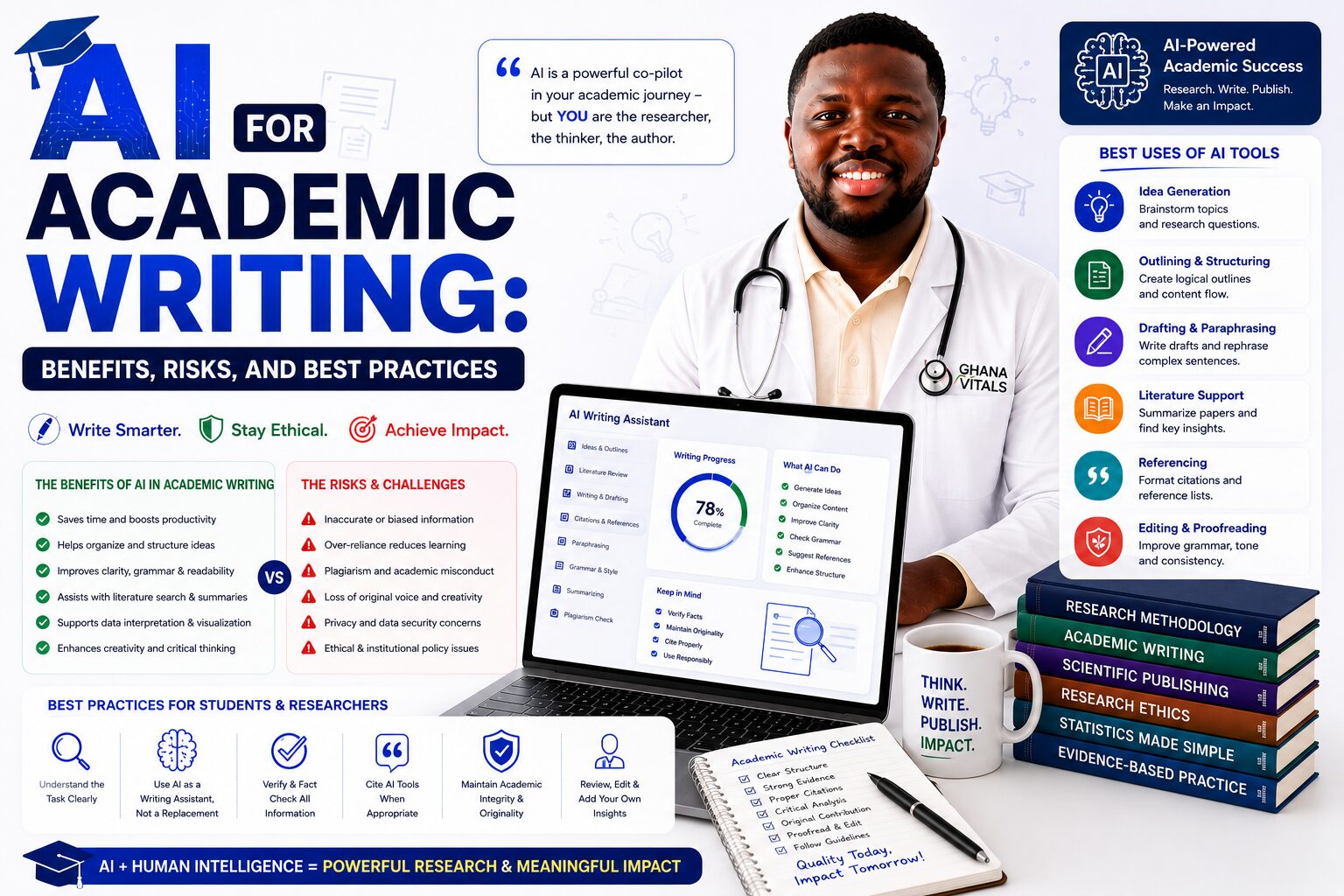
AI for Academic Writing: Benefits, Risks, and Best Practices
By Dr Festus Kaasung Kunde, MD
Medical Doctor | AI in Healthcare Advocate | Founder, AI Doctor Africa & Ghana Vitals
Academic Writing Is Hard—But It Doesn’t Have to Be Lonely
Academic writing has always been one of the greatest challenges in higher education.
Whether you are writing a university assignment, undergraduate dissertation, master’s thesis, doctoral dissertation, research proposal, grant application, conference abstract, or scientific manuscript, the process demands far more than simply knowing your subject.
It requires you to think critically, organise complex ideas, support arguments with evidence, write clearly, and communicate your findings in a way that other researchers can understand and evaluate.
For many students and researchers, that is the most difficult part.
Throughout my journey in medicine—from medical school to clinical practice and while developing Ghana Vitals—I have come to appreciate that good academic writing is rarely about using complicated language.
It is about communicating complicated ideas clearly.
That is where artificial intelligence is changing the landscape.
Tools like ChatGPT, Claude, Gemini, and Perplexity are helping millions of students and researchers brainstorm ideas, improve writing, summarise literature, organise arguments, and edit manuscripts more efficiently than ever before.
But there is also a growing concern.
- Can researchers become too dependent on AI?
- Will AI weaken critical thinking?
- Can AI-generated writing be trusted?
- Is using AI considered cheating?
The answer is neither completely yes nor completely no.
Like every powerful tool, AI can be used responsibly—or irresponsibly.
This guide explains how researchers, healthcare professionals, and students can use AI ethically to improve academic writing without compromising scientific integrity.
Why Academic Writing Feels Difficult
Academic writing is unlike any other form of writing.
Unlike blog posts or casual communication, academic writing demands:
- Precision
- Evidence-based arguments
- Logical organization
- Critical analysis
- Proper referencing
- Clear methodology
- Objective language
Students often struggle because they know what they want to say but are unsure how to express it academically.
Researchers face a different challenge.
They often have too much information and struggle to organise it coherently.
AI can help solve both problems.
Why AI Is Becoming Essential for Researchers
Research output continues to grow at an extraordinary pace.
Thousands of new scientific papers are published every day.
Keeping up has become increasingly difficult.
Artificial intelligence helps researchers by reducing repetitive writing tasks, allowing them to focus more on scientific thinking.
Instead of spending hours rewriting sentences, researchers can spend more time designing better studies, interpreting results, and generating new ideas.
That is where AI creates its greatest value.
What AI Can Help You Do
AI is particularly effective at improving the writing process rather than replacing it.
Researchers can use AI to:
- Brainstorm topics
- Develop research questions
- Improve outlines
- Rewrite paragraphs
- Simplify complex language
- Summarize literature
- Improve grammar
- Check logical flow
- Generate tables
- Suggest headings
- Improve readability
Notice something important.
None of these tasks replaces scientific expertise.
They simply make researchers more efficient.
Benefits of AI for Academic Writing
1. Faster Brainstorming
Many researchers spend days trying to refine a research topic.
AI can generate dozens of possibilities within minutes.
Prompt:
Suggest ten research topics on hypertension prevention in Sub-Saharan Africa.
2. Better Organisation
Researchers often know their subject well but struggle to structure their ideas.
AI can suggest logical chapter organisation, paragraph flow, and transitions.
3. Improved Clarity
Clear writing is one of the biggest predictors of manuscript quality.
Prompt:
Rewrite this paragraph using concise academic language while preserving its meaning.
4. Language Support
For researchers writing in English as a second language, AI provides valuable editing assistance without changing the scientific content.
5. Literature Summaries
AI can summarise long articles into key findings, helping researchers identify themes more efficiently.
Always verify summaries against the original paper.
6. Writing Confidence
Many students hesitate because they fear the blank page.
AI helps overcome writer’s block by generating starting points that researchers can refine.
Risks of Using AI in Academic Writing
While AI offers enormous benefits, it also introduces significant risks.
Hallucinated References
AI may invent citations that appear genuine.
Every reference must be checked.
Factual Errors
AI occasionally states incorrect information confidently.
Researchers must verify every important claim.
Loss of Critical Thinking
Students who rely entirely on AI may stop asking important scientific questions.
AI should stimulate thinking—not replace it.
Plagiarism Concerns
Copying AI-generated text without review or violating institutional policies may create academic integrity issues.
Know your university’s guidelines.
Ethical Challenges
Researchers should never use AI to:
- Fabricate data
- Create fake references
- Misrepresent results
- Write peer reviews dishonestly
Scientific integrity remains non-negotiable.
Best Practices for Using AI Responsibly
After using AI extensively in medical education and healthcare innovation, these principles have served me well.
Think First, Prompt Second
Always understand the problem before asking AI for assistance.
Verify Everything
Never assume AI is correct.
Cross-check important facts with reliable sources.
Use AI to Improve, Not Replace
AI should strengthen your writing—not become your writing.
Maintain Your Voice
The final manuscript should sound like you, not a chatbot.
Follow Institutional Policies
Many universities and journals now publish AI guidelines.
Read them carefully.
ChatGPT vs Claude for Academic Writing
ChatGPT
Strengths:
- Brainstorming
- Editing
- Tables
- Structured outlines
- Quick responses
Claude
Strengths:
- Long-form academic writing
- Logical flow
- Detailed explanations
- Reviewing entire manuscripts
- Maintaining context across large documents
Which Do I Use?
For complex academic projects, I often prefer Claude to build the first structured draft because of its strong long-context reasoning.
For editing, brainstorming, and refining prompts, ChatGPT remains one of my favourite tools.
Each complements the other.
My Academic Writing Workflow
If I were starting a new research paper today, my workflow would look like this:
- Define the research question.
- Conduct a literature search using trusted databases.
- Read the original studies.
- Use AI to summarise themes.
- Build a manuscript outline.
- Draft each section myself with AI assistance.
- Ask AI to review clarity and logical flow.
- Verify references manually.
- Proofread before submission.
This keeps scientific thinking firmly under human control.
20 AI Prompts Every Researcher Should Save
- Improve my academic writing.
- Rewrite this paragraph clearly.
- Suggest stronger transitions.
- Identify weaknesses in my argument.
- Generate a manuscript outline.
- Improve readability.
- Explain this concept simply.
- Compare two theories.
- Summarise this article.
- Suggest future research directions.
- Review my introduction.
- Improve my discussion section.
- Check logical flow.
- Simplify complex sentences.
- Explain statistical terminology.
- Generate presentation slides.
- Prepare reviewer responses.
- Suggest journal titles.
- Review grammar.
- Create an editing checklist.
The Future of Academic Writing
Artificial intelligence will almost certainly become a routine part of academic writing.
Future tools may:
- Search literature automatically.
- Detect logical inconsistencies.
- Suggest missing citations.
- Improve statistical reporting.
- Personalise writing assistance.
However, one thing is unlikely to change.
Research will always depend on human curiosity.
AI can help communicate discoveries.
It cannot replace the imagination required to make them.
Key Takeaways
- AI improves efficiency—not expertise.
- Researchers remain responsible for accuracy.
- Verify every citation.
- Use AI to improve clarity.
- Maintain your own scientific voice.
- Ethical use of AI is essential.
- Critical thinking remains irreplaceable.
Frequently Asked Questions
Can AI write my dissertation?
AI can help organise and edit your dissertation, but the research, analysis, and conclusions must remain your own.
Is using AI considered cheating?
It depends on your institution’s policies. Many universities allow responsible AI-assisted writing, but disclosure requirements may apply.
Which AI is best for academic writing?
Both ChatGPT and Claude are excellent. Claude is particularly strong for long-form academic writing, while ChatGPT excels at brainstorming and editing.
Should I trust AI-generated references?
No. Always verify references using trusted academic databases before citing them.
Related Articles
- AI for Research Proposal Writing
- Can AI Write Scientific Papers?
- AI for Grant Applications and Funding Proposals
- AI for Medical Research in 2026
- Top AI Tools for Medical Researchers
About the Author
Dr Festus Kaasung Kunde is a Medical Doctor, AI in Healthcare Advocate, and Founder of AI Doctor Africa and Ghana Vitals. He holds an MD from Stavropol State Medical University, Russia (2025), and completed an internship at Korle-Bu Teaching Hospital in Accra. His mission is to help African healthcare professionals adopt AI responsibly to improve learning, research, and patient outcomes.
AI Doctor Africa | aidoctorafrica.com
Medical Disclaimer: For educational purposes only. AI tools do not replace clinical supervision, verified study resources, or your medical school’s academic guidance. Always verify clinical facts against authoritative primary sources.