
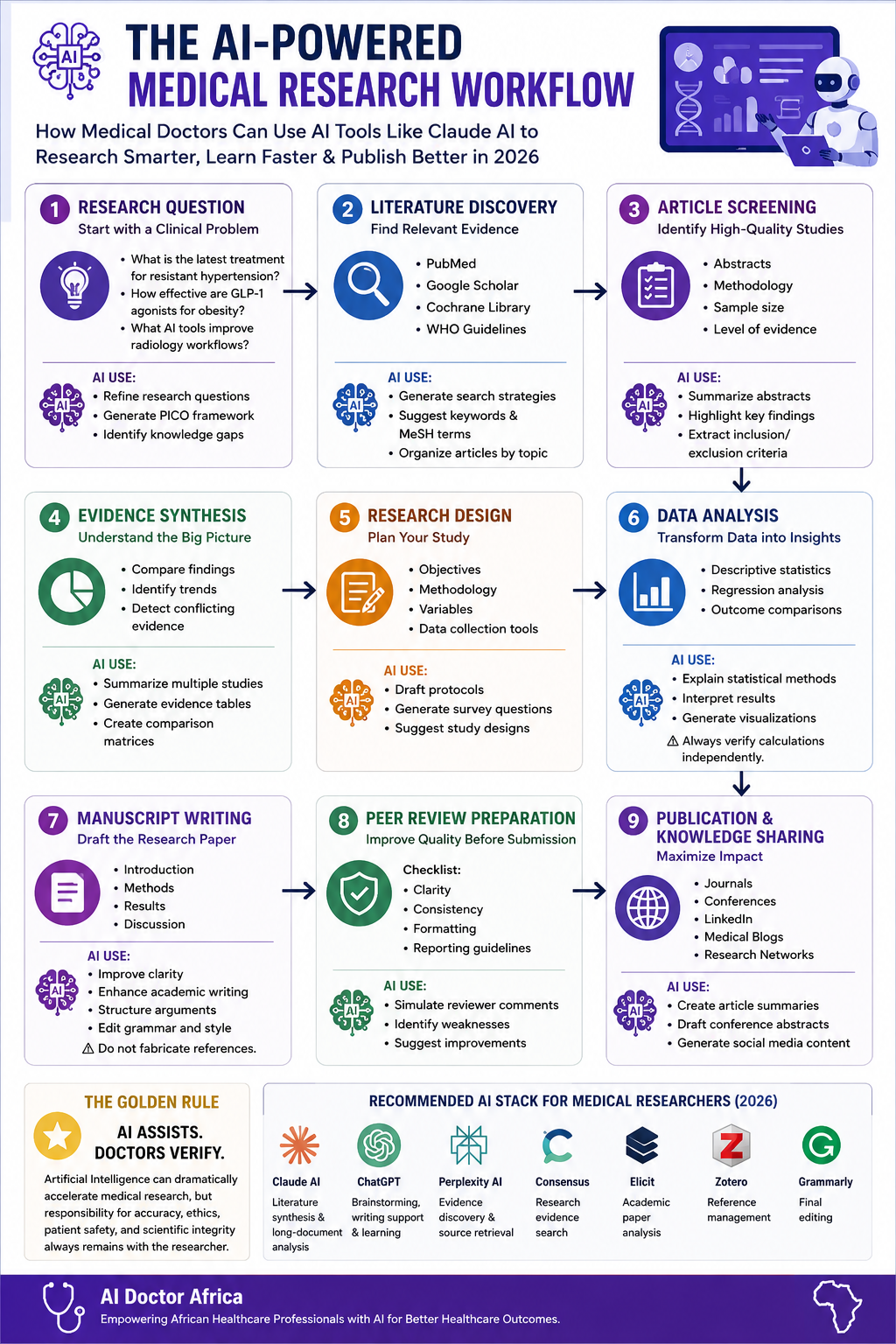
Claude AI for Doctors: Research, Clinical Learning, and Productivity in 2026
In 2026, one of the biggest challenges facing healthcare professionals is no longer a lack of information. It is information overload, and this is why learning Claude AI for Doctors: Research, Clinical Learning, and Productivity in 2026 will be an advantage.
Medical knowledge is expanding at a pace that no human being can comfortably keep up with. New research papers are published every day. Clinical guidelines are regularly updated. New drugs, technologies, and treatment protocols emerge constantly.
At the same time, doctors are expected to do so,
- Deliver excellent patient care
- Stay current with evidence-based medicine
- Conduct research
- Complete documentation
- Teach students
- Attend continuing professional development activities
- Prepare for examinations and specialist training
Many healthcare professionals are exhausted before they even begin tackling these responsibilities.
I experienced this challenge firsthand during my internship at Korle-Bu Teaching Hospital in Ghana. Every morning before ward rounds, I was expected to understand the history, investigations, management plans, and progress of numerous patients. As an intern preparing for my licensing examinations, I carried this responsibility alongside the pressure of studying vast amounts of medical information.
On some days, I needed to understand and summarise more than fifteen patient cases before presenting them to senior doctors. I also needed to anticipate the follow-up questions that consultants and supervising physicians might ask. For many young doctors, this situation sounds familiar. You finish ward rounds only to spend hours reviewing textbooks, clinical guidelines, lecture notes, and research papers.
- The challenge is not intelligence.
- The challenge is time.
This is where artificial intelligence tools such as Claude AI are beginning to change healthcare education and professional practice.
When used responsibly, Claude AI can help healthcare professionals:
- Learn faster
- Research more efficiently
- Organise information better
- Improve productivity
- Create educational materials
- Enhance professional development
Most importantly, AI allows doctors to spend less time searching for information and more time understanding and applying it.
The purpose of this article is not to suggest that artificial intelligence can replace doctors.
It cannot.
Instead, this article explores how Claude AI can become one of the most valuable tools in a healthcare professional’s toolkit.
What is Claude AI?
Claude AI is an advanced artificial intelligence assistant developed by Anthropic, a company focused on building safe and reliable AI systems.
Like other large language models, Claude can:
- Understand natural language
- Analyze documents
- Summarize information
- Generate content
- Answer questions
- Assist with reasoning tasks
However, Claude has developed a strong reputation for handling long documents and producing highly structured, thoughtful responses.
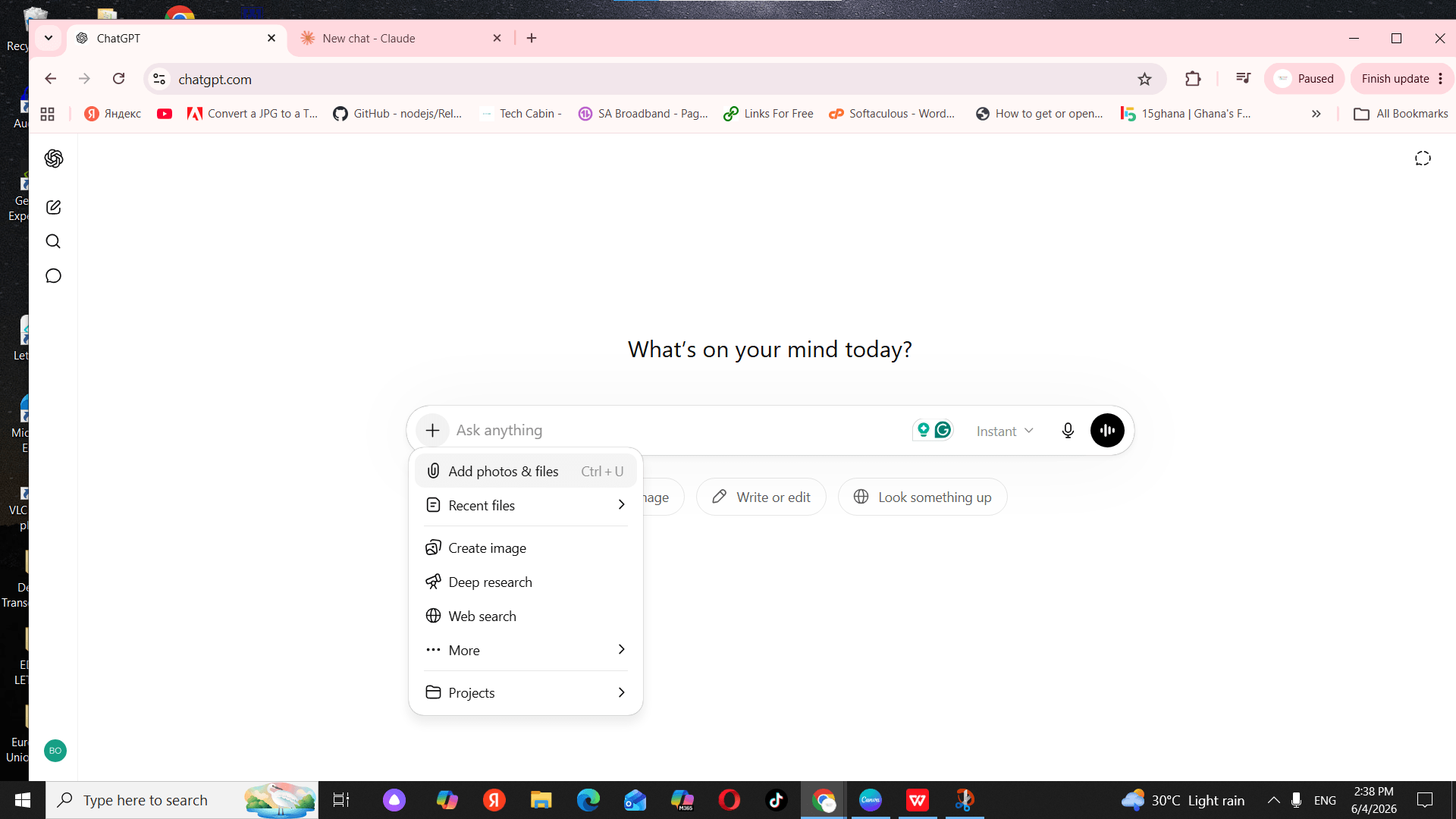
For healthcare professionals, this capability is particularly important.
Doctors frequently work with:
- Clinical guidelines
- Research papers
- Protocols
- Patient education materials
- Policy documents
- Public health reports
Many of these documents are lengthy and time-consuming to review.
Claude helps simplify the process.
Key Features of Claude AI
Long-Context Processing
One of Claude’s most significant strengths is its ability to analyse very large amounts of text simultaneously.
This allows healthcare professionals to:
- Upload lengthy research papers
- Analyse clinical guidelines
- Compare multiple studies
- Review reports
without losing important context.
Research Assistance
Claude can help:
- Summarize evidence
- Identify themes
- Compare studies
- Extract key findings
- Highlight limitations
Educational Support
Medical students and doctors can use Claude to:
- Explain concepts
- Generate practice questions
- Create study notes
- Build revision plans
Writing Support
Healthcare professionals spend considerable time writing.
Claude can assist with:
- Research manuscripts
- Reports
- Presentations
- Educational content
- Grant proposals
Knowledge Organization
Rather than replacing expertise, Claude helps organise information in ways that make learning and decision-making more efficient.
Claude AI vs ChatGPT: Which Is Better for Doctors?
This question is increasingly common among healthcare professionals.
The honest answer is:
Both are excellent.
However, they have different strengths.
Areas Where Claude Often Excels
Research Summaries
Claude tends to perform particularly well when reviewing lengthy academic papers.
Long Documents
Many healthcare documents are hundreds of pages long.
Claude’s ability to maintain context across large amounts of text is a major advantage.
Structured Writing
Researchers often appreciate Claude’s ability to create highly organised outputs.
Areas Where ChatGPT Often Excels
Coding
For healthcare professionals involved in programming, data science, or automation, ChatGPT often has advantages.
Integrations
ChatGPT has a larger ecosystem of integrations and custom GPTs.
Multimedia Features
Depending on the version used, ChatGPT may provide additional capabilities.
Which Should Doctors Use?
My recommendation is simple:
Use both.
Think of them as different specialists. You would not expect a cardiologist to replace a surgeon. Similarly, different AI systems have different strengths. The goal is not loyalty to one platform. The goal is to solve problems effectively.
Why Medical Doctors Should Learn Claude AI in 2026
Most doctors still view AI as a future technology. That is a mistake.
Artificial intelligence is already transforming healthcare.
The question is no longer:
“Will doctors use AI?”
The question is:
“Which doctors will learn to use AI effectively?”
Information Overload
The volume of medical knowledge is increasing rapidly.
Research estimates suggest that biomedical literature continues to grow at an extraordinary rate.
- No doctor can read everything.
- No specialist can know everything.
- Students can’t memorise everything.
- Claude helps bridge this gap by making information easier to process.
Research Burden
Researchers spend enormous amounts of time:
- Reading papers
- Extracting findings
- Comparing studies
- Writing manuscripts
Many of these tasks involve information management rather than original thinking.
Claude can significantly accelerate these processes.
Continuing Medical Education
- Medicine requires lifelong learning.
- Doctors must continuously update their knowledge.
- Claude can help transform complex updates into concise learning materials.
Documentation Demands
Administrative work contributes significantly to physician burnout.
While AI cannot eliminate documentation, it can reduce some of the burden associated with writing and organising information.
Productivity Expectations
Modern healthcare professionals are expected to achieve more than ever before.
AI offers one way to increase efficiency without compromising quality.
Using Claude AI for Medical Research
Research is one of the most exciting areas where Claude AI can create value.
Literature Reviews
Literature reviews are essential but time-consuming. Researchers often spend weeks reviewing papers before identifying patterns and themes.
Claude can accelerate this process by helping to:
- Summarize studies
- Compare findings
- Identify trends
- Highlight research gaps
Practical Example
Imagine a Ghanaian researcher investigating hypertension screening programs in rural communities.
Instead of manually reviewing dozens of papers from beginning to end, Claude can help organise the evidence and identify recurring findings. The researcher still evaluates the evidence.
The AI simply helps manage information more efficiently.
Journal Article Summaries
One of my favourite applications is summarising journal articles.
A typical medical paper may contain:
- Background
- Methods
- Results
- Discussion
- Limitations
Claude can extract these sections and present them in a digestible format.
This allows doctors to determine whether a paper deserves deeper review.
Research Brainstorming
Researchers often struggle to identify meaningful research questions.
Claude can help generate:
- Study ideas
- Research hypotheses
- Potential variables
- Methodological approaches
For example:
“Suggest 20 research questions related to diabetes screening among urban populations in Ghana.”
The resulting ideas can serve as a starting point for deeper investigation.
Protocol Development
Developing a research protocol requires substantial effort.
Claude can assist with:
- Background sections
- Research objectives
- Methodology frameworks
- Data collection approaches
Importantly, researchers must still verify everything produced.
AI should assist, not replace, scientific rigour.
Using Claude AI for Clinical Learning
One of the greatest advantages of Claude AI for doctors is its ability to accelerate learning. Medicine is unique among professions because graduation does not mark the end of education. In many ways, graduation is only the beginning. Every healthcare professional must continuously learn throughout their career.
New diseases emerge.
Treatment guidelines change.
Diagnostic technologies improve.
Research challenges existing practices.
The ability to learn efficiently becomes a competitive advantage.
Exam Preparation
Medical students and doctors preparing for examinations can use Claude as a study companion.
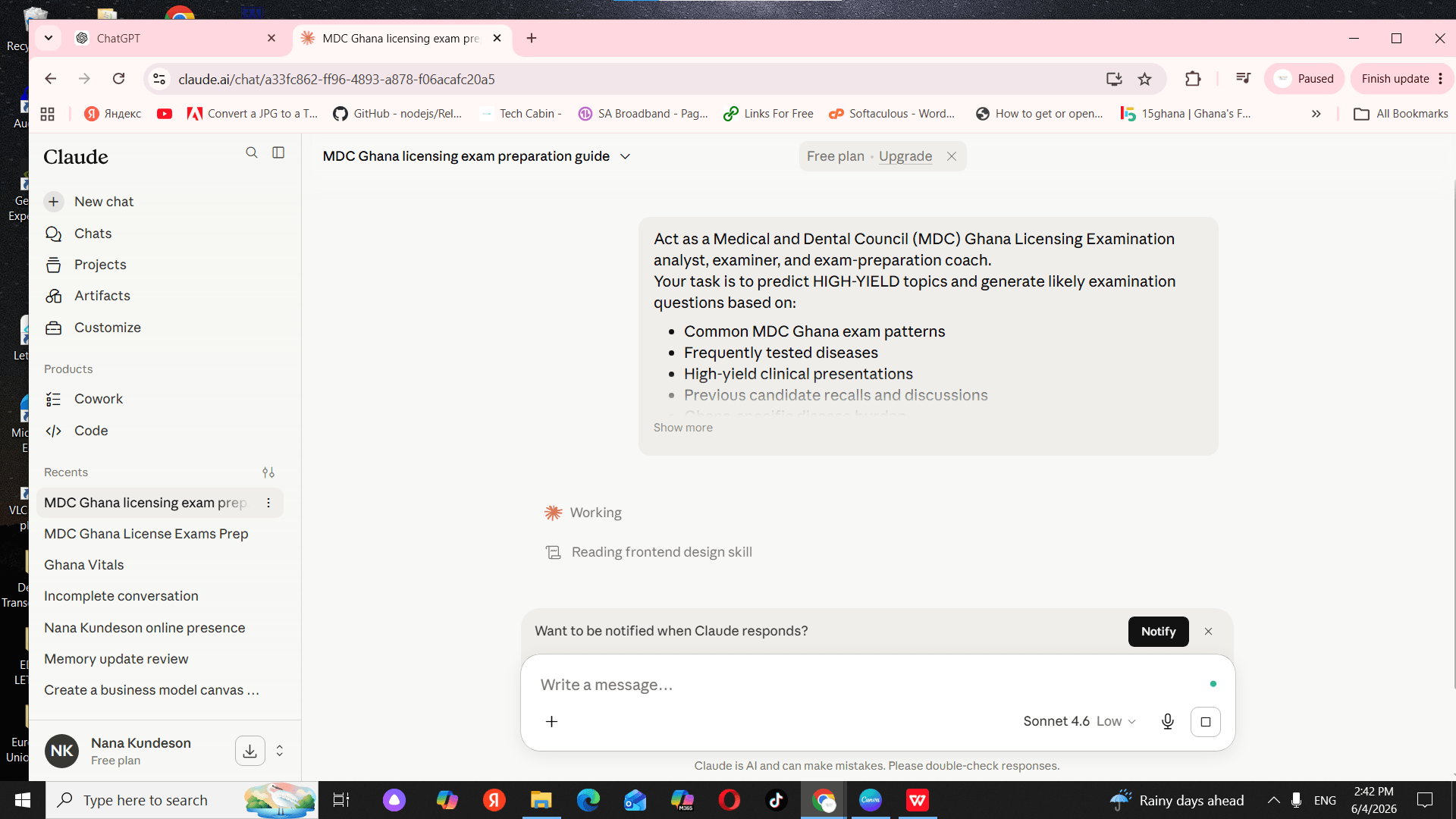
During my own preparation for licensing examinations, I discovered that AI could help transform passive reading into active learning.
Instead of simply reading guidelines, I could ask:
“Generate 20 licensing examination questions based on these guidelines.”
Or:
“Act as a consultant physician and ask me viva questions about heart failure.”
This transformed learning from information consumption into knowledge application.
Claude can generate:
- Multiple-choice questions
- Short-answer questions
- Viva questions
- OSCE scenarios
- Clinical case discussions
This is particularly useful for:
- MDC examinations
- Residency entrance examinations
- Specialist training
- Continuing medical education
Case-Based Learning
Medicine is best learned through cases.
Claude can help doctors work through patient scenarios in a structured way.
For example:
“A 62-year-old diabetic patient presents with progressive shortness of breath and lower limb edema. Discuss the differential diagnosis.”
Claude can walk through:
- History
- Differential diagnoses
- Investigations
- Management principles
- Learning points
The value is not necessarily the answer itself.
The value is seeing the clinical reasoning process.
Understanding Differential Diagnosis
Many students memorise lists.
Experienced clinicians think in probabilities.
Claude can help bridge that gap.
Instead of asking:
“What are the causes of chest pain?”
Ask:
“How would an experienced physician prioritize differential diagnoses in a 55-year-old hypertensive patient presenting with chest pain?”
This encourages clinical thinking rather than memorisation.
Guideline Simplification
Many clinical guidelines exceed 100 pages.
Claude can convert these into:
- One-page summaries
- Revision notes
- Flashcards
- Clinical algorithms
This can significantly improve retention.
My Experience at Korle-Bu Teaching Hospital
One reason I believe AI will become indispensable for healthcare professionals is that I have experienced its benefits firsthand.
During my internship at Korle-Bu Teaching Hospital, I was responsible for preparing patient presentations before ward rounds.
Each day required understanding:
- Patient histories
- Investigations
- Differential diagnoses
- Treatment plans
- Follow-up management
In addition, I was studying for my licensing examinations. There were days when I felt overwhelmed, not because I lacked motivation but because I lacked resources. The reason because there was simply too much information. I remember reviewing more than 15 patient cases while simultaneously revising guidelines for the Ghana Medical and Dental Council examinations. Traditionally, this process could consume an enormous amount of time. What changed was my approach.
I began using AI to organise educational case summaries, cross-reference concepts, and identify areas where my understanding was weak.
Claude would help me:
- Structure information
- Generate revision notes
- Create possible consultant questions
- Suggest areas for further reading
Something unexpected happened.
I became more prepared.
I became more confident.
And I became more efficient.
Many times, I found myself completing work significantly earlier than I otherwise would have.
The real benefit was not that AI gave me answers.
The real benefit was that it helped me learn faster.
That distinction is important.
Doctors should never use AI to avoid learning.
Doctors should use AI to accelerate learning.
Using Claude AI for Medical Productivity
Productivity is often overlooked in healthcare discussions.
However, productivity matters.
Every hour saved on administrative work is an hour that can be spent on:
- Patient care
- Learning
- Research
- Family
- Personal wellbeing
Email Drafting
Doctors write many emails.
Examples include:
- Research collaborations
- Conference applications
- Funding requests
- Academic communications
Claude can generate first drafts that can then be edited.
Report Writing
Healthcare professionals frequently write:
- Audit reports
- Public health reports
- Project reports
- Quality improvement reports
Claude can assist with structure and clarity.
Presentation Preparation
Doctors teach.
Whether speaking to:
- Students
- Nurses
- Residents
- Patients
Claude can help generate:
- Learning objectives
- Slide outlines
- Speaker notes
- Discussion questions
Educational Content
Healthcare professionals increasingly create:
- Blogs ( Just like this one)
- Podcasts
- Newsletters
- YouTube content
Claude can accelerate content creation while preserving accuracy through human review.
Meeting Summaries
Many healthcare meetings generate pages of notes.
Claude can convert those notes into:
- Action points
- Follow-up tasks
- Executive summaries
20 Advanced Claude AI Prompts for Doctors
Research
- Summarise this paper using PICO format.
- Compare these five studies and identify areas of agreement and disagreement.
- Identify potential research gaps in this literature.
- Generate research questions based on these findings.
- Critique this study’s methodology.
Learning
- Explain this disease at the consultant, resident, and medical student levels.
- Create a seven-day revision plan for this topic.
- Generate 30 multiple-choice questions with explanations.
- Create an OSCE station.
- Act as an examiner and conduct a viva.
Clinical Learning
- Explain the differential diagnosis of this presentation.
- Compare these two management approaches.
- Explain the pathophysiology step-by-step.
- Generate clinical pearls for this disease.
- Create a diagnostic algorithm.
Productivity
- Draft a professional email.
- Convert these notes into a report.
- Create a conference presentation outline.
- Summarise this meeting.
- Generate a patient education leaflet.
| Feature | Claude AI | ChatGPT |
|---|---|---|
| Research Summaries | Excellent | Excellent |
| Long Documents | Excellent | Very Good |
| Academic Writing | Excellent | Very Good |
| Clinical Learning | Excellent | Excellent |
| Coding | Good | Excellent |
| Educational Content | Excellent | Excellent |
| Presentation Creation | Excellent | Excellent |
| Large PDF Analysis | Excellent | Good |
| Long Context Processing | Excellent | Good |
| Research Synthesis | Excellent | Very Good |
My recommendation:
Use both.
Choose the tool that best fits the task.
Risks and Limitations of Claude AI in Medicine
Every powerful tool has limitations.
Hallucinations
AI can generate incorrect information.
Always verify:
- Drug dosages
- Guidelines
- References
- Clinical recommendations
Privacy Concerns
Patient confidentiality is non-negotiable.
Never upload identifiable patient information.
Bias
- AI systems learn from human-generated data.
- Bias can therefore exist.
Clinical Responsibility
- Doctors remain responsible for clinical decisions.
- AI should support decision-making.
- AI should not replace decision-making.
How African Doctors Can Benefit from Claude AI
Africa faces unique healthcare challenges.
These include:
- Limited specialist access
- Workforce shortages
- Resource limitations
- Geographic barriers
AI cannot solve all these problems.
But it can help.
Medical Education
Students in rural settings can access learning support.
Research Support
Researchers can improve productivity.
Public Health
AI can assist with data interpretation.
Clinical Learning
Doctors can access information more efficiently.
A Rare Autoimmune Disease That Changed My Perspective
One clinical experience remains memorable. A patient presented with features suggestive of a rare autoimmune condition. The disease was not commonly encountered. Access to specialist expertise was limited. The challenge was not necessarily making the diagnosis. The challenge was quickly accessing and synthesising information relevant to the case. This experience highlighted something important.
Many African doctors work in environments where specialist support may not always be immediately available.
Imagine being able to rapidly:
- Review disease summaries
- Explore differential diagnoses
- Access educational explanations
AI cannot replace specialists.
But it can make specialist-level information more accessible.
Ghana Vitals: Why Preventive Healthcare Matters
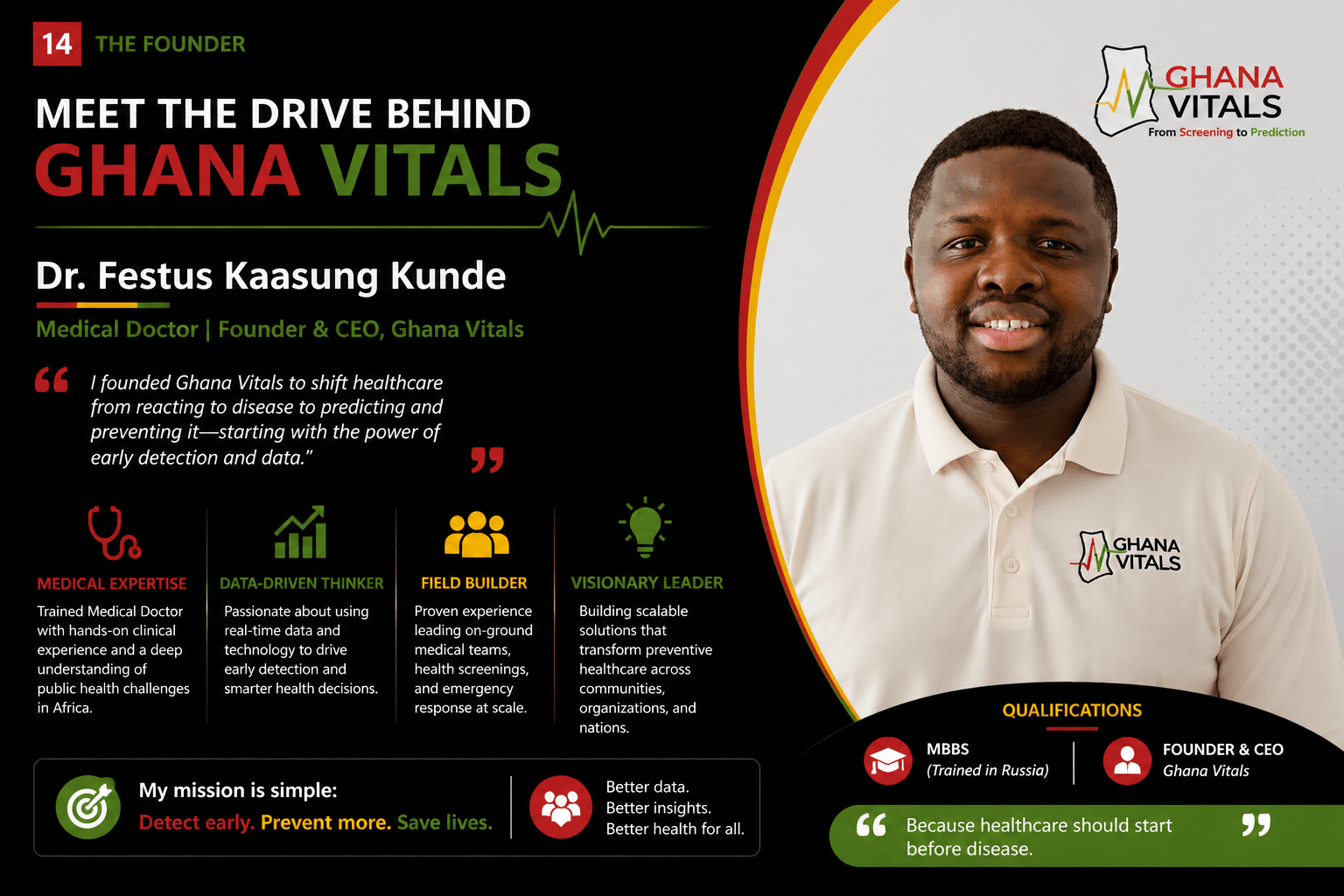
Perhaps the strongest reason I believe in the future of AI in healthcare is because of Ghana Vitals.
The idea emerged from a simple observation.
Again and again, I encountered patients who only discovered they had:
- Hypertension
- Diabetes
- Obesity
after complications had already developed.
I kept asking myself:
What if we could identify these risks earlier?
The more I thought about it, the clearer the problem became. Healthcare systems often focus on treating disease. Far less attention is given to identifying risk before disease develops. This inspired the creation of Ghana Vitals.
What is Ghana Vitals?
Ghana Vitals is a preventive health intelligence platform that combines:
- Community health screening
- Technology
- Data analytics
- Artificial intelligence
to help people understand their health status before they become patients.
Why BP, Glucose, and BMI?
Because they are powerful.
They are:
- Affordable
- Accessible
- Easy to measure
Yet they provide valuable insights into future health risks.
These simple measurements can identify risk for:
- Stroke
- Heart disease
- Diabetes
- Hypertension
before severe complications occur.
The Future Role of AI
AI will allow platforms like Ghana Vitals to:
- Predict disease risk
- Identify health trends
- Personalize recommendations
- Improve preventive healthcare
This is where I believe healthcare is heading.
Not just treatment.
- Prediction.
- Prevention.
- Early intervention.
The Future of Claude AI in Healthcare
By 2030, AI will likely become deeply integrated into healthcare.
Possible developments include:
AI Research Copilots
Researchers will work alongside AI assistants.
Personalised Medical Education
AI tutors tailored to individual learning needs.
Predictive Healthcare
It will help with Earlier disease detection.
Population Health Intelligence
Improved public health planning.
Administrative Automation
Reduced documentation burden.
The doctors who learn these tools today will be better positioned for tomorrow.
Key Takeaways
- AI literacy is becoming essential.
- Claude AI is a powerful research assistant.
- Claude improves clinical learning.
- Productivity gains can be significant.
- AI should accelerate learning, not replace learning.
- Patient confidentiality remains critical.
- African healthcare systems can benefit from the responsible adoption of AI.
- Preventive healthcare will increasingly depend on data and AI.
- Ghana Vitals represents one example of this future.
- The future belongs to clinicians who combine expertise with technology.
Frequently Asked Questions
Is Claude AI suitable for doctors?
Yes. Claude is particularly useful for research, education, writing, and productivity.
Can Claude diagnose patients?
No. Clinical diagnosis remains the responsibility of qualified healthcare professionals.
Is Claude useful for medical students?
Absolutely. It can assist with revision, case discussions, and exam preparation.
Can Claude summarise journal articles?
Yes. This is one of its strongest capabilities.
Claude’s usefulness for researchers?
Very useful when properly supervised.
Is patient data safe?
Identifiable patient information should never be uploaded.
Isn’t Claude better than ChatGPT?
Each platform has strengths and weaknesses.
Can Claude write research papers?
It can assist with drafting and organisation, but requires human review.
How can African doctors benefit?
Through improved learning, research productivity, and access to information.
What is the biggest limitation?
Potential inaccuracies that require verification.
About the Author
Dr Festus Kaasung Kunde is a Medical Doctor, AI in Healthcare Advocate, and Founder of AI Doctor Africa and Ghana Vitals.
He graduated from Stavropol State Medical University in Russia in 2025.
His professional interests include:
- Artificial Intelligence in Clinical Medicine
- Digital Health & Healthcare Innovation in Africa
- Health Data Analytics
- Medical Education
- AI for Medical Research
- Predictive Health Systems
Join the AI Doctor Africa Community
If you are a doctor, medical student, researcher, nurse, or healthcare professional interested in the future of healthcare, but do not
- Follow AI Doctor Africa
- Subscribe to our YouTube channel
- Join our newsletter
- Download our AI prompt guides
- Join our WhatsApp community
READ ALSO: