
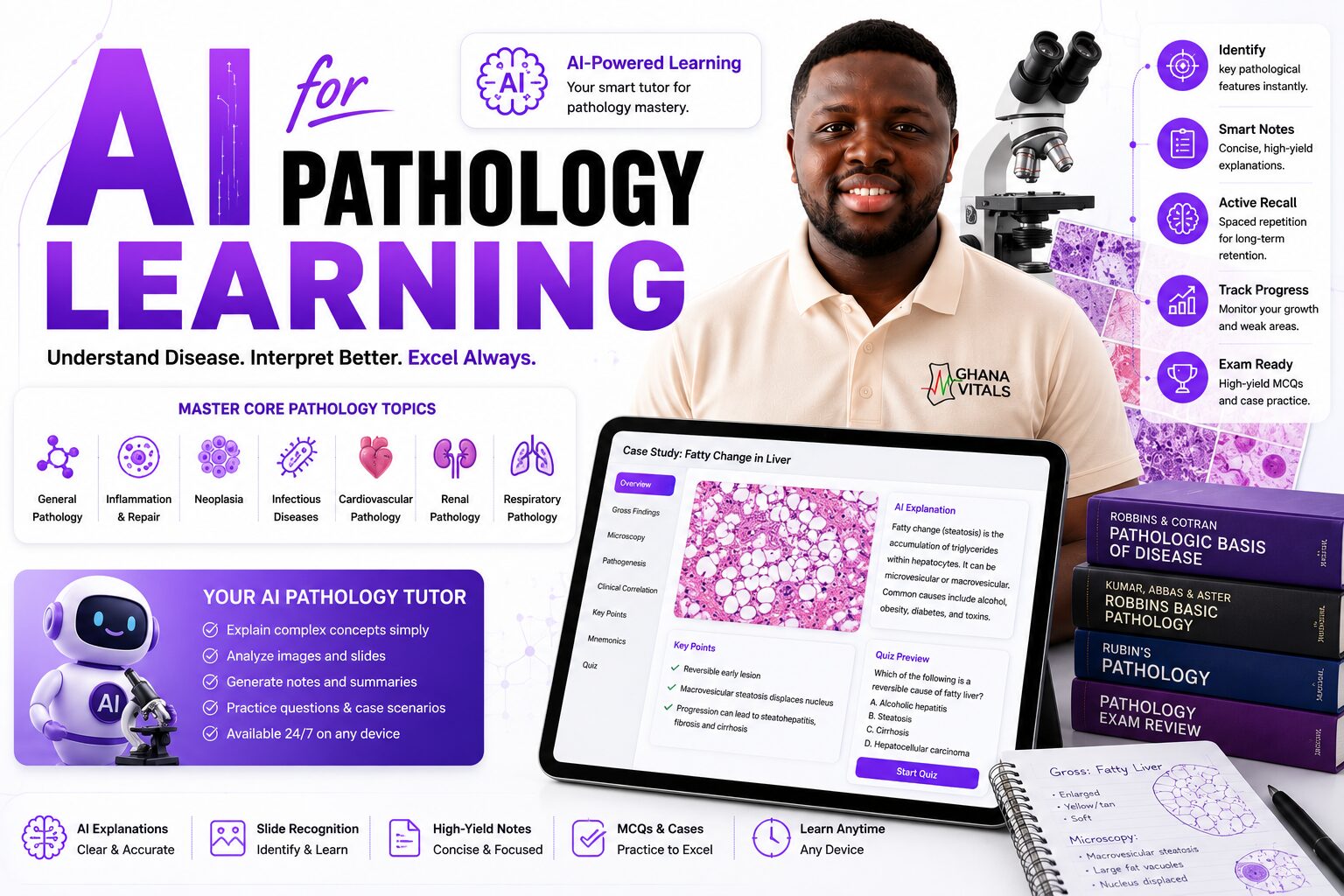
AI for Pathology Learning: How Medical Students Can Master Disease Mechanisms Faster in 2026
By Dr Festus Kaasung Kunde, MD
Medical Doctor | AI in Healthcare Advocate | Founder, AI Doctor Africa & Ghana Vitals
Published: June 2026 | Reading Time: 18–22 minutes | Category: AI for Medical Students
The Subject That Connected Everything
If physiology teaches you how the body works, pathology teaches you what happens when things go wrong. For me, pathology was the subject in which medicine truly started to come together. Suddenly, diseases weren’t just names anymore. Heart failure wasn’t simply a diagnosis. It resulted from structural and functional changes within the heart.
Diabetes wasn’t just elevated blood sugar. It became a disease that explained microscopic tissue damage, kidney failure, blindness, and cardiovascular disease. That was exciting, but pathology also came with its own challenges.
There were hundreds of diseases.
Thousands of microscopic images.
Countless mechanisms. And every lecturer seemed to remind us that “you must understand the pathology before you can understand clinical medicine.” They were right. Today, artificial intelligence is changing how students learn pathology. Instead of memorising isolated facts, AI helps connect pathology with physiology, histology, pharmacology, and clinical medicine.
Rather than replacing textbooks or laboratory sessions, AI acts like a knowledgeable study partner—available whenever questions arise.
In this guide, I’ll show you exactly how medical students can use AI to learn pathology more efficiently, prepare for licensing examinations, and develop a deeper understanding of disease.
Why Pathology Is One of the Most Important Subjects in Medicine
Pathology is often described as the bridge between the basic sciences and clinical medicine.
Without pathology, it becomes difficult to answer questions such as:
- Why do patients develop heart failure?
- Why does cancer spread?
- Why does pneumonia cause difficulty breathing?
- Why do kidneys fail in diabetes?
Understanding disease mechanisms allows students to move beyond memorisation and begin thinking like clinicians.
That is why pathology appears throughout:
- Medical school examinations
- OSCEs
- Licensing examinations
- Clinical ward rounds
Why Students Struggle With Pathology
Although fascinating, pathology can feel overwhelming.
Students must understand:
- Cellular injury
- Inflammation
- Healing
- Neoplasia
- Immunology
- Hematology
- Systemic pathology
- Organ-specific diseases
Many attempt to memorise disease after disease without recognising recurring patterns.
As the curriculum expands, that strategy quickly becomes unsustainable.
The Traditional Way of Learning Pathology
Most pathology revisions follow the same cycle.
Students:
- Read textbooks
- Highlight notes
- Memorise disease lists
- Review lecture slides
- Practice MCQs
While these methods still have value, they often emphasise memorisation over understanding. Artificial intelligence changes that approach.
How AI Changes Pathology Learning
Instead of reading passively, students can have conversations with pathology concepts.
Imagine asking:
Explain myocardial infarction from the first cellular injury until scar formation using simple language.
Or:
Compare Crohn’s disease and ulcerative colitis from a pathological perspective.
The AI responds immediately and allows unlimited follow-up questions.
Learning becomes interactive rather than passive.
8 Practical Ways Medical Students Can Use AI for Pathology
1. Understanding Disease Mechanisms
One of AI’s greatest strengths is simplifying complex mechanisms.
Prompt:
Explain the pathogenesis of atherosclerosis step by step using simple language.
Students move from memorisation to genuine understanding.
2. Connecting Pathology With Physiology
Disease only makes sense when students remember normal physiology.
Prompt:
Explain how heart failure develops beginning with normal cardiovascular physiology.
This reinforces multiple subjects simultaneously.
3. Connecting Pathology With Histology
Microscopic pathology often becomes easier after understanding normal tissue.
Prompt:
Compare normal liver histology with cirrhosis.
4. Creating Disease Comparison Tables
Students frequently confuse diseases with similar presentations.
Examples include:
- Crohn’s disease vs Ulcerative colitis
- Benign vs Malignant tumours
- Nephritic vs Nephrotic syndrome
- Osteoarthritis vs Rheumatoid arthritis
AI creates structured comparison tables in seconds.
5. Generating Active Recall Questions
Prompt:
Quiz me on inflammation one question at a time.
This transforms revision into active learning.
6. Creating High-Yield Summary Notes
Prompt:
Summarize Robbins Pathology chapter on neoplasia into two pages suitable for licensing examinations.
7. Building Clinical Cases
Prompt:
Create a pathology case involving lung cancer and ask me diagnostic questions.
Students begin thinking clinically instead of simply recalling facts.
8. Preparing for Practical Examinations
Prompt:
Act as a pathology examiner and describe gross specimens for me to identify.
This is particularly useful before practical examinations.
ChatGPT vs Claude for Pathology
Students often ask which AI is better.
ChatGPT
Excellent for:
- MCQs
- Flashcards
- Revision schedules
- Rapid summaries
Claude
Excellent for:
- Disease mechanisms
- Long explanations
- Research
- Connecting concepts
My Recommendation
Claude helps you understand pathology.
ChatGPT helps you practise pathology.
Together, they create an excellent learning system.
20 AI Prompts Every Pathology Student Should Save
- Explain the pathogenesis of ______.
- Compare Disease A and Disease B.
- Generate pathology MCQs.
- Quiz me on neoplasia.
- Explain inflammation using analogies.
- Connect pathology with physiology.
- Connect pathology with pharmacology.
- Explain gross pathology findings.
- Explain microscopic pathology findings.
- Summarise the Robbins chapter.
- Create flashcards.
- Create licensing examination questions.
- Explain cancer staging.
- Explain mechanisms of metastasis.
- Explain autoimmune disease pathology.
- Explain infection pathology.
- Explain shock pathology.
- Explain wound healing.
- Test my weak areas.
- Build a pathology revision timetable.
Pathology for Licensing Examinations
Pathology is heavily tested in:
- GMDC (Ghana)
- MDCN (Nigeria)
- HPCSA (South Africa)
- USMLE
- PLAB
- AMC
High-yield topics include:
- Inflammation
- Cell injury
- Neoplasia
- Hemodynamics
- Shock
- Immunopathology
- Infectious diseases
- Systemic pathology
AI can help students focus on these repeatedly tested concepts.
Common Mistakes Students Make
- Memorising diseases without understanding mechanisms
- Ignoring pathology images
- Not connecting pathology with physiology
- Not practising clinical application
- Using AI without verifying information
AI should support—not replace—medical learning.
My Recommended Pathology Study Workflow
If I were preparing for pathology examinations today:
Monday — Learn disease mechanisms with Claude.
Tuesday — Generate flashcards using ChatGPT.
Wednesday — Complete 30 pathology MCQs.
Thursday — Compare related diseases.
Friday — Study gross and microscopic pathology.
Weekend — Review weak areas and clinical cases.
This approach emphasises understanding before memorisation.
The Future of Pathology Education
Artificial intelligence is already changing pathology education.
Future developments may include:
- AI-assisted virtual microscopy
- Personalised pathology tutors
- Adaptive learning platforms
- Intelligent question banks
- Interactive disease simulations
Students who learn to use these tools responsibly will likely become more efficient learners.
Key Takeaways
- Pathology connects basic science with clinical medicine.
- Understanding mechanisms is more valuable than memorisation.
- AI simplifies complex disease processes.
- Claude excels at explanations.
- ChatGPT excels at practice questions.
- Pathology should always be integrated with physiology and histology.
- Active recall remains essential.
- AI is an educational assistant—not a replacement for medical training.
Frequently Asked Questions
Can AI replace pathology textbooks?
No. AI complements textbooks and laboratory sessions but cannot replace them.
Can AI explain pathology images?
Yes, educationally, but students should always verify findings with trusted teaching resources and instructors.
Which AI tool is better for pathology?
Claude generally provides deeper conceptual explanations, while ChatGPT is excellent for revision exercises.
Can AI help with licensing examinations?
Yes. AI can generate practice questions, summaries, and clinical cases relevant to licensing exams.
Related Articles
- AI for Histology Learning
- AI for Physiology Learning
- AI for Pharmacology Revision
- How AI Can Help You Pass Medical School
- Best AI Tools for Medical Students
About the Author
Dr Festus Kaasung Kunde is a Medical Doctor, AI in Healthcare Advocate, and Founder of AI Doctor Africa and Ghana Vitals. His interests include Artificial Intelligence in Medical Education, Clinical Medicine, Digital Health, Public Health Innovation, and Predictive Healthcare.
Through AI Doctor Africa, he helps healthcare professionals and students use artificial intelligence responsibly to improve learning, research, productivity, and patient care.
AI Doctor Africa | aidoctorafrica.com
Medical Disclaimer: For educational purposes only. AI tools do not replace clinical supervision, verified study resources, or your medical school’s academic guidance. Always verify clinical facts against authoritative primary sources.

Dr. Festus K. Kunde
Dr. Festus Kaasung Kunde is a medical doctor, Content creator, healthcare technology writer, and digital health innovator specializing in Artificial Intelligence in Medicine, Healthcare Systems Innovation, and Health Data Science in Africa. He is the founder of AI Doctor Africa (AIDoctorAfrica.com), an educational platform dedicated to helping healthcare professionals—including doctors, medical students, nurses, and researchers—understand and responsibly apply artificial intelligence in clinical practice, medical education, medical research, and healthcare innovation. He is also the creator of Ghana Vitals, a health data and predictive analytics initiative focused on collecting and analyzing key health indicators such as blood pressure, blood glucose, and BMI to support early disease detection, preventive healthcare, and data-driven decision-making in Ghana and across Africa. The project reflects his long-term vision of building scalable, AI-powered public health systems for African populations. Dr. Kunde’s work focuses on the practical integration of AI tools such as ChatGPT, Claude, and emerging clinical AI systems into real-world healthcare workflows. His content emphasizes improving clinical documentation, accelerating medical education, strengthening research productivity, and supporting healthcare decision-making in resource-limited settings. Through AI Doctor Africa, he publishes evidence-informed, practice-oriented resources including AI workflows, clinical use cases, medical education guides, and tutorials designed specifically for African healthcare professionals. Through Ghana Vitals, he extends this mission into population health innovation, aiming to leverage real-world health data and predictive models to improve early intervention, reduce preventable disease burden, and strengthen health systems across Africa. His overall mission is to bridge the gap between traditional clinical medicine, artificial intelligence, and data-driven public health, empowering African healthcare professionals to work smarter, diagnose earlier, and deliver better care through technology. Areas of Expertise Artificial Intelligence in Clinical Medicine Digital Health & Healthcare Innovation in Africa Health Data Analytics & Predictive Health Systems Medical Education and Exam Preparation AI for Medical Research and Scientific Writing Clinical Workflow Optimization using AI Tools Public Health Data Systems (Ghana Vitals Initiative) Professional Focus Dr. Kunde’s work sits at the intersection of clinical medicine, artificial intelligence, and population health systems, with a strong focus on scalable solutions for African healthcare challenges. His initiatives emphasize ethical AI use, data-driven decision-making, and practical implementation in real-world clinical and public health environments.
View author profile →