
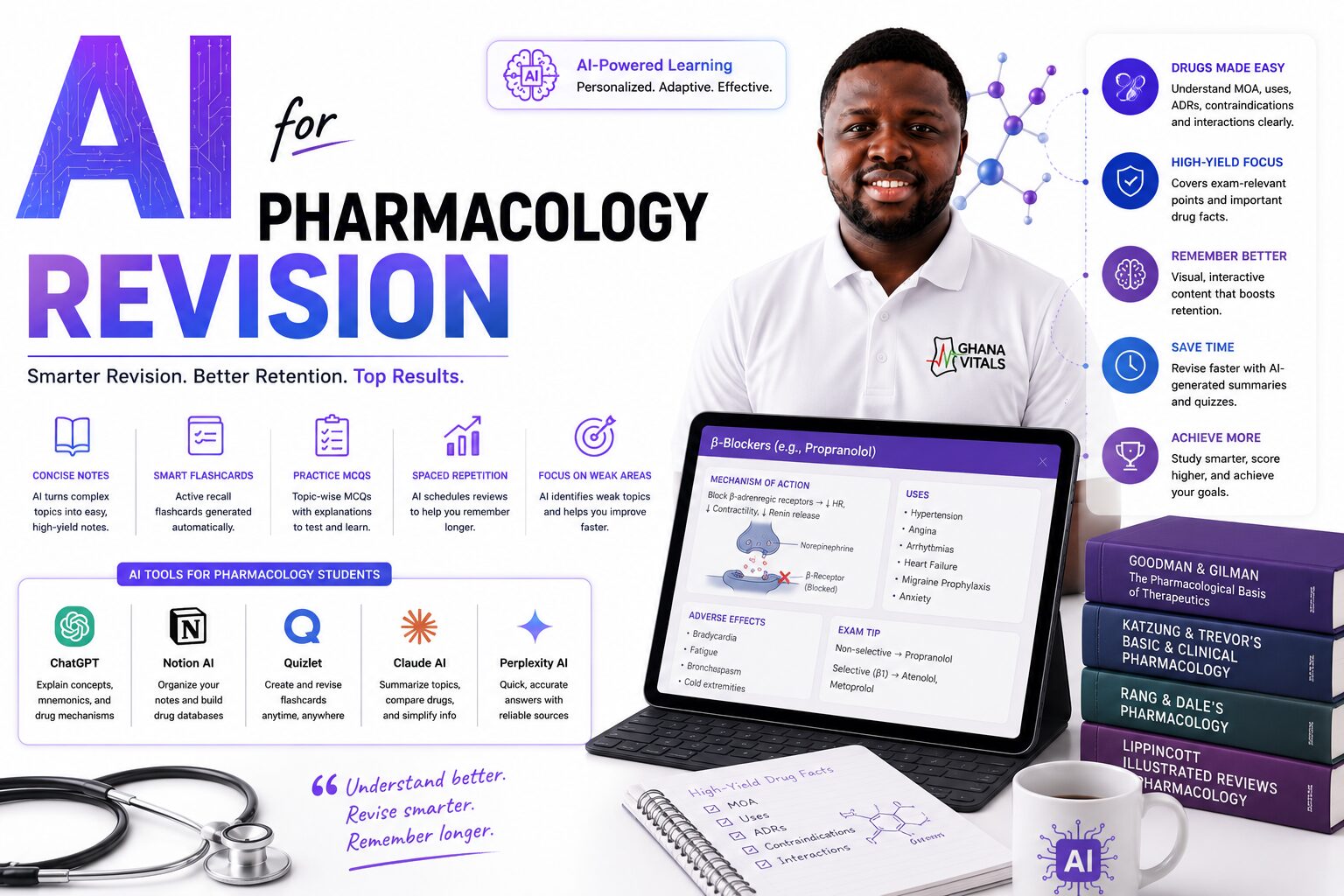
theen AI for Pharmacology Revision: How Medical Students Can Learn Drugs Faster in 2026
By Dr Festus Kaasung Kunde, MD
Medical Doctor | Founder, AI Doctor Africa & Ghana Vitals
Why Pharmacology Feels Overwhelming
Ask almost any medical student which subject keeps them awake at night, and pharmacology will usually be near the top of the list. There is a good reason for this. Pharmacology is not simply about memorising drug names.
Students are expected to understand:
- Mechanisms of action
- Indications
- Contraindications
- Side effects
- Drug interactions
- Toxicity
- Monitoring requirements
- Clinical applications
And unfortunately, the list never seems to end.
During medical school, I often found that pharmacology felt like learning an entirely new language. One day you are studying antibiotics. The next day, you are trying to remember antihypertensives, anticoagulants, antidiabetic medications, and psychiatric drugs. The challenge was never finding information.
The challenge was retaining it. Today, artificial intelligence is changing the way medical students approach pharmacology revision. Instead of spending hours creating flashcards, summarising textbooks, and organising notes, students can use AI to transform complex drug information into personalised learning systems.
This article explores how.
Why Pharmacology Is Difficult
Most students struggle because pharmacology combines several learning challenges simultaneously.
Volume
There are hundreds of drugs.
Similar Names
Many drugs sound alike.
Examples include:
- Dopamine vs Dobutamine
- Hydralazine vs Hydroxyzine
- Carbamazepine vs Carbidopa
Constant Updates
New medications continue to emerge.
Memorization Burden
Students often attempt to memorise information without understanding the underlying concepts.
This approach rarely works long-term.
The Problem With Traditional Pharmacology Revision
Traditional revision often follows a predictable pattern.
Students:
- Read textbooks
- Highlight notes
- Re-read notes
- Create flashcards
- Repeat
The problem is that passive revision is often inefficient. Many students spend hours studying without realising how little information they are actually retaining. The goal should not be to study harder but to study smarter.
How AI Changes Pharmacology Learning
Artificial intelligence allows students to move from passive learning to active learning. Instead of merely reading about a drug, students can interact with information.
For example:
Rather than reading ten pages about beta blockers, a student can ask:
Explain beta blockers to a final-year medical student preparing for licensing examinations. Include mechanism of action, indications, contraindications, side effects, clinical pearls, and examination tips.
The response becomes focused, organised, and easier to understand.
AI Use Case #1: Understanding Mechanisms of Action
One of the most powerful uses of AI is simplifying mechanisms of action. Many students memorise drugs without understanding how they work. This creates problems later.
For example:
Students may memorise that ACE inhibitors lower blood pressure. But if they understand the renin-angiotensin-aldosterone system, they can reason through:
- Why ACE inhibitors work
- Why cough occurs
- Why hyperkalemia develops
- Why do they help in heart failure
AI can explain mechanisms at different levels.
Prompt:
Explain ACE inhibitors to a second-year medical student. Use simple language and clinical examples.
Understanding always outperforms memorisation.
AI Use Case #2: Creating Personalised Flashcards
Flashcards remain one of the most effective learning methods. However, creating them can be time-consuming. AI can generate flashcards instantly.
Prompt:
Create 50 active recall flashcards on antihypertensive drugs.
Within seconds, students have a ready-made revision resource.
AI Use Case #3: Generating Pharmacology MCQs
Examination success requires practice.
AI can generate:
- Single best answer questions
- Extended matching questions
- Clinical scenarios
- Licensing exam-style questions
Prompt:
Generate 30 pharmacology MCQs on antibiotics with detailed explanations.
This transforms revision into active testing.
AI Use Case #4: Comparing Drug Classes
Many students confuse similar drug classes.
Examples include:
- ACE inhibitors vs ARBs
- Heparin vs Warfarin
- Beta Blockers vs Calcium Channel Blockers
AI can generate comparison tables instantly. These comparisons often improve understanding more than reading individual chapters.
AI Use Case #5: Creating Study Timetables
Pharmacology can feel overwhelming because students often lack structure. AI can help create revision schedules.
Prompt:
Create a 14-day pharmacology revision timetable for a final-year medical student preparing for licensing examinations.
The result is a focused plan rather than random studying.
My Experience as a Medical Student
One lesson I learned during medical school was that repetition alone is not enough. Students need engagement. The moments when pharmacology became easier were the moments when I understood why drugs worked rather than simply memorising them.
If AI tools had been as advanced during my earlier years of training as they are today, I would have used them extensively for:
- Mechanism explanations
- Clinical applications
- Practice questions
- Active recall exercises
Not because they replace textbooks. But they help make textbooks more useful.
The Drug Classes Students Struggle With Most
After speaking with medical students and reflecting on my own experiences, I have found that certain pharmacology topics consistently appear on the “most difficult” list.
These include:
Antibiotics
Students struggle with:
- Classification
- Spectrum of activity
- Side effects
- Resistance patterns
Antihypertensives
Confusion often occurs between:
- ACE inhibitors
- ARBs
- Beta blockers
- Calcium channel blockers
- Diuretics
Anticoagulants
Many students mix up:
- Heparin
- Low molecular weight heparin
- Warfarin
- Direct Oral Anticoagulants
Antidiabetic Drugs
Students must remember:
- Mechanisms
- Side effects
- Contraindications
- Clinical uses
Psychiatric Medications
Particularly:
- Antidepressants
- Antipsychotics
- Mood stabilizers
AI can simplify all of these areas.
AI Use Case #6: Learning Drug Classes Instead of Individual Drugs
One mistake many students make is studying drugs individually. This often leads to information overload. A more effective strategy is to learn drug classes first.
For example:
Instead of memorising:
- Enalapril
- Lisinopril
- Ramipril
- Perindopril
Study ACE inhibitors as a group.
AI can help students understand:
- Shared mechanism
- Shared side effects
- Shared indications
This dramatically reduces cognitive load.
AI Use Case #7: Understanding Clinical Applications
Many students know the drug. Few students know when to use it. Clinical pharmacology is where knowledge becomes useful.
Prompt:
Explain when beta blockers should and should not be used in clinical practice. Include common examination scenarios.
This helps connect pharmacology with patient care.
AI Use Case #8: Active Recall Training
The most effective revision technique remains active recall.
Instead of asking:
Explain metformin.
Ask:
Quiz me on metformin. Ask one question at a time and provide feedback after each answer.
This transforms AI into a personal tutor.
ChatGPT vs Claude for Pharmacology Revision
Students frequently ask:
Which AI tool is better for pharmacology?
The answer depends on the task.
ChatGPT Strengths
Excellent for:
- Flashcards
- MCQs
- Study plans
- Active recall
- Rapid summaries
Example
Prompt:
Generate 50 pharmacology flashcards on cardiovascular drugs.
ChatGPT performs exceptionally well.
Claude Strengths
Excellent for:
- Deep explanations
- Long-form learning
- Concept understanding
- Mechanisms of action
- Clinical reasoning
Example
Prompt:
Explain the pharmacological basis of heart failure treatment to a final-year medical student.
Claude often provides more detailed educational explanations.
My Recommendation
- Use Claude to Understand
- Use ChatGPT to Practice
This combination can significantly improve revision efficiency.
25 Pharmacology AI Prompts Every Medical Student Should Save
Understanding Drugs
Prompt 1
Explain [Drug] to a medical student preparing for licensing examinations.
2nd Prompt
Explain the mechanism of action of [Drug] using simple language.
Prompt 3
Create a visual analogy for understanding [Drug Class].
4th Prompt
Explain the clinical uses of [Drug].
Prompt 5
Summarize the most important examination points about [Drug].
Comparison Prompts
6th Prompt
Compare ACE inhibitors and ARBs.
Prompt 7
Compare Warfarin and DOACs.
8th Prompt
Compare Metformin and Sulfonylureas.
Prompt 9
Compare Beta Blockers and Calcium Channel Blockers.
Prompt 10
Compare Heparin and Low Molecular Weight Heparin.
MCQ Prompts
Eleventh Prompt
Generate 20 MCQs on antibiotics.
Prompt 12
Generate licensing exam pharmacology questions.
ThirPrompt
Create USMLE-style pharmacology questions.
Prompt 14
Create PLAB-style pharmacology questions.
Prompt 15
Create MDC Ghana pharmacology questions.
Active Recall Prompts
Sixteen Prompt
Quiz me on antihypertensive drugs.
Prompt 17
Test my understanding of diabetes medications.
18th Prompt
Ask pharmacology viva questions.
Prompt 19
Create rapid-fire pharmacology questions.
20th Prompt
Identify my weak areas in pharmacology.
Clinical Application Prompts
21st Prompt
Explain how pharmacology is applied in this clinical case.
Prompt 22
Which drugs are preferred and why?
23rd Prompt
Discuss contraindications in this scenario.
Prompt 24
Explain adverse effects likely to appear in this patient.
25th Prompt
Generate a clinical pharmacology case discussion.
AI for Licensing Examinations
One reason I believe pharmacology remains such an important subject is that it appears heavily in licensing examinations worldwide.
Examples include:
- MDC Ghana
- MDCN Nigeria
- HPCSA South Africa
- USMLE
- PLAB
- AMC
- Residency entrance examinations
Common pharmacology themes include:
- Mechanisms of action
- Side effects
- Contraindications
- Drug interactions
- Clinical decision-making
AI can help students focus on these high-yield areas.
Common Mistakes Medical Students Make
Mistake #1
Memorising without understanding.
Mistake #2
Studying individual drugs instead of drug classes.
Mistake #3
Ignoring side effects.
Many examination questions focus on adverse effects.
Mistake #4
Not practising questions.
Reading alone is insufficient.
Mistake #5
- Using AI as a shortcut.
- AI should enhance learning.
- Not to replace learning.
How I Would Study Pharmacology Today
If I were starting medical school again today, my workflow would look something like this:
Step 1
Use Claude to understand concepts.
Step 2
Use ChatGPT to generate flashcards.
Step 3
Use AI-generated MCQs daily.
Step 4
Review weak areas weekly.
Step 5
Apply knowledge to clinical cases.
This approach combines understanding, recall, and application.
The Future of Pharmacology Education
Medical education is changing.
Students today have access to tools that did not exist a few years ago.
The future will likely include:
- Personalised AI tutors
- Adaptive learning systems
- Real-time revision support
- Intelligent question banks
- Interactive pharmacology simulations
Students who learn how to use these tools responsibly will have a significant advantage.
Key Takeaways
- Pharmacology is difficult because of volume and complexity.
- Understanding beats memorisation.
- AI can simplify mechanisms of action.
- AI can generate flashcards instantly.
- AI can create unlimited practice questions.
- Drug classes should be learned before individual drugs.
- ChatGPT excels at practice and active recall.
- Claude excels at deep explanations.
- AI should support—not replace—study.
- Active learning remains essential for long-term retention.
Frequently Asked Questions
Can AI replace pharmacology textbooks?
No. AI should complement textbooks, not replace them.
Is ChatGPT good for pharmacology?
Yes. It is excellent for flashcards, MCQs, and active recall.
Is Claude better at understanding mechanisms?
Often yes. Claude tends to provide more detailed conceptual explanations.
Can AI help with licensing examinations?
Absolutely. AI can generate high-yield revision materials and practice questions.
Can AI improve memory retention?
Indirectly. Enabling active recall and personalised revision can improve learning efficiency.
What is the best way to use AI for pharmacology?
Understand first. Memorize second. Practice continuously.
Can AI generate pharmacology cases?
Yes. It can create realistic clinical scenarios for learning.
Is AI useful for final-year students?
Extremely useful, especially when preparing for licensing examinations and clinical rotations.
Related Articles on AI Doctor Africa
- How AI Can Help You Pass Medical School: The Complete Strategy Guide for 2026
- Best AI Tools for Medical Students in 2026: The Complete Guide
- 100 ChatGPT Prompts for Medical Students: The Complete 2026 Prompt Library
- Gemini AI for Medical Students: How to Use Google’s AI to Study Smarter
- AI for Medical Licensing Examinations: Ghana, Nigeria, South Africa, USMLE, and PLAB
- ChatGPT vs Claude for Medical Doctors: Which AI Is Better in 2026?
About the Author
Dr Festus Kaasung Kunde is a Medical Doctor, AI in Healthcare Advocate, and Founder of AI Doctor Africa and Ghana Vitals. He holds an MD from Stavropol State Medical University, Russia (2025), and completed an internship at Korle-Bu Teaching Hospital in Accra. His mission is to help African healthcare professionals adopt AI responsibly to improve learning, research, and patient outcomes.
AI Doctor Africa | aidoctorafrica.com
Medical Disclaimer: For educational purposes only. AI tools do not replace clinical supervision, verified study resources, or your medical school’s academic guidance. Always verify clinical facts against authoritative primary sources.

Dr. Festus K. Kunde
Dr. Festus Kaasung Kunde is a medical doctor, Content creator, healthcare technology writer, and digital health innovator specializing in Artificial Intelligence in Medicine, Healthcare Systems Innovation, and Health Data Science in Africa. He is the founder of AI Doctor Africa (AIDoctorAfrica.com), an educational platform dedicated to helping healthcare professionals—including doctors, medical students, nurses, and researchers—understand and responsibly apply artificial intelligence in clinical practice, medical education, medical research, and healthcare innovation. He is also the creator of Ghana Vitals, a health data and predictive analytics initiative focused on collecting and analyzing key health indicators such as blood pressure, blood glucose, and BMI to support early disease detection, preventive healthcare, and data-driven decision-making in Ghana and across Africa. The project reflects his long-term vision of building scalable, AI-powered public health systems for African populations. Dr. Kunde’s work focuses on the practical integration of AI tools such as ChatGPT, Claude, and emerging clinical AI systems into real-world healthcare workflows. His content emphasizes improving clinical documentation, accelerating medical education, strengthening research productivity, and supporting healthcare decision-making in resource-limited settings. Through AI Doctor Africa, he publishes evidence-informed, practice-oriented resources including AI workflows, clinical use cases, medical education guides, and tutorials designed specifically for African healthcare professionals. Through Ghana Vitals, he extends this mission into population health innovation, aiming to leverage real-world health data and predictive models to improve early intervention, reduce preventable disease burden, and strengthen health systems across Africa. His overall mission is to bridge the gap between traditional clinical medicine, artificial intelligence, and data-driven public health, empowering African healthcare professionals to work smarter, diagnose earlier, and deliver better care through technology. Areas of Expertise Artificial Intelligence in Clinical Medicine Digital Health & Healthcare Innovation in Africa Health Data Analytics & Predictive Health Systems Medical Education and Exam Preparation AI for Medical Research and Scientific Writing Clinical Workflow Optimization using AI Tools Public Health Data Systems (Ghana Vitals Initiative) Professional Focus Dr. Kunde’s work sits at the intersection of clinical medicine, artificial intelligence, and population health systems, with a strong focus on scalable solutions for African healthcare challenges. His initiatives emphasize ethical AI use, data-driven decision-making, and practical implementation in real-world clinical and public health environments.
View author profile →