
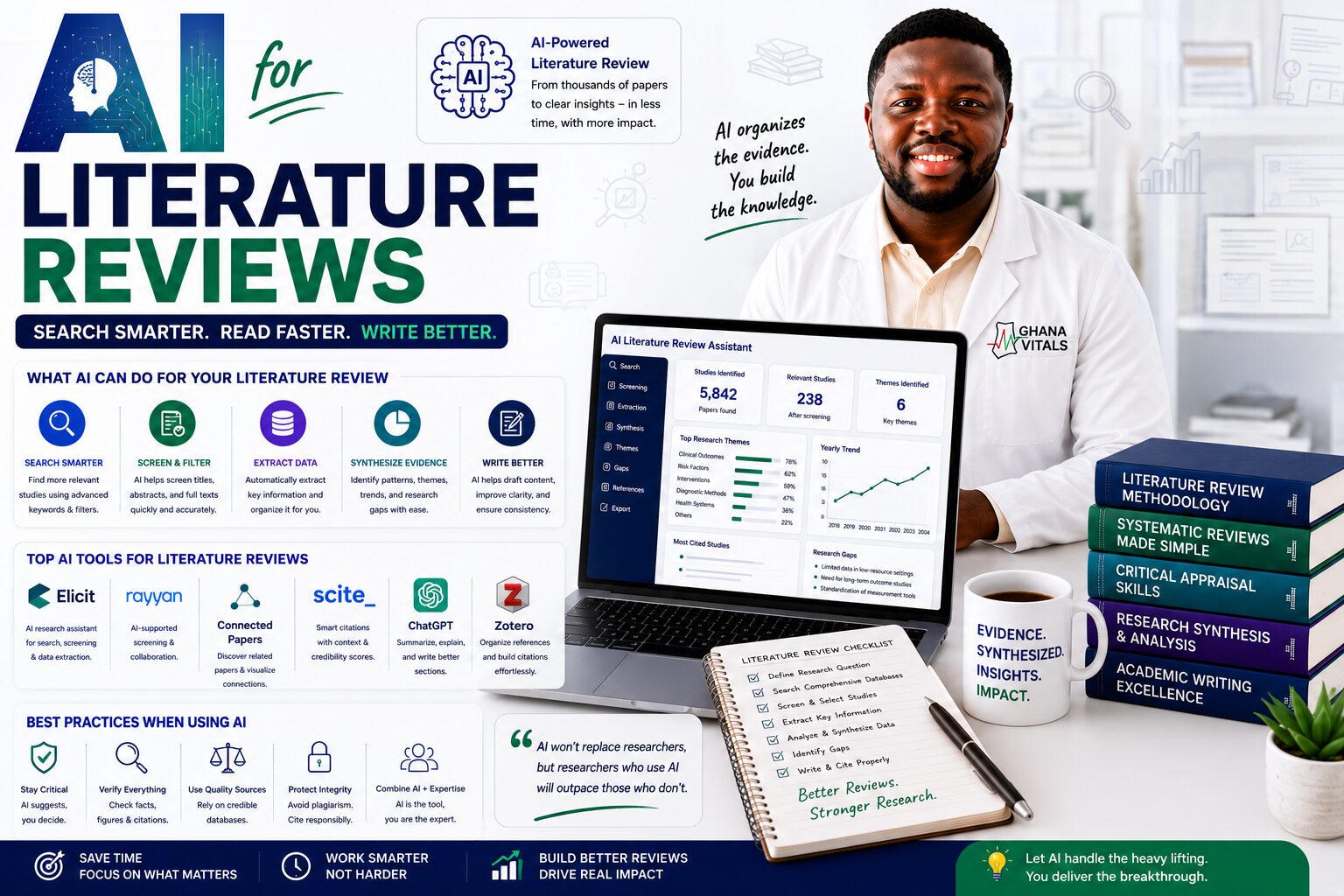
AI for Literature Reviews: The Complete Guide
By Dr Festus Kaasung Kunde
Medical Doctor | Founder, AI Doctor Africa and Ghana Vitals
A literature review is one of the first serious steps in almost every research project. Whether you are preparing a research proposal, writing a dissertation, developing a grant application, planning a systematic review, or trying to understand a clinical problem, you first need to know what has already been studied.
That sounds straightforward, but it is often one of the most frustrating parts of research.
You may search PubMed or Google Scholar and find hundreds of papers. Some are relevant, some are outdated, and others only appear useful from the title. After downloading several articles, you still have to read them, take notes, compare findings, identify gaps, and organise everything into a coherent argument.
I have experienced this challenge while working on medical research ideas and developing Ghana Vitals, a preventive-health initiative focused on community screening, health data, and early disease detection.
The problem is rarely a complete lack of information. The real problem is finding the right information, understanding it, and turning it into something useful.
This is where artificial intelligence can help.
AI tools such as ChatGPT, Claude, Gemini, NotebookLM, Elicit, Consensus, and Perplexity can make literature reviews faster and more organised. However, they must be used carefully. AI can summarise research, but it can also misunderstand studies, oversimplify findings, or generate references that do not exist.
The goal is not to allow AI to conduct the literature review for you. The goal is to use AI to reduce repetitive work while keeping scientific judgment under your control.
What Is a Literature Review?
A literature review is a structured examination of existing research on a particular topic.
It helps you understand:
- What is already known.
- Which methods have been used?
- Where researchers agree.
- Where findings conflict.
- What limitations exist?
- Which questions remain unanswered?
A good literature review does more than list studies.
It connects them.
Instead of writing one paragraph about Study A, another about Study B, and another about Study C, you should compare the studies and explain the broader meaning of their findings.
For example, if I were reviewing community hypertension screening in Ghana, I would not simply summarise each screening programme separately.
I would examine:
- Which populations were screened?
- Where screening took place.
- Which devices and thresholds were used?
- How many people had elevated blood pressure?
- Whether participants were referred.
- Whether they eventually entered treatment.
- Which barriers prevented follow-up?
That type of synthesis is more useful than a collection of summaries.
Different Types of Literature Reviews
Not every literature review follows the same method.
Narrative Literature Review
A narrative review provides a broad discussion of a topic. It is useful for explaining concepts, trends, and debates, but the search process may not be as rigid as that of a systematic review.
Systematic Review
A systematic review uses predefined methods to search for, select, appraise, and synthesise all relevant studies addressing a focused question.
Scoping Review
A scoping review maps the available evidence in a broad or emerging field. It is especially useful when the literature is diverse or the research area is still developing.
Rapid Review
A rapid review uses shortened systematic-review methods to provide evidence within a limited period.
Integrative Review
An integrative review may combine findings from different study designs to provide a broad understanding of a subject.
Before using AI, you must first decide what type of review you are conducting. The depth of searching, screening, appraisal, and reporting will depend on that decision.
How AI Can Help With Literature Reviews
AI can support almost every stage of the literature review process.
It can help you:
- Refine your topic.
- Develop a research question.
- Generate keywords and synonyms.
- Organise search concepts.
- Screen titles and abstracts.
- Summarise papers.
- Build evidence tables.
- Compare findings.
- Identify research gaps.
- Improve the final writing.
The greatest advantage is speed.
However, speed is only useful when accuracy is protected.
Step 1: Start With a Clear Question
Do not begin by asking an AI tool to “find diabetes research.” That topic is too broad.
A stronger question might be:
What barriers affect hypertension treatment follow-up after community screening among adults in sub-Saharan Africa?
A clear question makes searching and synthesis easier.
You can ask AI:
Help me refine this literature-review question. Identify the population, main concept, setting, and outcome. Suggest three more focused versions without changing the main topic.
AI can help improve wording, but you must decide whether the question is clinically important, feasible, and relevant.
Step 2: Generate Search Terms
Researchers often miss useful papers because different authors use different terms for the same concept.
For example, “high blood pressure screening” may also appear as:
- Hypertension detection.
- Blood-pressure assessment.
- Cardiovascular-risk screening.
- Community-based case finding.
- Opportunistic screening.
A useful prompt is:
Generate keywords, synonyms, abbreviations, and alternative spellings for the concepts hypertension, community screening, referral, and sub-Saharan Africa. Group the terms by concept.
Do not copy the result directly into a database without reviewing it.
Search syntax differs across PubMed, Scopus, Web of Science, Google Scholar, and other databases.
Step 3: Search Trusted Sources
AI chatbots should not replace academic databases.
Useful sources include:
- PubMed.
- Google Scholar.
- Scopus.
- Web of Science.
- Cochrane Library.
- African Journals Online.
- Institutional repositories.
- Government and professional reports.
For African research, local evidence is especially important.
An AI tool may repeatedly surface highly cited studies from Europe or North America while missing relevant work from Ghana, Nigeria, Kenya, South Africa, or other African countries.
This is why researchers must actively search regional journals, university repositories, conference proceedings, and grey literature.
Step 4: Screen Papers Efficiently
You do not need to read every paper fully.
Begin with the title and abstract.
Ask:
- Does the population match?
- Does the study address my topic?
- Is the setting relevant?
- Is the study design appropriate?
- Does it report an outcome I need?
AI can help with preliminary screening.
Prompt:
Using the criteria below, classify this abstract as relevant, not relevant, or uncertain. Quote the words supporting your decision. Do not assume information that is not stated.
Any uncertain paper should usually be reviewed manually.
AI should help prioritise reading, not silently exclude evidence.
Step 5: Summarise Papers Properly
AI is very useful for turning long papers into structured summaries.
A good summary should include:
- Research question.
- Study design.
- Setting.
- Sample size.
- Methods.
- Main findings.
- Limitations.
- Relevance to your topic.
Prompt:
Summarize this article under the headings objective, study design, population, methods, results, limitations, and relevance to my review. Use only the information provided in the article.
Always compare the summary with the original paper.
AI may confuse adjusted and unadjusted results, baseline and final values, or primary and secondary outcomes.
Step 6: Build an Evidence Table
One of the best ways to manage a literature review is to create an evidence table.
Suggested columns include:
| Author and year | Country | Study design | Population | Sample size | Main findings | Limitations | Relevance |
|---|
This prevents you from repeatedly opening the same papers.
After completing the table, AI can help identify patterns.
Prompt:
Using only this evidence table, group the studies into themes. Identify areas of agreement, disagreement, methodological weakness, and unanswered questions.
The table should remain your primary source. AI should not add information that is absent from it.
Step 7: Identify Themes, Not Just Individual Studies
A weak literature review sounds like this:
Study A found this. Study B found that. Study C reported something else.
A stronger review organises evidence by ideas.
Possible themes might include:
- Disease prevalence.
- Access to screening.
- Patient awareness.
- Health-worker shortages.
- Referral failure.
- Digital follow-up.
- Cost and sustainability.
Within each theme, compare the studies.
Ask:
- Do the findings agree?
- Why might they differ?
- Were the populations different?
- Were different outcome definitions used?
- Was one study stronger methodologically?
- Does the local context explain the variation?
AI can help organise the discussion, but the interpretation should come from your understanding of the evidence.
Step 8: Find the Research Gap
A research gap is not simply a topic with very few papers.
A meaningful gap may involve:
- A neglected population.
- A poorly studied setting.
- Conflicting findings.
- Weak study methods.
- Lack of long-term follow-up.
- Limited African evidence.
- Failure to study implementation.
- Lack of patient-centred outcomes.
For Ghana Vitals, for example, the gap may not be whether community screening can detect hypertension. That is already well established.
The more important questions may be:
- What happens after screening?
- Do patients enter care?
- Do they remain on treatment?
- Can community data improve risk prediction?
- Which follow-up system works best in Ghana?
That is the difference between identifying an interesting topic and identifying a useful research gap.
Step 9: Write the Review in Your Own Voice
AI-generated academic writing often sounds polished but generic.
A literature review should reflect your reasoning.
Use AI to:
- Improve clarity.
- Remove repetition.
- Strengthen transitions.
- Shorten long sentences.
- Check logical flow.
Do not ask it to invent your argument.
A safe prompt is:
Edit this paragraph for clarity and academic tone. Preserve my argument, do not add evidence, and flag any claim that appears to require a citation.
The final review should still sound like you.
Major Risks of Using AI
Fake References
AI may generate convincing citations that do not exist.
Never cite a paper until you have located and verified it yourself.
Incorrect Summaries
AI may misunderstand methods or findings.
Always check the original article.
Loss of Critical Thinking
Reading only AI summaries can create the illusion of understanding.
Important and influential papers should be read fully.
Overgeneralization
AI may combine different populations or study designs into one conclusion.
Preserve important differences.
Confidentiality Problems
Do not upload confidential manuscripts, identifiable participant information, or protected institutional documents without appropriate permission.
Excessive Dependence
AI should support your research skills, not prevent you from developing them.
My Recommended AI Literature-Review Workflow
My preferred approach is simple:
- Define the question myself.
- Search trusted databases.
- Save references in Zotero or another reference manager.
- Screen titles and abstracts.
- Read the most relevant papers.
- Use AI to create structured summaries.
- Verify every summary against the source.
- Build an evidence table.
- Identify themes and gaps.
- Draft the review in my own voice.
- Use AI for editing and consistency checks.
- Verify every citation before submission.
This approach saves time without giving away control of the research.
Practical Prompts to Save
Question Development
Refine this literature-review question and identify what is too broad or unclear.
For Search Terms
Generate synonyms and alternative terms for each concept in this research question.
Article Summaries
Summarize this article under objective, methods, findings, limitations, and relevance.
For Comparison
Compare these studies by population, design, methods, findings, and limitations.
Research Gaps
Based only on this evidence table, identify unanswered questions and explain why they matter.
For Writing
Improve the clarity and flow of this section without changing the argument or adding new evidence.
Final Review
Identify unsupported claims, repeated ideas, abrupt transitions, and areas requiring citations.
Related Articles
About the Author
Dr Festus Kaasung Kunde is a Medical Doctor, AI in Healthcare Advocate, and Founder of AI Doctor Africa and Ghana Vitals. He holds an MD from Stavropol State Medical University, Russia (2025), and completed an internship at Korle-Bu Teaching Hospital in Accra. His mission is to help African healthcare professionals adopt AI responsibly to improve learning, research, and patient outcomes.
AI Doctor Africa | aidoctorafrica.com
Medical Disclaimer: For educational purposes only. AI tools do not replace clinical supervision, verified study resources, or your medical school’s academic guidance. Always verify clinical facts against authoritative primary sources.

Dr. Festus K. Kunde
Dr. Festus Kaasung Kunde is a medical doctor, Content creator, healthcare technology writer, and digital health innovator specializing in Artificial Intelligence in Medicine, Healthcare Systems Innovation, and Health Data Science in Africa. He is the founder of AI Doctor Africa (AIDoctorAfrica.com), an educational platform dedicated to helping healthcare professionals—including doctors, medical students, nurses, and researchers—understand and responsibly apply artificial intelligence in clinical practice, medical education, medical research, and healthcare innovation. He is also the creator of Ghana Vitals, a health data and predictive analytics initiative focused on collecting and analyzing key health indicators such as blood pressure, blood glucose, and BMI to support early disease detection, preventive healthcare, and data-driven decision-making in Ghana and across Africa. The project reflects his long-term vision of building scalable, AI-powered public health systems for African populations. Dr. Kunde’s work focuses on the practical integration of AI tools such as ChatGPT, Claude, and emerging clinical AI systems into real-world healthcare workflows. His content emphasizes improving clinical documentation, accelerating medical education, strengthening research productivity, and supporting healthcare decision-making in resource-limited settings. Through AI Doctor Africa, he publishes evidence-informed, practice-oriented resources including AI workflows, clinical use cases, medical education guides, and tutorials designed specifically for African healthcare professionals. Through Ghana Vitals, he extends this mission into population health innovation, aiming to leverage real-world health data and predictive models to improve early intervention, reduce preventable disease burden, and strengthen health systems across Africa. His overall mission is to bridge the gap between traditional clinical medicine, artificial intelligence, and data-driven public health, empowering African healthcare professionals to work smarter, diagnose earlier, and deliver better care through technology. Areas of Expertise Artificial Intelligence in Clinical Medicine Digital Health & Healthcare Innovation in Africa Health Data Analytics & Predictive Health Systems Medical Education and Exam Preparation AI for Medical Research and Scientific Writing Clinical Workflow Optimization using AI Tools Public Health Data Systems (Ghana Vitals Initiative) Professional Focus Dr. Kunde’s work sits at the intersection of clinical medicine, artificial intelligence, and population health systems, with a strong focus on scalable solutions for African healthcare challenges. His initiatives emphasize ethical AI use, data-driven decision-making, and practical implementation in real-world clinical and public health environments.
View author profile →