
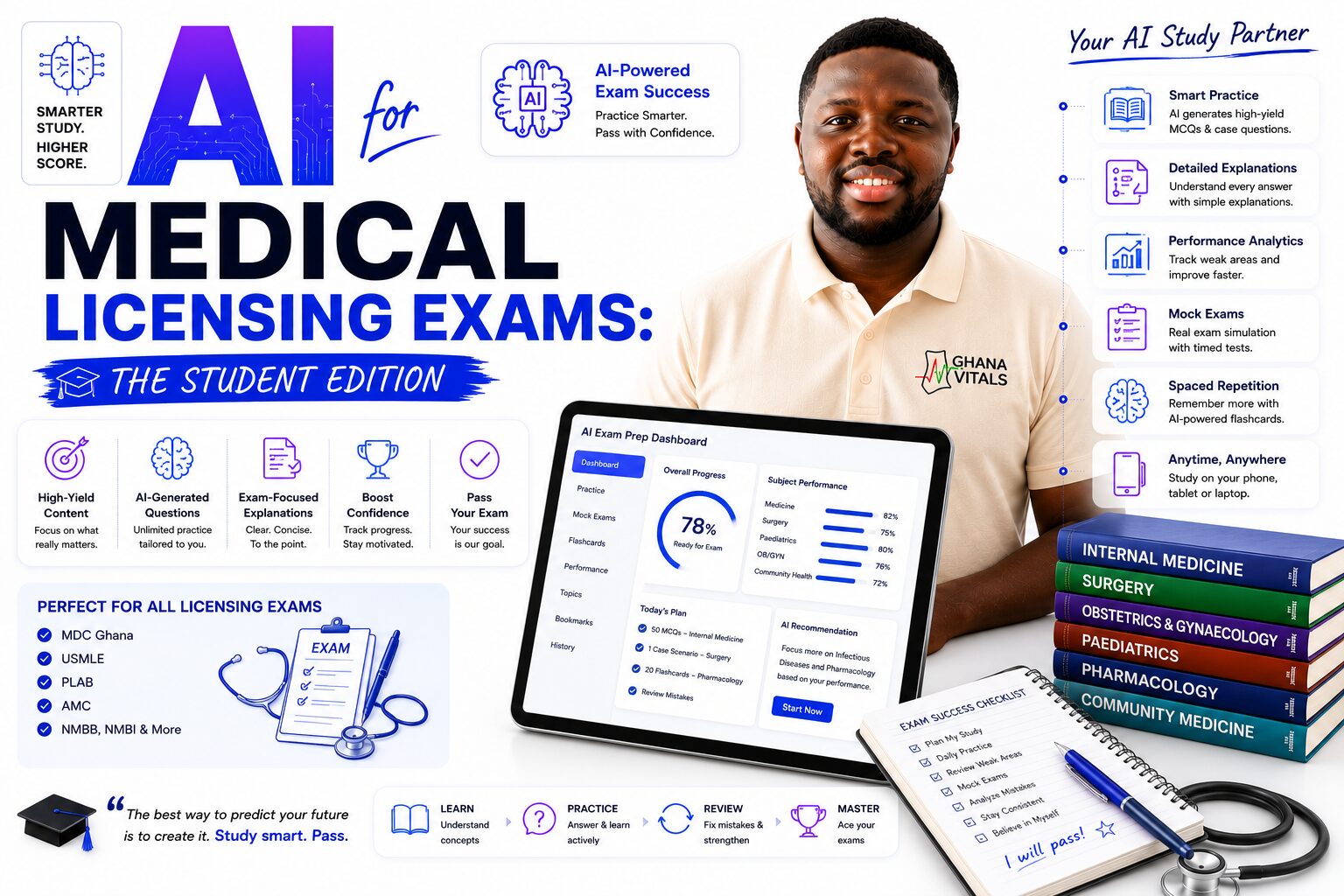
AI for Medical Licensing Exams: The Student Edition (2026 Guide)
How Medical Students Can Use Artificial Intelligence to Prepare for the GMDC, MDCN, HPCSA, USMLE, PLAB, AMC, MCCQE, and Other Medical Licensing Examinations
By Dr Festus Kaasung Kunde, MD
Medical Doctor | AI in Healthcare Advocate | Founder, AI Doctor Africa & Ghana Vitals
Category: AI for Medical Licensing Exams
The Exam That Determines Your Future
Every medical student remembers the moment they realised graduation wasn’t the finish line.
Passing the licensing examination was.
Whether you’re preparing for the Ghana Medical and Dental Council (GMDC) Licensing Examination, MDCN Nigeria, HPCSA South Africa, USMLE, PLAB, AMC, or another licensing examination, one thing becomes obvious very quickly:
This exam is different.
Unlike university examinations, licensing exams are designed to determine whether you can safely practice medicine.
They test more than memory.
They test judgment.
Clinical reasoning.
Decision-making.
Pattern recognition.
Time management.
And perhaps most importantly, your ability to apply knowledge under pressure.
I experienced this transition during my internship at Korle-Bu Teaching Hospital.
Every ward round reminded me that there was still so much to learn.
Every patient became another reminder that medicine isn’t simply about recalling textbook facts.
It is about connecting physiology, pathology, pharmacology, investigations, and management into one coherent picture.
Artificial intelligence has become one of the most useful tools I have used during this stage of my training.
Not because it gives answers.
But it helps organise knowledge, identify weak areas, and make revision far more efficient.
This guide explains exactly how medical students can use AI responsibly to prepare for licensing examinations.
Why Licensing Examinations Are Different
Medical school examinations often focus on individual subjects.
Licensing examinations integrate everything.
A single question may require knowledge of:
- Anatomy
- Physiology
- Pathology
- Pharmacology
- Surgery
- Internal Medicine
- Pediatrics
- Obstetrics & Gynecology
- Community Medicine
Students often discover that simply rereading lecture notes is no longer enough.
The challenge becomes integration.
That is where AI becomes particularly valuable.
What AI Can—and Cannot—Do
Before discussing study strategies, one principle is essential.
AI should assist your preparation.
It should never replace genuine learning.
Artificial intelligence cannot:
- Take your examination.
- Replace clinical experience.
- Guarantee a passing score.
- Replace textbooks or guidelines.
However, AI can help you:
- Organise revision.
- Generate practice questions.
- Explain difficult concepts.
- Simulate Viva examinations.
- Build study schedules.
- Identify weak topics.
- Connect basic sciences with clinical medicine.
Used responsibly, it becomes an incredibly powerful learning companion.
10 Practical Ways to Use AI for Licensing Exam Preparation
1. Build a Structured Study Plan
One of the biggest mistakes students make is studying randomly.
Instead, ask:
Create a 12-week licensing examination study timetable for a medical graduate preparing for the GMDC Licensing Examination.
A structured plan reduces anxiety and improves consistency.
2. Generate High-Yield MCQs
Practice questions remain one of the best revision methods.
Prompt:
Generate 50 high-yield licensing examination questions covering Internal Medicine, Surgery, Pediatrics, Obstetrics & Gynecology, and Community Health.
3. Revise Weak Areas
AI can become your personal tutor.
Prompt:
Based on these incorrect answers, identify my weakest topics and create a targeted revision plan.
4. Simulate Viva Examinations
Many licensing exams include oral components.
Prompt:
Act as a consultant physician and conduct a viva examination on acute kidney injury.
The AI asks questions one at a time, allowing you to think aloud just as you would during a real examination.
5. Learn Through Clinical Cases
Instead of memorising isolated facts, ask:
Create a realistic licensing examination case involving a patient with decompensated heart failure.
Clinical cases strengthen reasoning skills.
6. Connect Basic Sciences
Many students revise subjects separately.
AI can integrate them.
Prompt:
Explain the physiology, pathology, pharmacology, and clinical management of asthma.
7. Review National Guidelines
If you’re preparing for the GMDC or another national examination, ask AI to summarise educationally relevant guideline recommendations and compare them with international standards. Always verify against the latest official guidance.
8. Create Flashcards
Prompt:
Generate 100 active recall flashcards covering common licensing examination topics.
9. Practice Rapid Recall
Prompt:
Ask me rapid-fire licensing examination questions for 20 minutes.
This improves speed and confidence.
10. Simulate Ward-Round Questions
One workflow I found particularly valuable during my internship was asking AI to generate the follow-up questions a consultant was likely to ask based on an educational case summary.
This encouraged me to revise beyond the obvious diagnosis and think more like a clinician.
My Internship Workflow
During my internship at Korle-Bu Teaching Hospital, every patient became an opportunity to prepare for the licensing examination.
After work, I would:
- Review the day’s cases.
- Identify unfamiliar conditions.
- Summarise them without patient identifiers.
- Ask AI to explain the pathophysiology, investigations, management, and likely viva questions.
This process often uncovered knowledge gaps that I would have otherwise missed.
It wasn’t about taking shortcuts.
It was about studying more deliberately.
ChatGPT vs Claude for Licensing Examinations
ChatGPT
Excellent for:
- MCQs
- Flashcards
- OSCE stations
- Study schedules
- Rapid revision
Claude
Excellent for:
- Long-form explanations
- Clinical reasoning
- Guideline summaries
- Consultant-style teaching
- Integrating multiple subjects
My Recommendation
Use Claude to deepen your understanding.
Use ChatGPT to test yourself repeatedly.
25 AI Prompts Every Licensing Candidate Should Save
- Generate 50 GMDC-style MCQs.
- Create PLAB-style clinical scenarios.
- Simulate a USMLE-style case discussion.
- Conduct a viva on pneumonia.
- Explain septic shock step by step.
- Compare Crohn’s disease and ulcerative colitis.
- Generate Paediatrics revision questions.
- Test my Obstetrics knowledge.
- Explain ECG interpretation.
- Explain ABG interpretation.
- Review chest X-rays conceptually.
- Create an Internal Medicine revision timetable.
- Explain common surgical emergencies.
- Quiz me on Community Medicine.
- Identify my weak topics.
- Build flashcards.
- Summarise hypertension guidelines.
- Explain diabetes management.
- Generate pharmacology questions.
- Teach me endocrine emergencies.
- Simulate emergency medicine cases.
- Explain laboratory interpretation.
- Generate consultant follow-up questions.
- Build a seven-day revision plan.
- Test me until I consistently score above 85%.
Common Mistakes Students Make
- Studying passively.
- Ignoring weak areas.
- Memorising instead of understanding.
- Neglecting clinical reasoning.
- Using AI without verifying information.
AI should strengthen your learning—not become your only source of information.
My Recommended AI Study Workflow
Morning
Revise one major topic.
Afternoon
Practice AI-generated MCQs.
Evening
Review clinical cases.
Night
Use active recall and flashcards.
Repeat daily.
Consistency beats cramming.
Key Takeaways
- Licensing examinations test application, not just recall.
- AI can improve efficiency, but cannot replace hard work.
- Clinical cases are more valuable than isolated facts.
- ChatGPT is excellent for practice.
- Claude is excellent for deep understanding.
- Every patient encounter can become a revision opportunity.
- Active recall remains one of the most effective study techniques.
Frequently Asked Questions
Can AI help me pass my licensing examination?
AI can improve your preparation, but success depends on consistent study, clinical exposure, and critical thinking.
Which AI tool is best?
Many students benefit from using both ChatGPT and Claude because each has different strengths.
Can AI replace question banks?
No. AI complements question banks but should not replace established revision resources.
Is it safe to upload patient cases?
Never upload identifiable patient information. Always anonymise educational case summaries and follow institutional privacy requirements.
Related Articles
- Best AI Tools for Medical Students
- AI for Clinical Rotations
- AI for Pharmacology Revision
- AI for Pathology Learning
- How AI Can Help You Pass Medical School
About the Author
Dr Festus Kaasung Kunde is a Medical Doctor, AI in Healthcare Advocate, and Founder of AI Doctor Africa and Ghana Vitals. He holds an MD from Stavropol State Medical University, Russia (2025), and completed an internship at Korle-Bu Teaching Hospital in Accra. His mission is to help African healthcare professionals adopt AI responsibly to improve learning, research, and patient outcomes.
AI Doctor Africa | aidoctorafrica.com
Medical Disclaimer: For educational purposes only. AI tools do not replace clinical supervision, verified study resources, or your medical school’s academic guidance. Always verify clinical facts against authoritative primary sources.

Dr. Festus K. Kunde
Dr. Festus Kaasung Kunde is a medical doctor, Content creator, healthcare technology writer, and digital health innovator specializing in Artificial Intelligence in Medicine, Healthcare Systems Innovation, and Health Data Science in Africa. He is the founder of AI Doctor Africa (AIDoctorAfrica.com), an educational platform dedicated to helping healthcare professionals—including doctors, medical students, nurses, and researchers—understand and responsibly apply artificial intelligence in clinical practice, medical education, medical research, and healthcare innovation. He is also the creator of Ghana Vitals, a health data and predictive analytics initiative focused on collecting and analyzing key health indicators such as blood pressure, blood glucose, and BMI to support early disease detection, preventive healthcare, and data-driven decision-making in Ghana and across Africa. The project reflects his long-term vision of building scalable, AI-powered public health systems for African populations. Dr. Kunde’s work focuses on the practical integration of AI tools such as ChatGPT, Claude, and emerging clinical AI systems into real-world healthcare workflows. His content emphasizes improving clinical documentation, accelerating medical education, strengthening research productivity, and supporting healthcare decision-making in resource-limited settings. Through AI Doctor Africa, he publishes evidence-informed, practice-oriented resources including AI workflows, clinical use cases, medical education guides, and tutorials designed specifically for African healthcare professionals. Through Ghana Vitals, he extends this mission into population health innovation, aiming to leverage real-world health data and predictive models to improve early intervention, reduce preventable disease burden, and strengthen health systems across Africa. His overall mission is to bridge the gap between traditional clinical medicine, artificial intelligence, and data-driven public health, empowering African healthcare professionals to work smarter, diagnose earlier, and deliver better care through technology. Areas of Expertise Artificial Intelligence in Clinical Medicine Digital Health & Healthcare Innovation in Africa Health Data Analytics & Predictive Health Systems Medical Education and Exam Preparation AI for Medical Research and Scientific Writing Clinical Workflow Optimization using AI Tools Public Health Data Systems (Ghana Vitals Initiative) Professional Focus Dr. Kunde’s work sits at the intersection of clinical medicine, artificial intelligence, and population health systems, with a strong focus on scalable solutions for African healthcare challenges. His initiatives emphasize ethical AI use, data-driven decision-making, and practical implementation in real-world clinical and public health environments.
View author profile →