How Doctors and Medical Students Can Use AI for Medical Research in 2026: The Complete African Doctor’s Guide
By Dr Festus Kaasung Kunde, MD | Stavropol State Medical University
Medical Doctor | AI in Healthcare Advocate | Founder, AI Doctor Africa & Ghana Vitals
Published: June 2026 | Reading Time: 35–40 minutes | Category: AI for Research
What This Article Covers
Medical research is one of the most important — and most underused — skills in African healthcare. This article is a complete, experience-based guide to using AI across every phase of the medical research process: from finding papers and screening literature to writing manuscripts and presenting findings. It covers 15+ AI tools, a 10-stage research workflow, personal stories from clinical practice and medical school, and specific guidance for African doctors and students navigating research with limited resources. Approximately 10,000 words.
Part One: Why Medical Research Matters More Than Most Doctors Realise
The Research Deficit in African Healthcare
There is a quiet crisis in African medicine that rarely makes it onto conference agendas or into policy discussions. Shortage of intelligent doctors, committed students, or passionate researchers isn’t in doubt, but the shortage of published, peer-reviewed research that reflects the realities of African clinical practice.
Consider what this means in practice. When a doctor in Ghana looks up the management guidelines for hypertension, the evidence underpinning those guidelines was predominantly generated by studies conducted in North America and Europe — on populations with different genetic profiles, dietary patterns, comorbidity burdens, and access to healthcare than the patients sitting in front of them. When a researcher in Nigeria searches PubMed for data on the prevalence of complications of sickle cell disease in urban West African populations, they may find only a handful of studies, some of them decades old.
The research that should be guiding clinical decisions in Africa, built from African patients, African healthcare systems, and African disease realities, is dramatically underrepresented in the global medical literature.
This is not inevitable. It is changeable. And in 2026, AI tools have made it more possible than ever for African doctors and medical students to conduct, publish, and disseminate high-quality research — even without the institutional infrastructure that large Western universities provide.
This article is my attempt to share everything I have learned about using AI for medical research — from the struggles of a thesis written in Russia on a tropical disease that Russian professors had rarely seen, to the observations from a health screening exercise across all 16 regions of Ghana that convinced me we needed better data, better tools, and better systems to prevent the diseases that are quietly devastating communities across this continent.
What Most Doctors Get Wrong About Research
When I talk to doctors and medical students about research, the most common response I hear is some version of: “Research is for academics. I am a clinician.”
I understand that instinct. Clinical medicine is demanding enough without adding the responsibilities of a research career on top of it. But this framing misses something important.
Research is not a separate profession. It is a skill set that improves every aspect of clinical practice. A doctor who understands how to read a study critically, can search the literature efficiently, and knows how to evaluate the strength of evidence behind a treatment protocol is a safer, more effective clinician than one who cannot.
Evidence-based medicine — the foundation of modern clinical practice — depends on every doctor having a working relationship with research. Not necessarily producing original research every year. But understanding how research is done, what makes it reliable, and how to apply its findings to individual patients.
AI has dramatically lowered the barrier to that relationship. Literature searches that previously required specialist database training can now be completed in minutes. Paper analysis that previously demanded hours of careful reading can now be supplemented with AI-generated structured summaries. Research proposals that previously required institutional support can now be drafted, refined, and structured using tools available to anyone with an internet connection.
The question for African healthcare professionals in 2026 is not whether they can afford to engage with research. It is whether they can afford not to.
Part Two: My First Real Encounter With AI-Assisted Research — The Malaria Thesis
A Tropical Disease in a Country That Does Not Have It
In my final year at Stavropol State Medical University in Russia, my research partner, Dr Ama Dufie Opare and I were required to complete a thesis as part of our graduation requirements. We chose a topic that felt deeply personal to both of us as African students studying medicine far from home:
“Malaria: A Problem in Endemic Regions“
It seemed straightforward at first. Malaria is one of the most studied infectious diseases in the world. The WHO publishes comprehensive annual reports. PubMed contains thousands of papers. We assumed the research would be the easy part.
We were wrong.
The challenge was not finding malaria research globally. The challenge was that we were conducting this research in Russia — a country where malaria is not endemic, clinical cases are vanishingly rare, and most available textbooks, reference materials, and academic resources are written in Russian. The Russian-language medical literature on tropical infectious diseases is considerably thinner than the English-language equivalent. Many of the most relevant and current studies — epidemiological data from sub-Saharan Africa, clinical trial results from Ghana and Nigeria, WHO treatment protocol updates — were either untranslated, unavailable in the university library, or buried behind paywalls.
As African students with a personal connection to the disease we were researching — both of us had grown up in countries where malaria is not a statistic but a lived reality — this was deeply frustrating. We had the clinical experience. We had the contextual understanding. What we lacked was efficient access to the research that could support and validate what we already knew.
How AI Saved Our Thesis
That experience was our first serious immersion in AI-assisted research. And it permanently changed the way I approach research.
We used ChatGPT to help us navigate English-language literature summarised in Russian-language sources, explain concepts that the available textbooks covered inadequately, and structure the thesis itself. Grammarly corrected and polished our academic English to the standard required for a formal university submission. Gamma AI handled our presentation — producing professional, well-structured slides from the content we had written.
The result was a thesis that we were genuinely proud of. We passed with a score of 5 — the highest grade in the Russian academic system, equivalent to Excellent. Not because AI wrote our thesis. AI removed the barriers between our knowledge and our ability to express and present it effectively.
The Lesson From the Malaria Thesis
AI did not give us expertise in malaria. We brought that expertise — as African students who had grown up with the disease, seen its effects in our communities, and understood its human cost in a way no Russian textbook could capture. What AI gave us was access. Getting literature that we could not easily reach. Access to language tools that elevated our academic expression. Presentation tools that made our work look and feel as serious as it was. That is what AI does for African researchers. It democratises access.
The Language Barrier in Russian Medical Education — and How AI Dissolves It
My experience in Russia is not unique. Thousands of African medical students study in Russia, Eastern Europe, China, and other countries where English is not the primary language of medical education. The challenge is not intelligence or dedication. The challenge is access.
Russian medical libraries are genuinely excellent. Stavropol State Medical University has strong library resources and a tradition of rigorous academic training. The problem is that the most current, most comprehensive resources on tropical and infectious diseases — the diseases that will dominate the clinical careers of most African graduates — are written in English. And the time it takes to locate, translate, and understand Russian-language content on topics such as malaria pathophysiology or the African NCD burden can be prohibitive for a student already managing a demanding academic schedule.
With the right prompt, AI eliminates this barrier almost entirely. A question like:
“Explain the current WHO classification of malaria severity, the pathophysiology of cerebral malaria, and the evidence base for artesunate versus quinine in severe malaria management — in English, at the level of a final-year medical student.”
produces, in seconds, a response equivalent to what a student would spend hours finding, translating, and synthesising from multiple Russian-language sources. The information is accurate, structured, and immediately applicable to the thesis, the examination, and ultimately to clinical practice.
This is not cheating. It is using available tools to overcome a structural disadvantage. And African students in Russia, China, Ukraine, and elsewhere deserve to know that these tools exist and how to use them effectively.
Part Three: The Patient With the Illegible Stack of Records — A Case for AI in Clinical Data
A Ward Round That Should Have Taken Minutes
During my internship at Korle-Bu Teaching Hospital in Accra — one of West Africa’s largest and most complex tertiary healthcare institutions — I encountered a patient whose medical history exemplified one of the most persistent and underappreciated problems in African clinical medicine: fragmented, handwritten, multi-author medical records.
The patient had a thick folder of medical history spanning years of care at multiple facilities. Different doctors, different handwriting styles, different formats, different terminologies. Some notes were written in full clinical paragraphs. Others were barely legible abbreviations. Some referenced previous investigations without including the results. Some mentioned medications without specifying doses, durations, or outcomes.
What should have been a straightforward case review became a days-long exercise in medical archaeology. I spent significant time simply deciphering what previous clinicians had written, cross-referencing notes from different dates, and searching for information about conditions I encountered in those notes that were unfamiliar to me. Not because I was unprepared — but because the information was buried in a format that was genuinely difficult to extract efficiently.
The Clinical Data Problem in African Medicine
That experience clarified something important for me. In medicine, the quality of clinical decisions depends not only on the clinician’s knowledge — it depends on the quality, accessibility, and interpretability of the information available at the point of care. A brilliant doctor cannot make a good decision with incomplete or incomprehensible information. And across much of Africa, medical records remain handwritten, fragmented, and difficult to synthesise — not because of negligence, but because of systemic resource constraints.
How AI Could Transform Clinical Data Management
Looking back at that experience now, the application of AI is obvious — and the potential impact is significant.
Imagine uploading a scanned set of clinical notes to Claude and prompting: “Extract a structured clinical timeline from these notes. Identify all diagnoses mentioned, all medications prescribed with doses and dates, all investigations ordered and their results, and all referrals made. Highlight any inconsistencies or gaps.”
The output would be a structured, legible, chronological clinical summary — produced in minutes rather than days. The clinician would still review, verify, and apply judgment. But the information retrieval barrier — the hours spent deciphering handwriting and cross-referencing fragmented notes — would be largely eliminated.
This is not a distant future application. The technology exists today. What is missing is awareness, workflow integration, and institutional willingness to implement it. AI literacy among African clinicians is one of the most important investments the healthcare profession on this continent can make — and it starts with individual doctors understanding what these tools can do.
That is part of why I built AI Doctor Africa. Not to create a technology platform. But to bridge the awareness gap — to ensure that doctors and medical students across Africa know that these tools exist, understand how to use them responsibly, and can begin applying them in their own clinical and research contexts.
Part Four: The Woman in the Western Region — What Real-World Health Data Looks Like
A Blood Pressure Reading That Shouldn’t Have Been Possible
During the national health screening exercise that covered all 16 regions of Ghana — the exercise that ultimately gave rise to the concept behind Ghana Vitals — our team encountered hundreds of individuals who were unaware of their health status. Undiagnosed hypertension. Unmonitored blood glucose. Elevated BMIs that had never been formally assessed. These were not isolated cases. They were patterns repeated across communities, regions, and the country. But one encounter has stayed with me more vividly than any other.
High BP
In a city in Ghana’s Western Region, we met a woman whose blood pressure reading that day was 260/150 mmHg.
To put that in a clinical context: a blood pressure of 260/150 mmHg is not simply elevated. It is a hypertensive crisis — a level at which the risk of stroke, hypertensive encephalopathy, aortic dissection, and acute kidney injury is immediate and severe. In a hospital setting, this is a medical emergency. In a community screening setting, with no emergency resources immediately available, it is terrifying.
Her Story
When we spoke with her, she was calm. She was not in obvious distress. It was made known to us that she had checked her blood pressure before, at a pharmacy, irregularly, when she remembered or when she happened to be passing. The lady had been prescribed antihypertensive medication. She had taken it. When the course finished, and she felt better — when the symptoms that had brought her to the pharmacy subsided — she stopped. That was five years ago. She had not taken medication since. She had not been monitored since. There was no record anywhere of her previous readings, her medication history, or her cardiovascular risk trajectory. No continuous data. In the absence of a follow-up system. There wasn’t an alert to flag that five years had passed without a check-up. Nothing.
The Research Question That Came Out of That Moment
That encounter crystallised the research question that drives everything I am building with Ghana Vitals.
We know — from published research — that an estimated 66% of individuals with hypertension in Africa, including Ghana, remain undiagnosed. Among those diagnosed, only 31% receive medical treatment. Of those who receive treatment, just 6.5% achieve disease control. These statistics, drawn from a 2025 study published in Tropical Medicine and International Health, describe a healthcare system in which the majority of patients with a preventable, treatable, deadly condition are falling through every gap simultaneously.
The woman in the Western Region was not an outlier. She was the norm.
The research question is not “Why do patients have hypertension?” We know the risk factors. The research question is: why does the healthcare system consistently fail to identify, monitor, and maintain people at risk — and what data systems, predictive tools, and community-based interventions could change that outcome?
That is the research agenda that Ghana Vitals is built around. And it is the research agenda that I hope to pursue formally through a Master of Public Health with a focus on preventive and predictive analytics — using AI and data science to build the kind of population health monitoring systems that could have caught that woman five years earlier, before her blood pressure reached 260/150.
Why African Healthcare Needs More African Researchers
The data that would answer these questions — the population-level health data from rural Ghana, from peri-urban communities in Nigeria, from underserved districts across East Africa — does not exist at the scale or quality needed to drive policy and system change. It has to be generated. And it has to be generated by African researchers, with African funding, using African data, and asking questions shaped by African clinical realities.
AI makes this more achievable than ever. The tools for literature review, data analysis, research writing, and dissemination are now available to a doctor in Accra at the same cost and with the same capabilities as those of a researcher at Harvard. What remains is the will, the training, and the community of practice to use them.
The most important medical research in Africa over the next decade will not come from Western universities studying African populations. It will come from African doctors and researchers, equipped with modern tools, asking questions that only someone who has stood in those communities can think to ask.
Part Five: AI Tools for Every Phase of Medical Research
The Research Workflow — An Overview
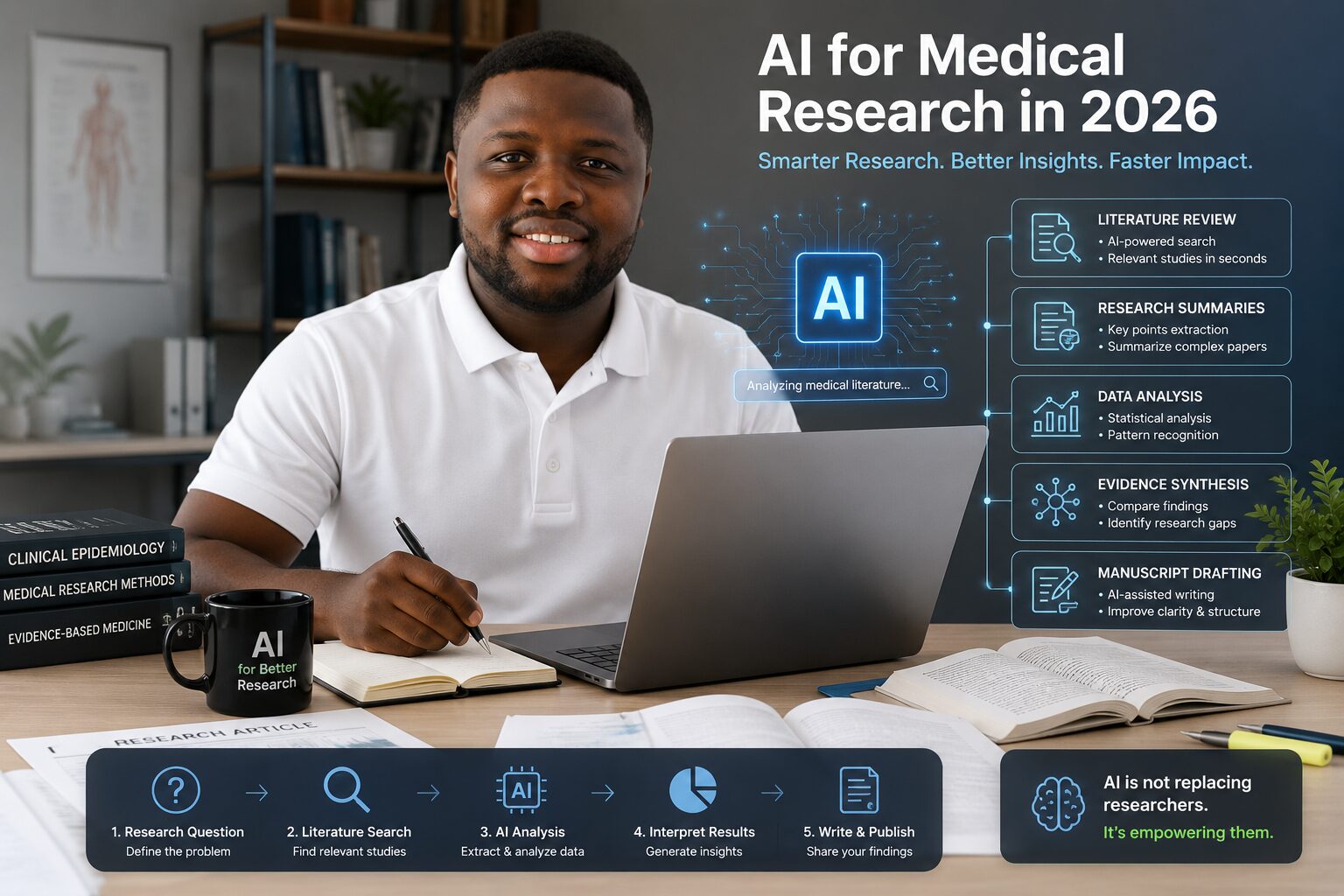
Medical research follows a broadly consistent workflow regardless of the type of study being conducted. Understanding where AI adds value at each stage — and which specific tools to use — is the foundation of an effective AI-assisted research practice.
| Phase | Task | Best AI Tool(s) | Free? |
| Discovery | Finding relevant papers | Semantic Scholar, ResearchRabbit | Yes |
| Discovery | Evidence-based Q&A | Consensus, Perplexity AI | Yes (limited) |
| Screening | Systematic review screening | Rayyan, Elicit | Yes / $12 |
| Extraction | Data extraction from papers | Elicit, Paperguide | $12 / $20 |
| Analysis | Deep paper analysis | Claude, NotebookLM | $20 / Free |
| Citation Check | Verifying how papers are cited | Scite | $20 |
| Synthesis | Writing literature reviews | Claude, ChatGPT | $20 |
| Writing | Draft manuscripts, abstracts | Claude, ChatGPT, Grammarly | $20 / $12 |
| Presentation | Research presentations | Gamma AI, Canva AI | Free / $15 |
| Reference Mgmt | Organising citations | Zotero, Mendeley | Free |
| Visualisation | Citation mapping | Litmaps, Connected Papers | Free |
| Full Workflow | End-to-end literature review | Paperguide | $20 |
The sections below examine each major phase of this workflow in detail, with specific tool recommendations, proven prompts, and practical guidance for African researchers.
Phase 1: Defining Your Research Question
The most important step in any research project is also the most frequently rushed: defining a clear, answerable, clinically meaningful research question. A poorly defined question produces a poorly focused study. No amount of AI assistance can fix a fundamentally flawed research question.
The PICO framework — Population, Intervention, Comparison, Outcome — is the standard tool for structuring clinical research questions. AI is highly effective at helping researchers apply this framework.
Prompt example: “I want to research why hypertensive patients in Ghana are lost to follow-up. Help me frame this as a PICO research question. Then suggest three alternative framings — one for a cross-sectional survey, one for a qualitative study, and one for a systematic review.”
Claude and ChatGPT are both effective at this stage. The key is providing sufficient context — the clinical problem you observed, the population you are interested in, and the type of study you are considering. Vague prompts produce vague research questions. Specific prompts produce focused, publishable ones.
Phase 2: Building a Search Strategy
A rigorous search strategy is the backbone of any systematic or scoping review. It defines which databases you will search, which search terms and Boolean operators you will use, and which date ranges and language filters you will apply. A weak search strategy means missing relevant papers — and reviewers of systematic reviews will scrutinise your search strategy closely.
Prompt example: “Help me build a comprehensive search strategy for a systematic review on the effectiveness of community health worker interventions for hypertension management in sub-Saharan Africa. I will search PubMed, Embase, the Cochrane Library, and the African Index Medicus. Provide Boolean search strings for each database, including MeSH terms where relevant.”
ChatGPT and Claude are both effective at generating Boolean search strings. PubMed AI can help refine search terms directly within the PubMed interface. Always run your AI-generated search string through a librarian or experienced researcher review before executing a formal systematic review search — small errors in Boolean logic can lead to significant omissions.
Phase 3: Literature Discovery at Scale
Semantic Scholar
Semantic Scholar, developed by the Allen Institute for AI, indexes over 200 million scientific papers and uses machine learning to surface the most relevant results for any query. Unlike Google Scholar, Semantic Scholar understands conceptual relationships between papers — not just keyword matches. For African researchers looking to map the existing literature on a topic, it is the most powerful free tool available.
Best for: Initial literature discovery, identifying foundational papers, and finding recent publications on niche topics.
Free: Completely free, no account required.
ResearchRabbit
ResearchRabbit is a citation-network visualisation tool that allows researchers to enter a seed paper and then explore all papers that cite it, all papers it cites, and all papers conceptually related to it. The visual interface makes it easy to identify clusters of research activity, spot foundational papers in a field, and discover work that keyword searches alone would miss.
Best for: Exploring an unfamiliar research field, finding related work after identifying a key paper, and visualising citation networks.
Free: Completely free.
Research tip: Start with one strong, relevant paper — a recent systematic review or highly-cited study on your topic. Feed it into ResearchRabbit. The citation network it generates will often surface 20–30 highly relevant papers that a PubMed keyword search would not have found.
Elicit
Elicit is an AI research assistant that allows users to search over 125 million papers using natural language queries and extract structured data from multiple papers simultaneously. For systematic and scoping reviews, Elicit is particularly powerful: upload a set of papers and ask it to extract specific data points — sample size, methodology, primary outcome, country of study, risk of bias — and it produces a structured comparison table in minutes.
Best for: Systematic literature searches, structured data extraction, and comparing methodologies across studies.
Cost: Free tier available; Plus plan at $12/month provides significantly expanded functionality.
Consensus
Consensus is an AI search engine that answers research questions using peer-reviewed evidence. Every answer is grounded in actual published papers, with links to the sources. For quick evidence checks — ‘does intervention X have evidence behind it?’ — Consensus is one of the most reliable and time-efficient tools available.
Best for: Evidence-based question answering, quick literature checks, and understanding the state of evidence on a specific clinical or research question.
Cost: Free tier available; Premium at $11/month.
Phase 4: Systematic Review Screening
Rayyan
Rayyan is the most widely used AI tool for screening systematic review titles and abstracts. Researchers import search results from multiple databases into Rayyan, and the platform uses AI to predict which papers are likely to be relevant based on the reviewer’s inclusion and exclusion criteria. The AI learns from reviewer decisions and becomes progressively more accurate as screening proceeds.
Key advantage: Rayyan supports collaborative screening — multiple reviewers can independently screen the same set of papers, and the platform tracks agreement and flags disagreements for adjudication. This is a requirement for Cochrane-standard systematic reviews.
Best for: Systematic review title and abstract screening, duplicate removal, collaborative multi-reviewer workflows.
Free: Unlimited reviewers and reviews.
Covidence
Covidence is the standard platform for Cochrane systematic reviews. It handles the full screening and data extraction workflow — including title and abstract screening, full-text review, data-extraction forms, and PRISMA flow diagram generation. For researchers targeting Cochrane or other high-standard systematic review publications, Covidence is the expected tool.
Cost: $340/year — check whether your institution has an institutional subscription before purchasing individually.
Phase 5: Deep Paper Analysis
Claude for Long Document Analysis
For papers that require deep analysis — complex methodologies, nuanced statistical approaches, or lengthy clinical trial reports — Claude is the most capable general AI tool currently available for document-level analysis. Claude can accept full-text papers (via upload or paste) and provide structured analysis covering study design, methodology, key findings, limitations, and clinical implications.
Prompt example: “I have uploaded a systematic review on AI-assisted hypertension screening in sub-Saharan Africa. Provide: (1) a structured summary of the methodology, (2) the key findings and their effect sizes, (3) the main limitations identified by the authors, (4) any findings specifically relevant to Ghana, and (5) the most significant research gaps the authors identified.“
The output quality from Claude on complex academic papers is consistently higher than that of other general AI tools — particularly for nuanced methodological analysis and the identification of research gaps.
Scite — Citation Context Analysis
Scite is one of the most underused tools in medical research. It analyses over 1.2 billion citation statements and classifies them as supporting, contrasting, or mentioning — allowing researchers to quickly determine whether a paper’s key claims have been supported or challenged by subsequent research.
This is enormously valuable for research quality assessment. A paper that appears credible in isolation may have been significantly challenged by later work. Scite surfaces that context in seconds — context that would previously have required hours of back-and-forth citation tracing.
Best for: Evaluating the reliability of individual studies, checking whether foundational claims in your field have been replicated or contradicted, and quality assessment for systematic reviews.
Cost: $20/month.
NotebookLM
Google’s NotebookLM allows researchers to upload multiple papers, notes, and documents, then conduct an AI-powered conversation across the entire corpus. Unlike Claude or ChatGPT, which work from general training data, NotebookLM works exclusively from the documents you provide — making it highly reliable for synthesis tasks where staying grounded in specific sources is critical.
Best for: Synthesis across multiple uploaded papers, staying grounded in specific sources, preparing for research presentations, and cross-document question answering.
Free: Completely free via a Google account.
Phase 6: Data Analysis and Statistical Support
For researchers conducting original quantitative studies, data analysis is often the most technically demanding phase. AI tools are increasingly capable of supporting this work — from explaining statistical concepts to helping with code for data analysis.
Prompt for statistical support: “I have collected blood pressure data from 500 participants at a community screening exercise. I want to (1) describe the prevalence of hypertension by age, sex, and region, (2) identify predictors of uncontrolled hypertension using logistic regression, and (3) compare hypertension control rates between urban and rural participants. What statistical tests are appropriate for each analysis? How should I handle missing data?”
ChatGPT is particularly strong for generating Python, R, or SPSS code for data analysis. Claude is stronger for explaining the statistical reasoning behind analytical choices and for reviewing statistical methodology in published papers. Neither tool replaces formal statistical training — but both significantly accelerate the learning process and reduce the time required to implement standard analyses.
Important: Always have your statistical analysis reviewed by a qualified biostatistician before submission to a journal. AI can help you understand and implement analyses, but statistical errors in published research have real consequences for clinical practice.
Phase 7: Writing the Manuscript
The AI-Assisted Writing Workflow
Writing a medical research manuscript is a structured exercise with well-defined components: Introduction, Methods, Results, Discussion, Conclusion, Abstract, and References. AI is most useful at the structural and clarity-improvement stages of this workflow — not for generating the scientific content itself.
A proven workflow for AI-assisted manuscript writing:
- Use Claude to generate a detailed outline of each section based on your research question and findings
- Write each section yourself using your data and your clinical insight
- Use Claude to review each section for logical flow, clarity, and academic register
- Use Grammarly for grammar, spelling, and style consistency throughout
- Use ChatGPT or Claude to draft and refine your Abstract — abstracts require a particularly precise, condensed writing style
- Use Zotero or Mendeley to manage references throughout — never manually type references
Prompt for discussion section: “I am writing the Discussion section of a research paper on lost-to-follow-up rates among hypertensive patients in Ghana. My key findings are: (1) 37% of patients did not return for follow-up within 12 months, (2) younger patients and those in rural areas had higher loss-to-follow-up rates, (3) patients registered with the NHIS had better follow-up than uninsured patients. Help me structure a Discussion that contextualises these findings within the existing literature, explains potential mechanisms, addresses limitations, and identifies policy implications.”
Grammarly for Academic Writing
Grammarly remains the most effective tool for improving the quality of language in medical research writing — particularly for researchers writing in English as a second or third language. The premium version provides suggestions not just for grammar and spelling but for clarity, concision, formality, and academic tone. For African researchers submitting to international journals, Grammarly’s language improvements can be the difference between a manuscript that reads as professionally as native-English academic writing and one that is rejected on language grounds.
Cost: Free tier available for grammar and spelling; Premium at approximately $12/month adds clarity and style improvements.
Reference Management: Zotero and Mendeley
No serious researcher should be managing references manually in 2026. Both Zotero and Mendeley are free reference management tools that automatically capture citation information from PubMed, Google Scholar, and most journal websites, organise your library, and generate formatted reference lists in any citation style (Vancouver, APA, Harvard, AMA) at the click of a button.
Zotero is generally preferred for academic research due to its open-source nature, browser plugin, and superior citation capture accuracy. Mendeley is a strong alternative with good collaboration features. Both integrate with Microsoft Word and Google Docs for seamless in-text citation management.
Set up tip for African researchers: Install the Zotero browser plugin on Chrome or Firefox. Every time you open a paper on PubMed, Semantic Scholar, or a journal website, Zotero’s plugin icon will appear in your browser bar. One click saves the complete citation to your library — authors, title, journal, year, DOI, and abstract. Building a research library this way takes seconds per paper, not minutes.
Phase 8: Presenting Research Findings
Gamma AI — From Research to Presentation
When my thesis partner, Dr Ama Dufie Opare, and I needed to present our malaria research in Russia, Gamma AI was the tool that transformed our written content into a presentation we were proud to stand behind. In 2026, Gamma has evolved significantly — it can now take a research abstract, a set of bullet points, or even a full manuscript section and generate a professional, well-designed presentation with appropriate layouts, visual structure, and content organisation.
The Prompt
Prompt example: “I have completed a cross-sectional study on hypertension prevalence in the Western Region of Ghana. The key findings are: prevalence of 38.6%, 74.6% of hypertensive participants had comorbid diabetes, only 6.5% had controlled blood pressure, and 37% had been lost to follow-up for more than 12 months. Create a 15-slide research presentation for a regional health conference audience. Include: background, objectives, methodology, key findings, discussion, implications, and recommendations.”
The resulting presentation structure is immediately usable — and with Gamma’s built-in design system, it looks professional without requiring any graphic design skill. Your role is to verify the clinical accuracy of every slide and add the nuance, context, and narrative that comes from actually having done the research.
Canva AI for Research Infographics
Communicating research findings to non-specialist audiences — policymakers, community health workers, the public — requires different visual tools from those used in academic presentations. Canva’s AI-powered design features allow researchers to create clear, visually appealing infographics from their data. For researchers involved in public health outreach — as I have been with health talks at secondary schools and universities in Accra — Canva is an invaluable tool for making evidence accessible and engaging.
Cost: Free tier available; Pro at approximately $15/month.
Phase 9: Citation Verification — The Most Important Step Most Researchers Skip
Citation fabrication by AI is one of the most serious risks in AI-assisted research. ChatGPT and Claude — when used as primary research discovery tools rather than analysis tools — have a well-documented tendency to generate plausible-sounding but entirely fictitious citations: real-looking author names, realistic journal titles, believable publication years, and entirely invented paper content.
This is not a minor inconvenience. In academic research, citing a paper that does not exist is a form of academic fraud — even if the fabrication was unintentional. It can result in paper retraction, reputational damage, and, in clinical contexts, it can affect the evidence base used to make patient care decisions.
The rule is simple and non-negotiable:
Never include a citation in academic research that you have not personally verified exists in PubMed, Google Scholar, or the original journal — regardless of which AI tool provided it.
Scite is the most powerful tool for citation verification — it not only confirms that a paper exists but tells you how it has been cited by subsequent research, allowing you to assess its reliability and standing in the field. For every claim in your manuscript that relies on a specific citation, run that citation through Scite before submission.
Part Six: The Complete AI-Assisted Medical Research Workflow
The following table summarises the complete AI-assisted research workflow from question formulation to final presentation. Use it as a practical checklist for any research project:
| Stage | What to Do | AI Tools to Use | Time Saved |
| 1. Define Question | Frame PICO/research question | Claude, ChatGPT | 30–60 min |
| 2. Search Strategy | Build search terms, Boolean strings | Claude, ChatGPT, PubMed AI | 1–2 hrs |
| 3. Literature Discovery | Find relevant papers at scale | Semantic Scholar, ResearchRabbit, Elicit | 2–4 hrs |
| 4. Screening | Screen titles/abstracts for relevance | Rayyan, Elicit | 3–8 hrs |
| 5. Data Extraction | Extract methods, outcomes, stats | Elicit, Paperguide | 4–10 hrs |
| 6. Quality Assessment | Evaluate study methodology | Claude, Scite | 2–4 hrs |
| 7. Citation Verification | Check how papers cite each other | Scite, Semantic Scholar | 1–2 hrs |
| 8. Synthesis | Identify themes, gaps, and conflicts | Claude, Elicit, Consensus | 3–6 hrs |
| 9. Writing | Draft manuscript/review sections | Claude, ChatGPT, Grammarly | 4–8 hrs |
| 10. Presentation | Create slides and visuals | Gamma AI, Canva AI, ChatGPT | 1–3 hrs |
Time-saving estimate: A research workflow that would previously have taken 6–8 weeks for a single clinician can, with AI tools used strategically across all ten stages, be compressed to 2–3 weeks without sacrificing quality. For African researchers without dedicated research support staff or institutional research infrastructure, this is transformative.
Part Seven: AI for Medical Research in the African Context — Specific Challenges and Solutions
The Structural Challenges African Researchers Face
Conducting medical research in Africa is not simply a scaled-down version of that in Europe or North America. It involves navigating a specific set of structural challenges that most AI tool reviews — written by and for Western academic audiences — do not address.
| Challenge | How AI Addresses It |
| Russian/foreign-language textbooks and resources | AI translates, summarises, and explains content from any language instantly — eliminating the language barrier that plagued African students in Russia |
| Paywalled research papers | Semantic Scholar, PubMed, Elicit, and Unpaywall surface free full-text versions of papers; Claude/ChatGPT summarise abstracts when full text is unavailable |
| Underrepresentation of African diseases in literature | AI helps find niche research from African Index Medicus, AJOL, and other African databases that standard Western searches miss |
| No institutional library or database access | Free tools (Semantic Scholar, ResearchRabbit, Consensus, Rayyan) provide research-grade functionality at zero cost |
| Thesis and dissertation pressure with limited supervision | AI assists with structure, writing, citation management, and presentation preparation — as my own thesis experience demonstrated |
| Slow internet and unreliable connectivity | Zotero and Anki work offline; papers can be downloaded in advance and analysed with Claude in batch sessions |
| Lack of experienced research mentors locally | Claude functions as a 24/7 research consultant — reviewing methodology, suggesting improvements, and explaining statistical concepts |
| Grant writing and funding applications | ChatGPT and Claude help structure compelling grant proposals aligned with WHO, NIH, and Gates Foundation priorities |
The Underrepresentation Problem — and What African Researchers Can Do About It
One of the most significant structural problems in global medical research is the underrepresentation of African populations and African clinical contexts in the peer-reviewed literature. Studies conducted in high-income countries dominate the evidence base. Treatment protocols developed for European populations are applied in West African hospitals. Diagnostic thresholds calibrated on North American datasets are used in Ghanaian clinics.
The consequences are real. A meta-analysis published in PLOS Global Public Health found that the prevalence of hypertension among people with diabetes in Ghana is 74.6% — one of the highest rates in Africa. This data, essential for policy and clinical practice in Ghana, came from a systematic review that required researchers to search across multiple databases, screen thousands of papers, and synthesise findings from studies conducted over several decades. Without AI tools, that kind of synthesis is beyond the reach of most African clinical researchers.
With AI tools, it is not.
The opportunity for African researchers in 2026 is to use these tools to generate, analyse, and publish data that are currently missing from the global medical literature. The disease burden is here. The clinical experience is here. The AI tools that can make research more efficient and accessible are here. What is needed is a research culture, training, and a community of practice to bring these elements together.
Africa does not need to wait for Western researchers to study African populations. African doctors, armed with modern AI research tools, can build the evidence base that African healthcare needs — from within the communities that need it most.
Using PubMed and AI for Health Education — Beyond Academic Research
Not all research engagement has to be formal academic research. In the years since medical school, I have used PubMed and AI tools not primarily for academic publishing, but for preparing health talks I deliver at secondary schools and universities in Accra.
This is a form of research application that I believe is deeply undervalued in discussions about AI and medicine. The evidence from PubMed — on hypertension risk factors, diabetes prevention, the effects of physical inactivity, and the risks of early-onset NCD — becomes the foundation for health education content that reaches young people before they become patients.
AI makes this more efficient. A PubMed search on diabetes prevention in young adults in Ghana, fed into Claude with the prompt: “Summarise the key findings from these papers in language accessible to a secondary school student audience,” produces content that would previously have required hours of reading and adaptation. The result is health talks that are evidence-based, relevant, and immediately applicable to the lives of young Ghanaians.
This is preventive medicine at scale. And it is exactly the kind of application that AI Doctor Africa was built to support.
Part Eight: Ghana Vitals, Predictive Analytics, and the Research Agenda I Am Building Toward
From Screening Data to Research Questions
The national health screening exercise that inspired Ghana Vitals was not just a public health intervention. It was a research opportunity — one that generated a set of questions that I have been turning over ever since.
When we met that woman in the Western Region with a blood pressure of 260/150 and five years of unmonitored hypertension, the clinical question was immediate: how do we lower her blood pressure safely and quickly? But the research question that came out of that encounter is much larger: how do we build a system that would have identified her risk five years earlier, maintained her on treatment, and prevented her blood pressure from ever reaching 260/150 in the first place?
That question — how do we predict and prevent rather than react and treat — is the foundation of the research agenda I am building toward.
The Role of Predictive Analytics in African Preventive Health
Predictive analytics in healthcare refers to the use of statistical models, machine learning algorithms, and population health data to identify individuals at elevated risk of disease — before clinical manifestation — so that preventive interventions can be targeted effectively.
In high-income countries, predictive analytics is increasingly embedded in electronic health record systems. Algorithms flag patients at elevated cardiovascular risk, predict readmission probabilities, and identify populations at risk of developing diabetes based on metabolic markers. These tools exist. They work. And the evidence base supporting their use is growing rapidly.
In Africa, the challenge is not the algorithm. The challenge is the data. Predictive analytics requires longitudinal, structured, population-level health data — blood pressure readings over time, glucose measurements, BMI trajectories, and medication adherence records. In a healthcare system where most patient records are handwritten, fragmented, and facility-specific, the data does not exist at the required scale.
Ghana Vitals is designed to address exactly this gap — to create the data infrastructure that would make predictive health analytics possible at the community level in Ghana. Not a replacement for the healthcare system. A data layer that makes the healthcare system smarter.
The MPH Research I Want to Do
If I have the opportunity to pursue a Master of Public Health, the research focus I want to build is clear: preventive and predictive analytics for non-communicable diseases in low-resource settings, with a specific focus on hypertension and diabetes in Ghana.
The research questions I want to answer include:
- What are the most significant predictors of lost-to-follow-up among hypertensive patients in community health settings in Ghana — and can these be identified prospectively?
- Can a simple, community-deliverable risk score — using blood pressure, BMI, age, family history, and physical activity — predict 5-year cardiovascular risk with sufficient accuracy to guide community health worker interventions?
- What is the cost-effectiveness of AI-assisted community hypertension screening compared to standard opportunistic screening in Ghanaian district health settings?
- How do mobile money payment systems affect medication adherence among insured and uninsured hypertensive patients in urban Ghana?
These are not abstract academic questions. They are direct responses to the clinical realities I observed during my internship at Korle-Bu and during the national screening exercise. They are the research that African healthcare needs. And they are the research that AI tools make feasible for a clinician-researcher without the institutional resources of a major research university.
Part Nine: Responsible AI Use in Medical Research — Ethical Principles Every Researcher Must Know
AI Disclosure in Academic Publishing
The academic publishing community has moved rapidly toward requiring explicit disclosure of AI use in research manuscripts. In 2026, most major journals indexed in PubMed — including those published by Elsevier, Springer Nature, the BMJ Group, and Wiley — require authors to disclose whether AI tools were used in the preparation of the manuscript, and if so, for what purpose.
The standard approach is to include a brief AI disclosure statement in the Methods section. A model statement:
“AI writing assistance tools (Claude, Anthropic; Grammarly) were used to improve the clarity and language of this manuscript. AI tools were not used for data collection, analysis, interpretation, or the formulation of conclusions. All intellectual content, including research design, data analysis, and scientific interpretation, was the work of the named authors.”
AI cannot be listed as an author under the International Committee of Medical Journal Editors (ICMJE) guidelines. Authorship requires the ability to take responsibility for the work — something that AI tools, which have no legal identity or professional accountability, cannot do.
Research Ethics and Patient Confidentiality
Patient confidentiality is non-negotiable in medical research. This principle applies equally to AI-assisted research workflows.
Never enter identifiable patient information — names, hospital numbers, dates of birth, addresses, or any combination of data points that could identify a specific individual — into any external AI platform. This includes ChatGPT, Claude, Grammarly, and every other cloud-based AI tool. The legal basis for this prohibition includes Ghana’s Data Protection Act, the General Data Protection Regulation (GDPR) for researchers working with European data, and the core principles of research ethics set out in the Declaration of Helsinki.
For case reports and case series, all patient information must be fully anonymised before any AI tool is used for writing or analysis. If there is any doubt about whether anonymisation is sufficient, consult your institution’s ethics committee before proceeding.
Avoiding AI Hallucination in Research
We have discussed citation hallucination above. But the risks of AI hallucination in research extend beyond fabricated references.
AI tools can also:
- Misrepresent the findings of real papers — describing a study’s conclusions incorrectly while citing the paper correctly
- Present outdated guidance as current, particularly in rapidly evolving fields like antibiotic resistance or oncology treatment protocols
- Generate plausible statistical values that do not exist in any published dataset
- Mischaracterise study designs — describing a retrospective cohort study as a randomised controlled trial, for example
The defence against all these risks is the same: critical appraisal and primary-source verification. Every factual claim in a research manuscript must be traceable to a primary source that you have personally read and verified. AI can help you find, understand, and synthesise that source — but it cannot replace your responsibility to verify it.
Part Ten: A Practical Getting-Started Guide for African Doctors Beginning Their Research Journey
Your First Week Using AI for Research
Day 1 — Set up your free tool stack: Create accounts on Semantic Scholar, ResearchRabbit, Elicit (free tier), Consensus (free tier), and Rayyan. Install the Zotero browser plugin. These five tools, all free, cover the core of your research workflow.
Day 2 — Identify your research question: Use Claude or ChatGPT to help you frame a PICO question around a clinical problem you have observed. This is the most important step — spend real time on it.
Day 3 — Run your first literature search: Search Semantic Scholar for your topic. Find one highly-cited recent review paper. Feed it into ResearchRabbit to explore the citation network. Save everything relevant to Zotero.
Day 4 — Upload and analyse: Take the most relevant paper you found and upload it to Claude. Ask for a structured summary that covers the methodology, key findings, limitations, and research gaps. Compare Claude’s analysis with your own reading of the abstract.
Day 5 — Build your search strategy: Use ChatGPT to generate Boolean search strings for PubMed and at least one other database. Run the searches. Import results into Rayyan for screening.
Days 6–7 — Write and reflect: Draft a one-page research proposal using the information you have gathered. Use Claude to review and improve the structure. Use Grammarly to polish the language. Reflect on what the process taught you about both the topic and the tools.
Building a Research Habit
Research fluency is not built in a week. It is built through consistent practice — the same way clinical skills are built. The doctors who become effective researcher-clinicians are those who read, question, and engage with evidence as a regular part of their professional life, not as an occasional exercise.
AI tools lower the barrier to that practice. They make it faster to find papers, easier to understand complex methodology, and less intimidating to begin writing. But they do not replace the habit of engagement itself.
My recommendation: commit to one research-related activity per week. One paper was read and analysed with Claude. One new tool was explored. One research question has been refined. One section of a proposal has been written. These small, consistent investments compound over months and years into genuine research capability.
The African healthcare system needs more clinician-researchers — doctors who are both excellent at the bedside and capable of generating and applying evidence at the population level. AI makes that combination more achievable than ever. The question is whether we will use these tools to build the research culture that African medicine needs.
Key Takeaways
- Medical research is not only for academics — it is a clinical skill that makes every doctor safer and more effective
- AI tools have dramatically lowered the barrier to research for African doctors and students who lack institutional infrastructure
- The malaria thesis experience demonstrated that AI can overcome language and resource barriers that structurally disadvantage African students abroad
- The patient with 260/150 mmHg after 5 years without monitoring illustrates exactly why Africa needs better research on NCD follow-up and predictive risk systems
- A complete AI-assisted research workflow covers ten stages — from question formulation to presentation — with specific tools for each
- Semantic Scholar, ResearchRabbit, Elicit, Rayyan, and Zotero form a powerful, largely free research stack for any African researcher
- Citation hallucination is a serious risk — never include a citation you have not personally verified in PubMed or the original journal
- AI disclosure is now required by most major journals — transparency about AI use is both ethically correct and professionally expected
- Patient confidentiality is non-negotiable — never enter identifiable patient data into any external AI platform
- Africa needs African researchers asking African questions — AI makes this more achievable than ever before
FAQ’s
The following questions address the most common queries from doctors and medical students beginning to use AI for research:
Question |
Answer |
| Can AI write my research paper for me? | No — and attempting this is both academically dishonest and strategically counterproductive. AI should structure, improve, and accelerate your writing — not replace your intellectual contribution.
The ideas, clinical insights, and judgments in a research paper must come from the researcher. AI handles the friction; you provide the expertise. |
| Is AI-assisted research accepted in medical journals? | Increasingly, yes — with disclosure. Most major journals, including those indexed in PubMed, now accept manuscripts that use AI tools for writing assistance, grammar checking, and literature review, provided the use is disclosed in the Methods section.
AI cannot be listed as an author under ICMJE guidelines, as authorship requires accountability. |
Can I use AI to find papers for a systematic review? |
Yes, but with important caveats. AI tools like Elicit, Rayyan, and Semantic Scholar significantly accelerate the screening and discovery phases of systematic reviews.
However, a rigorous systematic review still requires a comprehensive, reproducible search strategy across multiple databases, explicit inclusion/exclusion criteria, and quality assessment — AI can assist with these steps but does not replace them. |
| Do AI tools hallucinate research citations? | Yes — this is one of the most serious risks in AI-assisted research. General AI tools like ChatGPT and Claude can generate plausible-sounding but entirely fabricated paper titles, authors, and journal names.
Always use citation-grounded tools (Consensus, Elicit, Semantic Scholar, Scite) for paper discovery, and verify every citation in PubMed before including it in academic work. |
Can African doctors and students access these AI research tools? |
Yes. All tools reviewed in this article are accessible across Africa. Semantic Scholar, ResearchRabbit, Consensus (limited), Rayyan, Zotero, and Connected Papers are completely free.
Elicit, Claude, ChatGPT, and Scite offer free tiers with meaningful functionality. Payment is accepted via international debit cards and virtual cards from mobile money platforms across Ghana and most of Africa. |
| What is the best AI tool for a first-time researcher? | Start with three tools: Semantic Scholar (free paper discovery), Elicit (paper analysis and extraction), and Claude (concept explanation, synthesis, and writing).
This stack covers the core research workflow at minimal cost and provides a strong foundation to build on as your research skills develop. |
| How should I cite AI in my research paper? | Disclose AI use in the Methods section. State which tools were used and for what purpose — for example: ‘AI writing assistance (Claude, Anthropic) was used to improve manuscript clarity.
AI tools were not used for data collection, analysis, or interpretation.’ Follow your target journal’s specific AI disclosure policy, as these vary. |
| Can AI help with research ethics applications? | Yes. Claude and ChatGPT are effective for structuring ethics applications, drafting informed consent documents, explaining risk-benefit frameworks, and ensuring your protocol addresses standard ethical requirements.
However, the ethical judgments themselves — particularly around vulnerable populations, consent capacity, and risk assessment — must come from the researcher and the supervising ethics committee. |
Related Articles on AI Doctor Africa
- How Medical Doctors Can Use Claude AI for Research, Clinical Learning, and Productivity in 2026
- ChatGPT vs Claude for Medical Doctors: Which AI Is Better?
- How Doctors Can Use AI to Save 10 Hours Every Week
- Best AI Tools for Medical Students in 2026: The Complete Guide
- 50 Claude AI Prompts Every Medical Doctor Should Save
About the Author
Dr Festus Kaasung Kunde is a Medical Doctor, AI in Healthcare Advocate, and Founder of AI Doctor Africa and Ghana Vitals. He holds an MD from Stavropol State Medical University in Russia (2025) and completed a clinical internship at Korle-Bu Teaching Hospital in Accra, Ghana — one of West Africa’s largest tertiary healthcare institutions.
Dr Kunde has conducted health screening exercises across all 16 regions of Ghana, delivered evidence-based health talks at secondary schools and universities in Accra, and is building Ghana Vitals — a preventive health data platform designed to identify chronic disease risk before complications develop. He is currently preparing for the Medical and Dental Council (MDC) licensing examinations in Ghana and aspires to pursue a Master of Public Health with a focus on preventive and predictive health analytics.
His mission is to help healthcare professionals across Africa understand, adopt, and responsibly use artificial intelligence to improve learning, research, productivity, and patient outcomes — and to build the evidence base that African healthcare needs from within the communities that need it most.
AI Doctor Africa | aidoctorafrica.com
Medical Disclaimer: This article is for educational and informational purposes only. It does not constitute medical advice, research guidance, or legal counsel. All research activities must be conducted in accordance with your institution’s ethics requirements and applicable national laws.