
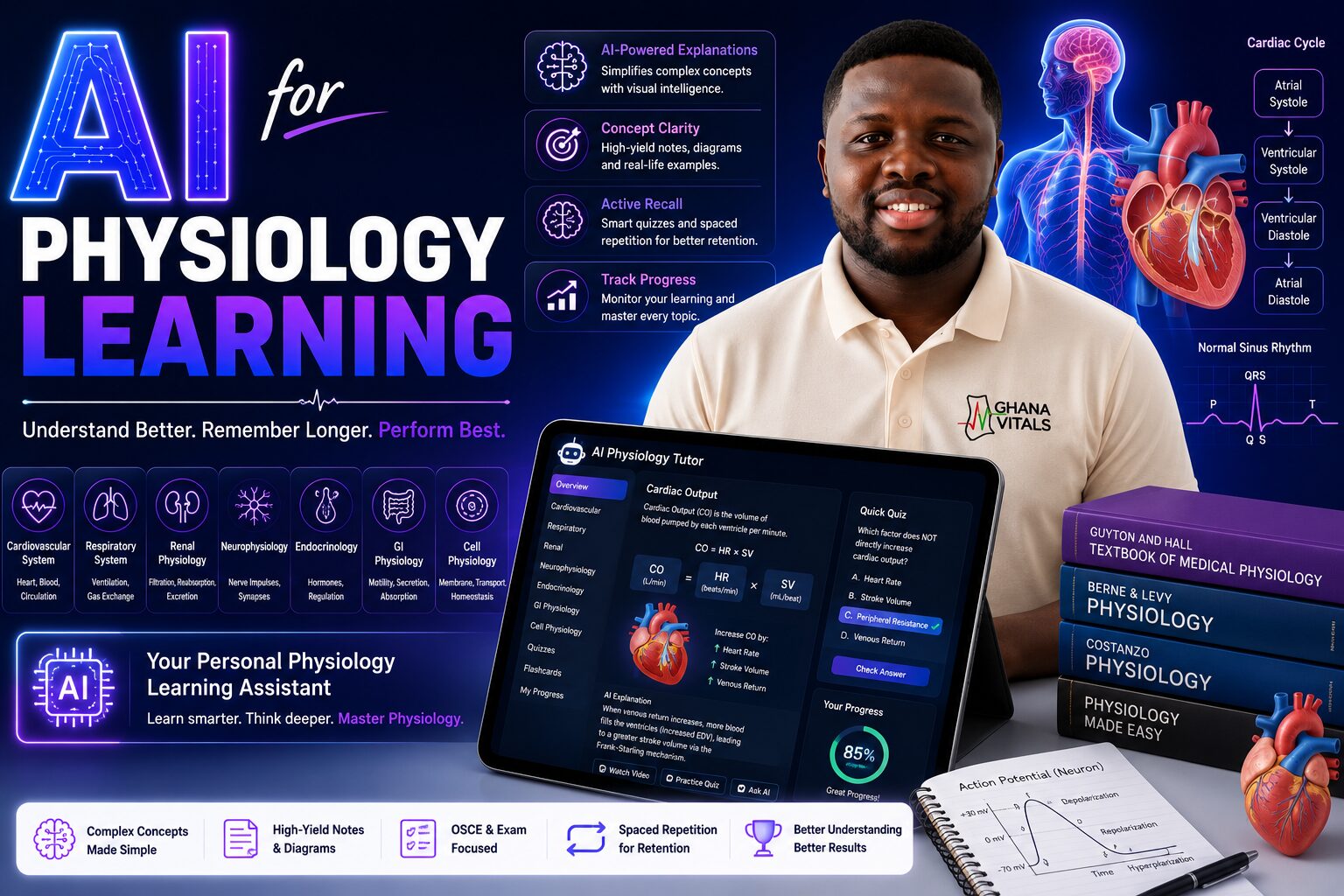
AI for Physiology Learning: How Medical Students Can Master Physiology Faster in 2026
By Dr Festus Kaasung Kunde, MD
Medical Doctor | Founder, AI Doctor Africa & Ghana Vitals
Why Physiology Is the Foundation of Medicine
If anatomy teaches you where things are, physiology teaches you how they work. And if you do not understand physiology, almost everything else in medicine becomes more difficult. Pathology makes less sense. Pharmacology becomes harder. Clinical medicine becomes confusing.
Yet physiology remains one of the subjects that medical students struggle with most. Not because it is impossible. But it requires understanding rather than memorisation. Many students discover that the strategies that worked in high school no longer work in medical school.
- You cannot simply memorise physiology.
- You must understand it.
During my own medical education, I realised that students who understood physiology deeply often performed better across multiple subjects.
Why?
Because physiology connects everything. When you understand how normal systems work, it becomes easier to understand disease. Today, artificial intelligence is helping students learn physiology in a completely different way. Instead of reading the same chapter repeatedly, students can interact with concepts, ask questions, create visual explanations, and receive personalised teaching.
This article explores how.
Why Physiology Is Difficult
Many students enter medical school expecting anatomy to be the hardest basic science. Then they encounter physiology. Suddenly they must understand:
- Membrane potentials
- Cardiac output
- Renal regulation
- Acid-base balance
- Respiratory mechanics
- Hormonal feedback systems
And many of these concepts interact with each other. The challenge is not the amount of information. The challenge is the complexity of relationships. Physiology requires students to understand processes. Not facts.
The Traditional Physiology Problem
Most physiology lectures involve:
- Large textbooks
- Complex diagrams
- Dense explanations
- Mathematical concepts
Students often attempt to solve this by reading more. Unfortunately, physiology rarely improves through passive reading. Many students read a chapter repeatedly without truly understanding it. The result is frustration. Artificial intelligence offers a different approach.
How AI Changes Physiology Learning
AI allows students to transform physiology from a passive subject into an interactive subject. Instead of reading a chapter on cardiac physiology and hoping it makes sense, students can ask:
Explain cardiac output to a second-year medical student using simple language and real-life examples.
The result is immediate clarification.
Students can then ask:
Why does cardiac output increase during exercise?
and continue learning through conversation. This interactive approach mirrors how many students naturally learn best.
AI Use Case #1: Simplifying Difficult Concepts
One of the greatest strengths of AI is its ability to simplify. Many physiology topics appear intimidating at first. Examples include:
- Action potentials
- Starling forces
- Renal clearance
- Ventilation-perfusion relationships
AI can break these topics into manageable pieces.
Example Prompt
Explain the action potential to a first-year medical student using simple language and analogies.
The resulting explanation is often easier to understand than traditional textbook descriptions.
AI Use Case #2: Building Conceptual Understanding
Many students memorise physiology without understanding why things happen. This creates problems later.
For example:
Students may memorise that aldosterone increases sodium reabsorption. But if they understand the physiological purpose of aldosterone, they can reason through:
- Fluid balance
- Blood pressure regulation
- Potassium changes
- Disease states
AI encourages this deeper understanding.
AI Use Case #3: Creating Physiology Summaries
Long chapters can be overwhelming.
AI can convert:
- Textbook chapters
- Lecture notes
- Study guides
into concise summaries.
Prompt:
Summarize renal physiology into one page for licensing examination revision.
Students can then focus on the most important concepts.
AI Use Case #4: Generating Physiology Diagrams
One challenge in physiology is visualisation. Many concepts involve processes rather than structures.
Examples include:
- Cardiac cycle
- Renin-Angiotensin-Aldosterone System
- Oxygen transport
- Hormonal feedback loops
AI can help describe these processes step by step and generate diagram explanations.
AI Use Case #5: Active Recall Learning
Active recall remains one of the most effective learning strategies.
Instead of asking:
Explain respiratory physiology.
Ask:
Quiz me on respiratory physiology one question at a time and provide explanations after each answer.
This transforms AI into a personal physiology tutor.
The Physiology Topics Students Struggle With Most
Based on years of medical education, the most difficult areas often include:
Cardiovascular Physiology
- Cardiac cycle
- Cardiac output
- Blood pressure regulation
Renal Physiology
- GFR
- Tubular function
- Acid-base regulation
Respiratory Physiology
- Gas exchange
- Oxygen transport
- Ventilation-perfusion matching
Endocrine Physiology
- Hormonal feedback systems
- Pituitary function
- Thyroid regulation
Neurophysiology
- Action potentials
- Neurotransmission
- Sensory pathways
These are exactly the areas where AI can provide enormous value.
My Experience Learning Physiology
Looking back, physiology became easier when I stopped trying to memorise everything. Instead, I focused on understanding systems. Once I understood why a physiological process existed, remembering details became much easier. If I were starting medical school again today, I would use AI extensively to:
- Simplify difficult concepts
- Create revision questions
- Build active recall exercises
- Generate summaries
- Connect physiology with clinical medicine
Not because AI replaces learning.
But it also helps students learn more effectively.
ChatGPT vs Claude for Physiology Learning
One of the most common questions medical students ask today is:
Which AI tool is better for physiology?
The honest answer is that both tools are excellent. However, they have different strengths.
ChatGPT Strengths
ChatGPT performs particularly well when students need:
- Quick explanations
- Flashcards
- MCQs
- Active recall exercises
- Study schedules
For example:
Prompt:
Generate 30 MCQs on cardiovascular physiology for a medical student preparing for licensing examinations.
ChatGPT excels at quickly creating large volumes of practice material.
Claude Strengths
Claude often performs better when students need:
- Deep conceptual understanding
- Long-form explanations
- Complex physiological reasoning
- Detailed summaries
For example:
Prompt:
Explain the Frank-Starling mechanism and its clinical relevance to a final-year medical student.
Claude often provides richer educational explanations.
My Recommendation
For physiology:
- Use Claude to Understand
- Use ChatGPT to Practice
This combination creates a powerful learning system.
AI Use Case #6: Connecting Physiology to Clinical Medicine
One reason students struggle with physiology is that they fail to see its relevance. The moment physiology becomes connected to real patients, everything changes. Consider heart failure. A student who understands:
- Cardiac output
- Preload
- Afterload
- Neurohormonal activation
will understand heart failure far more easily than someone who only memorises symptoms. AI can help bridge this gap.
Prompt:
Explain the physiological basis of heart failure and connect it to clinical signs and symptoms.
This helps students understand why medicine works the way it does.
AI Use Case #7: Understanding Acid-Base Physiology
Few topics create more anxiety among medical students than acid-base balance.
Students often memorise:
- Respiratory acidosis
- Respiratory alkalosis
- Metabolic acidosis
- Metabolic alkalosis
without understanding the underlying physiology. AI can simplify the process.
Prompt:
Teach me acid-base physiology step by step as if I know nothing about the topic.
Many students find this approach far easier than traditional textbook learning.
AI Use Case #8: Mastering Cardiovascular Physiology
Cardiovascular physiology appears repeatedly in:
- Medical school exams
- Licensing examinations
- Clinical medicine
AI can assist students in understanding:
- Cardiac cycle
- Blood pressure regulation
- Hemodynamics
- Heart sounds
- Shock physiology
Prompt:
Explain cardiovascular physiology from first principles and include common examination questions.
AI Use Case #9: Renal Physiology Without Tears
Renal physiology is another area where students frequently struggle.
Concepts such as:
- GFR
- Tubular transport
- Counter-current mechanisms
- Acid-base regulation
It can feel overwhelming. I can break these topics into manageable sections.
Prompt:
Explain renal physiology using simple diagrams, analogies, and clinical examples.
AI Use Case #10: Building Physiology Revision Notes
Many students spend hours creating notes. AI can accelerate this process significantly.
Prompt:
Create high-yield revision notes on endocrine physiology suitable for licensing examinations.
The resulting notes can then be personalised and refined.
25 AI Prompts Every Medical Student Should Save for Physiology
Understanding Concepts
Prompt 1
Explain [Physiology Topic] using simple language.
2nd Prompt
Teach me [Topic] as if I am a first-year medical student.
Prompt 3
Explain [Topic] using real-life examples.
4Th Prompt
Create an analogy for understanding [Topic].
Prompt 5
Summarize [Topic] in one page.
Active Recall Prompts
6th Prompt
Quiz me on cardiovascular physiology.
Prompt 7
Ask physiology viva questions.
8th Prompt
Test my understanding of renal physiology.
Prompt 9
Create rapid-fire physiology questions.
10th Prompt
Identify weak areas in my physiology knowledge.
Exam Preparation Prompts
11th Prompt
Generate 20 MCQs on respiratory physiology.
Prompt 12
Create licensing exam questions on endocrine physiology.
13th Prompt
Generate USMLE-style physiology questions.
Prompt 14
Generate PLAB-style physiology questions.
15th Prompt
Generate MDC Ghana physiology questions.
Clinical Physiology Prompts
Prompt 16
Explain the physiology behind hypertension.
17th Prompt
Explain the physiology of shock.
Prompt 18
Explain the physiology of heart failure.
19th Prompt
Explain the physiology of diabetes mellitus.
Prompt 20
Explain the physiology of asthma.
Advanced Learning Prompts
21st Prompt
Compare normal and abnormal physiology.
Prompt 22
Connect physiology with pathology.
23rd Prompt
Connect physiology with pharmacology.
Prompt 24
Explain clinical relevance of this physiology topic.
25th Prompt
Create a physiology revision roadmap.
Physiology for Licensing Examinations
Physiology remains one of the most heavily tested subjects worldwide.
Examples include:
- MDC Ghana
- MDCN Nigeria
- HPCSA South Africa
- USMLE
- PLAB
- AMC
- Residency entrance examinations
Common topics include:
- Cardiovascular physiology
- Respiratory physiology
- Renal physiology
- Endocrine physiology
- Neurophysiology
AI can help students focus on these high-yield areas.
Common Mistakes Students Make
Mistake #1
Trying to memorise physiology.
Physiology should be understood before it is memorised.
#2 Mistake
Ignoring diagrams.
Physiology is highly visual.
Mistake #3
Studying systems in isolation.
Everything in physiology is connected.
#4th Mistake
Not practising questions.
Knowledge without application quickly fades.
Mistake #5
Using AI as a shortcut.
AI should strengthen understanding.
Not to replace learning.
The Physiology Study Workflow I Recommend
If I were preparing for physiology examinations today, my workflow would be:
1st Step
Use Claude to understand concepts deeply.
Step 2
Use ChatGPT to create flashcards.
3rd Step
Generate MCQs daily.
Step 4
Use active recall every day.
4th Step
Connect physiology to clinical medicine.
Step 6
Review weak areas weekly.
This approach combines understanding, repetition, and application.
The Future of Physiology Education
Medical education is changing rapidly.
The future may include:
- AI tutors
- Personalised learning systems
- Interactive simulations
- Adaptive question banks
- Real-time performance feedback
Students who learn how to use these tools responsibly will likely have a significant advantage. However, the fundamentals remain unchanged.
- Curiosity.
- Understanding.
- Consistency.
- Hard work.
Those principles will never become obsolete.
Key Takeaways
- Physiology is the foundation of medicine.
- Understanding is more important than memorisation.
- AI can simplify difficult concepts.
- ChatGPT excels at practice questions and active recall.
- Claude excels at deep explanations.
- AI can help connect physiology to clinical medicine.
- Active recall remains one of the most effective study techniques.
- Licensing examinations heavily test physiology.
- AI should support—not replace—learning.
- Students who combine understanding and practice achieve the best results.
Frequently Asked Questions
Can AI replace physiology textbooks?
No. AI should complement textbooks, not replace them.
Is ChatGPT useful for physiology revision?
Yes. It is excellent for MCQs, flashcards, and active recall exercises.
Is Claude better for physiology explanations?
Often yes. Claude tends to provide more detailed educational discussions.
Can AI help me pass physiology exams?
AI can improve learning efficiency, but success still depends on understanding and consistent study.
Is physiology more important than anatomy?
Both are essential, but physiology often provides the foundation for understanding disease and treatment.
Can AI generate physiology cases?
Yes. AI can create realistic clinical scenarios that reinforce physiological principles.
How should medical students use AI responsibly?
Use AI to learn, verify information from trusted sources, and avoid relying on it blindly.
What is the best way to study physiology?
Understand concepts first, then use active recall, practice questions, and clinical application.
Related Articles on AI Doctor Africa
- Best AI Tools for Medical Students in 2026
- How AI Can Help You Pass Medical School
- AI for Pharmacology Revision
- 100 ChatGPT Prompts for Medical Students
- AI for Medical Licensing Examinations
About the Author
Dr Festus Kaasung Kunde is a Medical Doctor, AI in Healthcare Advocate, and Founder of AI Doctor Africa and Ghana Vitals. He holds an MD from Stavropol State Medical University, Russia (2025), and completed an internship at Korle-Bu Teaching Hospital in Accra. His mission is to help African healthcare professionals adopt AI responsibly to improve learning, research, and patient outcomes.
Final Thoughts
Physiology is not just another subject in medical school. It is the language that explains how the human body works. Every disease, every drug, and every clinical decision ultimately traces back to physiological principles. Artificial intelligence cannot replace the effort required to master physiology. But it can make the journey more efficient, more interactive, and far less intimidating.
Students who learn to integrate traditional medical education with modern AI tools will be better positioned to thrive in the future of medicine.
AI Doctor Africa | aidoctorafrica.com
Medical Disclaimer: For educational purposes only. AI tools do not replace clinical supervision, verified study resources, or your medical school’s academic guidance. Always verify clinical facts against authoritative primary sources.

Dr. Festus K. Kunde
Dr. Festus Kaasung Kunde is a medical doctor, Content creator, healthcare technology writer, and digital health innovator specializing in Artificial Intelligence in Medicine, Healthcare Systems Innovation, and Health Data Science in Africa. He is the founder of AI Doctor Africa (AIDoctorAfrica.com), an educational platform dedicated to helping healthcare professionals—including doctors, medical students, nurses, and researchers—understand and responsibly apply artificial intelligence in clinical practice, medical education, medical research, and healthcare innovation. He is also the creator of Ghana Vitals, a health data and predictive analytics initiative focused on collecting and analyzing key health indicators such as blood pressure, blood glucose, and BMI to support early disease detection, preventive healthcare, and data-driven decision-making in Ghana and across Africa. The project reflects his long-term vision of building scalable, AI-powered public health systems for African populations. Dr. Kunde’s work focuses on the practical integration of AI tools such as ChatGPT, Claude, and emerging clinical AI systems into real-world healthcare workflows. His content emphasizes improving clinical documentation, accelerating medical education, strengthening research productivity, and supporting healthcare decision-making in resource-limited settings. Through AI Doctor Africa, he publishes evidence-informed, practice-oriented resources including AI workflows, clinical use cases, medical education guides, and tutorials designed specifically for African healthcare professionals. Through Ghana Vitals, he extends this mission into population health innovation, aiming to leverage real-world health data and predictive models to improve early intervention, reduce preventable disease burden, and strengthen health systems across Africa. His overall mission is to bridge the gap between traditional clinical medicine, artificial intelligence, and data-driven public health, empowering African healthcare professionals to work smarter, diagnose earlier, and deliver better care through technology. Areas of Expertise Artificial Intelligence in Clinical Medicine Digital Health & Healthcare Innovation in Africa Health Data Analytics & Predictive Health Systems Medical Education and Exam Preparation AI for Medical Research and Scientific Writing Clinical Workflow Optimization using AI Tools Public Health Data Systems (Ghana Vitals Initiative) Professional Focus Dr. Kunde’s work sits at the intersection of clinical medicine, artificial intelligence, and population health systems, with a strong focus on scalable solutions for African healthcare challenges. His initiatives emphasize ethical AI use, data-driven decision-making, and practical implementation in real-world clinical and public health environments.
View author profile →