
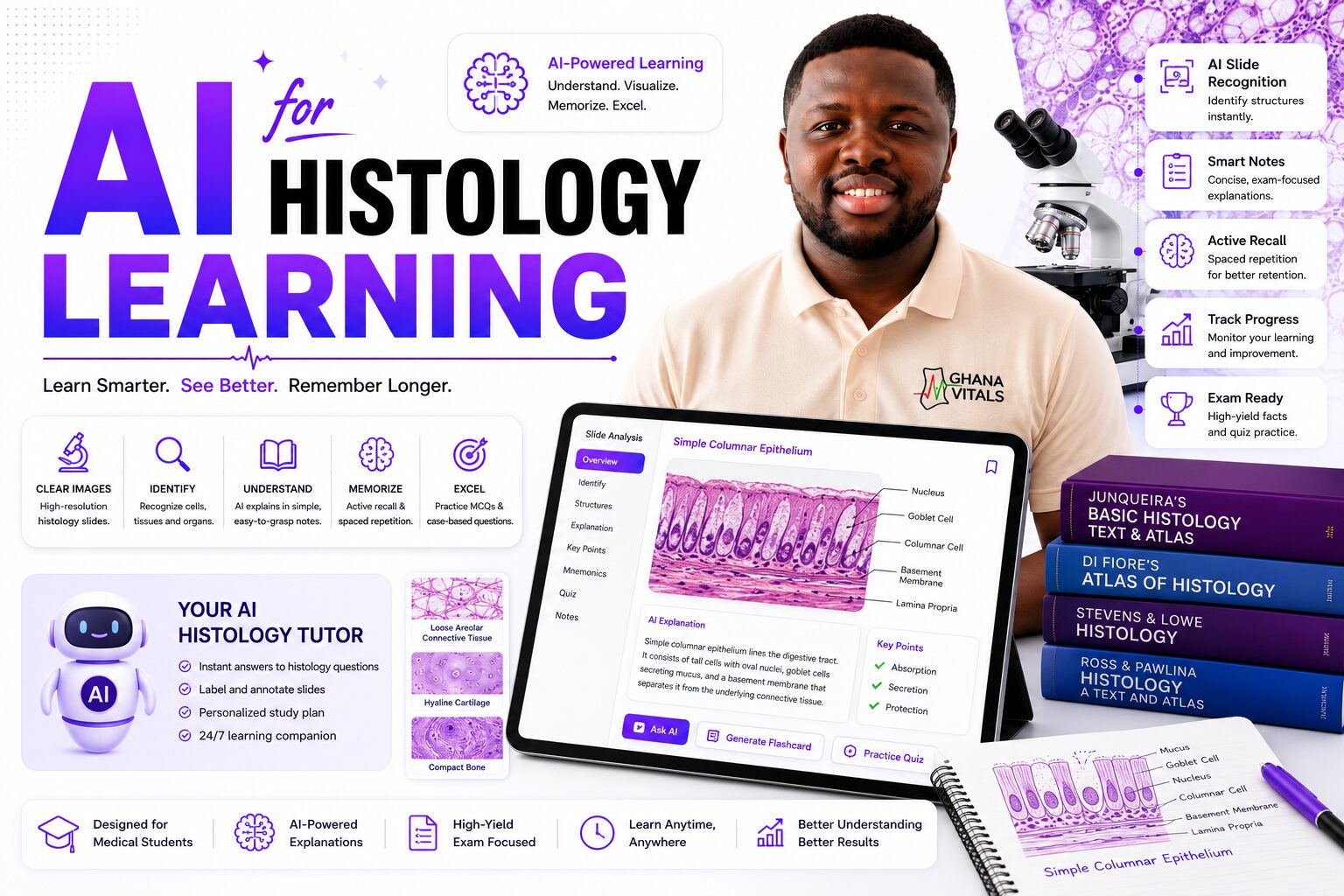
AI for Histology Learning: How Medical Students Can Master Histology Faster in 2026
The Day Histology Finally Made Sense
I’ll be honest.
Histology was one of those subjects that humbled me during medical school.
Unlike anatomy, where you can physically identify structures, or physiology, where you can reason through body functions, histology often felt like staring at a collection of colourful patterns and somehow being expected to identify exactly what tissue was on the slide.
Every microscope practical felt like a guessing game.
“Is this simple columnar epithelium?”
“Is this hyaline cartilage?”
“Why do these connective tissues all look the same?”
At first, I approached histology the way many students do.
I memorised labels, pictures, and slide appearances.
The problem was that the moment the examiner rotated the image, changed the stain slightly, or zoomed into a different area, my confidence disappeared.
That was when I realised something important.
Histology is not really about memorising pictures.
It is about recognising patterns.
Once I understood that, everything changed.
Today, artificial intelligence is helping medical students learn those patterns much faster than previous generations could.
Rather than simply looking at static images, students can now ask questions, receive explanations, compare tissues, create quizzes, generate mnemonics, and build personalised revision plans.
AI will never replace the microscope.
But it can become one of the most effective learning partners a medical student has.
Why Histology Feels Difficult
Histology introduces students to a microscopic world that is completely unfamiliar.
Instead of recognising organs with the naked eye, students must identify tissues made up of tiny cells and structures.
Some of the biggest challenges include:
- Similar-looking tissues
- Large volume of slides
- Complex terminology
- Limited practical laboratory time
- Difficulty connecting microscopic findings to clinical medicine
Many students spend hours looking at slides without understanding why a tissue has a particular appearance.
That is where AI can make a difference.
The Biggest Mistake Students Make
One mistake I made early in medical school was treating histology like a memory competition.
I thought success depended on remembering every slide exactly as it appeared in the atlas.
But real examinations rarely show textbook-perfect images.
Instead, you might see:
- Different staining
- Different magnification
- Partial tissue sections
- Unusual orientations
Students who understand why tissues look the way they do perform much better than students who only memorise photographs.
AI encourages this type of conceptual learning.
How AI Changes Histology Learning
Artificial intelligence transforms histology from passive observation into active learning.
Instead of staring at an image and hoping you recognise it, you can ask:
Explain why skeletal muscle appears striated under the microscope.
Or:
Compare hyaline cartilage with elastic cartilage using simple language and a table.
The response is immediate.
Better still, you can continue asking follow-up questions until the concept becomes clear.
That interactive process is something textbooks cannot provide.
8 Practical Ways Medical Students Can Use AI for Histology
1. Understanding Tissue Structure
Rather than memorising labels, ask AI to explain the purpose of each structure.
Example prompt:
Explain why simple squamous epithelium is thin and where it is found in the body.
Understanding function makes appearance easier to remember.
2. Comparing Similar Tissues
Students frequently confuse:
- Dense regular vs dense irregular connective tissue
- Hyaline vs elastic cartilage
- Smooth vs skeletal muscle
- Serous vs mucous glands
Prompt:
Compare smooth muscle and skeletal muscle in a table including microscopic appearance, function, location, and examination tips.
3. Creating Histology Flashcards
Instead of spending hours making cards manually, ask:
Generate 40 active recall flashcards on epithelial tissues.
Then review them daily.
4. Generating Practical Questions
Prompt:
Create 30 histology practical questions suitable for a medical school examination.
Testing yourself repeatedly improves retention far more than passive reading.
5. Learning Histological Stains
Many students struggle to remember what different stains reveal.
AI can simplify:
- Hematoxylin and Eosin (H&E)
- Periodic Acid–Schiff (PAS)
- Masson’s Trichrome
- Reticulin stain
Prompt:
Explain the purpose and appearance of common histological stains using clinical examples.
6. Connecting Histology to Pathology
One of the best ways to remember normal tissue is to understand what happens when disease alters it.
Prompt:
Explain how liver histology changes in cirrhosis compared with normal liver tissue.
7. Preparing for Practical Examinations
Prompt:
Act as a histology examiner. Show me one tissue at a time (described in words) and ask me to identify it.
This simulates viva and practical examinations remarkably well.
8. Building a Personalised Revision Plan
Prompt:
Create a two-week histology revision timetable for a final-year medical student preparing for licensing examinations.
AI removes the stress of deciding what to study next.
ChatGPT vs Claude for Histology
Students often ask which platform they should use.
The answer depends on the task.
ChatGPT
Best for:
- Flashcards
- Quizzes
- Revision schedules
- Rapid summaries
Claude
Best for:
- Conceptual explanations
- Long-form teaching
- Detailed comparisons
- Histology integrated with pathology and physiology
My recommendation is simple:
Use Claude to understand.
Use ChatGPT to practise.
20 Histology Prompts Every Medical Student Should Save
- Explain this tissue in simple language.
- Compare two tissue types.
- Create 30 histology MCQs.
- Generate flashcards.
- Quiz me one question at a time.
- Explain common histological stains.
- Summarise epithelial tissues.
- Explain connective tissue.
- Explain muscle histology.
- Explain nervous tissue.
- Connect histology with pathology.
- Connect histology with physiology.
- Create licensing examination questions.
- Explain clinical relevance.
- Teach me like a professor.
- Explain using analogies.
- Generate mnemonics.
- Identify my weak areas.
- Create a revision timetable.
- Test me until I score 90%.
Histology for Licensing Examinations
Histology remains a core component of many medical licensing examinations, including:
- GMDC (Ghana)
- MDCN (Nigeria)
- HPCSA (South Africa)
- USMLE
- PLAB
Although clinical reasoning becomes increasingly important in later years, a solid understanding of histology forms the basis for pathology, surgery, oncology, and many other specialities.
Students who understand normal tissue architecture are better equipped to recognise disease.
My Recommended Study Workflow
If I were starting medical school today, this is how I would study histology.
Monday: Learn one tissue group using Claude.
Tuesday: Generate flashcards using ChatGPT.
Wednesday: Complete 30 AI-generated MCQs.
Thursday: Compare similar tissues.
Friday: Connect histology with pathology.
Weekend: Review weak areas using active recall.
This cycle reinforces understanding while reducing the time spent creating study materials.
Key Takeaways
- Histology is about recognising patterns, not memorising pictures.
- Understanding tissue function improves retention.
- AI can simplify complex microscopic concepts.
- ChatGPT is excellent for revision and practice.
- Claude excels at deep explanations.
- Active recall remains essential.
- AI should complement, not replace, microscopy practice.
Frequently Asked Questions
Can AI replace microscope sessions?
No. AI supports learning but cannot replace practical laboratory experience.
Is ChatGPT good for histology revision?
Yes. It is excellent for quizzes, flashcards, and revision plans.
Is Claude better for conceptual learning?
In many cases, yes. Claude often provides more detailed explanations.
Can AI help with practical examinations?
Yes. It can simulate Viva questions and tissue identification exercises.
Related Articles on AI Doctor Africa
- How AI Can Help You Pass Medical School: The Complete Strategy Guide for 2026
- Best AI Tools for Medical Students in 2026: The Complete Guide
- 100 ChatGPT Prompts for Medical Students: The Complete 2026 Prompt Library
- Gemini AI for Medical Students: How to Use Google’s AI to Study Smarter
- AI for Medical Licensing Examinations: Ghana, Nigeria, South Africa, USMLE, and PLAB
- ChatGPT vs Claude for Medical Doctors: Which AI Is Better in 2026?
About the Author
Dr Festus Kaasung Kunde is a Medical Doctor, AI in Healthcare Advocate, and Founder of AI Doctor Africa and Ghana Vitals. He holds an MD from Stavropol State Medical University, Russia (2025), and completed an internship at Korle-Bu Teaching Hospital in Accra. His mission is to help African healthcare professionals adopt AI responsibly to improve learning, research, and patient outcomes.
AI Doctor Africa | aidoctorafrica.com
Medical Disclaimer: For educational purposes only. AI tools do not replace clinical supervision, verified study resources, or your medical school’s academic guidance. Always verify clinical facts against authoritative primary sources.
Dr. Festus K. Kunde
Dr. Festus Kaasung Kunde is a medical doctor, Content creator, healthcare technology writer, and digital health innovator specializing in Artificial Intelligence in Medicine, Healthcare Systems Innovation, and Health Data Science in Africa. He is the founder of AI Doctor Africa (AIDoctorAfrica.com), an educational platform dedicated to helping healthcare professionals—including doctors, medical students, nurses, and researchers—understand and responsibly apply artificial intelligence in clinical practice, medical education, medical research, and healthcare innovation. He is also the creator of Ghana Vitals, a health data and predictive analytics initiative focused on collecting and analyzing key health indicators such as blood pressure, blood glucose, and BMI to support early disease detection, preventive healthcare, and data-driven decision-making in Ghana and across Africa. The project reflects his long-term vision of building scalable, AI-powered public health systems for African populations. Dr. Kunde’s work focuses on the practical integration of AI tools such as ChatGPT, Claude, and emerging clinical AI systems into real-world healthcare workflows. His content emphasizes improving clinical documentation, accelerating medical education, strengthening research productivity, and supporting healthcare decision-making in resource-limited settings. Through AI Doctor Africa, he publishes evidence-informed, practice-oriented resources including AI workflows, clinical use cases, medical education guides, and tutorials designed specifically for African healthcare professionals. Through Ghana Vitals, he extends this mission into population health innovation, aiming to leverage real-world health data and predictive models to improve early intervention, reduce preventable disease burden, and strengthen health systems across Africa. His overall mission is to bridge the gap between traditional clinical medicine, artificial intelligence, and data-driven public health, empowering African healthcare professionals to work smarter, diagnose earlier, and deliver better care through technology. Areas of Expertise Artificial Intelligence in Clinical Medicine Digital Health & Healthcare Innovation in Africa Health Data Analytics & Predictive Health Systems Medical Education and Exam Preparation AI for Medical Research and Scientific Writing Clinical Workflow Optimization using AI Tools Public Health Data Systems (Ghana Vitals Initiative) Professional Focus Dr. Kunde’s work sits at the intersection of clinical medicine, artificial intelligence, and population health systems, with a strong focus on scalable solutions for African healthcare challenges. His initiatives emphasize ethical AI use, data-driven decision-making, and practical implementation in real-world clinical and public health environments.
View author profile →