
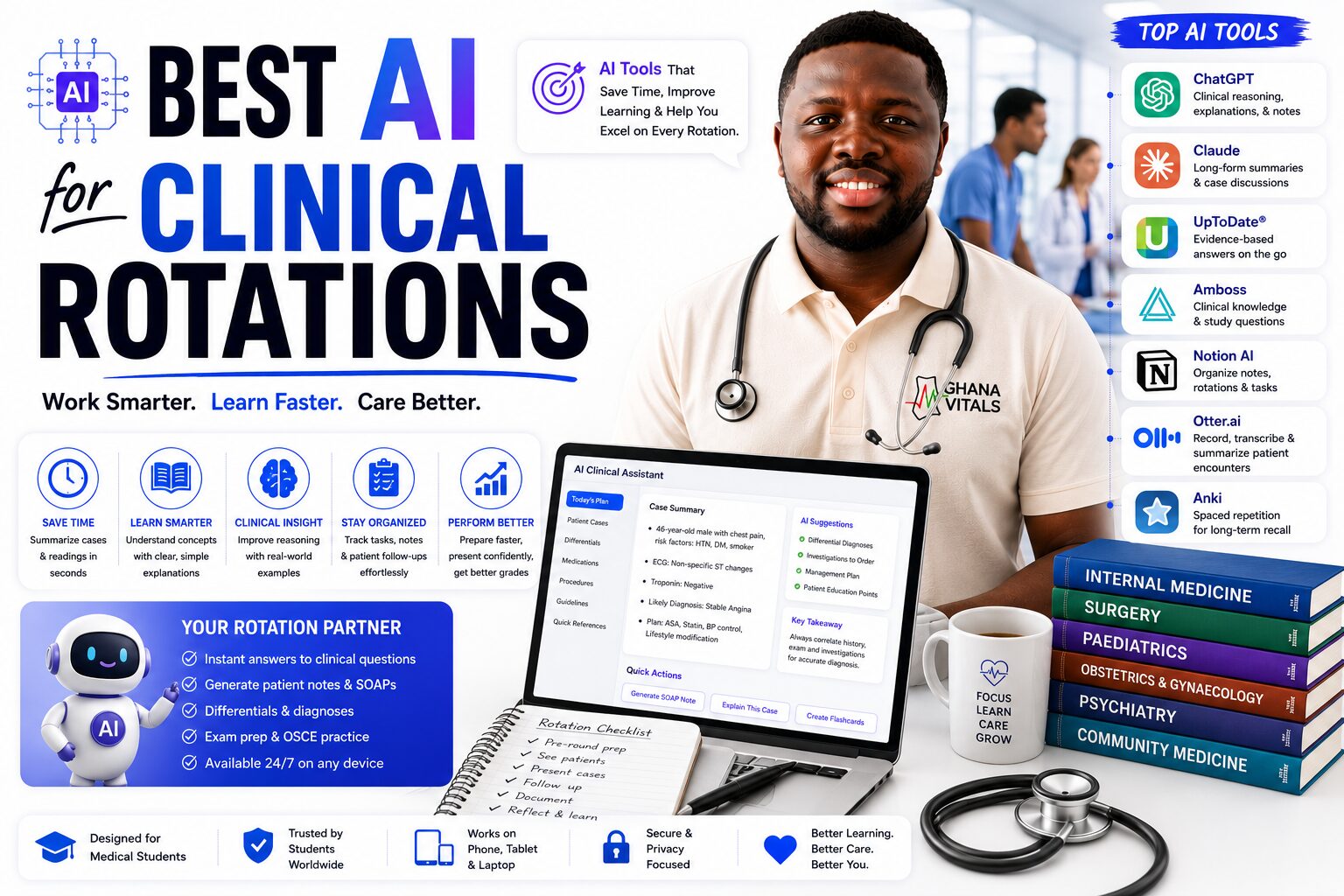
AI for Clinical Rotations: A Medical Student’s Survival Guide in 2026
By Dr Festus Kaasung Kunde, MD
Medical Doctor | AI in Healthcare Advocate | Founder, AI Doctor Africa & Ghana Vitals
Published: June 2026 | Reading Time: 8–12 minutes | Category: AI for Medical Students
The Day I Realised Medical School Was Really Beginning
No lecture prepared me for my first day on the wards.
Medical school had taught me anatomy, physiology, pathology, pharmacology, and countless disease definitions. I had passed written examinations and practical assessments. I knew the theory.
But standing beside a real patient was different. Suddenly, medicine wasn’t multiple-choice questions anymore. It was a frightened patient waiting for answers, a consultant asking questions without warning. I was trying to remember investigations while simultaneously listening to the patient’s history.
It was realising that clinical medicine required something textbooks could never fully teach.
During my rotations—and later during my internship at Korle-Bu Teaching Hospital—I discovered that the biggest challenge wasn’t intelligence. It was information management. Every day involved learning new diseases, understanding investigations, preparing case presentations, anticipating consultant questions, and reading for the next day’s ward rounds.
Some evenings, I left the hospital mentally exhausted. Then I began using artificial intelligence differently. Not to replace learning. Not to diagnose patients. But to organise knowledge, identify gaps, and prepare more effectively.
Instead of spending hours wondering where to begin, I had a structured study partner available whenever I needed it. That changed everything. This guide explains how medical students can use AI responsibly to survive and thrive during clinical rotations.
Why Clinical Rotations Feel So Overwhelming
Clinical rotations represent one of the biggest transitions in medical education.
For the first time, students must combine:
- Basic sciences
- Communication skills
- Clinical reasoning
- Professional behaviour
- Practical procedures
- Time management
All while adapting to unfamiliar hospital environments.
Many students experience the same fears:
- “What if the consultant asks me something I don’t know?”
- “What if I forget important differential diagnoses?”
- “What if I embarrass myself during ward rounds?”
- “How do I prepare for every patient?”
These fears are normal.
Every doctor has experienced them.
What AI Can—and Cannot—Do During Clinical Rotations
Before discussing practical workflows, one principle is essential.
Artificial intelligence should support your learning.
It should never replace your clinical judgment, physical examination, or hospital protocols.
AI cannot:
- Examine a patient.
- Build rapport with a family.
- Obtain informed consent.
- Make clinical decisions for yourself.
However, AI can help you:
- Revise diseases before ward rounds.
- Understand unfamiliar conditions.
- Generate practice questions.
- Organise your notes.
- Prepare case presentations.
- Review clinical guidelines.
- Identify topics for further reading.
Used responsibly, it becomes a study assistant—not a substitute for medical training.
How AI Helped Me During Internship
One of the most valuable workflows I developed during my internship involved preparing for morning ward rounds.
Every day, I was expected to know:
- Each patient’s diagnosis.
- Relevant investigations.
- Current management.
- Overnight events.
- Future treatment plan.
On top of that, I had to anticipate follow-up questions from senior doctors.
After returning home, I would create educational summaries of each patient’s case—without including identifying information—and use AI to review them.
A typical prompt looked like this:
“Act as a consultant physician. Based on this educational case summary, ask me the most likely ward-round questions and explain the expected answers.”
The responses often highlighted areas I hadn’t considered. Sometimes it reminded me to revise electrolyte abnormalities.
Other times, it pointed me toward updated management guidelines.
It didn’t replace my reading.
It made my reading more focused.
Instead of spending the evening wondering what to revise, I knew exactly where my weak points were.
That saved time.
More importantly, it improved confidence.
8 Practical Ways to Use AI During Clinical Rotations
1. Prepare Before Seeing Patients
Before your rotation in cardiology, ask:
“Teach me the 20 most common cardiovascular conditions a final-year medical student should know before starting a cardiology rotation.”
This provides a roadmap before you even step onto the ward.
2. Improve History Taking
Prompt:
“Create a structured history-taking checklist for a patient presenting with chest pain.”
This helps students build consistent habits.
3. Practice Differential Diagnoses
Rather than memorising disease lists, ask:
“A 55-year-old man presents with progressive shortness of breath. Generate a differential diagnosis and explain how to distinguish each condition.”
This develops clinical reasoning rather than rote learning.
4. Understand Investigations
Students often know which test to order but not why.
Prompt:
“Explain when to request arterial blood gases and how to interpret common abnormalities.”
Understanding investigations makes ward discussions much easier.
5. Practise Case Presentations
Prompt:
“Listen to this patient summary and show me how a consultant would expect it to be presented.”
Good presentations are a skill.
Like every other skill, they improve with practice.
6. Review Procedures Before the Ward
Before assisting with a lumbar puncture or urinary catheterisation, ask AI to explain:
- Indications
- Contraindications
- Equipment
- Steps
- Complications
Then learn the procedure under proper supervision.
7. Learn From Every Patient
Every patient should teach you something new.
After seeing a patient with chronic kidney disease, ask:
“Explain chronic kidney disease from physiology through pathology, diagnosis, and management.”
One patient becomes one complete learning experience.
8. Prepare for Consultant Questions
One of the most stressful parts of clinical rotations is the unexpected question.
AI can simulate this.
Prompt:
“Act as a consultant physician and ask me viva questions about community-acquired pneumonia.”
This builds confidence before the actual ward round.
My Biggest Lesson During Clinical Training
Looking back, I realise something important.
The students who performed best were not necessarily those who memorised the most.
They were the students who could connect information.
They understood:
- Why do symptoms occur?
- Why were investigations ordered?
- Why treatments worked.
- Why did complications develop?
Artificial intelligence helped me strengthen those connections.
Instead of learning isolated facts, I began thinking in systems.
That shift changed the way I approached medicine.
ChatGPT vs Claude for Clinical Rotations
Both platforms are valuable.
ChatGPT
Best for:
- Practice questions
- OSCE stations
- Flashcards
- Quick summaries
- Study schedules
Claude
Best for:
- Case discussions
- Long explanations
- Guideline summaries
- Consultant-style teaching
- Clinical reasoning
My advice remains consistent:
Use Claude to understand.
Use ChatGPT to practise.
20 AI Prompts Every Medical Student Should Save
- Explain today’s patient in simple language.
- Ask consultant-style ward round questions.
- Create a differential diagnosis table.
- Generate OSCE questions.
- Explain the investigation results.
- Summarise current guidelines.
- Quiz me on today’s cases.
- Explain drug mechanisms.
- Connect pathology with symptoms.
- Explain ECG findings.
- Explain chest X-ray interpretation.
- Simulate a viva examination.
- Review my case presentation.
- Generate discharge counselling points.
- Explain complications.
- Create flashcards.
- Build a revision timetable.
- Test my weak areas.
- Generate licensing exam questions.
- Recommend further reading.
Common Mistakes Students Make
- Memorising instead of understanding.
- Reading without applying knowledge to patients.
- Failing to prepare before ward rounds.
- Ignoring feedback from supervisors.
- Depending on AI instead of clinical teaching.
AI should always complement your consultants, residents, tutors, and textbooks—not replace them.
Key Takeaways
- Clinical rotations are about applying knowledge, not just recalling it.
- AI helps organise learning and identify knowledge gaps.
- Every patient can become a complete learning opportunity.
- Preparing before ward rounds builds confidence.
- ChatGPT excels at practice; Claude excels at explanation.
- Clinical judgment must always remain with the healthcare professional.
Frequently Asked Questions
Can AI replace clinical rotations?
No. Clinical competence requires real patient interaction and supervised practice.
Can AI help me prepare for ward rounds?
Yes. It can help you revise diseases, understand investigations, and practise consultant-style questions.
Is it safe to upload patient information into AI?
Never upload identifiable patient information. Always protect patient confidentiality and follow your institution’s privacy policies.
Can AI help with OSCE preparation?
Absolutely. AI can generate stations, role-play examiners, and provide feedback on your responses.
Related Articles
- How AI Can Help You Pass Medical School
- AI for Pathology Learning
- AI for Pharmacology Revision
- AI for Medical Licensing Examinations
- 100 ChatGPT Prompts for Medical Students
About the Author
Dr Festus Kaasung Kunde is a Medical Doctor, AI in Healthcare Advocate, and Founder of AI Doctor Africa and Ghana Vitals. He holds an MD from Stavropol State Medical University, Russia (2025), and completed an internship at Korle-Bu Teaching Hospital in Accra. His mission is to help African healthcare professionals adopt AI responsibly to improve learning, research, and patient outcomes.
AI Doctor Africa | aidoctorafrica.com
Medical Disclaimer: For educational purposes only. AI tools do not replace clinical supervision, verified study resources, or your medical school’s academic guidance. Always verify clinical facts against authoritative primary sources.

Dr. Festus K. Kunde
Dr. Festus Kaasung Kunde is a medical doctor, Content creator, healthcare technology writer, and digital health innovator specializing in Artificial Intelligence in Medicine, Healthcare Systems Innovation, and Health Data Science in Africa. He is the founder of AI Doctor Africa (AIDoctorAfrica.com), an educational platform dedicated to helping healthcare professionals—including doctors, medical students, nurses, and researchers—understand and responsibly apply artificial intelligence in clinical practice, medical education, medical research, and healthcare innovation. He is also the creator of Ghana Vitals, a health data and predictive analytics initiative focused on collecting and analyzing key health indicators such as blood pressure, blood glucose, and BMI to support early disease detection, preventive healthcare, and data-driven decision-making in Ghana and across Africa. The project reflects his long-term vision of building scalable, AI-powered public health systems for African populations. Dr. Kunde’s work focuses on the practical integration of AI tools such as ChatGPT, Claude, and emerging clinical AI systems into real-world healthcare workflows. His content emphasizes improving clinical documentation, accelerating medical education, strengthening research productivity, and supporting healthcare decision-making in resource-limited settings. Through AI Doctor Africa, he publishes evidence-informed, practice-oriented resources including AI workflows, clinical use cases, medical education guides, and tutorials designed specifically for African healthcare professionals. Through Ghana Vitals, he extends this mission into population health innovation, aiming to leverage real-world health data and predictive models to improve early intervention, reduce preventable disease burden, and strengthen health systems across Africa. His overall mission is to bridge the gap between traditional clinical medicine, artificial intelligence, and data-driven public health, empowering African healthcare professionals to work smarter, diagnose earlier, and deliver better care through technology. Areas of Expertise Artificial Intelligence in Clinical Medicine Digital Health & Healthcare Innovation in Africa Health Data Analytics & Predictive Health Systems Medical Education and Exam Preparation AI for Medical Research and Scientific Writing Clinical Workflow Optimization using AI Tools Public Health Data Systems (Ghana Vitals Initiative) Professional Focus Dr. Kunde’s work sits at the intersection of clinical medicine, artificial intelligence, and population health systems, with a strong focus on scalable solutions for African healthcare challenges. His initiatives emphasize ethical AI use, data-driven decision-making, and practical implementation in real-world clinical and public health environments.
View author profile →