
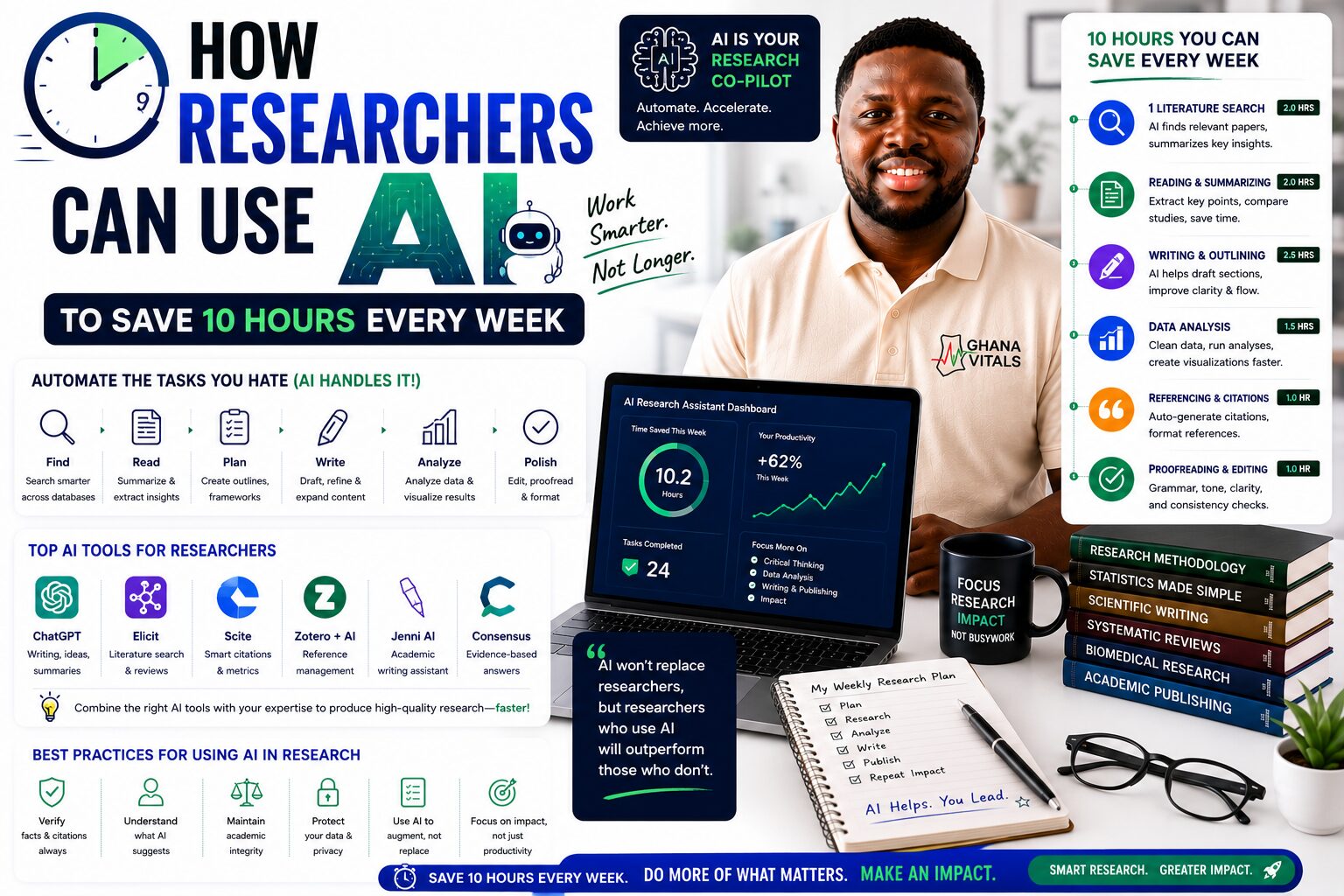
How Researchers Can Use AI to Save 10 Hours Every Week
A Practical Research Productivity System for Medical, Public Health, and Academic Researchers in 2026
By Dr Festus Kaasung Kunde, MD
Medical Doctor | AI in Healthcare Advocate | Founder, AI Doctor Africa & Ghana Vitals
Quick Summary
Researchers do not usually lose time because they are lazy or poorly organised.
They lose time because research contains dozens of small, repetitive tasks:
- Searching for papers
- Reading irrelevant articles
- Reformatting references
- Rewriting unclear paragraphs
- Preparing meeting notes
- Creating tables
- Responding to supervisors
- Building presentations
- Revising the same document repeatedly
Artificial intelligence cannot replace scientific judgment, research integrity, or subject expertise.
What it can do is remove friction.
A well-designed AI workflow can help many researchers recover approximately ten hours each week by reducing time spent on information management, first drafts, editing, literature screening, documentation, and administrative work.
The most important principle is simple:
Use AI for repetition, organization, and first drafts. Keep interpretation, ethics, evidence appraisal, and final decisions under human control.
The Real Productivity Problem in Research
When people imagine research, they often picture a scientist asking an important question, conducting an experiment, analysing results, and publishing a paper.
That is the visible part.
The invisible part is usually much larger.
A researcher may spend an entire afternoon:
- Renaming files
- Searching for a citation
- Rewriting one paragraph
- Converting notes into a report
- Comparing journal instructions
- Preparing slides for a meeting
None of those activities is necessarily difficult.
They are simply time-consuming.
That distinction matters.
Researchers often assume they need better discipline when what they actually need is a better system.
During the development of Ghana Vitals, I learned that ideas are rarely the main bottleneck.
The bottleneck is turning ideas into:
- Clear documents
- Actionable plans
- Research questions
- Implementation frameworks
- Funding proposals
- Measurable outcomes
Artificial intelligence became useful not because it created the vision for me, but because it helped me move from an unstructured thought to a structured working document much faster.
That is the role AI should play in research.
AI Shouldn’t be the scientist.
Not the author.
Not the final decision-maker.
The accelerator.
Where the Ten Hours Are Hiding
Before adopting any AI tool, conduct a simple time audit.
For one week, record how much time you spend on:
- Literature searching
- Reading papers
- Note-taking
- Writing
- Editing
- Meetings
- Emails
- Presentation preparation
- Reference management
- Administrative reporting
Most researchers discover that their time is not lost in one dramatic block.
It disappears in thirty-minute fragments.
Here is a realistic weekly breakdown.
| Research task | Traditional weekly time | AI-assisted time | Potential saving |
|---|---|---|---|
| Literature screening | 3 hours | 1.5 hours | 1.5 hours |
| Article summaries | 3 hours | 1 hour | 2 hours |
| Drafting and outlining | 3 hours | 1.5 hours | 1.5 hours |
| Editing and rewriting | 2.5 hours | 1 hour | 1.5 hours |
| Meetings and follow-up notes | 1.5 hours | 30 minutes | 1 hour |
| Presentation preparation | 2 hours | 1 hour | 1 hour |
| Emails and administration | 1.5 hours | 30 minutes | 1 hour |
| Data explanation and reporting | 1.5 hours | 1 hour | 30 minutes |
| Total potential saving | 10 hours |
These numbers are not guaranteed.
Some researchers may save more.
Others may save less.
The point is not the exact figure.
The point is that research productivity improves when dozens of small tasks become faster.
Time Saver 1: Stop Reading Every Paper From Beginning to End
Potential Saving: 1.5–2 Hours Per Week
Not every paper deserves a complete reading.
A common mistake among early-career researchers is treating every search result as equally important.
They open a paper and read:
- Introduction
- Methods
- Results
- Discussion
Only to discover that the study does not answer their question.
AI can help researchers screen papers before committing time to them.
A Better Workflow
For each paper:
- Read the title and abstract yourself.
- Upload or paste the article into an AI tool.
- Ask for a structured summary.
- Decide whether the paper deserves deep reading.
- Read the original paper fully if it is central to your work.
Useful Prompt
Summarize this article under the following headings: research question, study design, population, methods, main findings, limitations, and relevance to my research topic on [topic]. Do not add information that is not present in the paper.
This approach does not replace critical appraisal.
It helps you decide where critical appraisal is worth your time.
The Human Task That Remains
You must still evaluate:
- Whether the design was appropriate
- Whether the sample was representative
- Whether the analysis was valid
- Whether the conclusions were justified
AI can compress information.
It cannot take professional responsibility for interpreting it.
Time Saver 2: Build a Literature Map Instead of a Folder Full of PDFs
Potential Saving: 1–1.5 Hours Per Week
Many researchers collect papers without creating a system for understanding how they relate to one another.
The result is a folder containing fifty PDFs and no clear picture of the evidence.
A literature map is more useful.
It organises papers by:
- Theme
- Study design
- Population
- Intervention
- Outcome
- Research gap
- Strength of evidence
AI-Assisted Workflow
Create a table containing:
- Author and year
- Country
- Study design
- Sample size
- Main findings
- Limitations
- Relevance to your project
Then ask AI to identify recurring themes.
Useful Prompt
Using only the information in this evidence table, group the studies into major themes, identify areas of agreement and disagreement, and highlight questions that remain unanswered.
This can quickly reveal whether the literature is clustered around:
- Diagnosis
- Treatment
- Prevention
- Implementation
- Health systems
- Population differences
Why This Saves Time
Without a literature map, researchers repeatedly reopen the same papers.
With a structured map, the evidence becomes visible at a glance.
Time Saver 3: Use AI to Build the First Outline, Not the Final Paper
Potential Saving: 1–2 Hours Per Week
Blank pages waste time.
A researcher may know the topic well but still struggle to decide:
- What should come first?
- Which sections are necessary?
- Where should the argument lead?
- What belongs in the discussion?
AI is excellent at generating first outlines.
Example
Instead of asking:
Write my paper.
Ask:
Create a detailed outline for a scientific manuscript on [topic]. Use the IMRaD structure and include the purpose of each subsection. Do not write the manuscript.
That distinction is important.
The outline gives you structure without outsourcing the scientific work.
A Strong Outline Should Show
- The central argument
- The order of evidence
- The purpose of each section
- Where limitations belong
- How does the conclusion follow from the results
Your Responsibility
You decide whether the outline reflects:
- Your research question
- Your actual methods
- Your results
- Your interpretation
AI can suggest the architecture.
You remain the architect.
Time Saver 4: Create a “Bad First Draft” Faster
Potential Saving: 1–1.5 Hours Per Week
Many researchers delay writing because they want the first draft to sound polished.
That is unnecessary.
The first draft only needs to exist.
A useful approach is to write rough notes yourself, then ask AI to organise them.
Example Workflow
You write:
- Hypertension underdiagnosed
- Screening inconsistent
- Ghanaian data limited
- Community outreach may improve detection
- Need local implementation evidence
Then prompt:
Convert these notes into a coherent academic paragraph. Preserve the meaning, avoid adding statistics or references, and keep the tone suitable for a medical research proposal.
The result becomes a draft you can edit.
Why This Is Safer Than Asking AI to Write From Nothing
The ideas remain yours.
The AI performs language organisation.
This reduces the risk of:
- Invented claims
- Generic arguments
- False citations
- Loss of authorial voice
Time Saver 5: Use AI as a Developmental Editor
Potential Saving: 1–1.5 Hours Per Week
Editing is not one task.
It includes:
- Grammar
- Clarity
- Structure
- Repetition
- Logic
- Tone
- Consistency
Trying to fix all of these simultaneously is exhausting.
AI can help researchers edit in layers.
Pass 1: Logic
Identify gaps in the reasoning of this section. Do not rewrite it.
Editing Pass 2: Structure
Suggest a better order for these paragraphs.
Pass 3: Clarity
Rewrite sentences that are unnecessarily complex while preserving scientific meaning.
Editing Pass 4: Concision
Identify repeated ideas and suggest where the text can be shortened.
Pass 5: Academic Tone
Flag informal or vague wording and suggest more precise alternatives.
This layered approach is far more effective than repeatedly asking:
Improve this.
The more specific the editing request, the more useful the output.
Time Saver 6: Turn Meetings Into Decisions Immediately
Potential Saving: 45–60 Minutes Per Week
Research meetings often end with everyone remembering the discussion differently.
One person thinks the next step is data cleaning.
Another believes it is a literature review.
A third is waiting for ethics approval.
AI can convert rough notes into a structured action document.
Prompt
Convert these meeting notes into: decisions made, unresolved questions, action items, person responsible, and deadline. Do not invent responsibilities that were not discussed.
A Good Meeting Summary Should Include
- What was agreed
- What remains uncertain
- Who owns each task
- What must happen next
- When will progress be reviewed
Practical Benefit
The value is not merely time saved writing notes.
It prevents delays caused by confusion.
A five-minute AI-generated action summary can save hours of follow-up later.
Time Saver 7: Prepare Presentations Without Starting From Zero
Potential Saving: 1 Hour Per Week
Researchers frequently present:
- Journal clubs
- Proposal defenses
- Conference abstracts
- Departmental updates
- Research findings
- Grant pitches
Presentation creation becomes slow when researchers begin with an empty slide deck.
AI can create the first structure.
Prompt
Create a 12-slide presentation outline for a ten-minute research proposal presentation. Include the purpose of each slide, but do not invent data.
Then customize:
- Slide 1: Title
- Slide 2: Problem
- Slide 3: Knowledge gap
- Slide 4: Aim
- Slide 5: Objectives
- Slide 6: Methods
- Slide 7: Sample
- Slide 8: Analysis
- Slide 9: Ethics
- Slide 10: Expected impact
- Slide 11: Timeline
- Slide 12: Conclusion
Where Researchers Still Add Value
You determine:
- Which results matter
- Which figure communicates best
- What the audience needs
- What should be omitted
AI provides the skeleton.
You provide the story.
Time Saver 8: Draft Routine Emails in Minutes
Potential Saving: 30–60 Minutes Per Week
Researchers write many repetitive emails:
- Follow-ups to collaborators
- Requests for documents
- Ethics committee responses
- Meeting invitations
- Supervisor updates
- Journal correspondence
These emails do not require your highest level of intellectual effort.
Prompt
Draft a concise professional email to my research supervisor updating them on the completed literature review, the delay in ethics approval, and the revised timeline. Keep the tone respectful and direct.
Always review the output before sending.
AI should not communicate decisions you have not made.
Time Saver 9: Use AI to Prepare for Supervisor and Reviewer Questions
Potential Saving: 30–60 Minutes Per Week
A proposal or manuscript often improves most when someone challenges it.
AI can simulate that challenge.
Prompt
Act as a skeptical public health research supervisor. Ask ten difficult questions about the feasibility, methodology, bias, ethics, and significance of this proposal.
Or:
Review this discussion section as a journal reviewer. Identify overstatements, unsupported conclusions, missing limitations, and alternative explanations.
Why This Is Valuable
Researchers often become too familiar with their own work.
They stop noticing weak assumptions.
AI can provide a fresh, if imperfect, perspective.
It will not replace an experienced supervisor.
It can help you arrive at the meeting better prepared.
Time Saver 10: Create a Reusable Research Prompt Library
Potential Saving: Compounds Over Time
The most productive researchers do not write every prompt from scratch.
They build reusable templates.
Your prompt library might include:
- Article summary prompt
- Evidence table prompt
- Supervisor simulation prompt
- Academic editing prompt
- Meeting summary prompt
- Presentation outline prompt
- Grant review prompt
- Research gap prompt
- Methodology critique prompt
- Journal response prompt
Store these in:
- Google Docs
- Notion
- Word
- A simple notes application
Over time, your AI workflow becomes faster because you are no longer reinventing the process.
The Research Tasks You Should Never Fully Delegate
Saving time is useful.
Delegating responsibility is dangerous.
Some tasks should remain firmly human-led.
Choosing the Research Question
AI can suggest ideas.
The researcher must decide whether the question is:
- Important
- Ethical
- Feasible
- Relevant
- Original
Interpreting Results
AI can explain statistical language.
The researcher must interpret what the findings mean within the scientific and clinical context.
Making Causal Claims
AI may overstate conclusions.
Researchers must distinguish:
- Association
- Correlation
- Prediction
- Causation
Assessing Ethical Risks
AI cannot replace an ethics committee, institutional review board, or professional judgment.
Verifying References
Never cite a paper you have not located and checked yourself.
Writing the Final Conclusion
The conclusion represents your scientific judgment.
It should not be outsourced.
A Weekly AI Research Operating System
The most effective use of AI is not random.
It is scheduled.
Here is a practical weekly model.
Monday: Evidence Day
Use AI to:
- Screen new articles
- Summarise relevant papers
- Update the evidence table
- Identify knowledge gaps
Human task:
- Read the most important papers fully
- Evaluate quality
- Decide what changes your understanding
Tuesday: Writing Day
Use AI to:
- Build outlines
- Organise rough notes
- Improve paragraph flow
- Identify repetition
Human task:
- Develop the argument
- Interpret evidence
- Make scientific decisions
Wednesday: Methods Day
Use AI to:
- Compare study designs
- Explain statistical options
- Create procedural checklists
- Prepare supervisor questions
Human task:
- Select the design
- Confirm feasibility
- Consult statisticians and supervisors
Thursday: Communication Day
Use AI to:
- Draft emails
- Summarize meetings
- Prepare presentations
- Create project updates
Human task:
- Confirm decisions
- Approve communication
- Manage relationships
Friday: Review Day
Use AI to:
- Critique the week’s writing
- Identify unresolved issues
- Create next week’s task list
- Summarize progress
Human task:
- Set priorities
- Resolve scientific questions
- Decide what deserves further work
This structure prevents AI from becoming a distraction.
The tool supports a research system instead of interrupting it.
My Personal Perspective: Why Time Savings Matter in African Research
The discussion about research productivity is especially important in Africa.
Many African researchers work within systems where they may face:
- Limited journal access
- Heavy clinical workloads
- Small research teams
- Inadequate funding
- Unreliable internet
- Limited statistical support
- Administrative delays
Under these conditions, time becomes extremely valuable.
A doctor who is simultaneously managing patients, preparing for examinations, developing research, and contributing to public health work cannot afford to spend three hours formatting a document that could be organised in thirty minutes.
This does not mean African researchers should lower standards.
It means we should protect the limited time available for high-value scientific work.
While building Ghana Vitals, I repeatedly found that the challenge was not generating ideas.
The challenge was converting those ideas into:
- Structured proposals
- Operational plans
- Partnership documents
- Measurable frameworks
AI helped reduce that friction.
But the vision, ethical responsibility, local knowledge, and strategic decisions remained human.
That balance is essential.
Internet Cost, Tool Limits, and the African Researcher
AI productivity advice often assumes uninterrupted internet, premium subscriptions, and modern devices.
That is not the reality for every researcher.
Researchers working with limited connectivity can still benefit by:
- Preparing prompts offline before connecting
- Uploading several tasks during one session
- Saving reusable outputs locally
- Using free versions strategically
- Summarising only high-priority papers
- Avoiding repeated prompts caused by poor instructions
- Creating one detailed prompt instead of ten vague prompts
A strong prompt reduces wasted tokens, credits, and internet data.
For example, instead of asking five separate questions, use one structured request:
Analyze this study under the headings: objective, design, population, intervention, outcomes, limitations, relevance to Ghana, and questions for further research.
Efficiency matters even more when access is limited.
Common Productivity Mistakes Researchers Make With AI
Mistake 1: Using AI Without a Specific Goal
Opening a chatbot and asking random questions creates activity, not productivity.
Start with a defined task.
Mistake 2: Generating More Content Than You Need
Long outputs create more material to review.
Ask for the exact format and length required.
Mistake 3: Using AI Before Understanding the Topic
Researchers should first develop a basic understanding.
Otherwise, they may not recognise errors.
Mistake 4: Saving Time on the Wrong Task
Do not accelerate a weak research idea.
Improve the question first.
Mistake 5: Replacing Reading With Summaries
Summaries help with screening.
They do not replace reading foundational papers.
Mistake 6: Accepting Fabricated Citations
Every citation must be verified.
Mistake 7: Uploading Confidential Information
Never upload:
- Identifiable participant data
- Unpublished confidential results
- Protected institutional documents
- Sensitive reviewer comments
without appropriate authorisation and safeguards.
Mistake 8: Using AI Outputs Without Editing
The final document should reflect your expertise and voice.
Mistake 9: Collecting Too Many Tools
One well-designed workflow is better than ten AI subscriptions.
Mistake 10: Measuring Output Instead of Progress
Producing five pages is not progress if the argument remains weak.
Research productivity means moving the project toward a valid, ethical, useful result.
A Simple AI Tool Stack for Researchers
You do not need every AI tool available.
A lean stack is often more effective.
General Writing and Reasoning
- ChatGPT
- Claude
- Gemini
Evidence Discovery
- PubMed
- Google Scholar
- Perplexity
- Elicit
- Consensus
Source-Based Learning
- NotebookLM
Reference Management
- Zotero
- Mendeley
Data and Analysis Support
- Excel
- R
- Python
- Statistical software approved by your institution
The goal is not to use every tool.
The goal is to assign each tool a specific job.
Twenty Practical Prompts for Research Productivity
- Summarise this paper using objective, methods, findings, limitations, and relevance.
- Turn these rough notes into a structured outline.
- Identify repeated ideas in this section.
- Review this argument for logical gaps.
- Convert these meeting notes into action items.
- Create a twelve-slide research presentation outline.
- Draft a professional supervisor update.
- Identify unanswered questions in this evidence table.
- Compare these five studies.
- Suggest a more precise research question.
- Review this methodology for feasibility concerns.
- Explain this statistical output in plain language.
- Create a manuscript editing checklist.
- Rewrite this paragraph for clarity without adding facts.
- Identify claims that require citations.
- Simulate questions from a proposal defence panel.
- Create a weekly research plan from these tasks.
- Rank these tasks by urgency and scientific importance.
- Summarise the progress made this week.
- Identify which parts of this workflow can be automated safely.
How to Know Whether AI Is Actually Saving You Time
AI use is not automatically productive.
Measure it.
For two weeks, record:
- Time spent per task
- Number of revisions required
- Errors discovered
- Quality of final output
- Tasks completed
Ask:
- Did the tool reduce time?
- Did it improve clarity?
- Did it create additional verification work?
- Did it help me think better?
- Did it introduce errors?
- Was the final output genuinely useful?
Keep workflows that provide value.
Remove workflows that create more work.
The Ten-Hour Researcher Challenge
Try this for one week.
Recover Two Hours From Literature
Screen first.
Read deeply only when necessary.
Recover Two Hours From Writing
Use structured outlines and rough-note conversion.
Recover Two Hours From Editing
Edit in layers: logic, structure, clarity, and grammar.
Recover One Hour From Meetings
Generate action summaries immediately.
Recover One Hour From Presentations
Start with an AI-generated structure.
Recover One Hour From Email
Use templates for routine communication.
Recover One Hour From Planning
Create a weekly research dashboard and prioritised task list.
At the end of the week, review what changed.
The goal is not to work ten additional hours.
The goal is to regain control of ten hours already being consumed by low-value friction.
What Should You Do With the Time You Recover?
Saving time is not the final objective.
Using it meaningfully is.
Ten recovered hours could be used for:
- Reading foundational research
- Improving methodology
- Mentoring junior researchers
- Developing new collaborations
- Resting
- Spending time with family
- Preparing a stronger grant proposal
- Completing an abandoned manuscript
- Learning data analysis
- Starting a new project
The value of AI is not the number of words it generates.
The value is what the researcher can accomplish with the time it returns.
Key Takeaways
- Research time is often lost through small repetitive tasks.
- AI is most valuable for screening, organisation, first drafts, editing, and administration.
- Researchers should retain control over scientific judgment, ethics, interpretation, and conclusions.
- Literature summaries should support—not replace—critical reading.
- A weekly AI workflow is more effective than random chatbot use.
- Researchers working in resource-limited settings can benefit from carefully designed, data-conscious workflows.
- AI productivity should be measured by meaningful progress, not the volume of generated content.
- Ten hours per week can be recovered when several small efficiencies are combined.
- The best use of recovered time is deeper thinking, stronger research, and a healthier working life.
Frequently Asked Questions
-
Can researchers realistically save ten hours every week with AI?
Some can. The exact saving depends on workload, research stage, tool access, and current efficiency. Researchers who spend significant time on literature screening, writing, meetings, presentations, and administrative communication are most likely to see substantial gains.
-
Which research task provides the greatest time saving?
Literature screening and document summarisation often provide the fastest gains. Writing and editing workflows can also save significant time when researchers provide clear instructions and retain control of the scientific content.
-
Can AI conduct a literature review?
AI can help summarise and organise studies, but it should not replace a reproducible search strategy, database searching, study selection, quality assessment, or researcher-led synthesis.
-
Can AI analyse research data?
AI can help explain code, suggest analytical approaches, or interpret output educationally. Final analysis should be performed using validated methods and reviewed by someone with appropriate statistical expertise.
-
Is it safe to upload unpublished research?
Not automatically. Review the platform’s privacy terms, institutional policies, intellectual property rules, and data protection requirements before uploading unpublished or confidential material.
-
Should researchers disclose AI use?
Follow the requirements of your institution, journal, supervisor, funder, or ethics body. Disclosure expectations vary, but transparency is increasingly important.
-
Does AI make researchers lazy?
It can, if used to bypass thinking. Used properly, AI removes repetitive work and creates more time for difficult scientific reasoning.
-
What is the best AI tool for research productivity?
There is no universal winner. Claude is strong for long-document analysis and structured writing. ChatGPT is versatile for brainstorming, editing, analysis support, and workflow design. NotebookLM is useful for source-grounded document work. Evidence tools such as Elicit and Consensus can assist with research discovery.
-
Can students use these workflows?
Yes. Postgraduate and undergraduate researchers can benefit, but they should remain within institutional academic integrity rules and work closely with their supervisors.
-
What is the most important rule?
Never allow speed to outrun scientific integrity.
Related Articles
- AI for Academic Writing: Benefits, Risks, and Best Practices
- AI for Research Proposal Writing
- Can AI Write Scientific Papers?
- AI for Grant Applications and Funding Proposals
- AI for Medical Research in 2026
- Top AI Tools for Medical Researchers
About the Author
Dr Festus Kaasung Kunde is a Medical Doctor, AI in Healthcare Advocate, and Founder of AI Doctor Africa and Ghana Vitals. He holds an MD from Stavropol State Medical University, Russia (2025), and completed an internship at Korle-Bu Teaching Hospital in Accra. His mission is to help African healthcare professionals adopt AI responsibly to improve learning, research, and patient outcomes.
AI Doctor Africa | aidoctorafrica.com
Medical Disclaimer: For educational purposes only. AI tools do not replace clinical supervision, verified study resources, or your medical school’s academic guidance. Always verify clinical facts against authoritative primary sources.

Dr. Festus K. Kunde
Dr. Festus Kaasung Kunde is a medical doctor, Content creator, healthcare technology writer, and digital health innovator specializing in Artificial Intelligence in Medicine, Healthcare Systems Innovation, and Health Data Science in Africa. He is the founder of AI Doctor Africa (AIDoctorAfrica.com), an educational platform dedicated to helping healthcare professionals—including doctors, medical students, nurses, and researchers—understand and responsibly apply artificial intelligence in clinical practice, medical education, medical research, and healthcare innovation. He is also the creator of Ghana Vitals, a health data and predictive analytics initiative focused on collecting and analyzing key health indicators such as blood pressure, blood glucose, and BMI to support early disease detection, preventive healthcare, and data-driven decision-making in Ghana and across Africa. The project reflects his long-term vision of building scalable, AI-powered public health systems for African populations. Dr. Kunde’s work focuses on the practical integration of AI tools such as ChatGPT, Claude, and emerging clinical AI systems into real-world healthcare workflows. His content emphasizes improving clinical documentation, accelerating medical education, strengthening research productivity, and supporting healthcare decision-making in resource-limited settings. Through AI Doctor Africa, he publishes evidence-informed, practice-oriented resources including AI workflows, clinical use cases, medical education guides, and tutorials designed specifically for African healthcare professionals. Through Ghana Vitals, he extends this mission into population health innovation, aiming to leverage real-world health data and predictive models to improve early intervention, reduce preventable disease burden, and strengthen health systems across Africa. His overall mission is to bridge the gap between traditional clinical medicine, artificial intelligence, and data-driven public health, empowering African healthcare professionals to work smarter, diagnose earlier, and deliver better care through technology. Areas of Expertise Artificial Intelligence in Clinical Medicine Digital Health & Healthcare Innovation in Africa Health Data Analytics & Predictive Health Systems Medical Education and Exam Preparation AI for Medical Research and Scientific Writing Clinical Workflow Optimization using AI Tools Public Health Data Systems (Ghana Vitals Initiative) Professional Focus Dr. Kunde’s work sits at the intersection of clinical medicine, artificial intelligence, and population health systems, with a strong focus on scalable solutions for African healthcare challenges. His initiatives emphasize ethical AI use, data-driven decision-making, and practical implementation in real-world clinical and public health environments.
View author profile →