
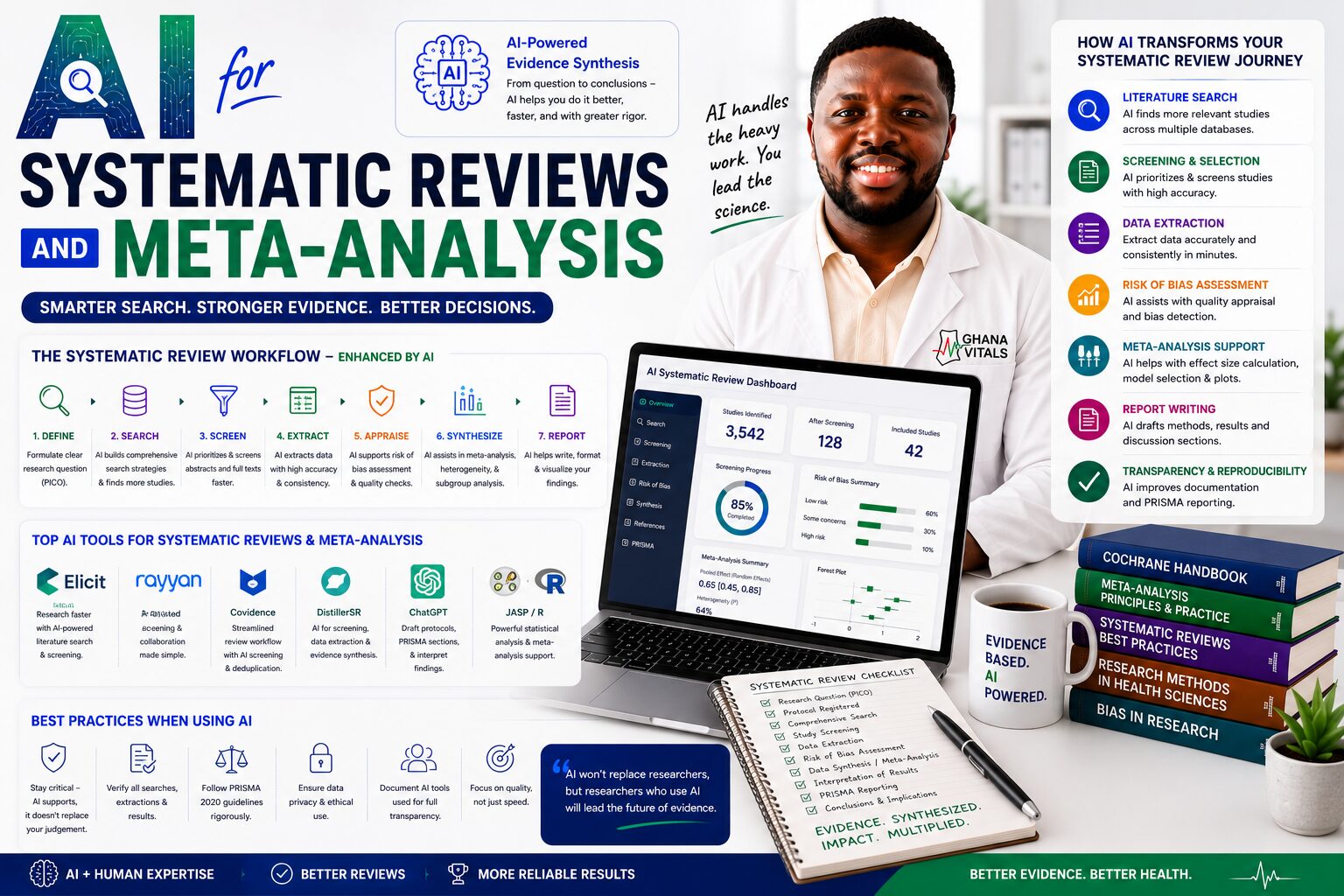
AI for Systematic Reviews and Meta-Analysis: A Practical Guide for Researchers
By Dr. Festus Kaasung Kunde, MD
Medical Doctor | AI in Healthcare Advocate | Founder, AI Doctor Africa & Ghana Vitals
Systematic reviews and meta-analyses sit near the top of the evidence hierarchy because they bring together findings from multiple studies to answer focused research questions.
When performed correctly, they can clarify uncertain evidence, identify patterns across studies, expose gaps in knowledge, and guide clinical practice, public health policy, research funding, and future investigations.
But systematic reviews are also demanding.
A research team may need to:
- Develop a precise research question.
- Register a protocol.
- Search several databases.
- Remove duplicate records.
- Screen thousands of titles and abstracts.
- Retrieve full-text articles.
- Extract data into structured tables.
- Assess risk of bias.
- Compare studies with different designs.
- Conduct statistical analysis.
- Interpret heterogeneity.
- Prepare flow diagrams and evidence tables.
- Write a transparent final report.
Each step requires time, concentration, methodological knowledge, and careful documentation.
Artificial intelligence is beginning to change this process.
AI tools can help researchers organize search concepts, screen records, extract information, summarize studies, identify inconsistencies, prepare analysis code, and improve manuscript clarity. Used responsibly, they can significantly reduce repetitive work.
However, AI can also create serious problems.
It can invent references, misclassify studies, misunderstand outcomes, extract the wrong numbers, overlook methodological weaknesses, and produce statistically convincing but scientifically incorrect explanations.
The central question is therefore not whether AI can perform systematic-review tasks.
It can.
The more important question is:
How can researchers use AI to make systematic reviews faster without weakening their transparency, reproducibility, or scientific integrity?
This guide explains where AI adds value, where human judgment remains essential, and how researchers can build a responsible AI-assisted workflow for systematic reviews and meta-analysis.
What Is a Systematic Review?
A systematic review is a structured method of identifying, evaluating, and synthesizing all relevant evidence addressing a clearly defined research question.
Unlike a traditional narrative review, a systematic review follows a predefined and reproducible methodology.
This usually includes:
- A focused research question.
- Clear eligibility criteria.
- A documented search strategy.
- Screening by predetermined criteria.
- Critical appraisal of included studies.
- Transparent data extraction.
- Structured evidence synthesis.
- Reporting of limitations and potential bias.
The objective is not simply to collect papers.
It is to reduce the influence of selective searching, author preference, and subjective interpretation.
A high-quality systematic review should allow another research team to understand exactly:
- What was searched.
- Where it was searched.
- When the search was performed.
- Which studies were included.
- Why studies were excluded.
- How data were extracted.
- How study quality was assessed.
- How conclusions were reached.
AI assistance must preserve this reproducibility.
If an AI tool contributes to screening, extraction, analysis, or writing, researchers should still be able to explain what the tool did and how its output was verified.
What Is a Meta-Analysis?
A meta-analysis is a statistical method used to combine quantitative findings from two or more sufficiently comparable studies.
A systematic review does not always include a meta-analysis.
Sometimes the studies are too different in their:
- Populations.
- Interventions.
- Comparators.
- Outcomes.
- Study designs.
- Measurement methods.
- Follow-up periods.
When pooling is appropriate, meta-analysis can provide a more precise estimate of an intervention effect, disease association, prevalence, diagnostic accuracy, or other outcome than an individual study may provide.
Common pooled measures include:
- Risk ratios.
- Odds ratios.
- Hazard ratios.
- Mean differences.
- Standardized mean differences.
- Correlation coefficients.
- Prevalence estimates.
- Sensitivity and specificity.
- Diagnostic odds ratios.
AI can assist with the technical preparation for meta-analysis, but it cannot independently determine whether combining studies is scientifically appropriate.
That decision requires methodological and clinical judgment.
Why Systematic Reviews Consume So Much Time
A systematic review is not a single task.
It is a chain of interconnected tasks, and an error at one stage may affect everything that follows.
For example, a weak search strategy may exclude important evidence. Poor screening may introduce irrelevant studies. Incorrect data extraction may distort the pooled estimate. Inappropriate statistical methods may produce misleading conclusions.
The workload also grows rapidly.
A database search may return several thousand records. Even after removing duplicates, researchers may need to screen hundreds or thousands of titles and abstracts.
Full-text screening can be even more difficult because exclusion decisions may depend on subtle details such as:
- The age of participants.
- The diagnostic criteria used.
- The intervention dose.
- The duration of follow-up.
- The reported outcome.
- Whether data for the target population can be separated.
- Whether two papers report results from the same study.
These are precisely the areas where AI appears attractive.
But they are also the areas where an incorrect automated decision can damage the review.
The best approach is therefore supervised acceleration rather than complete automation.
How AI Can Support a Systematic Review
AI can contribute at almost every stage of the review process.
Its strongest role is reducing repetitive cognitive work while allowing researchers to retain control over methodological decisions.
Researchers may use AI to help with:
- Refining the research question.
- Developing search concepts and synonyms.
- Piloting eligibility criteria.
- Prioritizing records for screening.
- Summarizing full-text studies.
- Extracting structured information.
- Identifying possible duplicate publications.
- Comparing study characteristics.
- Drafting risk-of-bias justifications.
- Preparing statistical code.
- Interpreting analysis output educationally.
- Creating evidence tables.
- Reviewing manuscript structure.
- Checking consistency across sections.
Each use requires different safeguards.
An AI-generated list of synonyms may require relatively simple human review. An AI-extracted mortality figure that will enter a meta-analysis requires far more rigorous verification. The greater the potential impact of an error, the stronger the required human oversight.
Step 1: Formulating the Review Question
A strong systematic review begins with a focused question.
AI can help researchers move from a broad interest to a structured and answerable review question.
Using PICO for Intervention Reviews
The PICO framework includes:
- Population: Who is being studied?
- Intervention: What treatment, programme, or exposure is being evaluated?
- Comparator: What is it being compared with?
- Outcome: What result is being measured?
For example:
Among adults with hypertension in sub-Saharan Africa, do community-based screening and follow-up programmes improve blood-pressure control compared with routine facility-based care?
AI can help identify missing elements, overly broad populations, vague outcomes, or inappropriate comparisons.
Other Useful Question Frameworks
Depending on the review type, researchers may use:
- PEO for qualitative or exposure questions.
- PICOS, adding study design.
- SPIDER for qualitative evidence synthesis.
- CoCoPop for prevalence reviews.
- PCC for scoping reviews.
Useful AI Prompt
Review the following systematic-review question using the PICO framework. Identify any vague components, suggest a more precise version, and explain how each proposed change could affect the search strategy and eligibility criteria: [insert question].
What AI Should Not Decide Alone
AI should not independently decide:
- Whether the question is clinically important.
- Whether a similar review already answers it.
- Whether the review is feasible.
- Which outcomes matter most to patients.
- Whether the proposed population reflects the local context.
These decisions require subject expertise and preliminary evidence checking.
Step 2: Developing the Protocol
A systematic-review protocol defines the methods before the results are known.
This reduces the risk of changing methods to obtain preferred findings.
A protocol commonly describes:
- Background and rationale.
- Review objectives.
- Eligibility criteria.
- Information sources.
- Search strategy.
- Screening process.
- Data-extraction methods.
- Risk-of-bias assessment.
- Planned synthesis.
- Subgroup analyses.
- Sensitivity analyses.
- Certainty-of-evidence assessment.
AI can help organize a protocol outline and identify methodological details that researchers may have overlooked.
Useful AI Prompt
Create a protocol checklist for a systematic review evaluating [topic]. Organize it under research question, eligibility criteria, search strategy, screening, data extraction, risk of bias, synthesis, subgroup analysis, sensitivity analysis, and certainty of evidence. Do not invent decisions; mark items that require researcher input.
This is safer than asking AI to write the complete protocol without guidance.
The research team should make every substantive methodological decision.
Step 3: Building the Search Strategy
Search strategy development is one of the most useful applications of AI, but it is also an area where researchers can become overconfident.
A good search must balance:
- Sensitivity: finding as many relevant studies as possible.
- Specificity: avoiding an unmanageable number of irrelevant results.
AI can generate:
- Synonyms.
- Alternative spellings.
- Abbreviations.
- Older terminology.
- Related clinical terms.
- Controlled-vocabulary suggestions.
- Boolean concept groups.
Example Search Concepts
For a review on AI-assisted diabetic-retinopathy screening in Africa, major concepts might include:
- Artificial intelligence.
- Diabetic retinopathy.
- Screening or diagnosis.
- African countries.
AI can suggest terms such as:
- Machine learning.
- Deep learning.
- Neural network.
- Automated image analysis.
- Computer-aided diagnosis.
- Fundus photography.
- Retinal screening.
Useful AI Prompt
Generate possible free-text synonyms and alternative spellings for each concept in this review question: [insert question]. Separate the concepts into groups and do not combine them into a final database query.
The researcher or information specialist can then evaluate the terms before adapting them for individual databases.
Why Database Adaptation Matters
A search written for one database may not work correctly in another.
Different databases use different:
- Field tags.
- Subject headings.
- Truncation symbols.
- Phrase-search rules.
- Proximity operators.
- Syntax.
AI-generated searches must therefore be tested directly within each database.
Involve a Librarian Where Possible
An experienced medical or academic librarian can identify missing concepts, inefficient syntax, and database-specific problems that an AI tool may overlook.
AI should support—not replace—expert search review.
Step 4: Managing Search Results and Removing Duplicates
Searches across several databases frequently retrieve the same article more than once.
Reference-management and review software can remove many exact duplicates automatically.
However, duplicates may remain when records differ in:
- Title punctuation.
- Author formatting.
- Journal abbreviations.
- Publication year.
- Online-first and print dates.
- Conference abstract and full-paper versions.
AI may help compare suspicious records or identify probable duplicate reports.
Useful AI Prompt
Compare these two citations and explain whether they may represent the same study, related publications from the same trial, or separate studies. Base your answer only on the details provided and list what additional information should be checked.
Researchers should distinguish between:
- Duplicate database records.
- Multiple publications from one study.
- Follow-up analyses from the same cohort.
- Conference abstracts later published as full papers.
Treating multiple reports from one study as independent data may lead to double-counting in a meta-analysis.
Step 5: Screening Titles and Abstracts
Screening is one of the most time-consuming stages of a systematic review.
AI tools may rank records by likely relevance, classify abstracts, or identify records resembling previously included studies.
This can reduce workload, particularly when searches produce thousands of records.
However, screening errors may exclude eligible evidence.
A Safer AI-Assisted Screening Model
Researchers can use AI to:
- Test eligibility criteria on a pilot sample.
- Identify ambiguous wording in the criteria.
- Rank records by likely relevance.
- Prioritize likely inclusions for earlier review.
- Flag uncertain records for human attention.
AI should not silently remove large groups of studies without validation.
Useful Screening Prompt
Using the eligibility criteria below, classify this abstract as include, exclude, or uncertain. Quote the exact words from the abstract supporting the decision. Do not assume information that is not reported. Eligibility criteria: [insert criteria]. Abstract: [insert abstract].
Requiring the tool to quote supporting text makes its reasoning easier to audit.
Why “Uncertain” Matters
When important information is missing from an abstract, the appropriate decision is usually to retrieve the full text rather than exclude the record.
AI systems may be tempted to fill gaps with assumptions.
Researchers should instruct them not to do so.
Dual Screening Remains Valuable
Independent screening by two reviewers reduces the risk of subjective or accidental exclusion.
An AI system may act as a prioritization assistant, but researchers should follow the methodological requirements of their protocol, institution, or target publication.
Step 6: Full-Text Screening
Full-text screening requires more nuanced judgment than title and abstract screening.
A study may appear eligible initially but be excluded because:
- The wrong comparator was used.
- The target outcome was not reported.
- The study population was mixed and subgroup data were unavailable.
- The article was a protocol rather than a completed study.
- It duplicated another publication.
- The study design did not meet the review criteria.
AI can help locate relevant information within a long paper.
Useful Full-Text Prompt
Assess this article against each eligibility criterion separately. For every criterion, report eligible, ineligible, or unclear, and provide the page number or section containing the supporting information. Do not make the final inclusion decision.
This preserves human authority over the final decision.
Record Specific Exclusion Reasons
Full-text exclusions should use clear and mutually understandable categories, such as:
- Wrong population.
- Wrong intervention.
- Wrong comparator.
- Wrong outcome.
- Ineligible study design.
- Duplicate publication.
- Insufficient data.
- Full text unavailable.
Avoid vague reasons such as “not relevant.”
AI may help standardize exclusion wording, but reviewers should confirm every decision.
Step 7: Extracting Data From Included Studies
Data extraction transforms research papers into structured information for synthesis.
Typical fields include:
- Study identification.
- Country and setting.
- Study design.
- Recruitment period.
- Participant characteristics.
- Sample size.
- Intervention and comparator details.
- Outcome definitions.
- Follow-up duration.
- Effect estimates.
- Measures of uncertainty.
- Funding source.
- Conflicts of interest.
- Information needed for risk-of-bias assessment.
AI can identify and organize this information, particularly when papers follow consistent reporting formats.
However, data extraction is one of the highest-risk uses of AI.
A single incorrect number may change the pooled result.
Common Extraction Errors
AI may confuse:
- Baseline values with final values.
- Means with medians.
- Standard deviations with standard errors.
- Adjusted estimates with unadjusted estimates.
- Intervention groups with control groups.
- Participants recruited with participants analysed.
- Percentages with absolute numbers.
- Primary outcomes with secondary outcomes.
- Intention-to-treat with per-protocol results.
Safer Extraction Prompt
Extract the requested information into a table. For every numerical value, include the exact table, figure, page, or paragraph where it appears. If a value is not explicitly reported, write “not reported.” Do not calculate missing values unless asked.
Double-Check Every Meta-Analysed Value
Any number entering a meta-analysis should be verified against the original paper by a researcher.
This includes:
- Event counts.
- Group totals.
- Means.
- Standard deviations.
- Effect estimates.
- Confidence intervals.
- Follow-up times.
AI can accelerate extraction.
It should not become the final source of record.
Step 8: Assessing Risk of Bias
Risk-of-bias assessment is not the same as assigning a general quality score.
It evaluates whether aspects of study design, conduct, analysis, or reporting may have distorted the findings.
The appropriate assessment depends on the study design.
Potential domains include:
- Randomization.
- Allocation concealment.
- Blinding.
- Missing outcome data.
- Outcome measurement.
- Selective reporting.
- Confounding.
- Participant selection.
- Intervention classification.
AI can help locate relevant statements and draft preliminary justifications.
Useful AI Prompt
Using the specified risk-of-bias domain, locate passages in the article that are relevant to the judgment. Summarize the evidence for and against bias, but do not assign the final rating. Domain: [insert domain].
This is preferable to asking:
Is this study high quality?
The final judgment should be made by reviewers familiar with the relevant assessment tool.
Why Human Judgment Is Essential
Articles often omit details.
Absence of information does not always prove that a method was not used.
Researchers may need to distinguish between:
- Low risk of bias.
- Some concerns.
- High risk of bias.
- Insufficient information.
AI may produce an unjustifiably confident rating when the paper is unclear.
Step 9: Deciding Whether Meta-Analysis Is Appropriate
Researchers should not conduct a meta-analysis simply because numerical data are available.
Before pooling studies, consider whether they are sufficiently comparable.
Important questions include:
- Are the populations clinically similar?
- Are the interventions meaningfully comparable?
- Are outcome definitions compatible?
- Were outcomes measured at similar time points?
- Are study designs appropriate to combine?
- Are effect measures compatible?
- Would the pooled estimate answer a useful question?
AI can create comparison tables and highlight differences.
It cannot decide the scientific acceptability of pooling without expert oversight.
Useful AI Prompt
Compare these studies across population, intervention, comparator, outcome definition, follow-up, and study design. Identify differences that may affect whether statistical pooling is appropriate. Do not make the final pooling decision.
Sometimes narrative synthesis is more scientifically honest than a pooled number.
Understanding Effect Measures
Choosing the correct effect measure is fundamental to meta-analysis.
Dichotomous Outcomes
For outcomes with two categories, such as death versus survival, researchers may use:
- Risk ratio.
- Odds ratio.
- Risk difference.
These measures are related but not interchangeable.
Continuous Outcomes
For outcomes measured numerically, researchers may use:
- Mean difference when all studies use the same scale.
- Standardized mean difference when studies measure the same construct using different scales.
Time-to-Event Outcomes
Hazard ratios are often used for outcomes such as:
- Time to death.
- Time to relapse.
- Time to hospital discharge.
Prevalence Studies
Prevalence meta-analysis may require transformations or models that account for proportions near zero or one and substantial between-study differences.
AI can explain effect measures and help prepare code, but a statistician or appropriately trained researcher should confirm the chosen method.
Fixed-Effect and Random-Effects Models
Researchers commonly choose between fixed-effect and random-effects approaches.
Fixed-Effect Model
A fixed-effect model assumes that included studies estimate one common underlying effect and that observed differences arise primarily from sampling error.
Random-Effects Model
A random-effects model assumes that the true effect may vary across studies.
This variation may result from differences in:
- Populations.
- Settings.
- Intervention delivery.
- Outcome measurement.
- Follow-up duration.
- Study methods.
- A random-effects model does not solve all heterogeneity problems.
It simply models between-study variation.
Researchers should not select a model mechanically based only on a statistical test.
The choice should reflect the research question and expected variation across studies.
Understanding Heterogeneity
Heterogeneity refers to differences among study findings.
It may be:
- Clinical.
- Methodological.
- Statistical.
Clinical Heterogeneity
Clinical heterogeneity may arise from differences in:
- Participant age.
- Disease severity.
- Treatment dose.
- Setting.
- Coexisting conditions.
- Duration of intervention.
Methodological Heterogeneity
Methodological heterogeneity may result from differences in:
- Study design.
- Risk of bias.
- Outcome definitions.
- Analysis methods.
- Follow-up duration.
Statistical Heterogeneity
Statistical heterogeneity describes variation in effect estimates beyond what may be expected from sampling error alone.
AI can help explain heterogeneity statistics, but researchers must investigate their clinical meaning.
A numerical measure should not replace thoughtful comparison of the studies.
Useful AI Prompt
Explain the possible clinical and methodological reasons for the heterogeneity shown in this meta-analysis. Use only the study characteristics provided and distinguish evidence-based explanations from hypotheses.
Subgroup Analysis and Meta-Regression
Researchers may explore whether effects differ across groups, such as:
- Adults versus children.
- Hospital versus community settings.
- High-income versus low-income settings.
- Short versus long follow-up.
- High versus low risk of bias.
- Different intervention intensities.
Subgroup analysis should ideally be planned in advance.
Conducting many unplanned subgroup analyses increases the risk of chance findings.
Meta-regression can examine whether study-level characteristics are associated with effect estimates. However, it requires adequate numbers of studies and careful interpretation.
AI may suggest possible moderators, but researchers should avoid data-driven searching for attractive explanations.
Sensitivity Analysis
Sensitivity analysis tests whether the review conclusions remain stable when methods or assumptions change.
Examples include:
- Removing studies at high risk of bias.
- Excluding unpublished studies.
- Using a different statistical model.
- Excluding outliers.
- Using adjusted rather than unadjusted estimates.
- Changing assumptions about missing data.
AI can help generate a sensitivity-analysis checklist based on the review design.
Useful AI Prompt
Based on the methods and potential limitations of this meta-analysis, suggest appropriate sensitivity analyses. Explain what uncertainty each analysis would test. Do not recommend analyses that are not supported by the available data.
Publication Bias and Small-Study Effects
Studies with statistically significant or favourable findings may be more likely to be published than studies with null or unfavourable results.
This can distort a systematic review.
Researchers may investigate publication bias and small-study effects through methods such as:
- Funnel-plot assessment.
- Statistical tests.
- Searching trial registries.
- Searching grey literature.
- Comparing published reports with protocols.
- Considering selective outcome reporting.
Funnel-plot asymmetry does not automatically prove publication bias.
It may also result from:
- Heterogeneity.
- Methodological differences.
- Chance.
- Poor study quality.
- Different effect sizes in smaller populations.
AI-generated interpretations should therefore be cautious.
Using AI to Prepare Meta-Analysis Code
AI can help researchers draft code for statistical software.
For example, it may assist with:
- Importing a dataset.
- Calculating effect sizes.
- Fitting fixed-effect or random-effects models.
- Producing forest plots.
- Conducting subgroup analyses.
- Performing sensitivity analyses.
- Generating funnel plots.
This can be especially useful for researchers learning R or another programming language.
However, generated code may contain:
- Incorrect variable names.
- Inappropriate functions.
- Unsupported assumptions.
- Outdated syntax.
- Wrong effect-size calculations.
- Missing data-handling errors.
Safer Coding Workflow
- Describe the dataset structure.
- State the desired effect measure.
- Specify the statistical model.
- Ask AI to explain each line.
- Run the code on a copy of the data.
- Review warnings and errors.
- Compare results with another validated method.
- Have the analysis reviewed by a statistician where possible.
Useful AI Prompt
Write annotated R code for a random-effects meta-analysis of risk ratios using event counts from intervention and control groups. Explain every step, identify the assumptions, and include checks for incorrect or missing values. Do not invent a dataset.
AI-generated code should be treated as a draft, not as validated statistical analysis.
AI for Narrative Synthesis
When statistical pooling is inappropriate, researchers may perform a narrative synthesis.
Narrative synthesis should still be systematic.
It may organize evidence by:
- Intervention type.
- Population.
- Outcome.
- Study design.
- Geographical setting.
- Direction of effect.
- Risk of bias.
AI can help compare studies and identify recurring themes.
Useful AI Prompt
Using only this evidence table, organize the studies into meaningful groups and summarize the direction and consistency of findings. Clearly distinguish between findings reported by the studies and your proposed interpretation.
Researchers should avoid allowing AI to produce a smooth narrative that hides important contradictions.
Disagreement between studies is often scientifically meaningful and should remain visible.
AI for Writing the Final Review
AI can help improve the language and organization of a systematic-review manuscript.
It may assist with:
- Structuring the introduction.
- Improving transitions.
- Reducing repetition.
- Clarifying methods.
- Standardizing terminology.
- Summarizing tables.
- Editing the discussion.
- Checking consistency between the abstract and main text.
- Drafting plain-language summaries.
AI Should Not Invent Missing Methods
The methods section must describe what the researchers actually did.
AI should never add procedures simply because they are commonly expected.
For example, it should not claim that:
- Two reviewers screened independently.
- A protocol was registered.
- Authors were contacted.
- Grey literature was searched.
- Sensitivity analyses were performed.
unless these actions actually occurred.
Useful Editing Prompt
Edit this methods section for clarity and consistency without adding, removing, or changing any methodological procedure. Flag statements that appear incomplete or ambiguous rather than filling in missing details.
Using AI to Check Reporting Completeness
Before submission, researchers can ask AI to compare the draft against a reporting checklist.
AI may flag missing information relating to:
- Eligibility criteria.
- Search dates.
- Full search strategies.
- Screening procedures.
- Data-extraction processes.
- Risk-of-bias methods.
- Synthesis decisions.
- Excluded studies.
- Protocol deviations.
- Funding and conflicts of interest.
Useful AI Prompt
Compare this manuscript against the reporting checklist provided. Create a table showing each item, whether it appears to be reported, where it is reported, and what may still be missing. Do not assume that an unreported method was performed.
The research team should conduct the final checklist assessment.
AI Tools That May Support Systematic Reviews
Different tools serve different functions.
General-Purpose AI Assistants
Tools such as ChatGPT, Claude, and Gemini can assist with:
- Question refinement.
- Search-term brainstorming.
- Article summarization.
- Data-table design.
- Code explanation.
- Writing and editing.
- Reviewer simulation.
Evidence-Discovery Tools
Research-focused platforms may assist with:
- Finding relevant studies.
- Exploring related papers.
- Extracting study characteristics.
- Comparing evidence.
- Prioritizing literature.
Screening Platforms
Some review-management platforms include machine-learning features that rank or prioritize records during screening.
Reference Managers
Reference-management software supports:
- Citation storage.
- Deduplication.
- PDF organization.
- Citation insertion.
- Bibliography formatting.
Statistical Tools
Meta-analysis may be conducted using:
- R.
- Stata.
- RevMan.
- Comprehensive Meta-Analysis.
- Other validated statistical packages.
Researchers should select tools based on their review design, institutional access, technical expertise, data-security requirements, and need for reproducibility.
Using more tools does not automatically improve the review.
A smaller, clearly defined toolset is often safer.
Major Risks of Using AI in Evidence Synthesis
AI assistance can introduce several forms of error.
Fabricated References
An AI system may generate articles, authors, journal names, or identifiers that do not exist.
Never add a citation to a systematic review unless it has been verified in the original database or publication.
Incorrect Eligibility Decisions
AI may exclude a study because it misunderstands:
- The population.
- The study design.
- The intervention.
- The outcome.
- The publication type.
Extraction Errors
AI may select the wrong time point, group, denominator, or statistical measure.
Loss of Reproducibility
A review becomes difficult to reproduce when researchers cannot document:
- Which tool was used.
- Which version was used.
- What instructions were provided.
- What records were processed.
- How decisions were verified.
Automation Bias
Researchers may trust AI output because it appears organized and confident.
Confidence of presentation is not evidence of accuracy.
Confidentiality Risks
Researchers should not upload sensitive or confidential information without checking:
- Institutional policies.
- Data-protection requirements.
- Platform terms.
- Research agreements.
- Participant consent.
- Intellectual-property restrictions.
Over-Synthesis
AI may force diverse studies into a single, coherent conclusion even when the evidence is inconsistent.
Good evidence synthesis should preserve uncertainty.
A Responsible AI-Assisted Workflow
A practical workflow may look like this:
Phase 1: Question and Protocol
Researchers:
- Select the topic.
- Confirm the review type.
- Define the question.
- Establish eligibility criteria.
- Register or publish the protocol where appropriate.
AI assists with:
- Question-framework checks.
- Protocol organization.
- Identification of unclear wording.
Phase 2: Search Development
Researchers:
- Choose databases.
- Approve concepts.
- Test search performance.
- Document final strategies.
AI assists with:
- Synonyms.
- Alternative terminology.
- Preliminary concept grouping.
Phase 3: Screening
Researchers:
- Pilot the criteria.
- Make final eligibility decisions.
- Resolve disagreements.
- Record exclusion reasons.
AI assists with:
- Record prioritization.
- Preliminary classification.
- Evidence-location support.
Phase 4: Extraction and Appraisal
Researchers:
- Approve the extraction form.
- Verify all numerical values.
- Make final risk-of-bias judgments.
AI assists with:
- Locating relevant passages.
- Populating preliminary tables.
- Identifying missing information.
Phase 5: Synthesis
Researchers:
- Decide whether pooling is appropriate.
- Select effect measures.
- Choose statistical models.
- Interpret findings.
AI assists with:
- Code drafting.
- Table preparation.
- Educational explanation of output.
- Identification of potential inconsistencies.
Phase 6: Reporting
Researchers:
- Write the scientific interpretation.
- Report limitations.
- Complete reporting checklists.
- Approve the final manuscript.
AI assists with:
- Language editing.
- Structural review.
- Consistency checks.
- Plain-language summaries.
At every stage, the researchers remain accountable.
A Verification Framework for AI Output
Before accepting an AI-generated contribution, ask five questions.
Is It Traceable?
Can the claim, number, or decision be traced to an original source?
Is It Reproducible?
Could another researcher repeat the process using the documented methods?
Is It Verifiable?
Has a human reviewer checked the output against the source material?
Is It Appropriate?
Does the method fit the research question and study design?
Is It Transparent?
Will readers understand where AI was used and how its output was supervised?
If the answer to any of these questions is no, the output should not enter the final review without further work.
Practical AI Prompts for Systematic Review Researchers
Question Development
Convert this broad topic into three focused systematic-review questions using the PICO framework. Explain the advantages and limitations of each question.
Search Planning
Generate free-text synonyms, abbreviations, spelling variants, and historical terms for each concept in this review question. Do not create references or claim that the list is complete.
Eligibility Criteria
Review these inclusion and exclusion criteria for overlap, ambiguity, and missing definitions. Suggest clearer wording without changing the intended scope.
Screening
Classify this abstract as include, exclude, or uncertain using the stated criteria. Quote the exact text supporting your classification and do not assume unreported information.
Full-Text Assessment
Evaluate this article against each eligibility criterion separately. Provide the relevant page or section for each judgment.
Data Extraction
Extract the specified study characteristics into a table. Include the page, table, or figure supporting each extracted value.
Risk of Bias
Identify passages relevant to the following risk-of-bias domain. Summarize the evidence but leave the final judgment to the reviewer.
Study Comparison
Compare the included studies across population, setting, intervention, comparator, outcome definition, follow-up, and study design.
Meta-Analysis Preparation
Check this dataset for missing values, impossible values, inconsistent labels, duplicated studies, and mismatched group totals.
Statistical Code
Draft annotated code for the specified meta-analysis. Explain assumptions, required variables, and validation checks.
Heterogeneity
Identify plausible clinical and methodological explanations for heterogeneity based only on the supplied study-characteristics table.
Sensitivity Analysis
Suggest sensitivity analyses relevant to these methodological concerns and explain what each analysis would test.
Discussion Writing
Review this discussion for overstatement, unsupported causal claims, repetition, and failure to reflect uncertainty. Do not rewrite it yet.
Reporting Check
Compare this manuscript with the supplied reporting checklist and identify potentially missing items, with section locations where available.
Peer-Review Simulation
Act as a systematic-review peer reviewer. Evaluate the search, screening, extraction, risk-of-bias assessment, synthesis, and interpretation. Separate major concerns from minor comments.
Common Mistakes Researchers Should Avoid
Asking AI to Find “All Relevant Studies”
No AI tool should be assumed to identify every eligible study.
Systematic searching requires documented database strategies and appropriate information sources.
Accepting AI Summaries Without Reading Key Papers
Summaries are useful for prioritization.
They should not replace detailed reading of studies central to the conclusions.
Entering Extracted Numbers Without Verification
Every numerical value used in analysis should be checked against the original report.
Asking AI to Choose the Statistical Model Automatically
Model selection requires methodological reasoning, not only software output.
Pooling Studies Because AI Says They Are Similar
Clinical and methodological compatibility must be assessed by researchers.
Generating Missing Data
AI should not estimate or invent unpublished values unless the review protocol specifies a valid calculation and the method is transparently reported.
Hiding Uncertainty
AI-generated writing often sounds more certain than the evidence justifies.
Researchers should use language that reflects the actual strength and limitations of the evidence.
Failing to Document AI Use
Undocumented AI involvement may reduce reproducibility and create questions about research integrity.
Special Considerations for African Researchers
Systematic reviews are particularly valuable in African healthcare because they can identify whether global evidence applies to local populations and health systems.
However, researchers examining African evidence may face additional challenges:
- Limited indexing of local journals.
- Incomplete database coverage.
- Poor access to full-text publications.
- Small numbers of primary studies.
- Inconsistent outcome definitions.
- Limited reporting of methods.
- Publication in several languages.
- Important evidence contained in reports, theses, or institutional documents.
- High clinical and methodological heterogeneity across settings.
AI may help organize fragmented evidence, but it can also amplify existing database biases.
If a tool is trained or optimized primarily on highly indexed literature, it may overlook local evidence.
Researchers should therefore consider:
- African regional databases.
- University repositories.
- Government reports.
- Conference proceedings.
- Professional associations.
- Direct contact with local experts.
- Citation searching.
- Grey-literature sources.
A review about African healthcare should not rely solely on whichever studies are easiest for an AI tool to retrieve.
Local knowledge remains essential.
How AI Could Support Ghana Vitals Research
A preventive-health initiative such as Ghana Vitals may eventually generate or use evidence relating to:
- Community hypertension screening.
- Diabetes detection.
- Cardiovascular-risk assessment.
- Referral completion.
- Preventive-health awareness.
- Community health data systems.
- Digital follow-up.
- AI-assisted risk stratification.
Before designing an intervention, a systematic review could assess:
- Which community-screening models have been tested in Africa.
- Whether screening improves linkage to care.
- Which follow-up strategies improve treatment initiation.
- How digital tools affect retention.
- What barriers reduce participation.
- Which approaches are cost-effective.
AI could accelerate the organization of this evidence.
However, the most important interpretation would still require understanding Ghana’s:
- Health system.
- Community structures.
- Referral pathways.
- Data-protection environment.
- Resource constraints.
- Cultural context.
Evidence synthesis becomes valuable when it helps researchers make better local decisions—not merely when it produces another publication.
Frequently Asked Questions
Can AI conduct an entire systematic review?
AI can assist with many tasks, but it should not independently conduct the entire review. Researchers must control the protocol, search validation, eligibility decisions, extraction verification, risk-of-bias judgments, statistical methods, and interpretation.
Can ChatGPT screen articles for a systematic review?
It can classify titles, abstracts, or full texts according to supplied criteria. However, its decisions should be validated, and researchers should avoid allowing it to exclude records automatically without appropriate quality checks.
Can AI perform data extraction?
AI can prepare preliminary extraction tables and locate relevant information. All data—especially values entering a meta-analysis—should be verified against the original article.
Can AI perform a meta-analysis?
AI can generate or explain statistical code, but the analysis must be conducted using validated statistical methods and reviewed by someone who understands meta-analysis.
Can AI create a database search strategy?
AI can suggest terms and preliminary Boolean groups. The final search should be adapted to each database, tested, documented, and ideally reviewed by an information specialist or librarian.
Should AI be used as one of the independent reviewers?
This depends on the protocol, research purpose, institutional requirements, and validation strategy. AI should not automatically be treated as equivalent to a trained human reviewer.
Can AI assess risk of bias?
AI may locate relevant passages and draft preliminary explanations. Final judgments should be made by reviewers who understand the assessment tool and study design.
Can AI interpret a forest plot?
AI can explain common elements such as effect estimates, confidence intervals, study weights, and pooled effects. Researchers must still interpret clinical relevance, heterogeneity, methodological quality, and certainty of evidence.
Is AI-generated statistical code safe?
Not automatically. Code should be inspected, tested, explained, and validated before use in a final analysis.
Should researchers disclose AI use?
Researchers should follow the requirements of their institutions, journals, funders, and professional bodies. Transparency is especially important when AI contributes to screening, extraction, analysis, or substantive manuscript content.
Key Takeaways
- AI can reduce repetitive work across systematic reviews and meta-analyses.
- The strongest applications include question refinement, search-term development, record prioritization, preliminary extraction, code drafting, and manuscript editing.
- AI should not make unsupervised final decisions about study eligibility, risk of bias, statistical pooling, or scientific conclusions.
- Every extracted value used in meta-analysis should be verified against the original study.
- Search strategies must be tested and adapted for each database.
- Statistical pooling should be based on clinical and methodological reasoning, not merely the availability of numerical data.
- AI-generated references and citations must always be verified.
- Researchers should document how AI was used and how its output was checked.
- African researchers should actively search for locally relevant and grey literature that may not be easily retrieved by mainstream AI systems.
- AI should improve efficiency without reducing transparency, reproducibility, or research integrity.
Related Articles
- AI for Academic Writing: Benefits, Risks, and Best Practices
- AI for Research Proposal Writing
- Can AI Write Scientific Papers?
- AI for Grant Applications and Funding Proposals
- AI for Medical Research in 2026
- Top AI Tools for Medical Researchers
About the Author
Dr Festus Kaasung Kunde is a Medical Doctor, AI in Healthcare Advocate, and Founder of AI Doctor Africa and Ghana Vitals. He holds an MD from Stavropol State Medical University, Russia (2025), and completed an internship at Korle-Bu Teaching Hospital in Accra. His mission is to help African healthcare professionals adopt AI responsibly to improve learning, research, and patient outcomes.
AI Doctor Africa | aidoctorafrica.com
Medical Disclaimer: For educational purposes only. AI tools do not replace clinical supervision, verified study resources, or your medical school’s academic guidance. Always verify clinical facts against authoritative primary sources.

Dr. Festus K. Kunde
Dr. Festus Kaasung Kunde is a medical doctor, Content creator, healthcare technology writer, and digital health innovator specializing in Artificial Intelligence in Medicine, Healthcare Systems Innovation, and Health Data Science in Africa. He is the founder of AI Doctor Africa (AIDoctorAfrica.com), an educational platform dedicated to helping healthcare professionals—including doctors, medical students, nurses, and researchers—understand and responsibly apply artificial intelligence in clinical practice, medical education, medical research, and healthcare innovation. He is also the creator of Ghana Vitals, a health data and predictive analytics initiative focused on collecting and analyzing key health indicators such as blood pressure, blood glucose, and BMI to support early disease detection, preventive healthcare, and data-driven decision-making in Ghana and across Africa. The project reflects his long-term vision of building scalable, AI-powered public health systems for African populations. Dr. Kunde’s work focuses on the practical integration of AI tools such as ChatGPT, Claude, and emerging clinical AI systems into real-world healthcare workflows. His content emphasizes improving clinical documentation, accelerating medical education, strengthening research productivity, and supporting healthcare decision-making in resource-limited settings. Through AI Doctor Africa, he publishes evidence-informed, practice-oriented resources including AI workflows, clinical use cases, medical education guides, and tutorials designed specifically for African healthcare professionals. Through Ghana Vitals, he extends this mission into population health innovation, aiming to leverage real-world health data and predictive models to improve early intervention, reduce preventable disease burden, and strengthen health systems across Africa. His overall mission is to bridge the gap between traditional clinical medicine, artificial intelligence, and data-driven public health, empowering African healthcare professionals to work smarter, diagnose earlier, and deliver better care through technology. Areas of Expertise Artificial Intelligence in Clinical Medicine Digital Health & Healthcare Innovation in Africa Health Data Analytics & Predictive Health Systems Medical Education and Exam Preparation AI for Medical Research and Scientific Writing Clinical Workflow Optimization using AI Tools Public Health Data Systems (Ghana Vitals Initiative) Professional Focus Dr. Kunde’s work sits at the intersection of clinical medicine, artificial intelligence, and population health systems, with a strong focus on scalable solutions for African healthcare challenges. His initiatives emphasize ethical AI use, data-driven decision-making, and practical implementation in real-world clinical and public health environments.
View author profile →