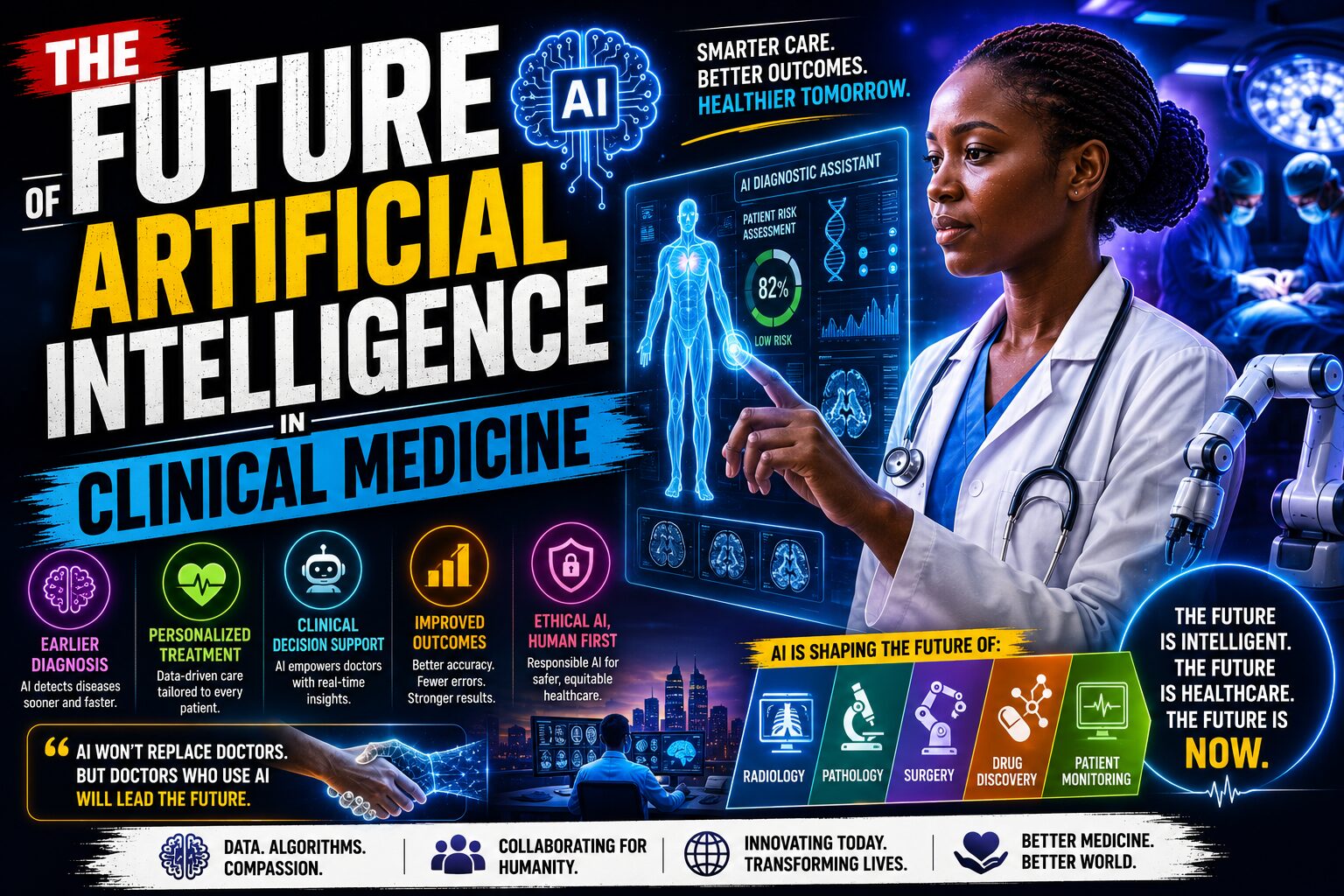
The Future of Artificial Intelligence in Clinical Medicine
By Dr Stephanie Owusu Ankomah
Medical Doctor | Medical Writer, AI Doctor Africa
Artificial intelligence (AI) is rapidly changing clinical medicine. What was once considered futuristic is now becoming part of everyday healthcare, assisting clinicians with diagnosis, documentation, treatment planning, medical imaging, and patient monitoring.
Yet, despite the excitement, one question remains: What does the future of AI in clinical medicine actually look like?
The answer is not a future where machines replace doctors. Instead, it is one where clinicians and AI work together to deliver safer, faster, and more personalised patient care.
AI as a Clinical Assistant
Over the next decade, AI is likely to become an everyday clinical assistant rather than an independent decision-maker.
Doctors may use AI to:
- Summarise patient histories.
- Draft clinic notes.
- Retrieve evidence-based guidelines.
- Generate differential diagnoses.
- Interpret laboratory trends.
- Flag abnormal investigations.
- Suggest appropriate follow-up.
Instead of replacing clinical reasoning, AI will reduce administrative workload, allowing clinicians to spend more time with patients.
Smarter Diagnostics
One of AI’s greatest strengths is pattern recognition.
Future AI systems will assist clinicians in analysing:
- X-rays.
- CT scans.
- MRI scans.
- Histopathology slides.
- Retinal images.
- ECGs.
- Dermatological lesions.
These systems may identify subtle abnormalities that are easily overlooked, helping clinicians detect diseases such as cancer, tuberculosis, diabetic retinopathy, stroke, and cardiovascular disease earlier.
However, the final diagnosis should always remain the responsibility of qualified healthcare professionals.
Personalised Medicine
Clinical medicine is moving away from a one-size-fits-all approach.
AI will increasingly combine information from a patient’s medical history, laboratory results, genetics, imaging, medications, and lifestyle to support more personalised treatment recommendations.
This could help clinicians choose therapies that are more effective while reducing unnecessary side effects.
Personalised medicine has the potential to improve outcomes across chronic diseases, oncology, cardiovascular medicine, and many other specialities.
Predicting Disease Before It Happens
Future AI systems may shift healthcare from reactive treatment to proactive prevention.
By analysing electronic health records and routine clinical data, AI could identify patients at increased risk of:
- Heart disease.
- Stroke.
- Diabetes.
- Chronic kidney disease.
- Sepsis.
- Hospital readmission.
- Medication-related complications.
Rather than waiting for disease to progress, clinicians could intervene earlier with lifestyle advice, screening, or treatment.
AI in Emergency and Critical Care
Emergency departments generate enormous amounts of information within a short period.
AI could assist clinicians by rapidly analysing vital signs, laboratory results, imaging, and clinical observations to identify patients at greatest risk of deterioration.
Potential applications include:
- Early sepsis detection.
- Stroke alerts.
- Cardiac risk prediction.
- ICU deterioration monitoring.
- Trauma triage.
- Medication safety checks.
These systems may improve response times without replacing clinical judgement.
Virtual Clinical Support
AI-powered virtual assistants may become integrated into routine healthcare.
Patients could use them to:
- Report symptoms.
- Receive appointment reminders.
- Monitor chronic diseases.
- Track medications.
- Access health education.
- Communicate with healthcare providers.
For clinicians, AI assistants may organise patient information before consultations, making appointments more efficient.
Transforming Medical Documentation
Documentation is one of the most time-consuming aspects of clinical practice.
Future AI systems may automatically generate:
- Consultation notes.
- Admission clerking.
- Discharge summaries.
- Referral letters.
- Operative reports.
- Clinical coding.
Healthcare professionals would review and approve these documents, significantly reducing paperwork while maintaining clinical oversight.
AI Will Strengthen, Not Replace, Clinical Judgement
Clinical medicine is far more than recognising patterns.
Doctors must interpret symptoms within the context of a patient’s history, social circumstances, physical examination, emotions, values, and preferences.
AI cannot comfort a frightened patient, deliver difficult news with empathy, obtain informed consent, or make ethical decisions in complex situations.
Clinical judgement, communication, compassion, and professionalism will remain uniquely human skills.
Challenges That Must Be Addressed
The future of AI in clinical medicine also comes with important challenges.
Healthcare systems must address:
- Patient privacy and data security.
- Algorithmic bias.
- Clinical accountability.
- Regulatory oversight.
- AI validation in diverse populations.
- Transparency of AI recommendations.
- Healthcare worker training.
AI should support evidence-based medicine, not replace it.
Clinicians must continue to question, verify, and critically evaluate AI-generated recommendations.
What This Means for Africa
AI offers enormous opportunities for African healthcare.
It could help address shortages of specialists, improve diagnostic support in rural hospitals, strengthen telemedicine, assist community health workers, and improve disease surveillance.
However, African AI solutions must be built for African realities.
Successful systems should work with limited internet connectivity, affordable devices, local disease patterns, national treatment guidelines, and multiple African languages.
Most importantly, African clinicians should play a central role in designing and evaluating these technologies.
Related Articles
- How African Doctors Can Use AI in Daily Practice
- AI in African Healthcare: Opportunities and Challenges
- The Future of AI in Ghanaian Healthcare
- AI for Rural Healthcare in Africa
- Can AI Solve Africa’s Healthcare Workforce Shortage?
- AI for Community Health Workers in Africa
- AI and Universal Health Coverage in Africa
- Top African HealthTech Startups Using AI
About the Author
Dr Stephanie Owusu Ankomah is a Medical Doctor, Medical Writer at aidoctorafrica, and a Healthcare Management MSc Student. She holds an MD from Stavropol State Medical University, Russia (2024), and is currently pursuing an MSc in International Healthcare Management in Germany, with hands-on experience supporting hospital operations, patient care coordination, clinical documentation, and multidisciplinary healthcare teams across outpatient clinics, wards, emergency care, surgery, and paediatrics.
AI Doctor Africa | aidoctorafrica.com
Medical Disclaimer: For educational purposes only. AI tools do not replace clinical supervision, verified study resources, or your medical school’s academic guidance. Always verify clinical facts against authoritative primary sources.