
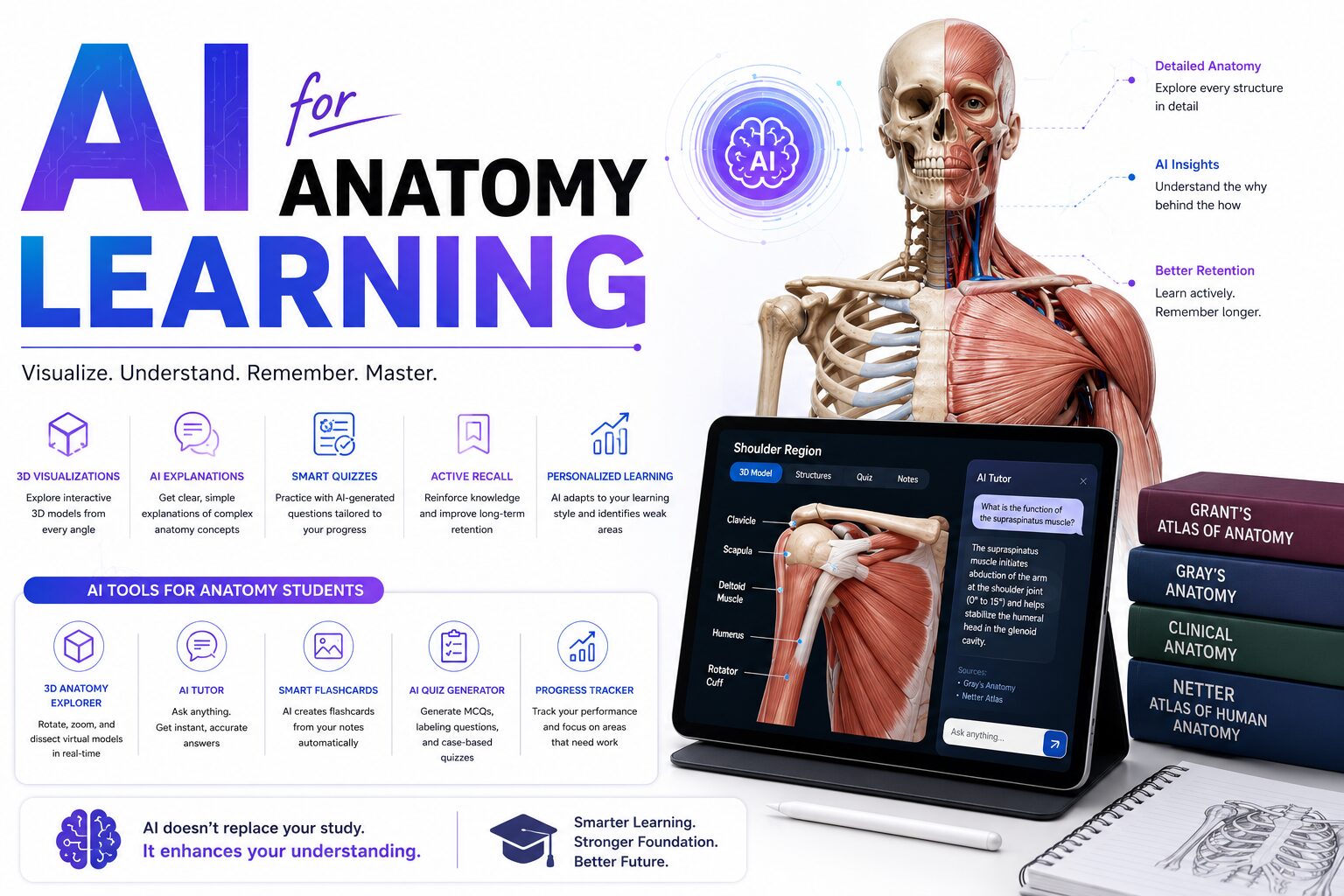
AI for Anatomy Learning: The Complete Guide for Medical Students in 2026
By Dr Festus Kaasung Kunde, MD
Medical Doctor | Founder, AI Doctor Africa
Published: 2026
Reading Time: 18–22 Minutes
Category: AI for Medical Students
Quick Summary
Anatomy remains one of the most difficult subjects in medicine. Thousands of medical students fail anatomy examinations not because they are unintelligent, but because anatomy requires the simultaneous mastery of visualisation, memorisation, spatial relationships, embryology, and clinical application.
In 2026, Artificial Intelligence has changed how anatomy is learned.
Instead of spending hours staring at static textbook diagrams, students can now use AI to generate mnemonics, create quizzes, explain anatomical relationships, build clinical correlations, visualise structures in three dimensions, and act as a personal anatomy tutor available 24 hours a day.
This guide explains how medical students can use AI tools such as ChatGPT, Claude, Gemini, Complete Anatomy, and Anatomy Learning 3D to master anatomy faster and retain it longer.
Why Anatomy Nearly Defeated Me
I still remember my first serious anatomy examinations at Stavropol State Medical University. Like many medical students, I approached anatomy the wrong way. I tried to memorise everything.
- Every muscle.
- Every artery.
- Every nerve.
- Every branch.
- Every foramen.
- Every surface marking.
The result?
Information overload. The more I memorised, the more I forgot. The brachial plexus looked like spaghetti. The cranial nerves seemed impossible. The skull foramina felt designed specifically to torture medical students. Then something changed. I stopped trying to memorise anatomy and started trying to understand anatomy.
- Why does this nerve travel here?
- Why does this artery branch this way?
- What happens clinically if this structure is damaged?
- How do all these structures relate in real life?
Today, AI helps students make that transition much faster than I was able to.
Instead of spending weeks trying to understand a concept, students can use AI as a tutor to explain anatomy from multiple angles until the concept becomes clear.
That is where AI becomes powerful.
Why Anatomy Is So Difficult
Most medical students struggle because anatomy requires five different skills simultaneously.
| Challenge | Why Students Struggle |
|---|---|
| Memorization | Thousands of structures |
| Visualization | Difficult to imagine 3D relationships |
| Spatial Understanding | Structures overlap |
| Clinical Correlation | Hard to connect anatomy to disease |
| Retention | Information fades quickly |
Traditional anatomy learning often focuses heavily on memorisation.
AI helps students focus on understanding.
How AI Helps Students Learn Anatomy
1. AI Explains Anatomy Like a Tutor
Instead of reading a textbook paragraph five times, you can ask:
Prompt
“Act as an anatomy professor. Explain the brachial plexus to a second-year medical student. Use simple language, diagrams in text form, clinical examples, and memory tricks.”
The AI adapts the explanation to your level.
2. AI Creates Mnemonics
Every medical student knows the power of mnemonics.
Example:
Cranial Nerves
“Oh Oh Oh To Touch And Feel Very Good Velvet AH”
AI can generate dozens of alternatives instantly.
Prompt:
“Create 20 memorable mnemonics for the cranial nerves that are easy to remember during exams.”
3. AI Generates Anatomy MCQs
Prompt:
“Generate 30 MDC Ghana anatomy MCQs focused on upper limb anatomy. Include explanations.”
This creates unlimited practice questions.
4. AI Builds Clinical Correlations
This is where anatomy becomes interesting.
Prompt:
“Explain the facial nerve. Then explain how Bell’s palsy occurs and why patients develop facial drooping.”
Students remember anatomy much longer when connected to real patients.
5. AI Creates Viva Practice
Prompt:
“Act as an anatomy examiner. Ask me one anatomy viva question at a time and wait for my answer.”
Perfect for oral examinations.
The Best AI Tools for Anatomy Learning
| Tool | Best For |
|---|---|
| ChatGPT | MCQs, mnemonics, quick explanations |
| Claude | Deep understanding |
| Gemini | Images and Google integration |
| Complete Anatomy | 3D anatomy |
| Anatomy Learning 3D | Visualization |
| Kenhub | Anatomy videos |
| Anki + AI | Long-term retention |
Anatomy Topics AI Is Excellent At Teaching
Upper Limb
- Brachial plexus
- Rotator cuff
- Axillary artery
- Cubital fossa
- Carpal tunnel
Lower Limb
- Femoral triangle
- Sciatic nerve
- Popliteal fossa
- Gluteal region
Neuroanatomy
- Cranial nerves
- Brainstem
- Corticospinal tract
- Basal ganglia
Thorax
- Heart anatomy
- Coronary circulation
- Mediastinum
Abdomen
- Portal system
- Liver anatomy
- Inguinal canal
Pelvis
- Female reproductive anatomy
- Male reproductive anatomy
- Pelvic floor
AI Prompts Every Medical Student Should Save
| Goal | Prompt |
|---|---|
| Learn a topic | Explain [topic] from first principles |
| Viva practice | Act as an anatomy examiner |
| MCQs | Generate 20 anatomy MCQs |
| Mnemonics | Create memory tricks for [topic] |
| Clinical relevance | Explain the clinical importance of [structure] |
| Revision | Summarise [topic] into one page |
| Exam prep | Give high-yield facts for [topic] |
| Weak area repair | Teach me anatomy, as if I keep failing this topic |
Using AI for the Brachial Plexus
The brachial plexus is one of the most feared topics in anatomy.
Instead of memorising:
Roots → Trunks → Divisions → Cords → Branches
Ask AI:
“Explain the brachial plexus like a road network from Accra to Kumasi. Make it impossible for me to forget.”
AI can turn abstract anatomy into memorable stories.
Anatomy Learning for MDC Ghana
Students preparing for MDC Ghana should focus on:
Frequently Tested Areas
- Cranial nerves
- Brachial plexus
- Inguinal canal
- Femoral triangle
- Coronary circulation
- Portal venous system
- Pelvic anatomy
- Histology basics
- Embryology basics
- Surface anatomy
Prompt:
“I am preparing for MDC Ghana. Identify the highest-yield anatomy topics tested repeatedly and teach them clinically.”
A Weekly AI Anatomy Study System
| Day | Activity |
|---|---|
| Monday | Learn one major anatomy topic |
| Tuesday | Generate MCQs |
| Wednesday | Clinical correlations |
| Thursday | Viva practice |
| Friday | Mnemonics and revision |
| Saturday | Full anatomy quiz |
| Sunday | Weak area review |
Total time:
Approximately 30–45 minutes daily.
Common Mistakes Students Make
Mistake 1
Using AI instead of studying.
AI is a tutor, not a replacement for textbooks.
Mistake 2
Ignoring cadaveric anatomy.
Nothing replaces actual dissection experience.
Mistake 3
Memorising AI answers without understanding.
Always ask:
“Why?”
Mistake 4
Never testing themselves.
Retrieval practice remains essential.
Can AI Replace Anatomy Professors?
No.
AI cannot replace:
- Cadaver dissection
- Practical demonstrations
- Clinical experience
- Professional mentorship
However, AI can provide something many anatomy departments cannot:
Unlimited one-on-one tutoring.
- Every hour.
- Every day.
- At no cost.
Key Takeaways
- AI makes anatomy easier to understand.
- AI improves retention through active learning.
- AI generates unlimited MCQs and viva questions.
- AI creates personalised mnemonics.
- AI helps connect anatomy to clinical medicine.
- AI should supplement, not replace, traditional anatomy teaching.
- The best results come from combining AI, textbooks, 3D anatomy apps, and active recall.
Frequently Asked Questions
Is AI good for anatomy?
Yes. Anatomy is one of the subjects that benefits most from AI because AI can explain structures, create mnemonics, generate quizzes, and provide clinical correlations instantly.
Can ChatGPT teach anatomy?
Yes, especially for concept explanation, MCQ generation, viva preparation, and revision.
What is the best AI for anatomy?
Claude is best for deep explanations, ChatGPT for practice questions, and Complete Anatomy for visualisation.
Can AI help me pass anatomy?
Yes, but only if combined with active recall, spaced repetition, and regular revision.
Is AI useful for MDC Ghana anatomy preparation?
Absolutely. AI can generate Ghana-focused anatomy revision materials and clinical correlations relevant to licensing examinations.
Related Articles on AI Doctor Africa
- How AI Can Help You Pass Medical School: The Complete Strategy Guide for 2026
- Best AI Tools for Medical Students in 2026: The Complete Guide
- 100 ChatGPT Prompts for Medical Students: The Complete 2026 Prompt Library
- Gemini AI for Medical Students: How to Use Google’s AI to Study Smarter
- AI for Medical Licensing Examinations: Ghana, Nigeria, South Africa, USMLE, and PLAB
- ChatGPT vs Claude for Medical Doctors: Which AI Is Better in 2026?
About the Author
Dr Festus Kaasung Kunde is a Medical Doctor, AI in Healthcare Advocate, and Founder of AI Doctor Africa and Ghana Vitals. He holds an MD from Stavropol State Medical University in Russia (2025) and completed an internship at Korle-Bu Teaching Hospital in Accra. His mission is to help African healthcare professionals adopt AI responsibly to improve learning, research, and patient outcomes.
AI Doctor Africa | aidoctorafrica.com
Medical Disclaimer: For educational purposes only. AI tools do not replace clinical supervision, verified study resources, or your medical school’s academic guidance. Always verify clinical facts against authoritative primary sources.

Dr. Festus K. Kunde
Dr. Festus Kaasung Kunde is a medical doctor, Content creator, healthcare technology writer, and digital health innovator specializing in Artificial Intelligence in Medicine, Healthcare Systems Innovation, and Health Data Science in Africa. He is the founder of AI Doctor Africa (AIDoctorAfrica.com), an educational platform dedicated to helping healthcare professionals—including doctors, medical students, nurses, and researchers—understand and responsibly apply artificial intelligence in clinical practice, medical education, medical research, and healthcare innovation. He is also the creator of Ghana Vitals, a health data and predictive analytics initiative focused on collecting and analyzing key health indicators such as blood pressure, blood glucose, and BMI to support early disease detection, preventive healthcare, and data-driven decision-making in Ghana and across Africa. The project reflects his long-term vision of building scalable, AI-powered public health systems for African populations. Dr. Kunde’s work focuses on the practical integration of AI tools such as ChatGPT, Claude, and emerging clinical AI systems into real-world healthcare workflows. His content emphasizes improving clinical documentation, accelerating medical education, strengthening research productivity, and supporting healthcare decision-making in resource-limited settings. Through AI Doctor Africa, he publishes evidence-informed, practice-oriented resources including AI workflows, clinical use cases, medical education guides, and tutorials designed specifically for African healthcare professionals. Through Ghana Vitals, he extends this mission into population health innovation, aiming to leverage real-world health data and predictive models to improve early intervention, reduce preventable disease burden, and strengthen health systems across Africa. His overall mission is to bridge the gap between traditional clinical medicine, artificial intelligence, and data-driven public health, empowering African healthcare professionals to work smarter, diagnose earlier, and deliver better care through technology. Areas of Expertise Artificial Intelligence in Clinical Medicine Digital Health & Healthcare Innovation in Africa Health Data Analytics & Predictive Health Systems Medical Education and Exam Preparation AI for Medical Research and Scientific Writing Clinical Workflow Optimization using AI Tools Public Health Data Systems (Ghana Vitals Initiative) Professional Focus Dr. Kunde’s work sits at the intersection of clinical medicine, artificial intelligence, and population health systems, with a strong focus on scalable solutions for African healthcare challenges. His initiatives emphasize ethical AI use, data-driven decision-making, and practical implementation in real-world clinical and public health environments.
View author profile →