
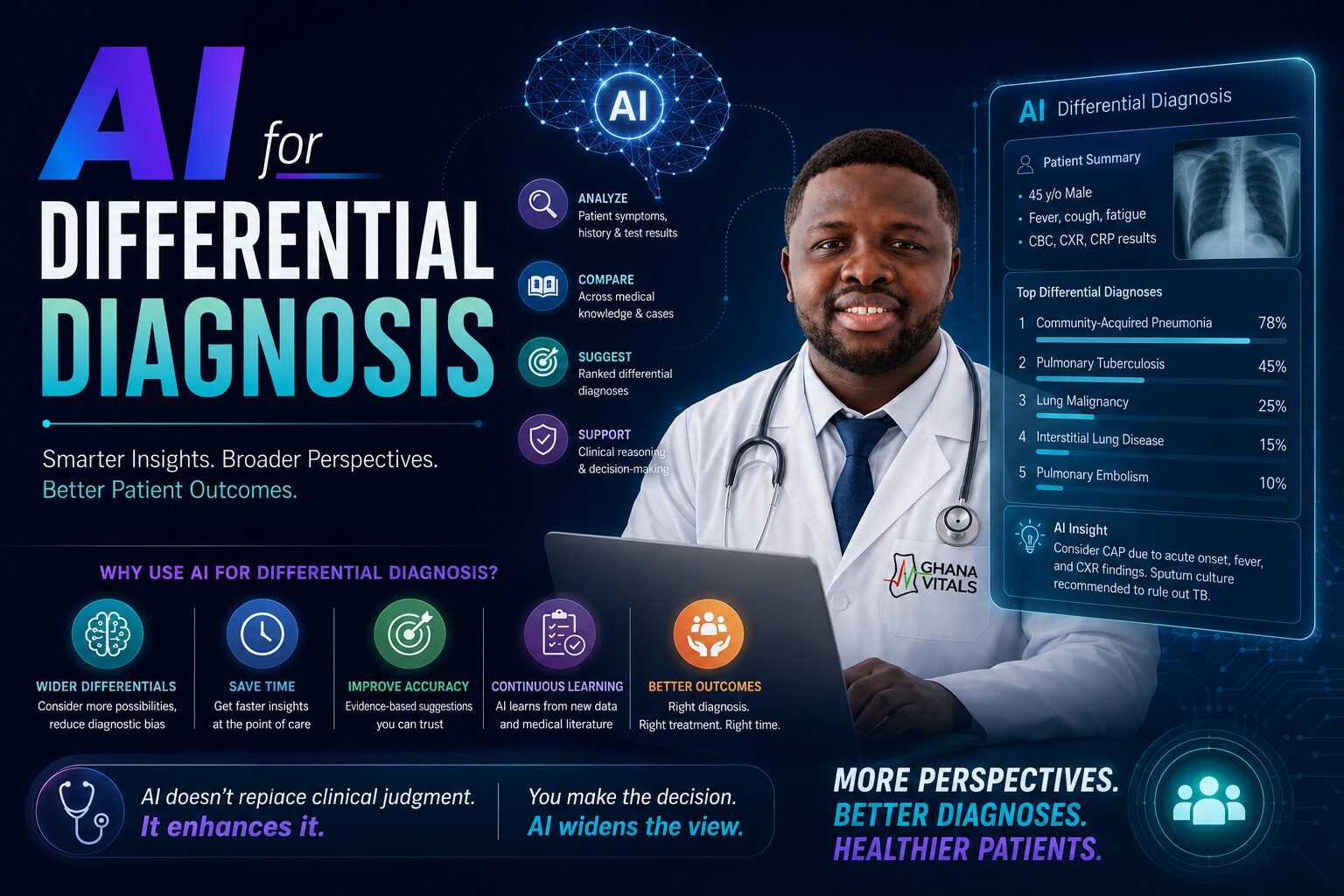
AI for Differential Diagnosis: What Doctors Need to Know in 2026
By Dr Festus Kaasung Kunde, MD | Stavropol State Medical University
Medical Doctor | AI in Healthcare Advocate | Founder, AI Doctor Africa & Ghana Vitals
Published: June 2026 | Reading Time: 20–24 minutes | Category: AI for Doctors
Quick Summary
Using AI for differential diagnosis is one of the most clinically valuable — and most misunderstood — applications of AI in medicine. AI does not diagnose patients. But it does something equally important: it broadens and structures the doctor’s clinical thinking as they make the diagnosis. Research from PNAS (2025) found that human-AI collectives outperformed both AI alone and physicians alone in diagnostic accuracy. This article explains exactly what AI can and cannot do in differential diagnosis, reviews the specific tools available in 2026, provides a 7-step AI-assisted DDx workflow, and addresses the specific adaptations needed for African clinical practice.
The Most Consequential Clinical Decision Doctors Make
Differential diagnosis is where medicine is most demanding and most human. Every clinical encounter begins with incomplete information. A patient describes their symptoms. You observe, examine, and interpret. And from that imperfect, incomplete, often ambiguous set of inputs, you must generate a list of what this could be — ranked by probability, constrained by clinical context, and shaped by the risk of missing something serious.
It is, by any measure, a cognitively complex task. Furthermore, diagnostic errors remain a significant patient safety problem globally. The National Academy of Medicine estimates that diagnostic errors affect approximately 12 million adults in the US annually. In sub-Saharan Africa, where atypical presentations of tropical diseases, overlapping infectious pathologies, and limited investigation resources all add complexity to the diagnostic process, the challenge is even greater.
Differential Diagnosis With Artificial Intelligence
AI for differential diagnosis has emerged as one of the most actively studied and most practically useful clinical AI applications. Moreover, the evidence is now compelling enough to dismiss it would be clinically irresponsible — but it also has important nuances that every doctor needs to understand before using these tools in practice.
I think about differential diagnosis constantly. During my internship at Korle-Bu Teaching Hospital in Accra, the wards move quickly, and the presentations are often complex. A patient with fever, headache, and altered consciousness in a malaria-endemic setting with high HIV prevalence requires a different differential prioritisation than the same patient in a London teaching hospital. The clinical reasoning required is not more difficult, but it is different. And AI tools, used correctly, can support that reasoning in ways that I have found genuinely valuable.
This article explains exactly what AI does in differential diagnosis, what it cannot do, the specific tools available in 2026, a practical workflow, and — critically — the adaptations that African doctors need to make to ensure AI-assisted DDx is relevant to their patients rather than calibrated for someone else’s.
The core principle is that AI for differential diagnosis is not a replacement for clinical reasoning. It is a cognitive forcing function — a structured second set of eyes that broadens the differential, surfaces diagnoses that premature closure might miss, and challenges the working diagnosis before it becomes fixed.
What the Research Actually Says About AI and Differential Diagnosis
Human-AI Collectives Outperform Both
The most important finding in recent research on AI and differential diagnosis is this: the highest diagnostic accuracy is achieved not by AI alone, not by physicians alone, but by their combination. A study published in PNAS in June 2025 — one of the most rigorous to date — found that integrating a single clinician’s differential diagnosis with a single LLM’s output yielded better performance than either alone in nearly all tested scenarios. Furthermore, even the worst-performing LLM, which individually underperformed the average human diagnostician, still improved collective accuracy when combined with physician judgment.
This finding has direct practical implications. It means the value of AI in differential diagnosis is not about replacing clinical reasoning. Rather, it is about combining AI’s breadth — its ability to generate a wide, systematically organised differential without the cognitive shortcuts and biases that human reasoning is subject to — with the clinician’s depth — their physical examination findings, their patient relationship, their understanding of the individual in front of them.
AI Influences Clinical Reasoning in Measurable Ways
A randomised controlled study published in a peer-reviewed journal examined the effects of providing physicians with an AI-generated list of differential diagnoses alongside a clinical case. The results were striking. The group that received the AI differential list achieved a diagnostic accuracy of 70.2%, compared to 55.1% in the control group, which worked without AI assistance. Furthermore, the study found that at least 15% of physicians’ final differential diagnoses were directly influenced by the AI list — suggesting that AI consistently surfaces diagnoses that clinicians might not have spontaneously considered.
This phenomenon has a clinical name: it is the antidote to premature closure. Premature closure — settling on the first plausible diagnosis without adequately considering alternatives — is one of the most common and consequential cognitive errors in clinical medicine. AI-generated differential lists directly address this by presenting a broader set of possibilities before the clinician’s reasoning has committed to a direction.
The Benchmark Reality — and Why Real-World Performance Differs
It is important to be honest about the limits of the research evidence. Many studies that show AI performing at or above the physician level in differential diagnosis use structured clinical vignettes in controlled settings. These benchmarks do not capture the full complexity of real clinical diagnosis, which involves incomplete histories, patient communication, physical examination findings that do not match the textbook description, and the judgment required to integrate conflicting information.
Furthermore, the benchmark-versus-real-world gap is the most important safety challenge in clinical AI. An AI that performs at 90% accuracy on a curated clinical vignette dataset may perform significantly worse on the messy, incomplete, and atypical presentations that constitute everyday clinical reality. Consequently, the safest interpretation of the evidence is that AI is a valuable structured second opinion — not a diagnostic authority — and that physician judgment remains essential at every decision point.
What the evidence justifies: using AI to broaden your differential, generate discriminating questions, surface diagnoses you might not have considered, and challenge premature closure. What the evidence does not justify: accepting AI diagnostic outputs without independent clinical assessment.
AI Tools for Differential Diagnosis in 2026: Complete Guide
The Landscape in 2026
The AI tools available for differential diagnosis in 2026 fall into two broad categories. The first category includes general large language models — Claude, ChatGPT — that can reason through differential diagnoses from clinical descriptions with impressive breadth and flexibility. The second category includes specialist clinical decision support tools — Glass Health, Isabel, DxGPT, VisualDx — that are specifically designed for clinical DDx workflows and often include safety features, probabilistic ranking, and structured output formats optimised for clinical use.
For African doctors, the practical reality is that the specialist tools are often more expensive and less accessible than general LLMs. However, general LLMs with well-constructed contextual prompts produce genuinely useful differential support — particularly when the prompt specifies the African clinical setting, the local disease burden, and the available investigation resources.
| Tool | Type | Best For | Free? | African Access |
| Claude AI | General LLM | Complex case reasoning, pathophysiology, broad differentials | Yes (free tier) | ✓ Yes |
| ChatGPT (GPT-4o) | General LLM | Rapid DDx generation, case vignettes, MCQ practice | Yes (free tier) | ✓ Yes |
| Glass Health | Specialist DDx + CDS | Encounter-based evolving differential, EHR integration, and ambient scribing | Limited free | ✓ Yes (web) |
| Isabel DDx Companion | Specialist DDx | 10,000+ conditions, probabilistic matching, <90 seconds, medical education | Free trial | ✓ Yes |
| DxGPT | LLM-based DDx | Free-text DDx generation, structured reasoning | Free | ✓ Yes |
| Perplexity AI | Cited search | Checking the current evidence behind a suspected diagnosis | Yes (free tier) | ✓ Yes |
| NotebookLM | Source-grounded AI | Uploading case summary + guidelines for cited DDx support | Free | ✓ Yes |
| VisualDx | Visual DDx | Skin, eye, and visually diagnosable conditions — image-based differentials | Subscription | Limited |
Glass Health — The Most Advanced Specialist DDx Tool
Glass Health deserves particular attention because it represents the most advanced currently available AI differential-diagnosis workflow. Unlike general LLMs that require manual input of clinical context, Glass Health can integrate directly with electronic health records, capturing patient demographics, medication lists, laboratory results, and encounter notes to inform a continuously evolving differential diagnosis.
Its ‘evolving differential’ feature — which updates the differential in real time as new clinical information becomes available during a consultation — addresses one of the fundamental limitations of static DDx tools: the differential generated at the start of an encounter should be different from the one generated after examination findings and initial investigation results are available. Glass Health provides this dynamic updating in a clinical workflow that does not interrupt the consultation.
However, African doctors considering Glass Health need to be aware of two important caveats. First, the tool was developed and trained predominantly on data from Western clinical settings, which means its probabilistic weighting may not reflect African disease epidemiology. Second, any tool that integrates with patient EHR data requires careful governance consideration regarding data privacy, storage, and patient consent — particularly in jurisdictions where AI-specific healthcare data governance frameworks are still developing.
Isabel DDx Companion — The Established Standard
Isabel DDx is the most established standalone DDx tool in clinical use, with over 22 years of clinical validation and deployment in hundreds of institutions globally. It covers more than 10,000 conditions across all ages and specialities and generates a ranked differential in under 90 seconds from entered clinical features.
Isabel uses a probabilistic matching algorithm rather than LLM-based reasoning, which makes it faster and more predictable but less capable of integrating complex, unstructured clinical narratives. Consequently, it works best as a structured checklist tool — ensuring that important diagnoses are not missed — rather than as a reasoning partner for complex case analysis.
For medical students and trainees, Isabel has a specific educational application: the Isabel Clinical Educator version is designed for case-based learning and self-assessment. Moreover, Isabel is available as a free trial and has an API for developers, making it potentially integrable into African healthcare IT systems.
Claude and ChatGPT — The Most Accessible DDx Tools for African Doctors
For most African doctors in 2026, the most practically accessible AI differential diagnosis tools are Claude and ChatGPT. Both are free to use at the basic level, accessible on a smartphone, and can generate clinically useful differential diagnoses from a well-constructed prompt.
The key distinction between these general LLMs and specialist DDx tools is context sensitivity. General LLMs do not automatically adjust for African epidemiology, local disease burden, or available investigation resources. They will, however, adjust significantly when you provide this context explicitly in your prompt. Furthermore, Claude is particularly strong in complex case reasoning — working through the pathophysiology, distinguishing features, and investigative rationale in depth. ChatGPT is stronger at producing rapid, structured output and at generating discriminating question lists quickly.
The section on African DDx adaptations later in this article provides specific prompts designed to contextualise general LLM output for African clinical settings.
The 7-Step AI-Assisted Differential Diagnosis Workflow
How to Integrate AI Into Your Diagnostic Thinking
Using AI for differential diagnosis is most effective when it is integrated into a structured clinical workflow rather than used as an afterthought or a final check. The following 7-step process represents the workflow I use personally — and that reflects the best current evidence on how AI most effectively supports clinical diagnostic reasoning.
| Step | Clinical Action | How AI Helps | Best Tool |
| 1. Generate initial list | List all diagnoses that could explain this presentation | Enter symptoms, signs, and clinical context — receive a broad initial differential | Claude, ChatGPT, Isabel |
| 2. Expand for rare diagnoses | Deliberately consider low-probability but high-risk diagnoses | AI flags uncommon conditions that symptom-pattern matching alone might miss | Isabel, Glass Health |
| 3. Rank by probability | Order differentials by pre-test probability in your clinical setting | AI applies epidemiological weighting; you adjust for local disease burden | Claude with context prompt |
| 4. Generate discriminating questions | Identify history and exam findings that would distinguish between the top diagnoses | AI lists the key clinical features that separate the most likely diagnoses | ChatGPT, Claude |
| 5. Plan investigations | Determine which investigations are both diagnostic and available | AI generates an investigation plan; you filter by what your setting has access to | Claude, Perplexity |
| 6. Check current evidence | Verify that your suspected diagnosis fits current diagnostic criteria | Real-time cited evidence check on diagnostic accuracy and criteria | Perplexity, NotebookLM |
| 7. Document reasoning | Record your clinical reasoning transparently | AI helps structure the written DDx in your clinical notes | Glass Health, Claude |
This workflow is designed to complement, not replace, your standard clinical assessment. Consequently, it adds approximately five to ten minutes to a complex case evaluation — time that is justified by the evidence that AI-assisted DDx reduces diagnostic errors and increases the probability of including the correct diagnosis in the initial differential list.
Critical principle for the workflow: Always complete your own initial differential before asking AI for its list. This prevents anchoring bias — where seeing the AI list first unconsciously narrows your own independent thinking. Generate yours first, then compare with the AI’s output.
AI for Differential Diagnosis in African Clinical Practice
The Contextualisation Problem
Here is something that no review of AI differential diagnosis tools for African doctors can afford to ignore. Most clinical AI — including the LLMs that underpin Claude, ChatGPT, and Glass Health — was trained predominantly on data from Western clinical settings. Consequently, the probabilistic weighting built into their diagnostic reasoning reflects the disease epidemiology of North America and Europe, not West Africa, East Africa, or the global south.
In practical terms, this means that when you describe a patient with fever, headache, and neck stiffness to a general AI tool without providing geographic context, the tool is more likely to weigh bacterial meningitis heavily and cerebral malaria less heavily than the epidemiology of a Ghanaian district hospital would justify. Similarly, a young adult with severe anaemia in Accra has a different first differential than the same patient in Amsterdam.
This is not a flaw in the AI — it is a reflection of the data it was trained on. Furthermore, it is addressable: providing explicit clinical context in your prompt substantially changes the differential output. The following table illustrates the most common presentations where the African context changes the differential significantly — and how to prompt AI correctly for each:
| Presentation | African First Differential | Why AI General Models May Miss This | What to Do |
| Fever + headache + neck stiffness | Cerebral malaria or bacterial meningitis — both are common | Western AI defaults to bacterial meningitis; underweights malaria | Specify ‘in a malaria-endemic setting’ — changes AI prioritisation |
| Acute abdomen + jaundice + fever | Typhoid fever with complications | Western AI lists biliary causes; typhoid is relatively uncommon in high-income countries | Specify geographic context; always include typhoid in African acute abdomen DDx |
| Chronic cough + weight loss | TB until proven otherwise | Western AI lists COPD and malignancy first; TB is less weighted in non-endemic training data | Explicitly prompt for TB-endemic context; follow GHS TB screening protocols |
| Young adult + severe anaemia | Sickle cell crisis, malaria, nutritional anaemia | AI may suggest haematological malignancy first in Western-trained models | State ‘West African patient, sickle cell trait known’ — reframes the differential |
| Breathlessness + leg swelling + JVP rise | Heart failure — but also consider peripartum cardiomyopathy in women | AI underweights peripartum cardiomyopathy without an explicit demographic context | Include patient demographics and obstetric history in your AI prompt |
| Skin rash + fever + lymphadenopathy | HIV seroconversion, secondary syphilis, drug reaction | AI may default to viral exanthems or autoimmune conditions without an African context | Specify ‘in a high HIV-prevalence setting’ — significantly shifts the differential |
The District Hospital Investigation Constraint
A second critical adaptation for African clinical practice involves investigation resources. AI tools trained on Western data will naturally suggest investigation sequences that include CT scanning, MRI, echocardiography, advanced laboratory testing, and subspecialty referral as early steps in the diagnostic workup. In a Ghanaian district hospital, many of these investigations are not immediately available.
Therefore, your AI differential diagnosis prompt should always explicitly specify your investigative resources. The prompt structure I use is: ‘I am working in a district hospital in Ghana with access to [list available investigations: FBC, malaria RDT, blood film, urine dipstick, CXR, ECG, basic biochemistry]. I do not have access to [CT, MRI, echocardiography, specialist referral today]. Given these constraints, rank the investigations I should request in order of diagnostic value.’
This contextualisation produces an investigation plan that is actually implementable in your clinical setting — rather than an idealised sequence designed for a fully-equipped teaching hospital.
Building a Personal African Clinical Context Prompt
The most efficient solution to the African contextualisation challenge is to build a standard context block that you prepend to every AI differential diagnosis query. This saves time and ensures consistency.
Standard African context block: ‘I am a doctor practising in [Ghana / West Africa / a district hospital in the Western Region of Ghana]. The patient population I serve has a high burden of malaria, tuberculosis, HIV, typhoid fever, and sickle cell disease. Available investigations include: FBC, malaria RDT, blood film, urine culture, CXR, ECG, liver function tests, and basic biochemistry. I do not have immediate access to CT, MRI, echocardiography, or subspecialty consultation. Please generate a differential diagnosis appropriate to this setting.’
Paste this context block before every clinical case query, and the AI output will be calibrated to your actual clinical reality rather than a default Western setting. Furthermore, you can save this as a saved prompt or note on your phone for quick access during clinical shifts.
Proven Prompts for AI Differential Diagnosis: Copy-Paste Ready
The following table provides proven prompt templates for every common AI DDx scenario. Each prompt is structured to produce a clinically useful, contextualised, and actionable differential diagnosis:
| Clinical Scenario | AI DDx Prompt Template |
| General DDx — any presentation | Act as a consultant physician practising in [Ghana/West Africa]. A [age]-year-old [sex] presents with [symptoms and duration]. [Key examination findings]. [Available investigations]. List the top 5 differential diagnoses in order of probability for this clinical setting. For each diagnosis: state the key supporting features present in this case, the discriminating features I should look for, and the investigations that would confirm or exclude it. |
| Rare diagnosis consideration | I have been considering [most likely diagnosis] for this patient. What serious or rare conditions could mimic this presentation that I may be missing? List them with the clinical features that would suggest each one over my working diagnosis. |
| Expanding for missed diagnoses | Act as a consultant who is concerned I may have premature closure on this case. Challenge my working diagnosis of [X]. What diagnoses have I likely not considered? What would make each of those correct instead? |
| African tropical context | I am a doctor in a district hospital in Ghana. A patient presents with [presentation]. Rank the differential diagnoses specifically for a West African clinical setting where [malaria, typhoid, TB, sickle cell disease] are common. Do not default to diagnoses that are more common in high-income countries. |
| Discriminating features | I have narrowed my differential to [diagnosis A] and [diagnosis B]. List the specific clinical features, examination findings, and accessible investigations that would distinguish between the two in a setting with [available resources]. |
| Investigation planning | For a patient with a differential of [diagnosis A, B, C], rank the investigations I should request in order of diagnostic value. Then indicate which of these investigations are available in a district hospital in Ghana and which require referral. |
| Paediatric differential | I am assessing a [age] child presenting with [symptoms]. I am in a paediatric ward in Accra, Ghana. Generate a ranked differential diagnosis appropriate for a West African paediatric setting, with the investigations available at a teaching hospital. |
What AI Cannot Do in Differential Diagnosis — Being Completely Honest
The Limits That Matter Most
I want to be direct about this, because I think the enthusiasm around AI in clinical medicine sometimes obscures the honest accounting of what these tools cannot do. Understanding the limits is not pessimism. It is clinical safety.
AI cannot physically examine patients.
A fever described in words and a fever felt with a hand are different clinical data points. The texture of a lymph node, the quality of a murmur, the appearance of a patient’s gait, the smell of a ward — these are diagnostic inputs that no AI tool can access. Consequently, the AI differential is always working from an incomplete dataset, no matter how thoroughly you describe the case.
AI cannot assess non-verbal information.
The patient who says they feel fine but whose face tells you otherwise. The family member’s anxiety that contradicts the patient’s minimisation of symptoms. The nurse’s observation that something changed overnight. These contextual signals profoundly influence clinical judgment — and they are invisible to AI.
AI cannot account for the individual patient’s trajectory.
A patient you have been following for six months, whose baseline you know, whose previous presentations you remember, whose family you have spoken with — the longitudinal knowledge of a doctor-patient relationship informs diagnosis in ways that a single case description to an AI cannot replicate.
AI makes confident mistakes.
This is perhaps the most clinically dangerous characteristic of current AI tools. They do not reliably signal when they are uncertain. A wrong differential generated with the same confident tone as a correct one is a specific patient safety risk. Therefore, always apply the same critical appraisal to an AI differential that you would apply to a colleague’s suggestion — regardless of how authoritative the output sounds.
Clinical safety rule: Generate your own differential first, independently of the AI. Then use the AI output to challenge and expand your list — not to replace it. If the AI differential and your clinical judgment diverge significantly on a high-stakes case, trust your clinical assessment and seek a senior opinion.
A Personal Reflection: Using AI for Differential Diagnosis at Korle-Bu
The Case That Taught Me How to Use These Tools Correctly
During my internship at Korle-Bu, I encountered a case that crystallised exactly why AI differential diagnosis support is valuable — and exactly where its limits lie.
A patient presented with a constellation of symptoms that initially seemed straightforward: fever, malaise, and abdominal discomfort. My first differential was malaria, typhoid, and a lower respiratory infection — entirely reasonable for Accra in the rainy season. After initial investigations were ordered, I moved around the Ward.
Later that evening, reviewing the case, I used Claude to run through the differential more systematically. The AI flagged two diagnoses I had not prominently included in my initial list: early peritonitis secondary to typhoid perforation, and a less common haematological condition that can present with constitutional symptoms in young adults. The possibility of peritonitis was the clinically significant one. When I returned to review the patient more carefully — with that expanded differential in mind — I noticed a degree of abdominal guarding that I had initially attributed to general abdominal tenderness. The subsequent clinical course confirmed that my initial differential had been too narrow.
What the AI did in that scenario was exactly what the evidence says it should do: it broadened my differential, surfaced a diagnosis that premature closure had pushed me past, and prompted me to look more carefully at a clinical sign I had underweighted. What the AI did not do was make the diagnosis. I made the diagnosis — through returning to the patient, examining more carefully, and applying the clinical judgment that the physical signs required.
That is the relationship I try to maintain with these tools. They expand my thinking. I make the clinical decisions.
Key Takeaways: AI for Differential Diagnosis
- The strongest evidence supports physician-plus-AI over either alone — a PNAS 2025 study found human-AI collectives outperformed both AI and physicians working independently
- AI-assisted DDx reduced diagnostic error and increased the correct diagnosis inclusion rate by 15 percentage points in a randomised controlled trial
- AI’s primary value in differential diagnosis is broadening the differential, preventing premature closure, and generating discriminating questions — not making the diagnosis
- For African doctors, explicit contextualisation of every AI DDx prompt is essential — specify the geographic setting, local disease burden, and available investigation resources
- Common presentations where African context changes the AI differential significantly include fever with headache (malaria vs meningitis), chronic cough (TB weighting), severe anaemia (sickle cell, malaria), and breathlessness (peripartum cardiomyopathy)
- Always generate your own initial differential before consulting AI — this prevents anchoring bias from the AI’s list, narrowing your independent reasoning
- Specialist DDx tools (Glass Health, Isabel) offer advantages over general LLMs for structured clinical workflows, but general LLMs with contextual prompts provide the most accessible option for African clinical settings
- AI makes confident mistakes — never accept an AI differential without independent clinical assessment, particularly on high-stakes presentations
- Never enter identifiable patient information into any external AI platform — use anonymised clinical details only
- AI differential diagnosis is a cognitive tool, not a diagnostic authority. The qualified clinician examining the individual patient makes every diagnosis — and bears full clinical and professional responsibility for it
Frequently Asked Questions: AI for Differential Diagnosis
These are the questions doctors most commonly ask about AI in differential diagnosis:
Question |
Answer |
| Can AI diagnose patients? | No — and this distinction is critical. AI tools generate structured lists of possible diagnoses based on clinical information provided to them. They do not examine patients, take a full history, interpret physical examination findings in real time, or carry any professional accountability for the outcome. The diagnosis is always the responsibility of the qualified clinician who has directly assessed the patient. AI supports and structures clinical reasoning — it does not perform it. |
| Is AI better than doctors at differential diagnosis? | On structured clinical vignettes in controlled studies, some AI models achieve higher diagnostic accuracy than individual physicians — one PMC study found AI achieved 85% accuracy versus 67% for doctors on the same vignettes. However, real-world clinical diagnosis involves dimensions that vignette testing does not capture: physical examination, patient communication, contextual judgment, and the integration of non-verbal information. Furthermore, the PNAS (2025) human-AI collective study found that the highest accuracy came from combining physician and AI judgment — neither alone outperformed the combination. |
Which AI tool is best for differential diagnosis? |
It depends on the clinical context. For broad, rapid differential generation from a clinical description, Claude and ChatGPT are most accessible and useful. For encounter-based AI that integrates with documentation, Glass Health is the most advanced platform currently available. For structured DDx with probabilistic matching across 10,000+ conditions in under 90 seconds, Isabel is the most established standalone tool. For African doctors without access to specialist tools, Claude, with a well-constructed contextual prompt, provides the most practically useful differential support. |
| Do AI differential diagnosis tools work for African disease presentations? | With an important caveat: most AI models were trained predominantly on clinical data from Western, North American, and European settings. Consequently, they may underweight tropical diseases, infections common in West Africa, and presentations specific to African patient populations. However, this limitation can be substantially addressed by providing explicit clinical context in your prompt — specifying the geographic setting, the local disease burden, and the available resources. A well-contextualised prompt to Claude or ChatGPT produces a significantly more relevant differential for an African clinical setting than a generic query. |
| What is premature closure, and how does AI help prevent it? | Premature closure is the cognitive error of stopping the diagnostic process too early — settling on the first plausible diagnosis without adequately considering alternatives. It is one of the most common causes of diagnostic error in clinical medicine. AI helps prevent premature closure by generating a broader differential than a single clinician might spontaneously consider, deliberately surfacing rare and atypical diagnoses, and explicitly challenging the working diagnosis when prompted. Studies show that AI-assisted DDx increases the consideration of diagnoses outside the initial clinical frame by a clinically meaningful margin. |
Can I use Claude or ChatGPT for real patient cases? |
Yes — with a critical caveat: never enter identifiable patient information. Do not include names, hospital numbers, dates of birth, or any combination of details that could identify a specific patient. Use clinical details only — age, sex, presenting symptoms, examination findings, and investigation results — in anonymised form. The clinical learning and reasoning value of AI-assisted DDx is identical whether you use a real anonymised case or a hypothetical one. Patient confidentiality is non-negotiable and does not have a diagnostic support exception. |
Related Articles on AI Doctor Africa
- Can Doctors Trust AI? Benefits, Risks, and Best Practices in 2026
- How African Doctors Can Use AI in Daily Practice: The Complete 2026 Guide
- Perplexity AI for Doctors: The Cited Search Tool Every Clinician Needs
- ChatGPT vs Claude for Medical Doctors: Which AI Is Better in 2026?
- How Doctors Can Use AI for Continuous Medical Education in 2026
- NotebookLM for Doctors: The Complete 2026 Guide for Healthcare Professionals
About the Author
Dr Festus Kaasung Kunde is a Medical Doctor, AI in Healthcare Advocate, and Founder of AI Doctor Africa and Ghana Vitals. He holds an MD from Stavropol State Medical University, Russia (2025), and completed an internship at Korle-Bu Teaching Hospital in Accra. His mission is to help African healthcare professionals adopt AI responsibly to improve learning, research, and patient outcomes.
AI Doctor Africa | aidoctorafrica.com
Medical Disclaimer: For educational purposes only. AI tools do not diagnose patients and do not replace clinical judgment. Every diagnostic decision remains the full responsibility of the qualified clinician who has directly assessed the patient.

Dr. Festus K. Kunde
Dr. Festus Kaasung Kunde is a medical doctor, Content creator, healthcare technology writer, and digital health innovator specializing in Artificial Intelligence in Medicine, Healthcare Systems Innovation, and Health Data Science in Africa. He is the founder of AI Doctor Africa (AIDoctorAfrica.com), an educational platform dedicated to helping healthcare professionals—including doctors, medical students, nurses, and researchers—understand and responsibly apply artificial intelligence in clinical practice, medical education, medical research, and healthcare innovation. He is also the creator of Ghana Vitals, a health data and predictive analytics initiative focused on collecting and analyzing key health indicators such as blood pressure, blood glucose, and BMI to support early disease detection, preventive healthcare, and data-driven decision-making in Ghana and across Africa. The project reflects his long-term vision of building scalable, AI-powered public health systems for African populations. Dr. Kunde’s work focuses on the practical integration of AI tools such as ChatGPT, Claude, and emerging clinical AI systems into real-world healthcare workflows. His content emphasizes improving clinical documentation, accelerating medical education, strengthening research productivity, and supporting healthcare decision-making in resource-limited settings. Through AI Doctor Africa, he publishes evidence-informed, practice-oriented resources including AI workflows, clinical use cases, medical education guides, and tutorials designed specifically for African healthcare professionals. Through Ghana Vitals, he extends this mission into population health innovation, aiming to leverage real-world health data and predictive models to improve early intervention, reduce preventable disease burden, and strengthen health systems across Africa. His overall mission is to bridge the gap between traditional clinical medicine, artificial intelligence, and data-driven public health, empowering African healthcare professionals to work smarter, diagnose earlier, and deliver better care through technology. Areas of Expertise Artificial Intelligence in Clinical Medicine Digital Health & Healthcare Innovation in Africa Health Data Analytics & Predictive Health Systems Medical Education and Exam Preparation AI for Medical Research and Scientific Writing Clinical Workflow Optimization using AI Tools Public Health Data Systems (Ghana Vitals Initiative) Professional Focus Dr. Kunde’s work sits at the intersection of clinical medicine, artificial intelligence, and population health systems, with a strong focus on scalable solutions for African healthcare challenges. His initiatives emphasize ethical AI use, data-driven decision-making, and practical implementation in real-world clinical and public health environments.
View author profile →