
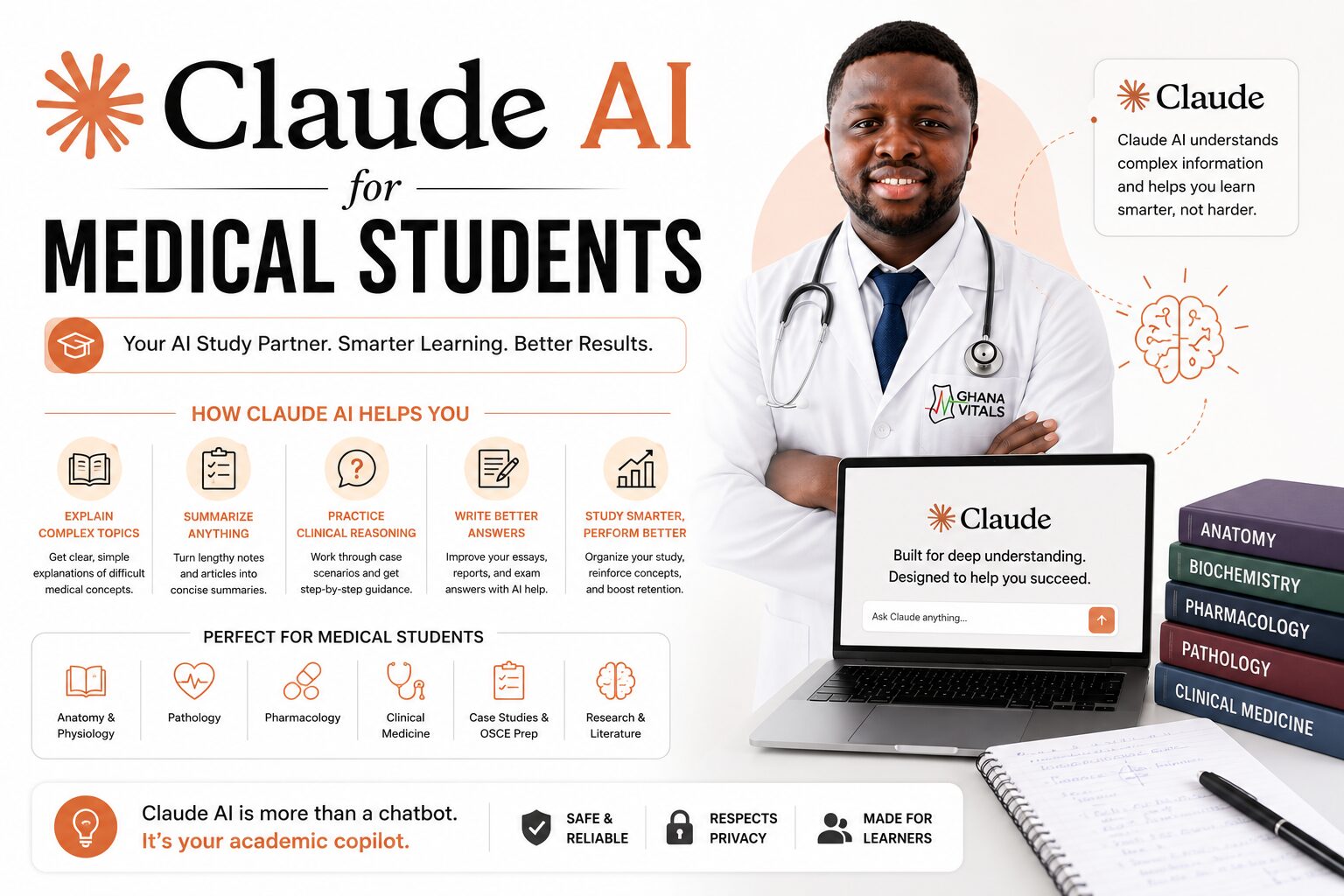
Claude AI for Medical Students: How to Use It, When to Use It, and Why It Works
By Dr Festus Kaasung Kunde, MD | Stavropol State Medical University
Medical Doctor | AI in Healthcare Advocate | Founder, AI Doctor Africa & Ghana Vitals
Published: June 2026 | Reading Time: 18–22 minutes | Category: AI for Medical Students
Quick Summary
Claude AI is the tool that medical students who want to genuinely understand medicine — not just memorise it — reach for first. In 2026, Claude launched Learning Mode (Socratic tutoring), Canvas and Panopto integration, Wiley peer-reviewed content access, and Projects for persistent study memory. This article explains every Claude feature a medical student needs to know, 10 proven copy-paste prompts for every study scenario, a weekly Claude study system, and personal stories from my time at Stavropol State Medical University and Korle-Bu Teaching Hospital.
Why Claude AI Became My Most-Used Study Tool in Medical School
I want to tell you about a specific evening at Stavropol State Medical University that I remember clearly. It was my fourth year, and I was trying to understand the pathophysiology of the renin-angiotensin-aldosterone system — not for an examination the following day, but because I had realised I did not actually understand it. I had memorised it. I knew the steps. But I did not understand why the steps worked as they did, or how understanding the mechanism would help me predict which antihypertensive drug to choose for a given patient.
Roski Ezek
The Russian-language pharmacology textbook was thorough. However, it was also 600 pages, and the section on RAAS was written for someone who already had a strong foundation in renal physiology that I had not yet consolidated. I spent two hours reading and re-reading the same four pages. By the end, I knew more words. I did not understand significantly more.
Then I inquired of Claude. not “explain the RAAS,” which is a question that gives a summary from the textbook. Instead: ‘I understand the steps of the RAAS, but I do not understand the why. Explain the evolutionary logic of this system. Why does the body require both aldosterone and angiotensin II to simultaneously cause sodium retention and vasoconstriction? What problem is the system solving? Then make a connection between this and the patient profiles for which ACE inhibitors, ARBs, and aldosterone antagonists are most beneficial. There was no summary of what came back.
The Convo
A conversation took place. Claude went over the system’s haemodynamic logic, connected it to the kidney’s role in controlling blood pressure, explained why the liver, lungs, adrenal glands, and kidneys all participate in a sequence that would otherwise seem overly complicated, and then showed how each major class of antihypertensive drugs changes or interrupts a particular step in that sequence. Furthermore, it asked me two questions at the end to check whether the explanation had actually produced understanding rather than just more information.
I spent 45 minutes with Claude that evening and understood the RAAS more deeply than I had over the previous 2 years of medical school. Moreover, that understanding lasted — because understanding connects to other knowledge in a way that memorisation does not. Consequently, when RAAS-related questions appeared in pharmacology examinations, in clinical rotations, and eventually in licensing examination preparation, I was drawing on a genuine conceptual model rather than fragile memorised steps.
That is what Claude AI does for medical students. This article explains exactly how to use it.
The core distinction between Claude and other AI tools for medical students: Claude is not optimised for speed or volume. It is optimised for depth, nuance, and reasoning. When you want to understand something properly — not just know it for tomorrow — Claude is the tool to reach for.
What Claude AI Is — and What Makes It Different
Built for Reasoning, Not Just Generation
Claude is an AI assistant developed by Anthropic — a company founded specifically to build AI that is safe, honest, and genuinely helpful. Unlike some AI companies that optimise primarily for speed and user engagement, Anthropic has built Claude around what they call Constitutional AI: a set of ethical principles that prioritise safety first, ethics second, and helpfulness third. In practice, this means Claude is more cautious about expressing false confidence, more likely to acknowledge uncertainty, and more careful about the clinical implications of what he says.
For medical students, this design philosophy matters. An AI that confidently generates wrong answers about drug interactions or dosing thresholds is more dangerous than one that says, ‘I am not certain — please verify this against the primary source.’ Claude’s built-in epistemic humility makes it safer for clinical learning than tools optimised purely for confident-sounding output.
Furthermore, Claude’s reasoning capabilities are genuinely different from those of most AI tools. When given a complex clinical case or a nuanced conceptual question, Claude does not just retrieve relevant facts — it builds an argument. It considers different perspectives, acknowledges where the evidence is contested, and structures its response in a way that supports your own reasoning rather than replacing it.
Claude for Education — What Changed in 2026
In 2026, Anthropic launched Claude for Education — a dedicated institutional programme that adds significant features specifically designed for academic learning environments. Understanding these features matters because they represent the most important evolution in Claude’s usefulness for medical students.
Learning Mode is the most significant addition. In Learning Mode, Claude does not give you the answer. Instead, it asks you guiding questions that lead you toward the answer yourself — exactly the way a good human tutor works. This Socratic approach is significantly more effective for long-term retention than being told the answer, because it forces retrieval and reasoning rather than passive reception.
Canvas integration means Claude can now be accessed directly inside Canvas — the learning management system used by many medical schools. Consequently, students can ask Claude questions about specific courses, assignments, and learning materials without leaving their institutional platform.
Panopto integration means Claude can access transcripts of your lecture recordings. Instead of re-watching a two-hour lecture to find the section on hepatic encephalopathy, you can ask Claude to explain what your professor covered on that topic and where the key points were. This saves significant time during revision.
Wiley integration means Claude can draw on peer-reviewed medical textbooks and journals from Wiley during conversations. Consequently, answers about clinical topics can be grounded in the same authoritative sources your curriculum uses, rather than general internet knowledge.
Additionally, in January 2026, Anthropic partnered with Teach For All — reaching 100,000 teachers and alumni across 63 countries and 1.5 million students globally. This partnership signals that Claude’s educational direction is specifically oriented toward accessibility and equity, including African medical students, who have historically been underserved by premium educational AI tools.
Claude AI for Medical Students: Every Feature You Need to Know
The following table covers every Claude feature relevant to medical students in 2026, with the specific use case each feature serves best:
| Claude Feature | What It Does | Best Medical Student Use Case |
| Claude AI free tier | Access to Claude Sonnet — deep reasoning, long context, file uploads | Concept explanation, case analysis, essay drafting, research synthesis |
Claude Pro ($20/mo) |
Priority access, higher usage limits, and extended thinking mode | Heavy daily study use, thesis work, complex case analysis |
| Learning Mode (Education) | Socratic mode — asks guiding questions instead of giving answers | Building a genuine understanding of complex mechanisms, not surface memorisation |
| Projects | Persistent memory across conversations — saves context for ongoing study topics | Keep a semester-long neurology project with your notes, questions, and progress saved |
File upload (PDF, images) |
Upload lecture slides, textbooks, guidelines, and handwritten notes | Summarise, quiz from, and analyse any uploaded clinical document |
| Canvas integration | Claude works inside Canvas LMS — summarises lectures, checks work | Access Claude directly inside your medical school learning management system |
| Panopto integration | Claude accesses lecture transcripts directly | Ask Claude questions about your exact lecture without re-watching it |
Wiley integration |
Claude pulls from Wiley’s peer-reviewed content | Cited answers from medical textbooks and journals in one conversation |
| Artifacts | Creates interactive mini-apps, study guides, and tables in the chat | Build visual study aids, differential diagnosis tables, and drug comparison charts |
| Anthropic Academy | Four free AI literacy courses — AI Fluency for students and educators | Build formal AI literacy that complements clinical training |
Note that most of these features are available on Claude’s free tier. Furthermore, the free tier has no advertisement model — Anthropic does not sell advertising, which means the tool’s incentives are aligned with making you genuinely more capable rather than keeping you engaged for engagement’s sake. Consequently, the free tier is a genuinely useful tool, not a limited version designed to frustrate you into upgrading.
Where Claude AI Excels for Medical Students
Deep Concept Explanation — Claude’s Greatest Strength
If you ask Claude to explain a difficult concept in medicine, it does not just retrieve a Wikipedia-style summary. It builds an explanation from first principles, connects the concept to related knowledge, anticipates your follow-up questions, and structures the response to support genuine understanding rather than surface memorisation.
During my time at Stavropol, I used this capability most heavily in pathophysiology and pharmacology — subjects where the mechanism is the understanding. Knowing that ACE inhibitors reduce blood pressure is not useful. Understanding why they reduce it, which patients benefit most, which patients they harm, and what happens mechanistically when a patient on an ACE inhibitor develops acute kidney injury — that is clinical pharmacology.
The key to unlocking Claude’s depth is prompt construction. A shallow prompt produces a shallow answer. The prompt I used most consistently in medical school was:
‘I want to genuinely understand [topic], not just memorise it. Explain the underlying mechanism from first principles. Connect it to clinical relevance. Then ask me two or three questions to check whether your explanation produced real understanding or just more information.’
That final instruction — asking Claude to test you at the end — transforms the interaction from passive consumption to active learning. Furthermore, Claude’s questions at the end often reveal gaps in understanding that you would not have identified by simply reading.
Clinical Case Reasoning — The Ward Round Preparation Tool
One of the most valuable uses of Claude AI for medical students is practising clinical case reasoning. This is the ability to take a clinical presentation, build a differential diagnosis, reason through the investigations and management, and anticipate the questions a senior clinician would ask. It is precisely the skill that ward rounds test — and precisely the skill that passive textbook reading does not develop.
During my clinical rotations, I used a specific Claude prompt the evening before any complex ward round presentation.
The prompt:
‘Act as a consultant physician who is about to conduct a ward round. I will describe my patient and my management plan. Your role is to challenge my diagnosis, question my reasoning, identify what I have missed, and ask me the three questions a consultant is most likely to ask tomorrow morning. Do not be easy on me — that is not how ward rounds work.’
This prompt consistently revealed gaps in my clinical reasoning that would otherwise have become visible in front of a consultant rather than in the privacy of a study session. Moreover, working through those gaps with Claude — understanding why a specific diagnostic step was wrong, why a management choice was suboptimal — produced the kind of learning that ward rounds are supposed to produce, without the public anxiety that real ward rounds inevitably carry.
Academic Writing and Thesis Support
Claude is the strongest AI tool currently available for academic writing — and for medical students who must write case reports, systematic reviews, research proposals, and ultimately a thesis, this capability is significant.
When Dr Opare and I were writing our malaria thesis at Stavropol State Medical University, one of the most time-consuming challenges was structuring our argument across a document that needed to be both academically rigorous and clinically relevant. We had the knowledge. We had the evidence. What we sometimes struggled with was the architecture — how the argument flowed from one section to the next, how our conclusions connected to our methodology, how to express technical clinical reasoning in English academic prose that would meet the standards of a Russian university defence.
Claude overcame each and every one of these obstacles. AI reviewed draft paragraphs, suggested changes, and pointed out where our argument veered off topic too quickly. It helped us express clinical reasoning that we understood but had not yet articulated clearly. Furthermore, because Claude’s writing is more formal and more precise than ChatGPT’s by default, the improvements it suggested consistently moved our writing toward the academic register the thesis required.
We passed with a grade of 5 — Excellent. Claude did not write our thesis. But it brought our ability to express what we knew up to the standard that the thesis required.
The Malaria Thesis and the Language Barrier
There is a specific dimension of the thesis experience that I want to be honest about, because it affects thousands of African medical students studying abroad.
Writing a thesis in English at a Russian university — on a tropical disease that was barely represented in Russian-language medical literature — is a structural challenge. It is not an intelligence challenge. We understood malaria. We had grown up in countries where malaria is a lived reality, not an examination topic. What we needed was access to English-language tropical medicine literature and the ability to write about it in the formal academic English required for a thesis defence.
The Language Barrier
Claude addressed both of these needs. It helped us navigate the English-language literature, explained concepts we encountered in unfamiliar terminology, and reviewed our writing for the precision and formality that academic English demands. Consequently, our thesis reflected our genuine knowledge — freed from the structural disadvantage of language and access barriers that should not determine the quality of a medical student’s academic work.
This experience is part of why I built AI Doctor Africa. The same barriers that made our thesis harder — language, access, resource limitations — affect medical students across Africa every day. Claude, used correctly, addresses every one of them. Furthermore, it does so for free.
Claude vs ChatGPT vs Gemini: When to Use Which
Medical students should not feel they need to choose one AI tool. Claude, ChatGPT, and Gemini serve different purposes in a study workflow. The following table clarifies which tool does what best, so that you can reach for the right one rather than forcing one tool to do everything:
| Dimension | Claude | ChatGPT | Gemini |
| Depth of explanation | Excellent — most thorough and structured | Good | Good |
| Clinical reasoning (case discussion) | Excellent — strongest for nuanced case analysis | Good | Good |
| MCQ generation volume | Good | Excellent — faster and higher volume | Good |
| Learning/Socratic mode | Yes — Learning Mode (Education tier) | No dedicated mode | Yes — Guided Learning (LearnLM) |
| File upload and analysis | Excellent — handles long, complex documents best | Good | Good |
| Academic writing quality | Excellent — most formal and precise prose | Good | Good |
| Research synthesis | Excellent — strongest for multi-source analysis | Good | Good — with Deep Research |
| Google ecosystem integration | No | No | Yes — native Docs, Drive, YouTube |
| Canvas integration | Yes — Anthropic Education partner | Limited | No |
| Hallucination risk | Lower than average — more cautious by design | Medium | Medium |
| Free tier access in Africa | Yes — claude.ai | Yes — chat.openai.com | Yes — gemini.google.com |
| Best for medical students | Deep understanding, thesis, case reasoning, and academic writing | High-volume MCQs, speed, and OSCE simulation | Google integration, guided learning, and deep research |
My personal rule is simple: I use Claude when I want to understand something, when I am writing something, or when I am working through a complex case. I use ChatGPT when I need a large number of practice questions quickly. I use Gemini when I am working in Google Docs or when I want the Guided Learning experience with a topic I have already begun to understand. Together, these three tools cover every major medical student need — and all three have free tiers accessible in Ghana and across Africa.
10 Proven Claude AI Prompts for Medical Students
The following table provides copy-paste-ready prompts for every major medical student study scenario. Each prompt is designed to produce the kind of deep, active, clinical learning that Claude is strongest at:
| Study Task | Proven Claude Prompt |
Deep concept understanding |
Act as a physician educator. I want to understand [topic] at the level required for final year examinations, not just memorise facts. Explain the mechanism from first principles, connect it to clinical presentation, investigations, and management, and then ask me three questions to check my understanding before continuing. |
| Case-based clinical reasoning | I will describe a clinical case. Act as a senior registrar and guide my diagnostic and management reasoning — do not give me the answers directly. Ask me questions at each step. When I make an error, I correct it and explain why. Case: [paste anonymised case details]. |
| Lecture summarisation and quizzing | I have uploaded my [subject] lecture slides. First, give me a structured summary organised by: key definitions, core mechanisms, clinical relevance, and five high-yield exam facts. Then generate 15 MCQs from the content, one at a time, waiting for my answer before moving to the next. |
Essay and academic writing |
I need to write a [word count] essay on [topic] for my medical school assessment. I will write it myself, but help me: (1) outline the key arguments, (2) identify the strongest evidence to support each point, (3) suggest the structure, and (4) review my draft for clarity and academic register when I paste it. |
| Thesis research assistance | I am writing my medical school thesis on [topic]. Help me: (1) frame a clear research question, (2) identify the key themes in the literature I should address, (3) suggest a chapter structure, and (4) review the paragraph I will paste for logical flow and academic language. |
| Weak area targeting | I consistently score poorly on [topic] in MCQ practice. Identify the most likely gaps in my understanding of this topic. Then teach me the three concepts that most commonly cause errors, using clinical examples. Finally, generate 10 MCQs specifically targeting these gaps. |
OSCE communication station |
Simulate an OSCE communication station. You are a [patient description]. I have 8 minutes. Respond naturally. After the station, give me structured feedback on rapport-building, history or explanation quality, patient concerns addressed, information clarity, and safety-netting. Score me out of 10 for each. |
| Drug mechanism and comparison | Compare [drug class A] and [drug class B] for a medical student preparing for final examinations. Cover: mechanism of action, clinical indications, key side effects, contraindications, and one high-yield clinical pearl for each. Format as a comparison table I can use for revision. |
| Differential diagnosis expansion | My working diagnosis for this case is [X]. I want to stress-test this diagnosis before presenting to my supervisor. What are the three diagnoses I am most likely missing? For each, give the clinical feature that would make it more likely than my working diagnosis, and the investigation that would distinguish between them. |
| African clinical context | I am a medical student in Ghana preparing for the MDC licensing examination. Explain the management of [condition] specifically for the Ghanaian clinical setting — referencing Ghana Health Service guidelines where available, the investigations accessible in a district hospital, and the disease burden context of West Africa. |
Notice that the most effective prompts share a common structure: they tell Claude who to be (a physician educator, a senior registrar, a Socratic tutor), what specific behaviour you want (guide, challenge, test — not just explain), and what clinical or academic context you are working in. Furthermore, the best prompts end with an instruction for Claude to test your understanding rather than simply providing information. This turns a passive explanation into an active learning session.
The Weekly Claude AI Study System for Medical Students
A Realistic Daily Routine
The following weekly study system uses Claude as the primary tool for understanding and reasoning, complemented by ChatGPT for volume practice and Anki for retention. It requires approximately three and a half to four hours of active AI study per week — spread across short daily sessions that fit around lectures and clinical rotations:
| Day | Claude Task | How to Use It | Time |
| Monday | Deep concept session — pick the hardest topic from last week | Claude explains from first principles: use Learning Mode if available; ask follow-up questions | 40 min |
| Tuesday | Case-based reasoning — bring one anonymised clinical case | Present the case to Claude as the senior registrar; work through the differential and management step by step | 30 min |
| Wednesday | File upload session — upload lecture slides or guidelines | Ask Claude for a structured summary; generate 15 MCQs; identify high-yield facts | 35 min |
| Thursday | Essay or writing support — paste your draft or outline | Ask Claude to review structure, argument strength, and academic language | 25 min |
| Friday | Weak area drilling — target gaps from the week’s wrong MCQs | Ask Claude to explain each concept behind the wrong answers; create a short revision note | 30 min |
| Weekend | Thesis or research project work (final year) OR OSCE simulation | Claude’s thesis support or OSCE communication station simulation | 45–60 min |
The most important habit in this system is consistency. Three hours of focused, active AI study spread across six days produces significantly better outcomes than the same three hours in a single session. Furthermore, the Thursday writing support session is deliberately placed mid-week — after you have built understanding through Monday and Tuesday sessions, but with enough time before the weekend to revise based on Claude’s feedback.
Using Claude AI as an African Medical Student: What You Specifically Need to Know
Contextualisation Is Everything
Claude AI is trained on data that, like most large language models, reflects a predominantly Western clinical and educational context. Consequently, without explicit contextualisation, Claude’s answers about disease management may reflect US or UK guidelines, its examination preparation advice may be calibrated for USMLE or PLAB rather than MDC Ghana or MDCN Nigeria, and its clinical examples may emphasise diseases that are more common in high-income countries than in West Africa.
The solution is systematic contextualisation. Every time you use Claude for a clinical or examination topic, begin your prompt with your context. The most effective context block for Ghanaian medical students is:
‘I am a medical student at [medical school] in Ghana, preparing for [MDC Ghana licensing examination / final year examination / clinical rotation at Korle-Bu Teaching Hospital]. All responses should reflect the Ghana Health Service guidelines where relevant, assume a West African disease burden including high prevalence of malaria, tuberculosis, sickle cell disease, and HIV, and use investigation resources typical of a Ghanaian teaching or district hospital.’
With this context in place, Claude’s responses shift significantly. The differential diagnosis for a febrile patient weighs malaria appropriately. The antihypertensive recommendations reference drugs available through the NHIS. The investigation plans acknowledge what is and is not available in Ghanaian clinical settings. Consequently, the knowledge you build is directly applicable to the patients you will see and the examinations you will sit.
The Language Advantage for African Students Studying Abroad
For African medical students studying in Russia, Ukraine, China, Cuba, or any other non-English-speaking environment, Claude’s multilingual capability is one of its most practical features. Claude processes content in Russian, Mandarin, Ukrainian, Spanish, and many other languages accurately. Furthermore, it can take content in one language and produce an explanation and discussion in another.
This means Claude can explain your Russian-language pathology textbook chapter in clinical English. Your Chinese-language pharmacology lecture notes can be summarised and quizzed in English. The translation barrier that costs African students abroad hours of time and significant cognitive energy every week can be substantially reduced by a well-constructed Claude prompt.
Additionally, Claude helps African students who write in English as a second, third, or fourth language to produce academic prose at the standard required for international journals, university dissertations, and licensing examinations. The quality of your academic writing should not be determined by whether English is your first language. Claude helps ensure that it is not.
Using Claude Responsibly: What Every Medical Student Must Know
The Academic Integrity Line
Let me be direct about this, because the consequences of getting it wrong are serious.
Using Claude to understand concepts, generate practice questions, review your own writing, and build clinical reasoning is not academic dishonesty. It is the equivalent of using a private tutor, and it is explicitly supported by Anthropic’s educational philosophy, which emphasises using Claude to support learning rather than replace it.
Using Claude to generate submitted work — written assignments, case presentations, SOAP notes, learning objectives, examinations — and presenting that work as your own without disclosure is academic dishonesty. Furthermore, even if your medical school has not yet specified an AI policy for a particular assignment, submitting AI-generated content as your own work violates the honesty principle that medical education rests on. The doctor you are becoming is the doctor whose academic record says they can do. If your record does not reflect what you can actually do, that gap is a patient safety issue — not just an academic one.
The practical rule: use Claude to learn, to practise, and to improve your own work. Use your own knowledge to complete assessed activities. If you use Claude in a way that improves your submitted work — reviewing your draft, checking your argument structure — disclose that use honestly. That is not just ethical. It is the behaviour of a doctor-in-training.
The Hallucination Caveat for Clinical Facts
Claude is more cautious about clinical accuracy than most AI tools. However, it is not infallible. Claude can generate incorrect drug doses, cite outdated guidelines as current, misrepresent study findings, and occasionally produce plausible-sounding but fabricated clinical information. This is called hallucination, and it is a feature of every current large language model — including Claude.
The practical defence is consistent for medical students: never apply a Claude-generated clinical fact to a decision regarding patient management without verifying it against a primary source. For drug dosing, check the BNF or the Ghana Standard Treatment Guidelines. Verify clinical guidelines against the most recent document issued by the issuing body. For research citations, check that the paper Claude references actually exists and says what Claude says it says.
Use Claude to understand. Use primary sources to verify. This combination — AI for learning efficiency, primary sources for clinical accuracy — is the correct relationship between AI tools and medical knowledge.
Key Takeaways: Claude AI for Medical Students
- Claude AI’s free tier is fully accessible to medical students in Ghana and across Africa — no payment required for the features that matter most for study
- Claude’s primary strength for medical students is depth of reasoning — it is the strongest AI tool for genuine conceptual understanding, complex case analysis, and academic writing
- Claude for Education (2026) adds Learning Mode (Socratic tutoring), Canvas integration, Panopto lecture transcript access, and Wiley peer-reviewed content — check whether your medical school has an institutional agreement
- The most effective Claude prompt structure: tell Claude who to be, specify the behaviour you want (guide, challenge, test), provide your clinical context, and end with an instruction to test your understanding
- For case-based reasoning, the ‘act as a consultant who will challenge my diagnosis’ prompt structure is the most valuable single Claude application for clinical students
- For African medical students, systematic contextualisation — specifying your country, exam system, local disease burden, and available resources — significantly improves the clinical relevance of Claude’s responses
- For African students studying abroad, Claude’s multilingual capability removes the language barrier that costs hours of study time weekly
- Claude is the strongest AI tool for thesis support — structure, argument development, and academic writing review — as demonstrated by the malaria thesis at Stavropol that earned a grade of 5 Excellent
- Using Claude for learning and practice is not academic dishonesty; submitting Claude-generated content as your own work in assessed activities is — know the difference
- Always verify clinical facts against primary sources — Claude’s caution reduces hallucination risk but does not eliminate it
Frequently Asked Questions: Claude AI for Medical Students
These are the questions medical students most commonly ask about Claude AI:
| Question | Answer |
Is Claude AI free for medical students? |
Yes. Claude’s free tier at claude.ai is fully accessible to medical students in Ghana and across Africa with no payment required. The free plan includes access to Claude Sonnet, file uploads, Projects, and Artefacts, which is genuinely powerful for study purposes. Claude Pro, at $20 per month, offers higher usage limits, priority access, and extended thinking mode. Additionally, students at partner institutions through Claude for Education receive access equivalent to Claude Pro at no individual cost — check whether your medical school has an Anthropic Education agreement. |
| How is Claude different from ChatGPT for medical students? | Claude and ChatGPT are complementary rather than competing tools. Claude consistently produces more thorough, more nuanced, and more carefully reasoned explanations — making it stronger for deep concept understanding, complex case analysis, and academic writing. ChatGPT generates practice questions faster and at a higher volume, making it more effective for MCQ drilling and OSCE simulation. The most effective medical student workflow uses Claude for understanding and writing, and ChatGPT for testing and practice. Neither replaces the other. |
What is Claude Learning Mode, and can medical students use it? |
Claude Learning Mode is a feature available through Claude for Education — Anthropic’s institutional programme for universities. In Learning Mode, Claude asks guiding questions rather than giving direct answers, fostering genuine understanding over passive information consumption. It is the closest AI equivalent to a Socratic tutor. Students at Claude for Education partner institutions receive access to Learning Mode as part of their institutional package. Students without institutional access can approximate this behaviour by including in their prompt: ‘Do not give me the answer directly. Guide me with questions until I reach the correct understanding myself.’ |
| Can Claude help with my medical school thesis? | Yes — and this is one of Claude’s strongest use cases for medical students. Claude is particularly effective for thesis work in four ways: framing a clear research question, structuring your literature review sections, reviewing your academic writing for clarity and precision, and synthesising evidence across multiple uploaded papers. Use Claude as your thesis writing coach — not to generate the content, but to help you organise your thinking, improve your argument structure, and bring your writing up to academic standard. The malaria thesis I wrote with Dr Ama Dufie Opare at Stavropol State Medical University used Claude’s predecessor tools for exactly this purpose, and it earned a grade of 5 — Excellent. |
Is it academic dishonesty to use Claude in medical school? |
Using Claude for self-directed learning, concept explanation, practice question generation, and personal study is not academic dishonesty — it is the equivalent of using a tutor or a question bank. However, submitting Claude-generated content as your own original work in assessed assignments without disclosure is a violation of academic integrity. The distinction is between using Claude as a learning tool and using it to misrepresent your own knowledge. Always check your medical school’s specific AI policy for assessed work, and when in doubt, disclose your use of AI tools to your supervisor. |
| Does Claude work for African medical students? | Yes. Claude’s free tier is fully accessible in Ghana, Nigeria, South Africa, Kenya, and across Africa. It works on any device with internet access, including smartphones. Furthermore, Claude handles multilingual content well, which is particularly useful for African students studying in Russia, China, Ukraine, or other non-English environments where lecture notes may be in a different language. The most important adaptation for African students is contextualisation — always specify your clinical setting, your examination system, and your local disease burden in your prompts to ensure the responses are relevant to your actual practice context and not calibrated for a Western clinical environment. |
Related Articles on AI Doctor Africa
- How AI Can Help You Pass Medical School: The Complete Strategy Guide for 2026
- Best AI Tools for Medical Students in 2026: The Complete Guide
- 100 ChatGPT Prompts for Medical Students: The Complete 2026 Prompt Library
- Gemini AI for Medical Students: How to Use Google’s AI to Study Smarter
- AI for Medical Licensing Examinations: Ghana, Nigeria, South Africa, USMLE, and PLAB
- ChatGPT vs Claude for Medical Doctors: Which AI Is Better in 2026?
About the Author
Dr Festus Kaasung Kunde is a Medical Doctor, AI in Healthcare Advocate, and Founder of AI Doctor Africa and Ghana Vitals. He holds an MD from Stavropol State Medical University, Russia (2025), and completed an internship at Korle-Bu Teaching Hospital in Accra. His mission is to help African healthcare professionals adopt AI responsibly to improve learning, research, and patient outcomes.
AI Doctor Africa | aidoctorafrica.com
Medical Disclaimer: For educational purposes only. AI tools do not replace clinical supervision, verified study resources, or your medical school’s academic guidance. Always verify clinical facts against authoritative primary sources.

Dr. Festus K. Kunde
Dr. Festus Kaasung Kunde is a medical doctor, Content creator, healthcare technology writer, and digital health innovator specializing in Artificial Intelligence in Medicine, Healthcare Systems Innovation, and Health Data Science in Africa. He is the founder of AI Doctor Africa (AIDoctorAfrica.com), an educational platform dedicated to helping healthcare professionals—including doctors, medical students, nurses, and researchers—understand and responsibly apply artificial intelligence in clinical practice, medical education, medical research, and healthcare innovation. He is also the creator of Ghana Vitals, a health data and predictive analytics initiative focused on collecting and analyzing key health indicators such as blood pressure, blood glucose, and BMI to support early disease detection, preventive healthcare, and data-driven decision-making in Ghana and across Africa. The project reflects his long-term vision of building scalable, AI-powered public health systems for African populations. Dr. Kunde’s work focuses on the practical integration of AI tools such as ChatGPT, Claude, and emerging clinical AI systems into real-world healthcare workflows. His content emphasizes improving clinical documentation, accelerating medical education, strengthening research productivity, and supporting healthcare decision-making in resource-limited settings. Through AI Doctor Africa, he publishes evidence-informed, practice-oriented resources including AI workflows, clinical use cases, medical education guides, and tutorials designed specifically for African healthcare professionals. Through Ghana Vitals, he extends this mission into population health innovation, aiming to leverage real-world health data and predictive models to improve early intervention, reduce preventable disease burden, and strengthen health systems across Africa. His overall mission is to bridge the gap between traditional clinical medicine, artificial intelligence, and data-driven public health, empowering African healthcare professionals to work smarter, diagnose earlier, and deliver better care through technology. Areas of Expertise Artificial Intelligence in Clinical Medicine Digital Health & Healthcare Innovation in Africa Health Data Analytics & Predictive Health Systems Medical Education and Exam Preparation AI for Medical Research and Scientific Writing Clinical Workflow Optimization using AI Tools Public Health Data Systems (Ghana Vitals Initiative) Professional Focus Dr. Kunde’s work sits at the intersection of clinical medicine, artificial intelligence, and population health systems, with a strong focus on scalable solutions for African healthcare challenges. His initiatives emphasize ethical AI use, data-driven decision-making, and practical implementation in real-world clinical and public health environments.
View author profile →