
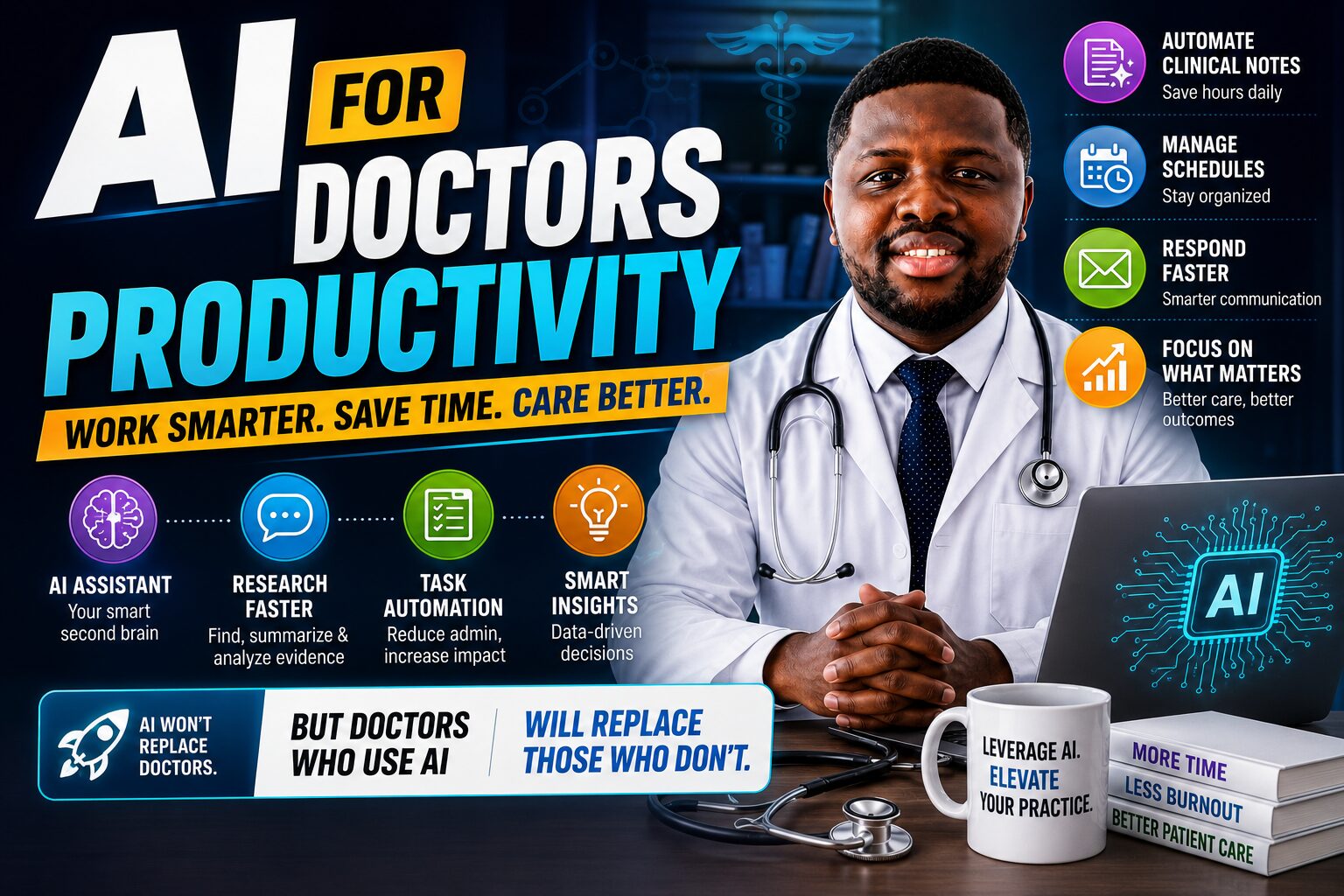
How Doctors Can Use AI to Save 10 Hours Every Week
By Dr Festus Kaasung Kunde, MD | Stavropol State Medical University
Medical Doctor | AI in Healthcare Advocate | Founder, AI Doctor Africa & Ghana Vitals
Published: June 2026 | Reading Time: 12–15 minutes | Category: AI for Doctors
What This Article Covers
Most doctors lose five to ten hours every week to low-value information management tasks — not clinical thinking. This article identifies exactly where that time goes, provides ten specific AI-powered strategies to recover it, includes real prompt examples from clinical practice, and explains how to build a weekly AI workflow that works in the African healthcare context.
The Real Problem Is Not Lack of Knowledge
One of the biggest misconceptions people have about medicine is that doctors spend most of their time diagnosing and treating patients. The reality is very different.
In a typical week, a healthcare professional spends significant time reading journals, writing reports, documenting clinical encounters, reviewing guidelines, preparing presentations, responding to administrative emails, and studying for continuing medical education. The challenge most doctors face is not intelligence or clinical skill. The challenge is time.
My Experience
I experienced this firsthand during my internship at Korle-Bu Teaching Hospital in Accra. Every morning began with ward rounds — but ward rounds were only part of the job. Before presenting patients to consultants, I needed to understand medical histories, laboratory results, imaging findings, treatment plans, and follow-up management. Simultaneously, I was preparing for the Medical and Dental Council licensing examinations. Some days I was switching between patient notes, clinical guidelines, textbooks, and research papers within the same hour.
AI USAGES
Then I started using artificial intelligence differently — not as a search engine, and not as a replacement for learning, but as a strategic productivity tool. The result surprised me. Many tasks that previously consumed hours could be completed in a fraction of the time. Not because AI did the thinking. Because AI helped organise the information.
Over time, I realised that many healthcare professionals could realistically recover five to ten hours every week by using AI more strategically. This article explains exactly how — with ten specific time savers, real prompt examples, a weekly workflow structure, and practical guidance for African healthcare professionals.
The 10 AI Time Savers for Doctors: Complete Overview
Before diving into each strategy, here is the complete summary. Use this as your quick reference guide:
| # | Time Saver | Hours Saved/Week | Primary AI Tool |
| 1 | Clinical Learning & Case Preparation | 2–3 hours | Claude |
| 2 | Research Paper Review | 2–4 hours | Claude |
| 3 | Licensing Exam Preparation | 1–2 hours | ChatGPT |
| 4 | Medical Presentations | 1–2 hours | ChatGPT |
| 5 | Clinical Guideline Summaries | 1–2 hours | Claude |
| 6 | Email & Communication | 30–60 mins | ChatGPT |
| 7 | Medical Writing & Proposals | 1–2 hours | Claude |
| 8 | Educational Content Creation | 1–3 hours | Both |
| 9 | Meeting Summaries & Action Points | 30–60 mins | ChatGPT |
| 10 | Public Health & Community Projects | 1–2 hours | Both |
Now let us examine each time saver in detail — with real examples, proven prompts, and the reasoning behind why each one works.
The Hidden Time Drains in Medicine
Most doctors significantly underestimate how much time they lose to low-value tasks. Consider a realistic week. You may spend time searching for clinical information across multiple websites, reviewing lengthy guidelines before implementing a new protocol, writing emails to collaborators and administrators, preparing presentations for ward rounds or teaching sessions, reading research papers to stay current, creating patient education materials, and revising for examinations or CPD requirements.
None of these activities are inherently wrong. The problem is inefficiency — and the cumulative cost of that inefficiency. An hour here, thirty minutes there. By the end of the week, hours that could have been used for deeper clinical thinking, research, or rest have been consumed by information management.
AI does not eliminate these tasks. It dramatically accelerates them. That is where the time savings come from.
Time Saver #1: Clinical Learning and Case Preparation
Estimated time saved: 2–3 hours per week
Many doctors spend significant time trying to understand unfamiliar conditions — particularly when encountering rare presentations, new guidelines, or complex cases outside their primary speciality. The traditional workflow involves searching across multiple websites, reading several articles of varying quality, comparing explanations, and organising notes manually. This process can easily consume 45 to 90 minutes for a single condition.
AI compresses this dramatically. A well-constructed prompt produces a structured, clinically relevant explanation within seconds.
Proven Prompt Example
“Act as a consultant physician. Explain Guillain-Barré Syndrome to a doctor preparing for licensing examinations. Include pathophysiology, clinical presentation, investigations, management, complications, and three high-yield clinical pearls.”
The output is organised, educational, and immediately useful — not a collection of links to parse. This does not replace textbooks or clinical experience. It eliminates the inefficiency of unstructured information searching.
My Korle-Bu Workflow
During the internship, I frequently used AI to anticipate consultant questions before ward rounds. The prompt I relied on was:
“Based on this case summary, identify the three most likely consultant follow-up questions and generate model answers at the level of a junior doctor.”
This approach revealed knowledge gaps before ward rounds — rather than during them. Instead of discovering weaknesses in front of senior doctors, I could address them the evening before. That single strategy improved both my confidence and my clinical preparation significantly.
Time Saver #2: Research Paper Review and Literature Triage
Estimated time saved: 2–4 hours per week
Research is one of the most significant hidden time consumers in healthcare. Reading a single paper thoroughly — abstract, introduction, methodology, results, discussion, limitations — can take 30 to 90 minutes. For a doctor attempting to stay current across even a narrow speciality, the volume of new publications each week makes comprehensive reading impossible.
AI changes this by enabling rapid triage. Instead of reading every paper fully before knowing whether it is relevant, doctors can receive a structured summary in under two minutes and decide whether the full paper warrants closer attention.
Proven Prompt Example
“Summarise this research paper and explain the clinical implications for a practising physician in Ghana. Highlight the methodology, key findings, limitations, and whether the conclusions apply to a sub-Saharan African clinical context.”
The output covers the study objective, methodology, key findings, strengths, limitations, and clinical significance. You still review important studies in full. You simply avoid wasting time on papers that are not relevant to your practice or research.
Important: For research purposes, always verify AI summaries against the original paper before citing findings. AI can occasionally misrepresent nuanced methodological details.
Time Saver #3: Licensing Examination Preparation
Estimated time saved: 1–2 hours per week
This time saver is particularly relevant for medical students, interns, and residents preparing for licensing or postgraduate examinations. Traditional revision often defaults to passive reading — working through textbook chapters or lecture notes sequentially. Passive reading is demonstrably less effective than active recall for long-term retention.
AI transforms examination preparation from passive to active learning almost instantly.
Proven Prompt Examples
“Generate 30 high-yield MDC-style examination questions on heart failure. Include the correct answer and a detailed explanation for each question. Flag any questions where the answer has changed with recent guideline updates.”
“I answered these 10 questions incorrectly. Identify my knowledge gaps and create a targeted 30-minute revision plan to address them.”
During my own MDC preparation, AI functioned like a personal tutor available at any hour. When I encountered a concept I did not fully understand, I could request an explanation, ask follow-up questions, and generate practice scenarios — without waiting for scheduled tutorials or study group sessions.
Time Saver #4: Medical Presentations and Teaching Materials
Estimated time saved: 1–2 hours per week
Almost every doctor eventually teaches — whether presenting to medical students during ward rounds, contributing to departmental grand rounds, running CME sessions for nurses, or presenting research at conferences. Creating a well-structured presentation from scratch is time-consuming: selecting a topic, finding evidence, organising slides, writing learning objectives, and ensuring clinical accuracy.
AI accelerates the structural work significantly. Instead of starting from zero, you start from approximately eighty per cent complete.
Proven Prompt Example
Create a detailed 20-slide presentation outline on stroke management for final-year medical students in Ghana. Include learning objectives, key clinical pearls, one case vignette, and suggested questions for audience engagement. Align content with current WHO and Ghana Health Service guidelines.”
The output provides a complete structure — headings, content points, teaching objectives, and suggested discussion questions. Your clinical expertise and local knowledge refine the content. AI handles the scaffolding.
Time Saver #5: Clinical Guideline Review and Summarisation
Estimated time saved: 1–2 hours per week
Many national and international clinical guidelines exceed 100 pages. Reading every word of every relevant guideline is not realistic for a practising clinician. Yet implementing outdated or incorrect protocols carries real clinical risk.
AI provides an efficient middle path: rapid summarisation of key recommendations, followed by targeted review of the sections most relevant to your practice.
Proven Prompt Example
“Summarise the latest WHO hypertension guidelines. Highlight: (1) the key diagnostic thresholds, (2) first-line treatment recommendations, (3) any significant changes from the previous version, and (4) specific considerations for patients in low-resource settings in sub-Saharan Africa.”
This gives you an immediate, clinically relevant overview. You then review the full sections most pertinent to your patient population in greater depth. The AI summary does not replace the guideline — it makes your engagement with the guideline more targeted and efficient.
Important: Always verify that the AI is referencing the most current version of a guideline. Ask explicitly: “What is the publication year of the guideline you are referencing?”
Time Saver #6: Professional Email and Communication Drafting
Estimated time saved: 30–60 minutes per week
Doctors consistently underestimate how much cumulative time they spend on professional communication. Research collaboration requests, conference applications, administrative correspondence, referral communications, and project updates individually seem small. At five to fifteen minutes per email, multiplied across fifteen to twenty emails per week, the total easily exceeds two hours.
AI eliminates the hardest part of professional writing: starting from a blank page.
Proven Prompt Examples
“Draft a professional email to a senior academic requesting collaboration on a research project investigating hypertension screening programmes in rural Ghana. I am a junior doctor with one year of clinical experience. Maintain a respectful and enthusiastic tone.”
“Write a formal abstract submission email for the Ghana Medical Association annual conference. The abstract is on AI-assisted diagnosis in resource-limited settings.”
The AI produces a professional first draft. Your role is review, personalisation, and final approval — not construction from zero. For most doctors, this reduces email drafting time by sixty to seventy per cent.
Time Saver #7: Medical Writing, Reports, and Grant Proposals
Estimated time saved: 1–2 hours per week
Writing is a major component of modern medicine. Doctors are expected to produce research papers, case reports, abstracts, grant proposals, clinical audit reports, and educational materials. One of the most common complaints among clinician-writers is not that they lack ideas — it is that they struggle to translate ideas into an organised structure.
AI excels at providing structure. It does not replace your expertise or your clinical insight. It eliminates the friction of the blank page.
Proven Prompt Example
“Create a structured outline for a research paper on the feasibility of AI-assisted hypertension screening in district hospitals in Ghana. Include: Introduction, Background, Objectives, Methodology, Expected Outcomes, Limitations, and Ethical Considerations. Suggest relevant databases to search for literature.”
The output gives you a working framework immediately. Your medical knowledge, local expertise, and clinical experience fill the content. This is exactly how productive clinician-researchers use AI — not to write the paper, but to eliminate the structural friction that delays starting.
Time Saver #8: Educational Content Creation
Estimated time saved: 1–3 hours per week
Many healthcare professionals now create educational content beyond their clinical roles — health blogs, YouTube videos, newsletters, social media posts, community health lectures, and CME materials. Before AI, creating this content required separate time for topic research, outline creation, drafting, and editing. The total time investment was often prohibitive for busy clinicians.
AI dramatically accelerates the groundwork without replacing the expertise.
My AI Doctor Africa Workflow
When developing content for AI Doctor Africa, I use prompts such as:
“Generate 50 article ideas for a medical blog targeting doctors and medical students in Africa who want to understand and use AI responsibly in clinical practice. Prioritise topics with high search volume and clear practical value.”
The resulting ideas become starting points. The medical expertise, personal clinical experience, and contextual insight that make the content genuinely valuable still come from my training and practice. AI accelerates the brainstorming and structural work — it does not substitute for clinical authority.
Time Saver #9: Meeting Summaries and Action Point Organisation
Estimated time saved: 30–60 minutes per week
Healthcare meetings — whether administrative, research, departmental, or project-related — consistently generate significant volumes of information. The challenge is not attending the meeting. The challenge is organising what was discussed into clear, actionable next steps that can be distributed and tracked.
Proven Prompt Example
“Convert these meeting notes into a structured summary with four sections: Key Decisions Made, Action Points (with responsible person and deadline for each), Open Questions Requiring Follow-Up, and Agenda Items for the Next Meeting.”
The result is an immediately distributable, clearly organised summary that would previously have required 30 to 45 minutes of post-meeting documentation time. For doctors involved in research teams, hospital committees, or health startup projects, this alone provides a meaningful weekly time saving.
Time Saver #10: Public Health and Community Project Planning
Estimated time saved: 1–2 hours per week
This time saver is particularly relevant for African healthcare professionals, many of whom participate in outreach programmes, community screenings, NGO activities, and public health campaigns alongside their clinical responsibilities. These activities generate significant administrative work: planning, proposal writing, budget frameworks, and activity reports.
Proven Prompt Example
“Design a community hypertension screening programme for a district in Ghana with a population of 50,000 people. Include: programme objectives, target population, screening protocol, equipment requirements, data collection approach, community engagement strategy, and a simplified one-page budget framework.”
The output provides a working framework that would previously have required several hours of research and writing. Domain experts then refine and contextualise the framework. AI handles the initial structural work.
The Ghana Vitals Connection
The vision behind Ghana Vitals emerged directly from this kind of public health thinking. After participating in health screening exercises across all 16 regions of Ghana, I observed repeatedly that patients were discovering hypertension, diabetes, and obesity only after complications had already developed — stroke, renal failure, diabetic neuropathy. The question that kept arising was: what if we could identify risk before disease develops?
That question became Ghana Vitals — a preventive health data platform designed to monitor blood pressure, glucose, and BMI trends and use predictive analytics to flag individuals at elevated risk. AI tools have been central to developing the planning documents, research frameworks, and educational materials that underpin this project.
10 Mistakes Doctors Make When Using AI — and How to Fix Them
After observing many healthcare professionals beginning to use AI tools, the same mistakes appear repeatedly. Understanding these errors — and their solutions — will significantly accelerate your productivity gains:
| Mistake | Example of What NOT to Do | What to Do Instead |
| Using vague prompts | “Explain hypertension.” | “Explain hypertension to a final-year medical student preparing for MDC licensing examinations in Ghana. Include pathophysiology, diagnosis, management, and clinical pearls.” |
| Expecting AI to replace learning | Asking AI to study for you | Use AI to organise and test knowledge — not substitute for active understanding |
| Trusting outputs blindly | Publishing AI content without verification | Always verify clinical facts against PubMed, WHO guidelines, or BNF |
| Ignoring patient confidentiality | Entering patient names, IDs, or clinical details | Never input identifiable patient information into any external AI platform |
| Using AI only as a search engine | “What is malaria?” | “Act as a consultant. Explain cerebral malaria to a doctor preparing for ward rounds — include diagnostic criteria, investigations, and management steps.” |
| Not asking follow-up questions | Accepting the first response | Refine outputs: “Expand the complications section” or “Rewrite this for a non-specialist audience” |
| Failing to provide context | Generic prompts without background | Specify your role, level, location, and purpose in every prompt |
| Using only one AI tool | Relying entirely on ChatGPT or Claude | Use ChatGPT for speed and generation; Claude for analysis and long documents |
| Not experimenting | Giving up after one poor response | Rephrase, add context, and iterate — prompting is a skill that improves with practice |
| Waiting too long to start | “I will start when AI is more developed” | Begin now. Doctors who build AI literacy today will lead the profession tomorrow |
A Practical Weekly AI Workflow for Doctors
The ten time savers above are most powerful when integrated into a consistent weekly rhythm rather than used reactively. Here is a simplified version of the workflow I use:
Monday — Research Review: Upload relevant papers from the week’s reading list. Request structured summaries. Identify which papers require full reading and which can be deprioritised.
Tuesday — Clinical Learning: Review unfamiliar conditions encountered during the previous week. Generate consultant-style questions on complex cases. Identify knowledge gaps before they become clinical weaknesses.
Wednesday — Content Creation: Plan articles, presentations, or educational materials. Develop outlines. Generate first drafts for review and personalisation.
Thursday — Research and Writing: Develop research proposals, review academic drafts, and improve the structure and coherence of written work. Use Claude for long documents and analytical tasks.
Friday — Planning and Productivity: Organise the following week’s priorities. Draft professional emails. Summarise meeting notes. Review goals and track project progress.
Weekend — Exploration and Learning: Explore new AI tools and workflows. Test new prompts. Build ideas for AI Doctor Africa and Ghana Vitals. This is where new productivity strategies are discovered.
The goal is not a rigid structure — it is intentional integration. AI productivity compounds when used consistently, not just occasionally.
What Could You Do With 10 Extra Hours Every Week?
Saving time is not the goal. Using that recovered time wisely is. Ten additional hours each week is a significant resource. For healthcare professionals, those hours could go toward:
- Deeper clinical learning and speciality development
- Research — literature reviews, data collection, paper writing
- Business development — health technology ventures, private practice growth
- Family time and personal well-being — often the first casualty of a demanding medical schedule
- Community service — outreach programmes, public health initiatives
- Content creation — building an audience and authority platform, such as AI Doctor Africa
- Postgraduate study — MPH preparation, specialist examinations, online courses
For me, much of the reclaimed time goes into AI Doctor Africa, Ghana Vitals, and long-term research. Time is the one resource that cannot be replaced. That is why productivity in medicine is not a luxury — it is a professional responsibility.
Key Takeaways
- Most doctors lose five to ten hours weekly to low-value information management — not clinical thinking
- AI does not replace clinical judgment — it eliminates the administrative friction around it
- Research paper triage and clinical learning consistently provide the largest immediate time savings
- Specific, contextualised prompts produce dramatically better outputs than vague queries
- African healthcare professionals should always prompt AI for their specific clinical context and resource environment
- Patient confidentiality is non-negotiable — never enter identifiable patient data into external AI platforms
- Always verify AI clinical outputs against primary sources before applying them in practice
- The best AI productivity workflows combine ChatGPT for speed and generation with Claude for analysis and long documents
- Consistent weekly integration of AI tools compounds productivity gains over time
- Doctors who build AI literacy today will lead the profession tomorrow
Frequently Asked Questions
The following questions address the most common concerns healthcare professionals raise about using AI for productivity:
Question |
Answer |
| Can AI really save doctors 10 hours every week? | For many healthcare professionals, yes — though the exact number varies by workflow. The time savings from research paper summaries, clinical learning acceleration, presentation creation, and administrative communication compound quickly. Doctors who implement all ten strategies described in this article consistently report saving between five and ten hours weekly. |
| Which AI tool should doctors use for productivity? |
The best toolThe best tool depends on the task. ChatGPT excels at rapid content generation, MCQ creation, email drafting, and presentations. Claude excels at analysing long documents, summarising research papers, and producing structured academic writing. Many productive healthcare professionals use both strategically. |
| Is AI safe for use in clinical medicine? | AI is safe as a productivity and learning tool when used responsibly. It should never replace clinical judgment, physical examination, or medical decision-making. Always verify AI outputs against primary clinical sources — especially for drug dosages, treatment protocols, and diagnostic criteria. |
| Can AI replace doctors? | No. AI can process and organise information at scale. It cannot provide the clinical judgment, empathy, ethical reasoning, or professional accountability that doctors bring to patient care. AI is a tool — not a clinician. |
| What is the single biggest productivity gain from AI for doctors? | Research and information management consistently provide the largest immediate return. A doctor who previously spent 60 minutes reading a single paper can now receive a structured summary in under two minutes, allowing them to triage which papers deserve full attention and which can be deprioritised. |
| Can African healthcare systems benefit from AI productivity tools? | Enormously. African doctors often work in high-burden, resource-limited environments with greater administrative and educational demands relative to available time. AI tools that reduce information management burden — research summaries, guideline reviews, educational content — can have an outsized positive impact on African healthcare professionals. |
| Is AI useful for medical students and interns? | Extremely. AI is particularly valuable for active exam preparation, clinical learning, and building presentation skills. Medical students who use AI to generate practice questions, simulate OSCE stations, and explain complex concepts report significantly improved learning efficiency. |
| What about patient confidentiality when using AI? | Patient confidentiality is non-negotiable. Never enter identifiable patient information — names, hospital numbers, dates of birth, or any detail that could identify a specific patient — into any external AI platform. Use anonymised or hypothetical cases for learning and productivity purposes only. |
About the Author
Dr Festus Kaasung Kunde is a Medical Doctor, AI in Healthcare Advocate, and Founder of AI Doctor Africa and Ghana Vitals. He graduated from Stavropol State Medical University, Russia, in 2025 and completed a clinical internship at Korle-Bu Teaching Hospital, Accra, Ghana.
Dr Kunde is passionate about Artificial Intelligence in Clinical Medicine, Digital Health, Healthcare Innovation in Africa, Medical Education, Health Data Analytics, and Preventive Health Systems. He is currently preparing for the Medical and Dental Council (MDC) licensing examinations in Ghana and building Ghana Vitals — a predictive health data platform designed to identify chronic disease risk before complications develop.
His mission is to help healthcare professionals across Africa understand, adopt, and responsibly use artificial intelligence to improve learning, research, productivity, and patient outcomes.
READ ALSO:
- How Medical Doctors Can Use Claude AI for Research, Clinical Learning, and Productivity in 2026
- 100 ChatGPT Prompts for Medical Students: The Complete 2026 Prompt Library
- Best AI Tools for Medical Students in 2026: The Complete Guide
- How Doctors Can Use AI to Make Money in 2026
- ChatGPT vs Claude for Medical Doctors: Which AI Is Better in 2026?
- NotebookLM for Doctors: The Complete 2026 Guide for Healthcare Professionals
AI Doctor Africa | aidoctorafrica.com
Medical Disclaimer: This article is for educational and informational purposes only. It does not constitute medical advice. All clinical decisions must be made by qualified healthcare professionals based on individual patient assessment.