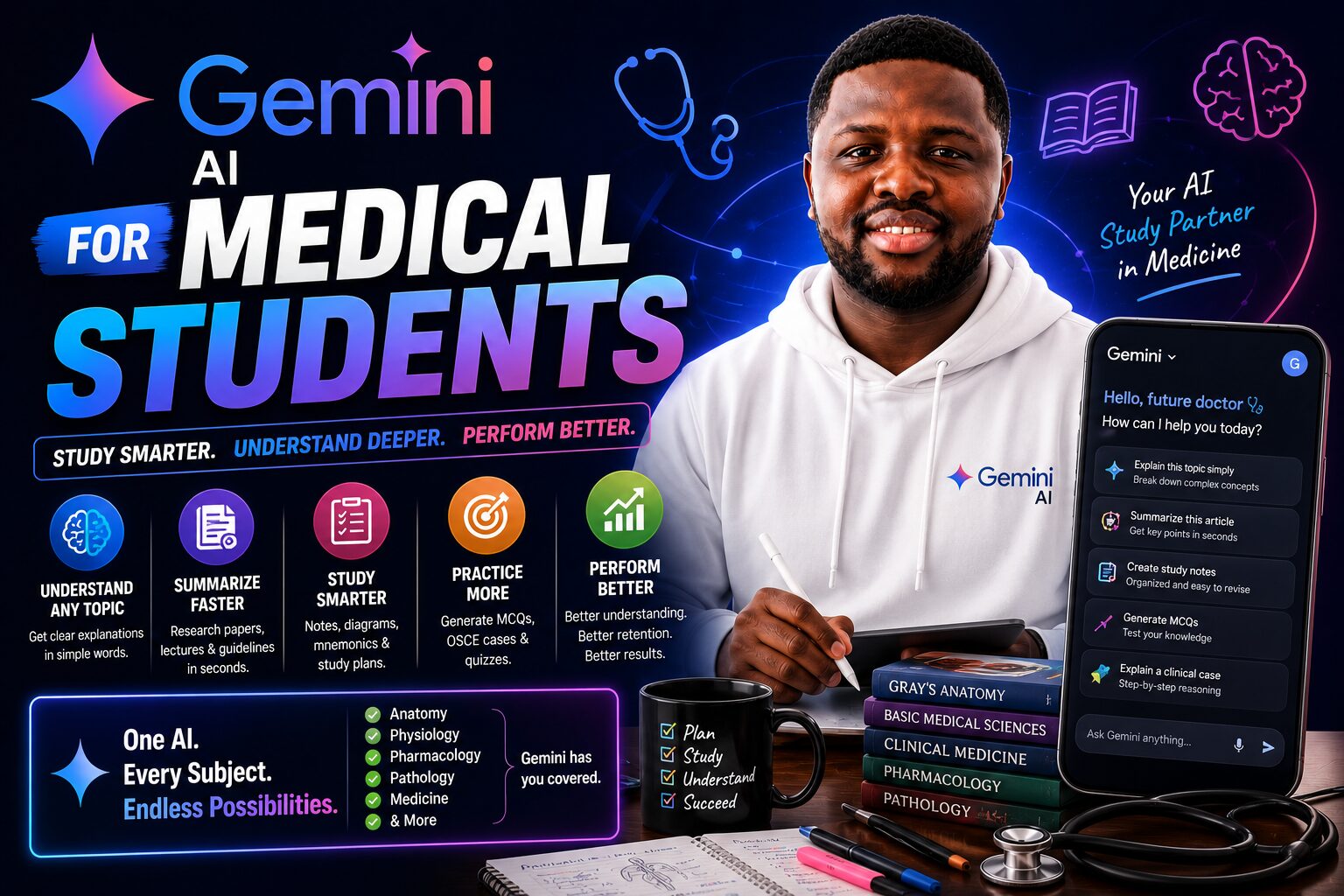
Gemini AI for Medical Students 2026: How to Use Google’s AI to Study Smarter in 2026
By Dr Festus Kaasung Kunde, MD | Stavropol State Medical University
Medical Doctor | AI in Healthcare Advocate | Founder, AI Doctor Africa & Ghana Vitals
Published: June 2026 | Reading Time: 13–16 minutes | Category: AI for Medical Students
Quick Summary
Most medical students who use Gemini only scratch the surface of what it can do. In 2026, Gemini is not just a chatbot — it is an AI learning ecosystem. It includes LearnLM, a model specifically trained to teach like a human tutor; Guided Learning mode, which asks Socratic questions rather than just giving answers; a photo-to-study-guide feature for handwritten notes; Deep Research for autonomous literature work; and NotebookLM Plus, bundled in the student plan. This article explains every feature that matters for medical students, with personal stories from my final year at Stavropol State Medical University, and the prompts that work.
The Year Everything Changed
My final year at Stavropol State Medical University was, honestly, the hardest year of my life.
Not because the medicine was beyond me. It was hard because of the volume. In the same period, I was completing clinical rotations, writing a full thesis on malaria with my research partner, preparing for final examinations across every major clinical speciality, and simultaneously trying to figure out what came next — the MDC examination in Ghana, internship applications, and whatever a career in medicine on a continent that was changing fast around me was going to look like.
The days started early and ended late. Lecture notes piled up faster than I could organise them. Some days, I would sit down in the evening with a stack of handwritten notes from three different rotations and genuinely not know where to begin. Other days, I would read the same paragraph from a Russian-language pharmacology textbook four times and still not feel like it had settled.
AI tools
AI tools were part of how I got through that year. Not a magic solution — nothing is a magic solution in medicine. But a genuine support system that changed how I studied, how I organised information, and how I approached the thesis that eventually earned us a grade of 5, Excellent.
The tools I had then were early versions of what exists now. What Gemini has become in 2026 — with LearnLM, Guided Learning, Deep Research, the photo-to-study-guide feature, and NotebookLM Plus bundled into one student plan — would have changed my final year significantly. I want to explain exactly how, because every medical student reading this right now is living through a version of what I experienced. And they deserve to know what is actually available to them.
What Gemini Is in 2026 — Not Just a Chatbot
The Ecosystem Distinction
The first thing to understand about Gemini is that it is not just an AI assistant. It is Google’s entire AI ecosystem — and for medical students who already live inside Google’s tools, that distinction matters enormously.
Most students already write their notes in Google Docs and store their PDFs and lecture slides in Google Drive. Most search for papers through Google Scholar. They watch educational content on YouTube. Gemini integrates natively with each of these. Consequently, when you use Gemini as a medical student, you are not adding a new tool to your workflow — you are adding AI intelligence to the workflow you already have.
Gemini 3.1 Pro
Furthermore, in 2026, Google introduced a student plan for students that no competitor has matched: a plan that bundles Gemini 3.1 Pro, Deep Research, NotebookLM Plus, and 2 TB of cloud storage at a discounted rate. The biggest differentiator, as one independent review noted, is the combination of Deep Research and NotebookLM Plus — no other student AI plan bundles a research synthesis tool with an AI-powered notebook organiser. For medical students conducting thesis work, preparing for licensing examinations, or managing the sheer volume of clinical and academic content that accompanies a medical degree, this combination is genuinely powerful.
LearnLM — The Part That Actually Teaches
Every AI tool can tell you what diabetic ketoacidosis is. That is not the hard part of medical education.
The hard part is understanding it — understanding the sequence of events from insulin deficiency to ketone accumulation to the compensatory mechanisms to the clinical signs you will see at the bedside. Understanding it well enough that, when a patient presents with altered consciousness and a blood glucose of 28 mmol/L, you know what you are looking at before the blood gas results come back.
LearnLM
This is what LearnLM was built for. It is Google’s AI model specifically fine-tuned for education, and it works differently from standard AI. Rather than answering your question directly, Guided Learning mode — powered by LearnLM — asks you questions back. It checks what you already understand. AI corrects your reasoning where it is wrong and guides you toward the right answer rather than just stating it.
Google Research
In independent evaluations published by Google Research, physician educators were asked to compare LearnLM responses with those of standard AI models in medical education scenarios. They rated LearnLM as demonstrating better pedagogy and behaviour, in their words, ‘more like a very good human tutor.’ That is a significant thing to say about an AI — and it reflects a genuine difference in how the tool engages with learners.
Personal reflection: In my final year at Stavropol, I often wished I had a tutor available at 11 pm who would sit with me and work through the cardiac cycle until I understood it properly, not just memorised it. Guided Learning mode is the closest thing to that which now exists — and it is free.
Every Gemini Feature Medical Students Should Know
The following table covers every major Gemini feature relevant to medical students in 2026, with the specific use case each one serves best:
| Gemini Feature | What It Does | Best Medical Student Use Case |
| Gemini 3.1 Pro | Google’s flagship model — deep reasoning, long context, multimodal | Complex concept explanation, case analysis, research summaries |
| Guided Learning (LearnLM) | Socratic tutoring mode — asks questions, checks understanding, teaches rather than tells | Understanding pathophysiology and clinical reasoning without rote answers |
| Deep Research | Autonomous multi-step research across the web produces cited long-form reports | Literature overviews for essays, thesis background, systematic review scoping |
| Deep Research Max | Advanced data analysis layer for agentic research tasks | Comparative analysis across multiple topics for academic papers |
| Custom Quizzes | Generate MCQs, short-answer or fill-in-the-blank quizzes from any uploaded document | Exam preparation from lecture notes and textbook chapters |
| Photo-to-Study-Guide | Photograph handwritten notes — Gemini converts them to structured digital study guides | Instant digitalisation of handwritten lecture and ward notes |
| Canvas | Collaborative document workspace — Gemini drafts, you edit in real time | Drafting essays, case reports, and research proposals collaboratively |
| NotebookLM Plus | Bundled source-grounded AI notebook — podcasts, flashcards, quizzes from your documents | Clinical guideline review, research paper synthesis, exam prep notebooks |
| Google Docs/Drive Integration | Gemini embedded in your existing Google Workspace — summarise, draft, rewrite in Docs | Cleaning up lecture notes, structuring case reports, drafting presentations |
| YouTube Integration | Pulls educational videos into explanations when relevant | Visual explanations of anatomy, surgical procedures, and physiological mechanisms |
| Google Lens / Vision | Analyse images, diagrams, pathology slides, and ECG strips from uploaded photos | Histology interpretation, ECG reading practice, radiograph analysis |
How These Features Would Have Changed My Final Year
The Handwritten Notes Problem
In Stavropol, I took most of my clinical notes by hand. Not because I preferred it — but because that was the culture, and because writing by hand during lectures and ward round observations helped information settle in a way that typing sometimes did not.
The problem came later, when I needed to use those notes. A stack of handwritten pages on endocrinology, written during a rotation that ended three months ago, in a mix of English and occasionally transliterated Russian medical terms, is not an easy thing to revise efficiently. I spent hours typing up summaries that I could actually search and study from. It was one of the biggest time drains of my final year.
Gemini’s photo-to-study-guide feature, introduced in 2026, solves this directly. You photograph your handwritten notes — even messy ones, even with diagrams in the margins — and Gemini converts them into a structured digital study guide. It identifies the key concepts, organises them under headings, and can generate flashcards or quiz questions from the same image. The process takes seconds. What used to cost me an hour costs me thirty seconds.
For African medical students who study in non-English environments — in Russia, Ukraine, Cuba, China — where notes may contain content in multiple languages or transliterated from non-Latin scripts, this feature is particularly valuable. Gemini handles multilingual content well. Consequently, even notes that mix English medical terminology with Cyrillic Russian labels from anatomical diagrams can be digitised and reorganised coherently.
The Thesis Research Problem
Writing the malaria thesis with my mate was one of the most challenging academic experiences of my time in Russia. The challenge, as I have described in other articles on this site, was not intelligence or dedication. It was access. Malaria is not a disease in Russia. The Russian-language literature was thin. The English-language literature required searching across databases that were not always well-indexed, pulling papers one by one, and manually synthesising evidence across sources with no systematic tool to help.
Gemini’s Deep Research feature is what we needed. Deep Research is an autonomous multi-step research agent — you give it a research question, and it independently searches across multiple web sources, reads and evaluates the content, and produces a long-form, cited research report. It does not just return search results. It reads those results and synthesises them into a structured document that you can then verify and build on.
For our malaria thesis, a Deep Research query like ‘Synthesise the current evidence on the epidemiology of Plasmodium falciparum malaria in sub-Saharan Africa, the most effective community-based prevention strategies, and the clinical evidence for artesunate over quinine in severe malaria management’ would have produced in fifteen minutes what took us days of manual literature work.
Furthermore, because Deep Research cites its sources, we could have verified every claim directly. The thesis would have been more comprehensive, the evidence base more complete, and the process less exhausting.
The lesson I took from writing that thesis is one I share with every medical student I talk to now: the quality of your research is limited not by your intelligence but by the quality of your research tools. In 2026, Gemini’s Deep Research gives every medical student access to research tools that were only available five years ago to well-resourced university research departments.
The 11 pm Pharmacology Problem
There is a specific kind of anxiety that visits medical students around 11 pm the week before a pharmacology examination. You have been studying antihypertensive drugs for two hours, and your thoughts are that you understand the renin-angiotensin-aldosterone system. ACE inhibitors can cause a dry cough, which is what you thought. And then you try to explain it to yourself out loud, and it falls apart.
The information is in your head. But it is not connected. You have memorised fragments without building the underlying model that makes those fragments make sense.
This happened to me regularly in my final year. And the reason it is significant is that this kind of fragmented memorisation is exactly what examination MCQs are designed to expose. You can memorise that ACE inhibitors cause a cough. But if you do not understand why — the bradykinin accumulation, the prostaglandin pathway, the fact that it affects the lungs specifically because of pulmonary metabolism — you will struggle with the clinical vignette MCQ that presents a patient with a chronic cough and asks you to identify the most likely culprit medication.
Guided Learning mode is built for this problem. Instead of asking Gemini to explain something and reading the answer passively, you turn on Guided Learning and tell it you want to understand, not just be told. What follows is a back-and-forth conversation where Gemini asks you what you already know, identifies where your model breaks down, and fills the gaps through questions rather than lectures.
The difference in retention between being told an answer and arriving at it through guided questioning is significant. This is established learning science — active retrieval, elaborative interrogation, and spaced feedback all improve long-term retention compared to passive reading. LearnLM applies these principles in every Guided Learning conversation.
The Google Docs Integration That Sounds Small But Is Not
Here is something that seems trivial but genuinely changed how I work. When I write notes, draft essays, or structure a case report in Google Docs, Gemini is available inside that document. I do not need to open a separate tab, copy text across, paste the response back, and format it, but can highlight a paragraph I have written and ask Gemini to improve the structure. Ask it to suggest a clearer explanation of a mechanism I have described. I can paste in a rough outline and ask it to expand each section.
In my final year at Stavropol, I spent a significant amount of time doing exactly this kind of formatting and restructuring work manually — not because I did not know what I wanted to write, but because the friction between knowing and writing was higher than it needed to be. Gemini in Docs reduces that friction. As a result, the time between having an idea and having it properly expressed in professional academic language is significantly shorter.
For African medical students writing in English as a second, third, or fourth language — which describes many of us who trained in Russia, Ukraine, China, or Cuba — this is not just a convenience. It is a genuine academic equaliser. The quality of your academic English should not determine the quality of your clinical thinking. Gemini in Docs helps ensure that it does not.
Gemini vs ChatGPT vs Claude: Which Should Medical Students Use?
This is the question I am asked most often by medical students who are trying to build their AI toolkit without spending money they do not have. The honest answer is that all three have free tiers, all three are accessible in Ghana and across Africa, and all three serve different purposes:
| Dimension | Gemini | ChatGPT | Claude |
| Student pricing | Free tier + $9.99/mo student rate (incl. Deep Research, NotebookLM Plus) | Free tier; $20/mo Plus — no standing student discount | Free tier; $20/mo Pro |
| Google ecosystem | Native — works in Docs, Drive, Gmail, YouTube | Limited integration | No integration |
| Guided Learning mode | Yes — LearnLM Socratic tutoring built in | No dedicated mode | Approximated via prompts |
| Photo of handwritten notes | Yes — converts to study guide automatically | Yes (GPT-4o vision) | Yes (via upload) |
| Custom quizzes from uploads | Yes — interactive with hints and summaries | Yes via prompts | Yes via prompts |
| Deep Research | Yes — bundled, autonomous, cited | Yes — separate feature | No |
| NotebookLM Plus | Yes — bundled in student plan | No | No |
| MCQ generation volume | Good | Excellent | Good |
| Deep concept explanation | Good | Good | Excellent |
| Research synthesis | Good with Deep Research | Good | Excellent |
| African student access | Yes — free tier globally accessible | Yes — free tier accessible | Yes — free tier accessible |
My recommendation for medical students starting out: begin with Gemini’s free tier. It gives you Deep Research, Canvas, Guided Learning, custom quizzes, and Google Docs integration — more built-in learning functionality than any other free AI plan. Additionally, if you are an eligible student, the $ 9.99-per-month student rate includes Gemini 3.1 Pro and NotebookLM Plus, which together form one of the most complete AI study systems available at any price.
Add Claude or ChatGPT for specific tasks they do better — Claude for deep concept explanation and academic writing, ChatGPT for high-volume MCQ generation — and you have a complete toolkit that costs between zero and $20 per month, depending on your usage.
Proven Gemini Prompts for Medical Students
The following table provides copy-paste-ready prompts for each major Gemini feature. Adapt them to your specific topic and clinical context:
| Task | Gemini Feature | Proven Prompt |
| Understand a complex concept | Guided Learning | Turn on Guided Learning. Then: I want to understand the pathophysiology of diabetic ketoacidosis properly — not just memorise it. Teach me step by step and check my understanding as we go. |
| Convert handwritten notes | Photo-to-Study-Guide | Take a photo of your handwritten lecture notes on heart failure. Upload the image. Then: Convert these handwritten notes into a structured study guide with key definitions, mechanisms, clinical features, and three exam-ready summary points. |
| Generate practice questions | Custom Quiz | I have uploaded my pharmacology lecture notes on antihypertensive drugs. Create a 20-question quiz covering the mechanism of action, clinical uses, side effects, and contraindications. Make it interactive with hints for wrong answers. |
| Research a thesis topic | Deep Research | Research the current evidence on AI-assisted hypertension screening programmes in sub-Saharan Africa. Include: key studies, their findings, current gaps in the literature, and the most significant unresolved questions. Produce a cited report. |
| Summarise a long document | Gemini Pro (upload) | I have uploaded the WHO 2023 malaria treatment guidelines. Summarise: the key diagnostic criteria, the first-line treatment for uncomplicated malaria, the management of severe malaria, and any significant changes from the 2021 version. |
| Draft a case report | Canvas | Open Canvas. Draft a structured case report for a 34-year-old patient with sickle cell disease presenting with acute chest syndrome. Include: case summary, discussion of pathophysiology, management, and learning points. I will edit as you draft. |
| Exam topic revision | NotebookLM Plus (bundled) | Create a NotebookLM notebook. Upload my cardiology lecture notes. Generate an Audio Overview for commute revision, flashcards for key drug doses, and a quiz on heart failure management. |
| Visual interpretation practice | Google Lens upload | Upload a photo of an ECG strip. Then, walk me through interpreting this ECG systematically. What is the rate, rhythm, axis, P wave morphology, PR interval, QRS duration, and ST segment changes? What is your interpretation? |
A Note for African Medical Students Specifically
The Access Situation in 2026
Gemini’s free tier is accessible in Ghana and across Africa. The student rate of $9.99 per month is payable via international debit cards and virtual cards from mobile money platforms. Furthermore, most of the core features — Guided Learning, Deep Research, custom quizzes, photo-to-study-guide, Google Docs integration — are available on the free tier in 2026, a significant improvement over previous years, when most of these capabilities required a paid subscription.
Additionally, Gemini works well in lower-bandwidth environments because many of its features do not require streaming large media files. Text-based interactions, document uploads, and quiz generation all function reliably on standard mobile data connections. Consequently, for medical students in Ghana, Nigeria, South Africa, or anywhere across sub-Saharan Africa, Gemini is genuinely accessible — not just theoretically available.
The Multilingual Advantage for African Students Abroad
Many African medical students study in countries where English is not the primary language of instruction, such as Russia, Ukraine, Cuba, China, and Eastern Europe. This creates a specific challenge: the medical knowledge you build during your training is encoded in a language that is not the language in which you will practise, examine, or publish.
Gemini handles this better than most AI tools. It accurately processes content in multiple languages, so it can analyse a document written in Russian or Chinese and produce output in clinical English that reflects the original content.
English-medium licensing examinations
For students writing theses, preparing for English-medium licensing examinations, or simply trying to convert their foreign-language lecture notes into revision material they can actually use, this multilingual capability is a practical advantage.
Moreover, when I was using AI during my final year to help bridge the gap between Russian medical education and the English-language medical world I was preparing to enter, the translation and contextualisation capabilities of AI tools were among the most valuable things they offered. Gemini’s multimodal ability — processing text, images, and PDFs in multiple languages simultaneously — makes it particularly well-suited for this specific challenge.
Using Gemini Responsibly: What Every Medical Student Must Know
There are things Gemini does well and things it does not. Being honest about both is important.
Guided Learning is not a substitute for studying.
The most effective use of Guided Learning is as a check on the understanding you have already begun to build. Use it after reading, not instead of reading. The questions it asks are most valuable when you have something to test — not when the topic is entirely new to you.
Deep Research requires verification. Deep Research produces impressive, cited long-form reports. However, it searches the web autonomously, which means it can cite lower-quality sources alongside excellent ones. For thesis work and academic submissions, always read the key papers yourself and verify that the citations in a Deep Research output actually say what Gemini says they say.
Never upload patient information.
Never photograph patient notes, include clinical case details with identifying information, or upload anything that could identify a specific patient to Gemini or any other external AI tool. This applies regardless of whether the information is in a PDF, a Google Doc, or a smartphone photo. Patient confidentiality is a legal and ethical obligation with no AI exception.
Gemini replaces effort, not judgment. Gemini can structure your notes, explain concepts, generate questions, and synthesise literature. It cannot develop your clinical intuition, your communication skills with patients, or the judgment that comes from being physically present in a clinical environment. Use it to be more efficient in the hours you spend studying. Use your clinical time to build the things AI cannot build for you.
Key Takeaways
- Gemini in 2026 is not just an AI chatbot — it is a full learning ecosystem including LearnLM, Guided Learning, Deep Research, custom quizzes, photo-to-study-guide, Canvas, NotebookLM Plus, and Google Docs integration
- LearnLM’s Guided Learning mode teaches through Socratic questioning rather than giving answers — rated by physician educators as behaving more like a very good human tutor than standard AI models
- The photo-to-study-guide feature converts handwritten lecture and ward notes into structured digital study guides — invaluable for medical students who take notes by hand or study in multilingual environments
- Deep Research autonomously searches multiple web sources, synthesises findings, and produces a cited long-form report — the thesis research tool that most final-year medical students wish they had earlier
- The Gemini student plan at $9.99 per month bundles Gemini 3.1 Pro, Deep Research, and NotebookLM Plus — the only student AI plan that combines a research tool with an AI-powered notebook organiser
- Gemini’s native Google Docs and Drive integration means AI assistance is available inside the tools most students already use, without copying and pasting between applications
- Gemini’s free tier is accessible across Africa; the student rate accepts mobile money virtual cards in Ghana; multilingual capability supports African students studying abroad
- Guided Learning works best as a check on understanding you have already started to build, not as a substitute for initial engagement with the material
- Always verify Deep Research citations before academic submission, and never upload identifiable patient information to any AI platform
- Gemini is strongest for learning, research, and Google ecosystem integration; use Claude for deep concept explanation and writing; use ChatGPT for high-volume MCQ generation
Frequently Asked Questions
Here are the questions medical students most often ask about using Gemini for study and clinical learning:
Question |
Answer |
| Is Gemini free for medical students in Ghana? | Yes. Gemini’s free tier is fully accessible in Ghana and across Africa with no payment required. The free plan in 2026 includes the base Gemini model, Deep Research, and Canvas, which is genuinely powerful. The student rate of $9.99 per month provides Gemini 3.1 Pro, NotebookLM Plus, and 2 TB of Google Drive storage. Payment accepts international debit cards and virtual cards from mobile money platforms, including MTN Mobile Money and Telecel Cash. |
| How is Gemini different from ChatGPT for medical students? | The biggest practical difference is ecosystem integration. Gemini works natively inside Google Docs, Google Drive, and Gmail — the tools most students already use for notes and assignments. If you write your notes in Google Docs, Gemini can summarise, restructure, and quiz you on them without any copying and pasting. Additionally, Gemini’s Guided Learning mode provides Socratic tutoring that neither ChatGPT nor Claude offers as a built-in feature. ChatGPT remains stronger for raw MCQ generation volume and speed. |
What is LearnLM, and why does it matter for medical students? |
LearnLM is Google’s AI model specifically fine-tuned for learning and education. Unlike a standard AI that just gives you answers, LearnLM is designed to ask you questions, check your understanding, and guide you to the correct reasoning rather than simply telling you the answer. In independent evaluations, physician educators rated LearnLM as more like a very good human tutor than a base AI model. For medical students who need to build deep clinical reasoning rather than surface memorisation, this matters significantly. |
| Can I use Gemini to help with my thesis? | Absolutely — and Deep Research is the feature most directly useful for this. Deep Research autonomously searches the web across multiple sources, synthesises findings, and produces a cited long-form report on any topic you specify. For thesis background chapters, literature scoping, and identifying research gaps, it produces in minutes what would previously have taken hours of manual searching and reading. Always verify the cited sources and read the key papers yourself before including them in your thesis. |
Can Gemini read handwritten notes? |
Yes. The Photo-to-Study-Guide feature introduced in 2026 allows students to photograph handwritten lecture notes and have Gemini convert them into structured digital study guides, flashcards, or quizzes. For medical students who take handwritten notes during ward rounds or lectures — as many of us did in Stavropol — this feature directly bridges the gap between analogue note-taking and AI-assisted digital revision. |
| Should I use Gemini instead of Claude or ChatGPT? | Not instead— alongside for specific tasks. Gemini is strongest in Google ecosystem integration, Guided Learning, photo-to-study-guide, and Deep Research. Claude is strongest in deep concept explanation and academic writing. ChatGPT is strongest for high-volume MCQ generation and content production. The most effective medical student setup uses each tool for what it does best, starting with whichever free tiers your data usage and workflow support. |
Related Articles on AI Doctor Africa
- Best AI Tools for Medical Students in 2026: The Complete Guide
- NotebookLM for Doctors: The Complete 2026 Guide for Healthcare Professionals
- Perplexity AI for Doctors: The Cited Search Tool Every Clinician Needs
- 100 ChatGPT Prompts for Medical Students: The Complete 2026 Prompt Library
- ChatGPT vs Claude for Medical Doctors: Which AI Is Better in 2026?
- AI for Medical Licensing Examinations: Ghana, Nigeria, South Africa, USMLE, and PLAB
About the Author
Dr Festus Kaasung Kunde is a Medical Doctor, AI in Healthcare Advocate, and Founder of AI Doctor Africa and Ghana Vitals. He holds an MD from Stavropol State Medical University, Russia (2025), and completed an internship at Korle-Bu Teaching Hospital in Accra. His mission is to help African healthcare professionals adopt AI responsibly to improve learning, research, and patient outcomes.
AI Doctor Africa | aidoctorafrica.com
Medical Disclaimer: For educational purposes only. AI tools do not replace clinical judgment, medical supervision, or verified primary sources.