
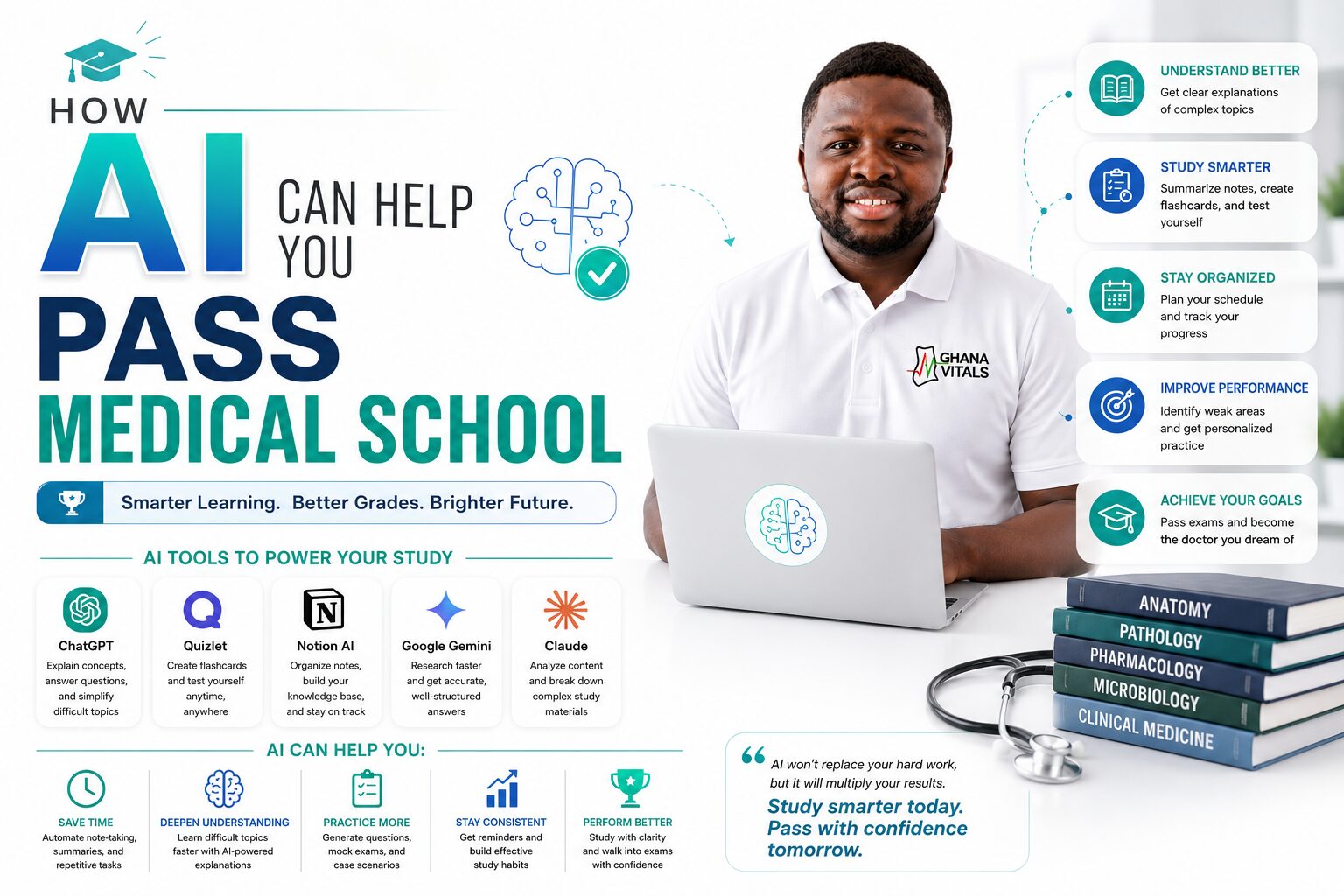
How AI Can Help You Pass Medical School: The Complete Strategy Guide for 2026
By Dr Festus Kaasung Kunde, MD | Stavropol State Medical University
Medical Doctor | AI in Healthcare Advocate | Founder, AI Doctor Africa & Ghana Vitals
Published: June 2026 | Reading Time: 20–25 minutes | Category: AI for Medical Students
Quick Summary
Over 90% of medical students now use AI tools in their education — but most use them at a fraction of their potential. This article shows you how to use AI to actually pass medical school: how to study smarter every year, how to build the active recall system that learning science says works, how to prepare for OSCEs and examinations efficiently, and how to avoid the mistakes that get students into trouble. It is written by a doctor who used AI through every stage of medical school — including the thesis and the licensing exam.
How AI Can Help You Pass Medical School — And Why Most Students Use It Wrong
Let me tell you something nobody said to me when I started medical school at Stavropol State Medical University in Russia. The reason most students struggle is not that they are not working hard enough. It is that they are working in the wrong direction.
They are re-reading notes instead of testing themselves, and they are spending hours with highlighters instead of practising recall under pressure. Studying in long, exhausting sessions instead of short, focused ones that their brain can actually consolidate overnight. Furthermore, they are doing all of this on passive material — textbooks, slides, lecture recordings — rather than the active engagement that learning science has consistently shown produces three to four times better retention.
The Equation Changer
AI changes this equation. Not by doing the learning for you — nothing does that — but by making the right kind of learning so easy and accessible that there is no longer a good excuse for the wrong kind. When ChatGPT can generate 25 targeted practice questions on the brachial plexus in forty seconds, there is no reason to spend three hours re-reading the same anatomy diagram for the fourth time.
Admitting I used AI throughout medical school and my internship at Korle-Bu Teaching Hospital in Accra. Also, I recall using it during my first year when the volume of anatomy and physiology felt genuinely unmanageable. I used it in my final year when Dr Ama Dufie Opare and I were writing our malaria thesis in Russia with limited access to English-language tropical medicine resources. I used it when preparing for OSCEs, for clinical rotations, and for the MDC Ghana licensing examination.
Consequently, this article is not a theoretical overview of what AI might do for medical students. It is a practical guide — the system I built, the tools that worked, the mistakes I made — written for every medical student who wants to use AI to study smarter, pass their examinations, and actually become a better doctor in the process.
The most important thing AI does for medical students is remove the friction between wanting to learn and actually learning. When active recall is one prompt away, you do it. When it requires building a flashcard deck from scratch, you put it off. Remove the friction. Use AI.
What the Evidence Says About AI and Medical School Performance
The Adoption Reality in 2026
Medical students are already using AI at rates that would have seemed extraordinary just three years ago. According to a 2026 study published in JMIR Human Factors, over 90% of medical students now incorporate AI into their education, using it an average of five times per week. Furthermore, a survey of one US medical school found that AI adoption among students rose from 24% in May 2024 to 77% by February 2025 — a more than three-fold increase in less than a year.
The same survey found that 91% of students considered AI exposure beneficial, and 94% found it helpful for researching learning objectives. Additionally, students consistently prioritised ‘summarising learning materials’ and ‘testing understanding’ as the most valuable AI applications — precisely the active recall and retrieval practice strategies that learning science has long recommended.
However, there is an important caveat in this data. Confidence in AI accuracy was lower than confidence in its usefulness — only 85% of students felt confident in AI’s accuracy. This gap is important. It tells us that students are using AI, but not always critically appraising its output. Consequently, the students who benefit most from AI are those who use it actively and critically — not those who accept every AI output at face value.
What Learning Science Says About How AI Helps
The reason AI helps medical students is not primarily technological. It is pedagogical. AI makes it easier to implement the study methods that learning science has always said work best — and harder to justify the passive methods that feel productive but are not.
The most important concept here is the testing effect — also called retrieval practice. Research published in Science (Roediger and Karpicke, 2006) demonstrated that students who were tested on material after studying retained significantly more after one week than students who simply re-studied the same material. Furthermore, the advantage of retrieval practice over re-studying increased over time — meaning the gap widened at one month and at one year.
AI implements the testing effect at zero marginal cost. Every study session can end with AI-generated practice questions, and every concept you read about can be immediately tested through AI-generated scenarios. All the gaps you identify can be immediately addressed with targeted AI explanations. As a result, the learning architecture that once required expensive tutors, large question banks, or significant time investment is now available to every medical student with an internet connection.
The Right Way and the Wrong Way to Use AI in Medical School
The Mistake That Wastes Every Advantage AI Offers
Before going into the system that works, I want to name the mistake clearly — because I see it constantly, and because it wastes the entire advantage AI offers.
The wrong way to use AI in medical school is to ask it to summarise a topic, read the summary, and move on. This feels productive. It is not. What you have done is substituted AI passive reading for human passive reading — and passive reading is the problem, not the solution. You have not been tested, nor have you been recalled. Neither have they been forced to use the information. Consequently, you will remember very little of that summary in a week.
Furthermore, another major misuse is asking AI to complete assessed work — written assignments, SOAP notes, and learning objectives — and submitting the output as your own. This is academic dishonesty. Beyond the ethical problem, it also deprives you of the genuine learning that writing produces. The students who write their own clinical case summaries, essays, and reflections — imperfectly, with AI used for feedback and refinement rather than generation — retain more, reason better, and become stronger clinicians.
The right way to use AI in medical school is as a system for active learning: generating the questions that force retrieval, explaining the concepts you have encountered in your own reading, challenging your reasoning before a supervisor does, and making the practice that produces genuine competence efficient enough to sustain throughout a demanding degree.
Simple test for whether you are using AI correctly: After your AI study session, close everything and write down everything you just learned from memory. If you recall, the session worked. If you cannot, you were consuming AI outputs rather than learning from them.
The AI Active Recall System: The Study Method That Actually Works
Why Passive Reading Fails and Active Recall Works
The table below shows why this matters so much. The difference in retention between passive and active methods is not marginal — it is transformative. Moreover, when AI is used to facilitate active recall, the combination produces outcomes that would previously have required intensive one-to-one tutoring.
| Study Method | Retention at 1 Week | AI Tool | How to Implement |
| Re-reading notes (passive) | ~10–20% | None needed | Not recommended as the primary method |
| Highlighting and summarising | ~20–30% | ChatGPT (summary check) | Use AI to verify your summary is accurate |
| Practice questions (active recall) | ~50–60% | ChatGPT, AMBOSS, Anki | Generate 20 MCQs after every study session |
| Spaced repetition (Anki) | ~70–80% | Anki + AnKing deck | Daily 30-minute Anki reviews — non-negotiable |
| Teaching / explaining to others | ~80–90% | Gemini Guided Learning, Claude | Ask AI to role-play as a student; explain the concept to it |
| AI-assisted active recall (combined) | ~85–90% | Claude + Anki + ChatGPT | Read → Claude’s explanation → ChatGPT MCQs → Anki cards |
The implication is that every study session should end with testing, not reading. Use the reading — textbook, lecture slides, and AI explanation — to acquire the information. Then immediately switch to active recall: ChatGPT MCQs, Anki cards, or explaining the concept to Gemini’s Guided Learning mode. The retrieval is where the learning actually happens.
Building the AI Active Recall Loop
The most effective AI study loop for medical school has four steps, and it should be completed for every major topic you study:
Step 1 — Read with intent. Read your textbook chapter, lecture slides, or clinical guideline. Do not highlight obsessively. Read to understand the structure of the topic — the mechanism, the clinical relevance, the key facts.
Step 2 — Claude explains and deepens. After reading, use Claude to explain the concept in a way that builds on what you just read. Ask for the mechanism, the clinical reasoning, and the connections to other topics. This adds depth to surface-level reading.
Step 3 — ChatGPT tests. Generate 20 MCQs on the topic. Answer them without looking at your notes. Review every wrong answer carefully — wrong answers are learning opportunities, not failures.
Step 4 — Anki consolidates. Turn the concepts from wrong answers and key facts into Anki flashcards. These cards will come back in your daily review at the scientifically optimal interval for long-term retention.
This four-step loop takes approximately 45 minutes per topic. Furthermore, the retention it produces is significantly higher than the same 45 minutes spent re-reading notes. Consequently, students who consistently implement this system find they need to revise less intensively before examinations because the material has already been consolidated through weeks of spaced practice.
How AI Can Help You Pass Medical School: Year by Year
Medical school has a distinct rhythm that shifts significantly from year to year. The tools and strategies that work in preclinical anatomy differ from those that work during clinical rotations or final-year examinations. The following table maps the best AI tools and strategies to each phase of medical school:
| Year | Primary Challenge | Best AI Tools | How They Help |
| Year 1 — Preclinical foundations | Anatomy, physiology, and biochemistry volume | Anki+AnKing, Gemini (Guided Learning), ChatGPT | Spaced repetition, concept explanation, and active recall practice |
| Year 2 — Pathology and pharmacology | Mechanisms, drug classes, disease processes | Claude, ChatGPT, Osmosis AI, Anki | Deep mechanism understanding, MCQ drilling, and visual pathophysiology |
| Year 3 — Clinical rotations | History taking, clinical reasoning, and ward rounds | Claude, ChatGPT, NotebookLM, Perplexity | Case preparation, clinical guideline review, and communication skills practice |
| Year 4 — Final examinations | Integration, OSCEs, high-stakes assessments | ChatGPT, Claude, Gemini, AMBOSS, Anki | MCQ banks, OSCE simulation, rapid revision, exam strategy |
| Final year — Thesis and licensing prep | Research, thesis writing, exam readiness | Claude, Elicit, Grammarly, Gamma AI, ChatGPT | Literature review, thesis structuring, presentation, licensing MCQs |
Year 1 and 2: Foundations — The Volume Problem
The first two years of medical school are defined by volume. Anatomy, physiology, biochemistry, microbiology, pathology, pharmacology — the breadth of content that must be absorbed in the preclinical years is genuinely staggering. Furthermore, most of it needs to be retained not just for the end-of-year examination but for the clinical years that follow, where you will apply this foundational knowledge daily.
My experience in the early years at Stavropol was that the biggest threat was not failing any specific examination — it was the feeling of falling irreversibly behind. One difficult week — illness, a difficult rotation, a personal issue at home — and suddenly there were 200 unreviewed Anki cards, two weeks of pharmacology unreviewed, and an anatomy examination approaching.
The solution to the volume problem is spaced repetition, implemented through Anki. This is not a new insight — medical educators have recommended Anki for years. What AI changes is the ease of card creation and the quality of explanation when you encounter a concept you do not understand. The AnKing deck provides pre-built, high-yield Anki cards covering the full preclinical curriculum. Additionally, Neural Consult automatically converts your lecture slides into Anki-style flashcards. Consequently, the manual card creation barrier that previously made Anki feel overwhelming disappears entirely.
Year 3 and 4: Clinical Rotations — The Reasoning Problem
When I moved from preclinical years into clinical rotations, the challenge shifted. It was no longer primarily about volume — it was about application. Knowing what heart failure is matters less on the wards than knowing how to recognise it in a patient who does not present the way the textbook describes, how to communicate with the patient about their diagnosis, and how to construct a management plan that works within the resources available.
Claude is the most valuable tool for this phase, not because it replaces clinical experience — nothing replaces standing at the bedside — but because it extends and structures the reasoning you are building during clinical exposure. The following prompt, which I used regularly during my clinical rotations, is the most valuable AI prompt I developed in medical school:
The prompt
“Act as a senior registrar reviewing my clinical reasoning. I have a patient who [clinical description — anonymised]. My working diagnosis is [X]. My planned management is [Y]. Challenge my diagnosis — what else could this be? Challenge my management — what have I missed or deprioritised? What questions will the consultant ask me on the ward round tomorrow?”
This prompt forces you to articulate your reasoning, exposes gaps in that reasoning before a consultant does so publicly, and builds the clinical confidence that ward rounds require. Furthermore, because you are using an anonymised clinical description rather than a real patient record, there is no confidentiality concern.
Final Year: The Thesis, the OSCE, and the Licensing Examination
My final year at Stavropol was the most demanding year of medical school — and the year where AI tools made the most difference. Three simultaneous challenges: the malaria thesis, the final OSCE examinations, and the knowledge base required for licensing examination preparation.
For the thesis, Dr Dufie and I used ChatGPT to navigate the English-language tropical medicine literature we could not access easily in Russia, Claude to structure the argument and synthesise evidence, Grammarly to polish the academic English to the required standard, and Gamma AI to produce the presentation that accompanied our defence. We passed with a grade of 5 — Excellent. AI did not write our thesis. But it removed every barrier that stood between our knowledge and our ability to express and defend it.
For OSCE preparation, ChatGPT’s ability to simulate patient interactions is genuinely valuable — and genuinely underused by most students. An OSCE is a performance under pressure. Consequently, the students who perform best are those who have practised the most, in the most realistic conditions. ChatGPT can simulate a patient with any clinical presentation, respond naturally to your history-taking questions, and score your performance at the end of the station. This gives you unlimited OSCE practice at any hour, day or night.
OSCE simulation prompt: ‘You are a 55-year-old patient who has come to the GP with a 3-week history of progressive breathlessness and ankle swelling. You are worried but trying to minimise your symptoms. Respond naturally to my questions. After 8 minutes, break character and score my performance on: opening and introduction, history of presenting complaint, relevant past history, medication review, and closing. Tell me specifically what I missed.’
The Complete Weekly AI Study System for Medical School
A Realistic, Sustainable Study Routine
Theory is useful. A specific weekly system you can actually follow is more useful. The following table shows the weekly AI study routine I developed and refined throughout medical school. It requires approximately four hours per week of active AI-assisted study — spread across short daily sessions that fit around lectures, rotations, and clinical placements:
| Day | Focus | AI Tool | Session Length |
| Monday | New topic — read then use Claude for a deep explanation | Claude | 45 min |
| Tuesday | Generate 25 MCQs on Monday’s topic; identify gaps | ChatGPT | 30 min |
| Wednesday | Anki review (previous topics) + NotebookLM Audio Overview on the new guideline | Anki + NotebookLM | 40 min |
| Thursday | Case-based reasoning — present a case to Claude; work through it | Claude | 35 min |
| Friday | Weak area drilling — use ChatGPT to generate targeted questions on gaps | ChatGPT | 30 min |
| Saturday | OSCE practice or thesis/research work — depending on year | ChatGPT (OSCE) / Claude (thesis) | 60 min |
| Sunday | Gemini Guided Learning — one topic you want to understand deeply, not just memorise | Gemini (Guided Learning) | 30 min |
Notice that Sunday uses Gemini’s Guided Learning mode rather than ChatGPT or Claude. This is deliberate. Guided Learning does not give you the answer — it asks you questions, checks your understanding, and guides you toward the correct reasoning. Furthermore, this Socratic approach produces deeper understanding than any other AI interaction format. Consequently, it is best saved for the topic you most want to understand properly, not just know for an examination.
The AI Examination Strategy: Phase by Phase
A Six-Phase Approach From Eight Weeks Out to Examination Day
Most medical students make the same examination-preparation mistake: they treat the weeks before an examination as a single undifferentiated revision period rather than a structured progression through distinct phases. AI allows you to implement a more sophisticated approach — one where each phase has a specific goal and a specific AI-assisted strategy:
Table
| Exam Phase | Strategy | AI Tool | Proven Prompt |
| 6–8 weeks out | Identify weak areas — generate a diagnostic quiz across all topics | ChatGPT | Generate 5 MCQs on each of the following topics to help me identify my weakest areas: [list 10 topics]. The flag that I got wrong. |
| 4–5 weeks out | Deep revision of weak areas — concepts, not memorisation | Claude | I consistently struggle with [topic]. Explain it from first principles, then quiz me on 10 clinical scenarios where this concept determines the management decision. |
| 3 weeks out | High-yield summary creation | ChatGPT + NotebookLM | Create a one-page high-yield summary of [topic] covering: definition, pathophysiology, key clinical features, investigations, and management. Then upload to NotebookLM for flashcards. |
| 2 weeks out | Intensive MCQ drilling — timed sessions | AMBOSS + ChatGPT | Do timed 40-question AMBOSS blocks. For each wrong answer, use Claude to explain the mechanism. Build a ‘wrong answer notebook’. |
| 1 week out | OSCE station practice — communication and clinical skills | ChatGPT | Simulate an OSCE station for [clinical scenario]. You are the patient/examiner. I have 8 minutes. Score me on [mark scheme criteria] at the end. |
| Final 48 hours | Rapid review — Audio Overviews and flashcards only. No new content. | NotebookLM + Anki | Play Audio Overview from your exam prep notebook on the commute. Anki review for 20 minutes. Sleep properly. |
The final 48 hours deserve special attention. No new content after 48 hours before the examination. Audio Overviews from NotebookLM during the commute, Anki review for 20 minutes on the morning of the examination, and adequate sleep. Furthermore, the cognitive evidence on sleep and memory consolidation is unambiguous: a night of good sleep before an examination is worth more to your performance than several additional hours of late-night revision. Consequently, an early bedtime the night before your examination is not laziness — it is an evidence-based examination strategy.
A Special Note for African Medical Students
Making AI Work for Your Specific Context
Most AI study guides are written for students at North American or European medical schools. They assume English as the primary language of instruction, Western-designed curricula, institutional access to expensive question banks, and disease presentations calibrated to the epidemiology of high-income countries. For African medical students — including those studying in Ghana, Nigeria, South Africa, Russia, Ukraine, Cuba, China, or any other country outside the Western mainstream — this matters.
The contextualisation principle applies to medical education as much as it applies to clinical practice. When you use ChatGPT to generate MCQs on infectious disease management, specify that you want questions calibrated to the Ghanaian disease burden and the Ghana Health Service treatment guidelines — not generic questions based on US or UK guidelines that may not reflect your examination’s content or your future clinical practice.
Additionally, for African students studying in non-English environments, AI’s multilingual capability is a genuine academic equaliser. Claude and ChatGPT both accurately process content in Russian, Chinese, Ukrainian, and other languages. Consequently, your Russian-language physiology notes can be translated into clinical English by an AI tool, bridging the language gap that affects the academic performance of many African students abroad.
Furthermore, the free tier of every major AI tool — Claude, ChatGPT, Gemini, NotebookLM, and Anki — is accessible in Ghana and across Africa. You do not need an institutional subscription, an international credit card, or access to a well-funded university library to implement the system in this article. You need an internet connection and the discipline to use these tools actively rather than passively.
What AI Cannot Do: Being Honest About the Limits
The Things No AI Tool Replaces
I want to close the main body of this article with something that the enthusiasm around AI in medical education sometimes obscures: the things that genuinely cannot be learned through AI interaction.
Clinical presence cannot be taught by AI. The skill of walking into a room and establishing trust with a patient in sixty seconds. The ability to perform a clinical examination that is both technically correct and human in its touch. The experience of being present when something goes wrong, of managing uncertainty under pressure, of sitting with a patient who is frightened. These experiences build the doctor that medical school is ultimately supposed to produce — and none of them happens in front of a screen.
Furthermore, clinical judgment — the integration of everything you have learned, everything you have observed, and everything you know about the individual patient in front of you — cannot be outsourced to any tool. AI supports and structures the knowledge base that judgment draws from. It does not develop the judgment itself.
Therefore, use AI to make your desk time more efficient so that you can be more present for your clinical time. Use it to know more so that you can observe more at the bedside. Use it to reduce anxiety about examinations, so that your mental energy in clinical environments goes toward patients rather than memorisation anxiety. That is how AI helps you pass medical school — and how it helps you become the kind of doctor that passing medical school is supposed to make you.
Key Takeaways: How AI Can Help You Pass Medical School
- Over 90% of medical students now use AI tools regularly — but most use them passively, which wastes the primary advantage AI offers
- The right use of AI in medical school is as a facilitator of active recall, not a substitute for it — AI generates the questions; you do the retrieving
- The AI active recall loop — read, Claude explains, ChatGPT tests, Anki consolidates — produces retention rates of 85–90% versus 10–20% for passive re-reading
- Anki with the AnKing deck is non-negotiable for preclinical year retention — spaced repetition is the single most evidence-based study method available to medical students
- Claude is the strongest tool for clinical reasoning development — use it to challenge your diagnosis, expose your gaps, and prepare for ward round questions
- ChatGPT OSCE simulation gives you unlimited station practice at any hour — the most underused AI application in medical school
- Gemini’s Guided Learning mode produces a deeper understanding than any other AI interaction format because it asks questions rather than giving answers
- For the final year, the thesis-OSCE-licensing examination triple challenge is manageable with AI — Claude for thesis structure, ChatGPT for OSCE, NotebookLM + Anki for rapid revision
- African medical students should contextualise every AI prompt for their specific curriculum, disease burden, and clinical context — generic prompts produce generic outputs
- AI makes desk time more efficient so that clinical time can be more present — use it in the service of becoming a better doctor, not as a shortcut around the process of becoming one
Frequently Asked Questions: How AI Can Help You Pass Medical School
These are the questions medical students most commonly ask about using AI in their studies:
| Question | Answer |
Is using AI in medical school cheating? |
No — when used responsibly. Using AI to understand concepts more deeply, generate practice questions, organise notes, and explore clinical reasoning is not academic dishonesty. It is the same as using a tutor, a study group, or a question bank. However, submitting AI-generated content as your own original work in assessed assignments without disclosure, or using AI during closed-book examinations, does violate academic integrity policies. The distinction is between using AI as a learning tool and using it to misrepresent your own knowledge. Always check your medical school’s specific AI policy for assessed work. |
| Can AI actually help me pass examinations? | Yes — and the evidence is clear. A 2026 JMIR Human Factors study found that over 90% of medical students now use AI regularly, with 91% reporting it beneficial and 94% finding it helpful for research and learning. The learning science evidence is even stronger: AI-facilitated active recall, spaced repetition, and case-based reasoning all produce significantly better examination outcomes than passive reading. However, AI works best when used to deepen understanding and apply what is learned — not to generate surface-level summaries that bypass genuine engagement with the material. |
Which AI tools are most important for medical school? |
The non-negotiable foundations are Anki (spaced repetition), ChatGPT (MCQ generation and quick outputs), and Claude (deep explanation and clinical reasoning). Add NotebookLM (guideline review and Audio Overviews) and Gemini (Guided Learning for genuine understanding). If you are preparing for licensing examinations, add AMBOSS for a physician-reviewed question bank. All of these have meaningful free tiers. The full stack costs between zero and $40 per month, depending on which paid upgrades you add. |
| How much time should I spend on AI-assisted study? | AI should enhance the quality of your study time, not increase its length. A well-structured 45-minute session using AI — reading, then Claude explanation, then ChatGPT MCQs, then Anki card creation — is more effective than three hours of passive re-reading. The weekly system described in this article requires approximately 4 hours of AI-assisted study spread over 7 days. The goal is efficiency, not more time at a desk. |
Can AI help with medical school stress and burnout? |
Indirectly, yes. One of the most significant sources of medical student stress is the feeling of falling behind — that the volume of material is outpacing your ability to learn it. AI tools that compress the time required to understand a concept, generate practice questions, and review previous material reduce this feeling of falling behind, which in turn reduces the anxiety cycle that drives burnout. However, AI is not a substitute for adequate sleep, social connection, physical activity, and professional support when needed. If you are struggling with your mental health in medical school, please speak to your student health service or a trusted person in your life. |
| What about medical schools that ban AI? | Some medical schools restrict AI use for specific assessed activities — SOAP notes, learning objectives, and written assignments. These restrictions are legitimate and should be followed. However, very few schools ban AI for self-directed learning, practice question generation, or personal revision — the uses described in this article. Check your institution’s specific policy carefully, and when in doubt, ask your academic supervisor. The skills you build using AI for personal study remain yours regardless of what the institution permits in assessed work. |
Related Articles on AI Doctor Africa
- Best AI Tools for Medical Students in 2026: The Complete Guide
- 100 ChatGPT Prompts for Medical Students: The Complete 2026 Prompt Library
- Gemini AI for Medical Students: How to Use Google’s AI to Study Smarter in 2026
- AI for Medical Licensing Examinations: Ghana, Nigeria, South Africa, USMLE, and PLAB
- NotebookLM for Doctors: The Complete 2026 Guide for Healthcare Professionals
- ChatGPT vs Claude for Medical Doctors: Which AI Is Better in 2026?
About the Author
Dr Festus Kaasung Kunde is a Medical Doctor, AI in Healthcare Advocate, and Founder of AI Doctor Africa and Ghana Vitals. He holds an MD from Stavropol State Medical University in Russia (2025) and completed an internship at Korle-Bu Teaching Hospital in Accra. His mission is to help African healthcare professionals adopt AI responsibly to improve learning, research, and patient outcomes.
AI Doctor Africa | aidoctorafrica.com
Medical Disclaimer: For educational purposes only. AI tools do not replace clinical supervision, verified study resources, or your medical school’s academic guidance.

Dr. Festus K. Kunde
Dr. Festus Kaasung Kunde is a medical doctor, Content creator, healthcare technology writer, and digital health innovator specializing in Artificial Intelligence in Medicine, Healthcare Systems Innovation, and Health Data Science in Africa. He is the founder of AI Doctor Africa (AIDoctorAfrica.com), an educational platform dedicated to helping healthcare professionals—including doctors, medical students, nurses, and researchers—understand and responsibly apply artificial intelligence in clinical practice, medical education, medical research, and healthcare innovation. He is also the creator of Ghana Vitals, a health data and predictive analytics initiative focused on collecting and analyzing key health indicators such as blood pressure, blood glucose, and BMI to support early disease detection, preventive healthcare, and data-driven decision-making in Ghana and across Africa. The project reflects his long-term vision of building scalable, AI-powered public health systems for African populations. Dr. Kunde’s work focuses on the practical integration of AI tools such as ChatGPT, Claude, and emerging clinical AI systems into real-world healthcare workflows. His content emphasizes improving clinical documentation, accelerating medical education, strengthening research productivity, and supporting healthcare decision-making in resource-limited settings. Through AI Doctor Africa, he publishes evidence-informed, practice-oriented resources including AI workflows, clinical use cases, medical education guides, and tutorials designed specifically for African healthcare professionals. Through Ghana Vitals, he extends this mission into population health innovation, aiming to leverage real-world health data and predictive models to improve early intervention, reduce preventable disease burden, and strengthen health systems across Africa. His overall mission is to bridge the gap between traditional clinical medicine, artificial intelligence, and data-driven public health, empowering African healthcare professionals to work smarter, diagnose earlier, and deliver better care through technology. Areas of Expertise Artificial Intelligence in Clinical Medicine Digital Health & Healthcare Innovation in Africa Health Data Analytics & Predictive Health Systems Medical Education and Exam Preparation AI for Medical Research and Scientific Writing Clinical Workflow Optimization using AI Tools Public Health Data Systems (Ghana Vitals Initiative) Professional Focus Dr. Kunde’s work sits at the intersection of clinical medicine, artificial intelligence, and population health systems, with a strong focus on scalable solutions for African healthcare challenges. His initiatives emphasize ethical AI use, data-driven decision-making, and practical implementation in real-world clinical and public health environments.
View author profile →