
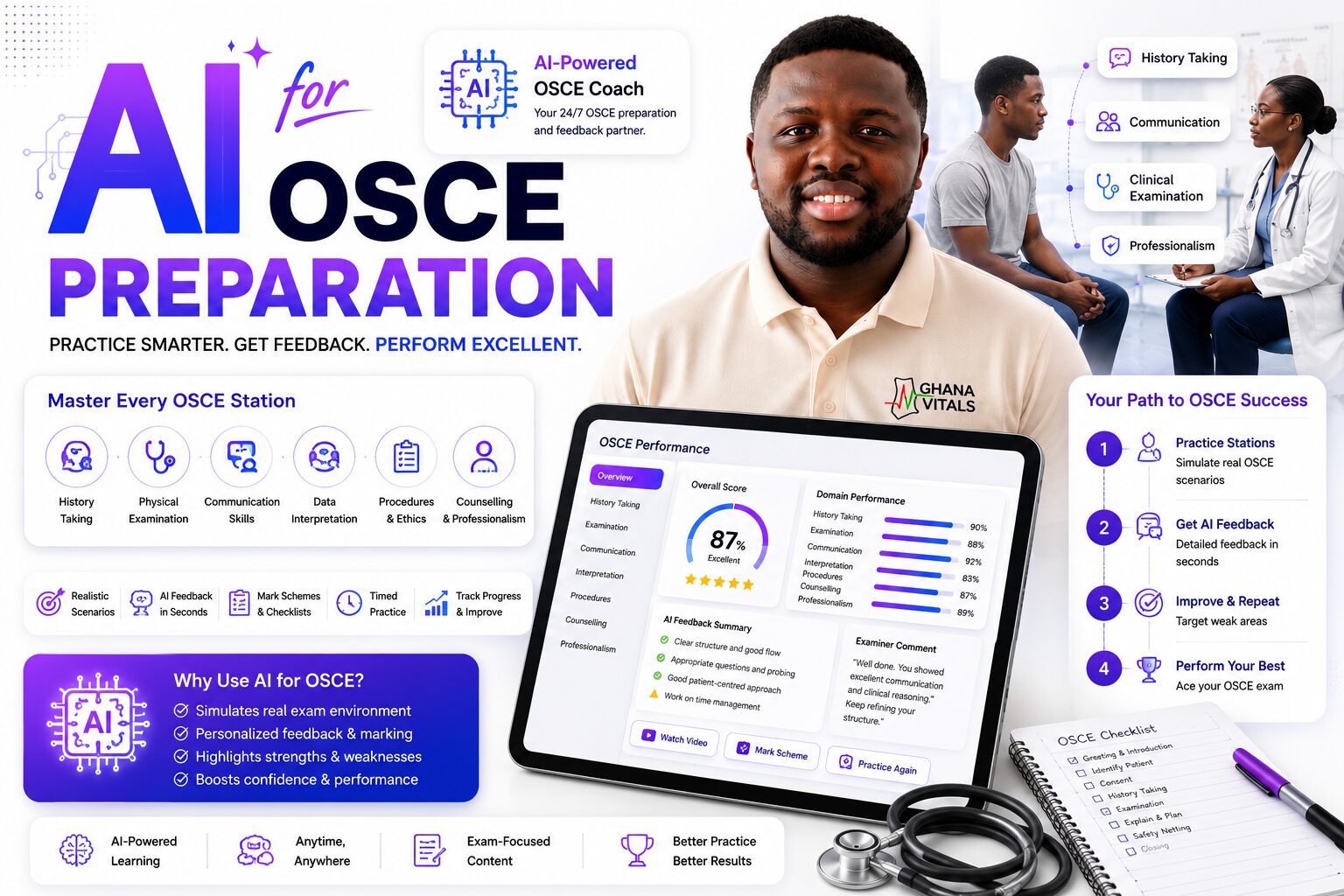
AI for OSCE Preparation: How Medical Students Can Use Artificial Intelligence to Pass OSCEs with Confidence in 2026
By Dr Festus Kaasung Kunde, MD
Medical Doctor | AI in Healthcare Advocate | Founder, AI Doctor Africa & Ghana Vitals
Published: 2026
Reading Time: 18–22 Minutes
Category: AI for Medical Students
Quick Summary
For many medical students, the Objective Structured Clinical Examination (OSCE) is the most stressful examination they will ever take.
Unlike written examinations, OSCEs test what you can actually do.
- Can you communicate effectively?
- Can you take a focused history?
- Can you perform a physical examination correctly?
- Can you explain a diagnosis to a patient?
- Can you break bad news professionally?
- Can you manage an emergency?
In 2026, Artificial Intelligence has become one of the most powerful tools available for OSCE preparation. Students can now practice history-taking, communication stations, counselling sessions, physical examination sequences, emergency scenarios, and viva questions with AI tutors available 24 hours a day.
This guide explains how medical students can use ChatGPT, Claude, Gemini, and other AI tools to improve OSCE performance, build confidence, and prepare more effectively for medical school examinations and licensing exams such as MDC Ghana, MDCN Nigeria, HPCSA South Africa, PLAB, and USMLE.
Why OSCEs Terrify Medical Students
I still remember preparing for my first major clinical examinations at Stgmu
I knew the medicine.
Also, I knew the pathology.
I knew the pharmacology.
But I was nervous. Not because I lacked knowledge. Because OSCEs are different. In a written examination, nobody is watching you.
In an OSCE station, everyone is. The examiner is watching. The patient is watching. The clock is watching. You have seven minutes. Sometimes eight. And suddenly, simple things become difficult.
You forget questions. Sometimes you skip examination steps and rush explanations. You miss obvious diagnoses. What I eventually learned was that OSCE success depends less on intelligence and more on practice. The more clinical conversations you have, the better you perform. The challenge is that most students do not have unlimited access to patients.
Today, AI solves part of that problem. You can now practice dozens of clinical encounters daily without needing a hospital ward, a standardised patient, or a study partner.
What Exactly Is an OSCE?
An Objective Structured Clinical Examination is designed to assess clinical competence through multiple stations.
Each station evaluates a specific skill.
| Station Type | Skill Tested |
|---|---|
| History Taking | Clinical communication |
| Physical Examination | Examination technique |
| Data Interpretation | Clinical reasoning |
| Counseling | Patient communication |
| Procedures | Practical skills |
| Emergency Management | Decision-making |
| Viva Questions | Medical knowledge |
Unlike written examinations, OSCEs assess both knowledge and performance. Knowing what to do is not enough. You must demonstrate it.
Why AI Is Perfect for OSCE Preparation
AI provides something most students rarely get:
Unlimited clinical practice.
A student can repeat the same station ten times in one evening.
Try doing that with a consultant.
Or a real patient.
AI never gets tired.
Never becomes impatient.
Never runs out of time.
Most importantly, AI provides immediate feedback.
The Five Ways AI Improves OSCE Performance
1. AI Simulates Patients
One of the best uses of AI is acting as a patient.
Prompt:
“Act as a 45-year-old male presenting with chest pain. Respond exactly like a real patient. Do not reveal the diagnosis unless I ask the correct questions.”
The AI responds realistically.
The doctor takes the history.
You formulate your diagnosis.
You practice clinical reasoning.
Exactly as you would in an examination.
2. AI Simulates Examiners
Prompt:
“Act as an OSCE examiner. Ask me questions about my history and challenge my clinical reasoning.”
This prepares students for follow-up questions that often cause panic during examinations.
3. AI Provides Structured Feedback
Prompt:
“Evaluate my history-taking performance and score me on communication, structure, clinical reasoning, empathy, and professionalism.”
Receiving instant feedback accelerates learning.
4. AI Creates OSCE Stations
Prompt:
“Generate 20 final-year medical school OSCE stations covering Internal Medicine, Surgery, Pediatrics, and Obstetrics.”
Students suddenly have access to an unlimited station bank.
5. AI Helps Build Confidence
Confidence often comes from repetition.
The more scenarios you practice, the less intimidating the real OSCE becomes.
Best AI Tools for OSCE Preparation
| Tool | Best Use |
|---|---|
| ChatGPT | Rapid station generation |
| Claude | Realistic patient simulation |
| Gemini | Communication training |
| NotebookLM | Revision notes |
| Complete Anatomy | Examination anatomy review |
The Most Common OSCE Stations
Internal Medicine
- Chest pain
- Shortness of breath
- Hypertension
- Diabetes counseling
- Heart failure
- Asthma review
Surgery
- Acute abdomen
- Hernia examination
- Breast lump
- Trauma assessment
- Postoperative review
Pediatrics
- Fever in a child
- Vaccination counseling
- Growth assessment
- Developmental milestones
Obstetrics & Gynecology
- Antenatal counseling
- Postpartum haemorrhage discussion
- Contraceptive counseling
- Vaginal bleeding history
AI Prompts for History Taking Practice
Chest Pain Station
Prompt:
“Act as a patient with chest pain. Give information only when I ask appropriate questions. Afterwards, score my performance.”
Headache Station
Prompt:
“Act as a patient with chronic headaches. Allow me to take a complete history and identify red flags.”
Abdominal Pain Station
Prompt:
“Act as a patient presenting with abdominal pain. Respond naturally. Do not reveal the diagnosis.”
AI Prompts for Physical Examination OSCEs
Prompt:
“Act as an OSCE examiner. Ask me to perform a cardiovascular examination. After I explain my examination sequence, I identify every step I missed.”
Prompt:
“Teach me the ideal respiratory examination sequence expected in final-year OSCEs.”
Prompt:
“Create a checklist for abdominal examination that examiners use.”
AI Prompts for Communication Stations
Communication stations are increasingly important.
Many students fail because they focus only on medical knowledge.
Breaking Bad News
Prompt:
“Act as a patient recently diagnosed with cancer. Allow me to break the news using the SPIKES framework.”
Counselling a Newly Diagnosed Diabetic
Prompt:
“Act as a patient recently diagnosed with Type 2 Diabetes. Ask realistic questions and concerns.”
Smoking Cessation
Prompt:
“Simulate a smoking cessation counselling station.”
AI for Emergency OSCE Stations
Emergency stations often carry significant marks.
Prompt:
“Create an OSCE scenario involving an unconscious patient. Allow me to manage the case step-by-step.”
Prompt:
“Simulate anaphylactic shock. Challenge my management decisions.”
Prompt:
“Test my ABCDE approach using realistic emergency scenarios.”
AI for MDC Ghana OSCE Preparation
Students preparing for MDC Ghana should focus on:
High-Yield Stations
- Hypertension counseling
- Diabetes counseling
- Antenatal care
- Child welfare clinic
- Tuberculosis counseling
- HIV counseling
- Malaria management
- Physical examinations
- Emergency medicine
Prompt:
“I am preparing for MDC Ghana OSCE examinations. Generate realistic stations commonly tested in Ghana.”
The Weekly AI OSCE Training System
Monday
History-taking station.
30 minutes.
Tuesday
Physical examination station.
30 minutes.
Wednesday
Communication station.
30 minutes.
Thursday
Emergency scenario.
30 minutes.
Friday
Data interpretation station.
30 minutes.
Saturday
Full mock OSCE.
60 minutes.
Sunday
Review weaknesses.
30 minutes.
Common Mistakes That Cause Students to Fail OSCEs
Poor Introduction
Always:
- Introduce yourself
- Confirm patient identity
- Explain purpose
- Obtain consent
Lack of Structure
Use frameworks.
SOCRATES.
ICE.
SPIKES.
ABCDE.
These frameworks save marks.
Ignoring Communication
Remember:
Patients award trust before examiners award marks.
Poor Time Management
Most students spend too much time collecting information and too little time summarising.
Practice timing repeatedly.
Forgetting Safety
Always mention:
- Red flags
- Escalation
- Follow-up
- Safety-netting
Examiners love safety-conscious candidates.
Can AI Replace Real OSCE Practice?
No.
AI cannot replace:
- Real patients
- Standardized patients
- Bedside teaching
- Clinical attachments
- Ward rounds
However, AI can dramatically increase practice volume between clinical encounters.
Think of AI as your personal OSCE tutor.
Not your replacement for clinical exposure.
The Future of AI and OSCE Training
Within the next few years, medical students will likely practice OSCEs using voice-based AI systems capable of:
- Real-time conversations
- Virtual patients
- Emotional responses
- Physical examination simulations
- Automatic scoring
The students who learn to use these tools effectively today will have a major advantage tomorrow.
Key Takeaways
- OSCE success depends heavily on practice.
- AI provides unlimited opportunities for clinical practice.
- AI can simulate patients, examiners, and viva stations.
- Communication skills improve significantly through AI role-play.
- AI helps students prepare for MDC Ghana, MDCN Nigeria, HPCSA South Africa, PLAB, and USMLE.
- AI should supplement, not replace, real patient interactions.
- Consistent daily practice produces the greatest improvement.
Frequently Asked Questions
Can AI help me pass my OSCE?
Yes. AI is extremely useful for communication practice, history-taking, viva preparation, and station simulation.
Which AI is best for OSCE practice?
Claude is excellent for realistic patient simulations, while ChatGPT is excellent for generating large numbers of OSCE stations.
Can AI improve communication skills?
Yes. Repeated role-playing improves structure, confidence, and patient interaction skills.
Can AI replace standardised patients?
No. Real human interaction remains essential.
Is AI useful for MDC Ghana OSCE preparation?
Absolutely. AI can generate realistic Ghana-focused clinical stations and provide structured feedback.
Related Articles on AI Doctor Africa
- How AI Can Help You Pass Medical School
- Best AI Tools for Medical Students in 2026
- AI for Anatomy Learning
- AI for Pharmacology Revision
- AI for Medical Licensing Examinations
- 100 ChatGPT Prompts for Medical Students
About the Author
Dr Festus Kaasung Kunde is a Medical Doctor, AI in Healthcare Advocate, and Founder of AI Doctor Africa and Ghana Vitals. He completed his medical training at Stavropol State Medical University and clinical internship at Korle-Bu Teaching Hospital. His mission is to help African healthcare professionals use Artificial Intelligence responsibly to improve learning, research, and patient outcomes.
AI Doctor Africa
Empowering African Healthcare Through Artificial Intelligence.

Dr. Festus K. Kunde
Dr. Festus Kaasung Kunde is a medical doctor, Content creator, healthcare technology writer, and digital health innovator specializing in Artificial Intelligence in Medicine, Healthcare Systems Innovation, and Health Data Science in Africa. He is the founder of AI Doctor Africa (AIDoctorAfrica.com), an educational platform dedicated to helping healthcare professionals—including doctors, medical students, nurses, and researchers—understand and responsibly apply artificial intelligence in clinical practice, medical education, medical research, and healthcare innovation. He is also the creator of Ghana Vitals, a health data and predictive analytics initiative focused on collecting and analyzing key health indicators such as blood pressure, blood glucose, and BMI to support early disease detection, preventive healthcare, and data-driven decision-making in Ghana and across Africa. The project reflects his long-term vision of building scalable, AI-powered public health systems for African populations. Dr. Kunde’s work focuses on the practical integration of AI tools such as ChatGPT, Claude, and emerging clinical AI systems into real-world healthcare workflows. His content emphasizes improving clinical documentation, accelerating medical education, strengthening research productivity, and supporting healthcare decision-making in resource-limited settings. Through AI Doctor Africa, he publishes evidence-informed, practice-oriented resources including AI workflows, clinical use cases, medical education guides, and tutorials designed specifically for African healthcare professionals. Through Ghana Vitals, he extends this mission into population health innovation, aiming to leverage real-world health data and predictive models to improve early intervention, reduce preventable disease burden, and strengthen health systems across Africa. His overall mission is to bridge the gap between traditional clinical medicine, artificial intelligence, and data-driven public health, empowering African healthcare professionals to work smarter, diagnose earlier, and deliver better care through technology. Areas of Expertise Artificial Intelligence in Clinical Medicine Digital Health & Healthcare Innovation in Africa Health Data Analytics & Predictive Health Systems Medical Education and Exam Preparation AI for Medical Research and Scientific Writing Clinical Workflow Optimization using AI Tools Public Health Data Systems (Ghana Vitals Initiative) Professional Focus Dr. Kunde’s work sits at the intersection of clinical medicine, artificial intelligence, and population health systems, with a strong focus on scalable solutions for African healthcare challenges. His initiatives emphasize ethical AI use, data-driven decision-making, and practical implementation in real-world clinical and public health environments.
View author profile →